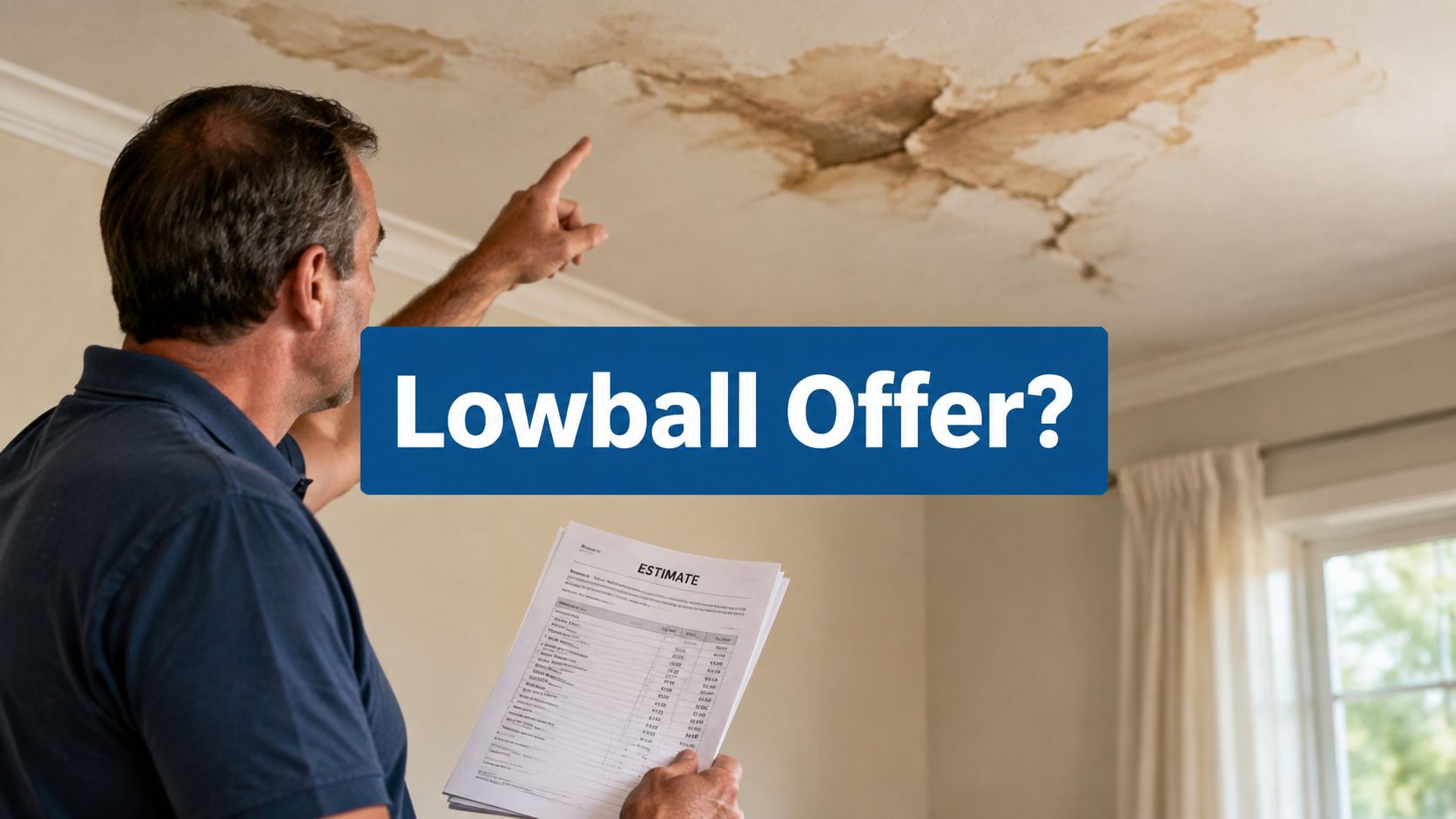
You open the insurer's email expecting help with the damage. Instead, the offer barely covers the contractor's deposit, and the estimate seems to skip obvious work. The adjuster says the number reflects “the scope,” but the scope contains vague allowances, missing code upgrades, and depreciation you can't reconcile with the condition of the property.
Don't accept that explanation at face value. A lowball insurance settlement offer is usually exposed by the carrier's own file. Your job is to find the missing line items, identify the assumptions behind the valuation, and replace them with evidence the adjuster must answer.
What Counts as a Lowball Insurance Settlement Offer
A low offer isn't defined by how insulting it feels. It's defined by the gap between the payment and the documented cost to restore covered damage under the policy.
The offer deserves scrutiny when it does one or more of the following:
- Leaves out necessary work: The estimate omits demolition, debris removal, preparation, finish work, or related trades needed to complete the repair.
- Uses the wrong repair category: The carrier prices a replacement as a patch, or treats a covered damaged component as unrelated maintenance.
- Applies depreciation incorrectly: The estimate reduces items that should be paid at replacement cost or subtracts depreciation before the policy permits recovery.
- Ignores code requirements: The payment doesn't account for upgrades required by current building regulations, even though the policy includes ordinance or law coverage.
- Uses weak pricing inputs: The adjuster relies on outdated regional pricing instead of current bids and site-specific measurements.
A smaller estimate can still be fair if the insurer has accurately measured the loss and explained every exclusion. The problem is a structurally underpaid claim, where the carrier's method makes the project impossible to complete for the amount offered.
The first-pass estimate review
Look at the estimate before calling the adjuster. Search for generic labels such as “miscellaneous,” “allowance,” or “included elsewhere.” Those descriptions make it difficult to verify what the carrier priced.
Check whether the estimate includes:
- Overhead and profit, when the project requires multiple trades and contractor supervision.
- Debris removal and disposal, including hauling and dump charges.
- Protection and temporary repairs, such as tarping, board-up work, drying, or dust control.
- Complete roofing components, including flashing, drip edge, underlayment, ventilation, and required fasteners.
- Code-required upgrades, supported by the applicable ordinance and your contractor's scope.
Your policy controls the dispute. In Oregon and Washington, the declarations, endorsements, exclusions, conditions, and valuation provisions matter more than an adjuster's verbal summary. Before you argue about the amount, download the policy and compare the estimate against its replacement-cost, ordinance-or-law, matching, and loss-payment language.
For a useful foundation on how estimates are assembled, review this guide to insurance claim estimates. Don't send a demand based on a total you haven't audited.
Why Insurers Open Low and How Underpayment Shows Up in the Numbers
The opening offer is often a negotiating position, not the carrier's final assessment of the loss. A University of Michigan business study examined nearly 13,000 auto-injury insurance claims nationwide and found that insurers paid about 78 cents on the dollar for easier-to-detect non-sprain injuries and about 71 cents on the dollar for harder-to-diagnose sprain claims. For sprain claims, total payments rose only $1.02 for each $1.00 increase in claimed financial losses, compared with $1.54 for each $1.00 for non-sprain claims, as documented by the University of Michigan study.
The lesson applies beyond auto injury claims. When damage is difficult to measure, the carrier's assumptions can compress the payment. A desk adjuster may rely on a regional estimate, software defaults, supplied photographs, or limited measurements rather than the full conditions at the property.
Industry-facing summaries based on Insurance Research Council reporting place first settlement offers at roughly 52% of fair claim value. The same summary gives a practical range of $48,000 to $56,000 on a $100,000 claim, illustrating why an initial offer shouldn't become your anchor. Review the lowball settlement offer analysis for that framework and its discussion of represented and unrepresented claimants.
Where the money disappears
| Line Item Category | Typical Adjuster Trim | Why It Matters |
|---|---|---|
| Labor rates | Uses a lower regional rate or omits specialty labor | Local contractors may be unable to complete the work at the estimate rate |
| Roofing scope | Prices a repair instead of full replacement or misses accessory components | Small omissions can make the roof system incomplete |
| Overhead and profit | Excludes contractor supervision and coordination | Multi-trade work requires management, scheduling, and general conditions |
| Depreciation | Applies age deductions broadly or to items subject to replacement-cost recovery | The actual recoverable amount may be materially higher |
| Code upgrades | Leaves out ordinance-or-law work | The property may not pass inspection without the required upgrades |
| General conditions | Omits protection, cleanup, temporary utilities, or site supervision | Necessary project costs remain unfunded |
Loss-cost pressure is part of the carrier's operating environment. A basic loss ratio guide for underwriters helps explain why claim payments affect insurer performance, but it doesn't make an incomplete estimate acceptable. Your response should focus on the file, the policy, and the cost to perform the covered work.
Reverse-Engineering the Carrier's Valuation File
Don't start with a generic demand letter. Start by obtaining the material the adjuster used to reach the offer.
Request the complete claim valuation file, including the detailed estimate in an exportable Xactimate or Symbility format, the depreciation schedule, photographs, measurement documentation, pricing information, comparable properties when valuation depends on market evidence, and the revision history. Ask for the written explanation of coverage decisions, exclusions, partial denials, and any reinspection findings.
Ask for the underlying math
Your request should identify the records precisely. In Oregon, refer to the claim-handling and unfair-claim-practice requirements associated with ORS 746.270. In Washington, refer to the insurer's claim-handling obligations under RCW 48.30.210. Those citations don't replace legal advice, and they don't guarantee that every internal document will be produced, but they make clear that you're requesting the basis for the carrier's position rather than merely asking for a higher check.
Ask the carrier to identify:
- The estimate version used for payment, including the date and author.
- Every depreciation entry, its assumed useful life, age, condition, and whether it's recoverable.
- The pricing database and geographic setting used for labor and materials.
- All measurements, including roof areas, wall dimensions, floor areas, and quantities.
- The revision history, showing additions, deletions, reclassifications, and changed unit prices.
- The photo log, including photographs the adjuster took and the images relied on for exclusions.
Then build a side-by-side spreadsheet. Put the carrier's item in one column, your contractor's corresponding item in another, and a third column for the difference. Add a fourth column for the policy provision, code requirement, photograph, invoice, or measurement supporting your position.
Look for category changes
The most valuable discoveries often aren't obvious omissions. They're reclassifications. A roof replacement may become a repair. Water-damaged drywall may become cosmetic damage. A damaged cabinet may be treated as maintenance. Each change reduces the scope before depreciation even enters the calculation.
Match your contractor's measurements against the carrier's quantities. If the carrier priced a smaller roof surface, fewer affected rooms, or a lower quantity of insulation, attach the measurement source and ask for correction. If you need help understanding how estimating platforms structure line items, this Verisk Xactimate training resource can help you read the estimate more critically.
Practical rule: Never argue that the offer is “too low” without identifying the exact input that made it low.
Building the Documentation and Evidence Package That Forces Movement
A negotiation call rarely fixes an unsupported claim. A well-organized evidence package can.
Start with a visual record. Photograph and video every damaged surface, room, building system, exterior elevation, personal item, and area affected by smoke, water, fire, wind, or vandalism. Keep the original files, preserve their metadata, and add a written log describing what each image shows.
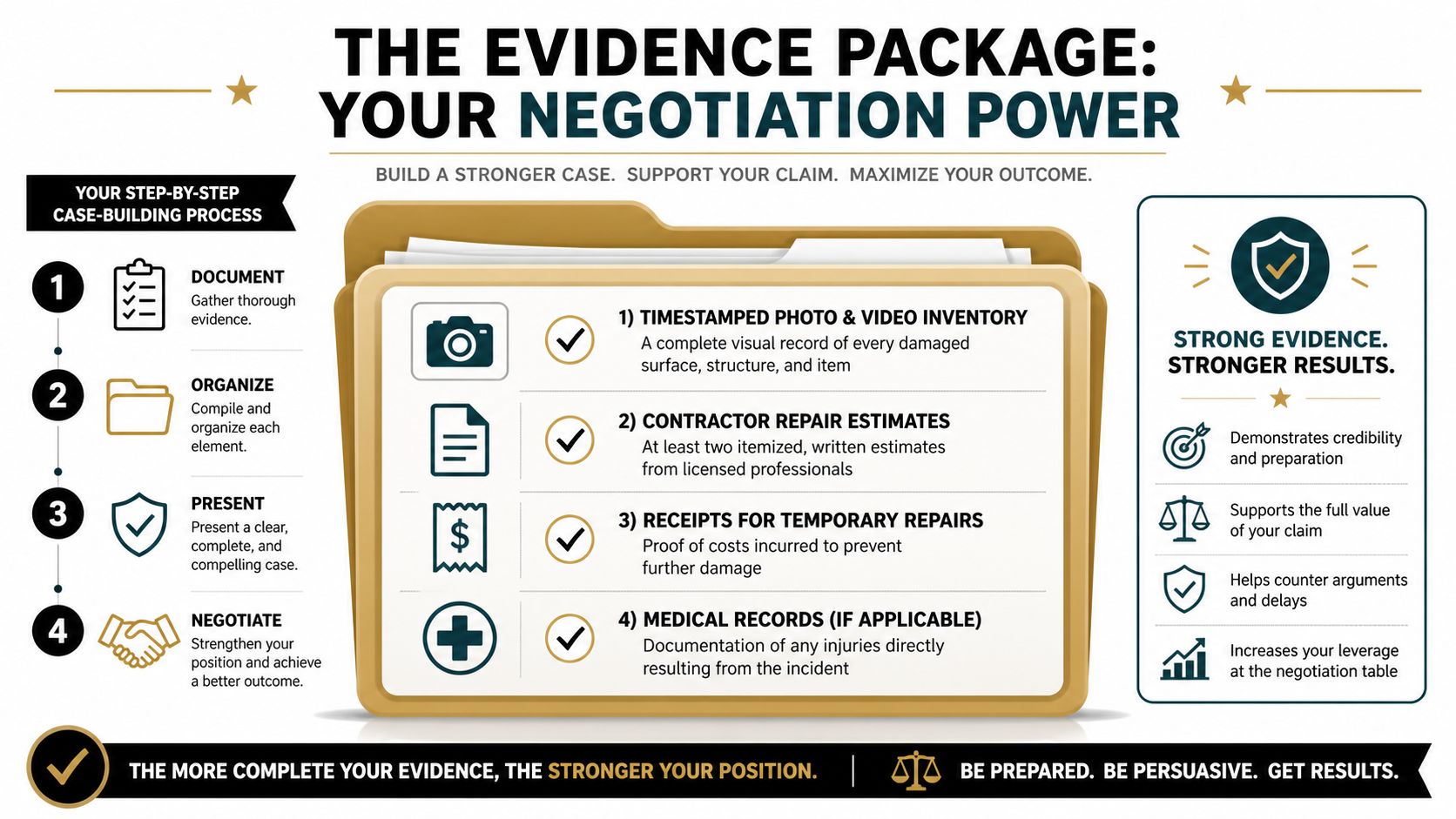
Assemble evidence that answers valuation questions
Your package should contain more than photographs:
- Contractor estimates: Obtain written, itemized estimates organized by trade. Ask contractors to identify quantities, labor, materials, access conditions, code work, and necessary supervision.
- Ownership and cost records: Gather receipts, invoices, warranties, purchase records, manuals, and photographs showing the condition and age of damaged items.
- Temporary-repair records: Preserve invoices and receipts for tarping, board-up work, drying, cleanup, storage, and other steps taken to prevent additional damage.
- Technical findings: For water or fire losses, include engineering opinions, moisture mapping, drying documentation, air-quality findings, or other qualified assessments when causation or hidden damage is disputed.
- Your loss narrative: Write a room-by-room account linking the observed damage to the covered event, the immediate response, and the work required to restore the property.
- Comparison worksheet: Mark every line the carrier trimmed, reclassified, excluded, or depreciated, then cite the evidence supporting your correction.
The order matters. Preserve the original condition before repairs begin whenever it's safe to do so. If emergency work is necessary, photograph the area first and keep removed materials when practical.
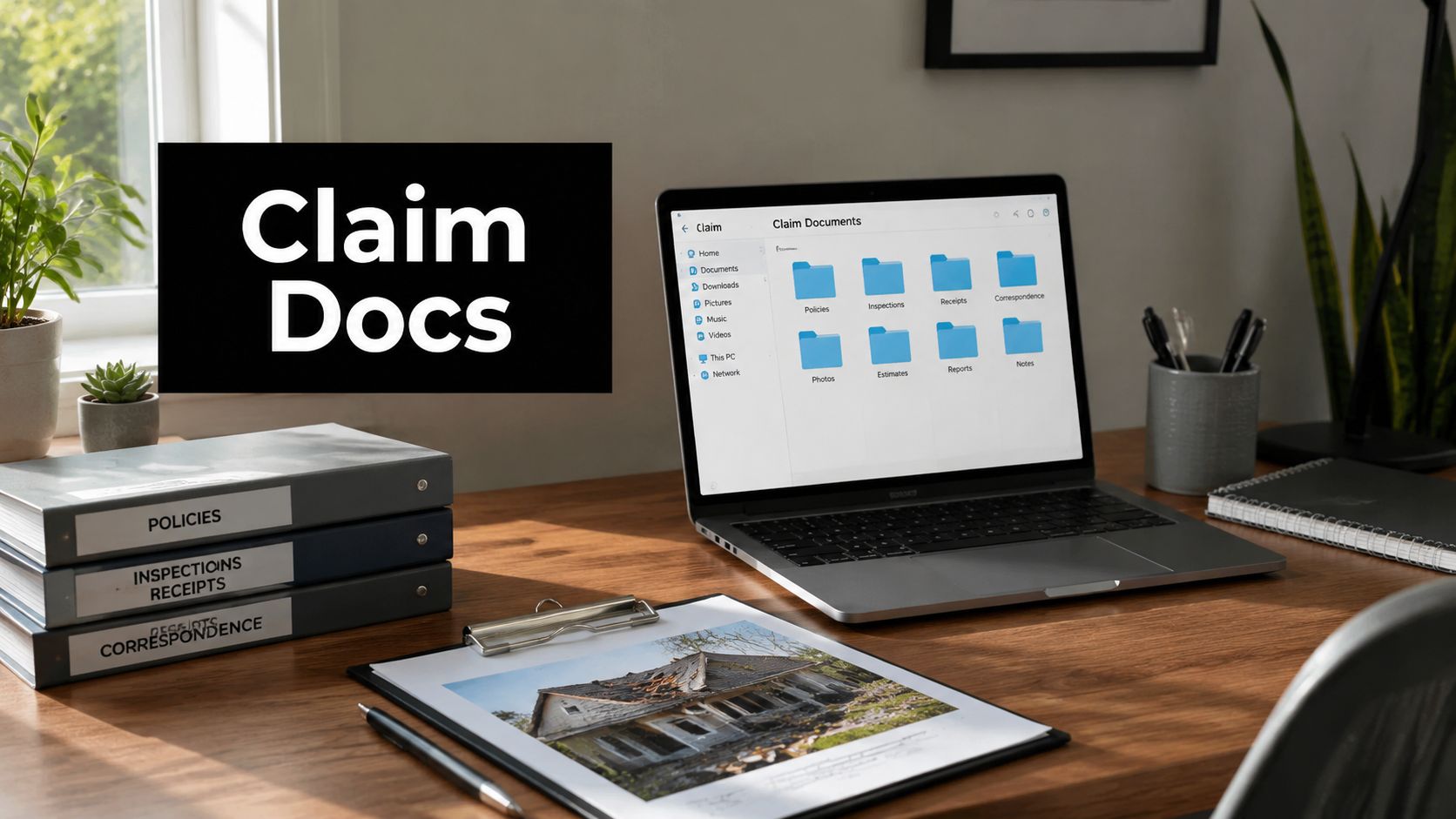
Use a naming system that lets an adjuster find a document quickly. For example, organize folders by building area, trade, and evidence type. This evidence preservation guidance can help you protect the record before demolition or cleanup changes what the property shows.
A strong package converts an emotional dispute into a series of answerable questions. The adjuster must explain why a photographed damaged component is absent, why a contractor's quantity differs, or why depreciation applies under the policy.
Negotiation Tactics and Sample Objection Language You Can Send
The adjuster calls and says, “We've already included everything supported by the inspection.” A frustrated response invites another general explanation. A useful response asks for the estimate version, the disputed line items, the policy basis, and the evidence supporting each exclusion.
Write back instead of arguing by phone. Keep the tone controlled, identify the disagreement precisely, and reserve your position until you've reviewed the complete file. Guidance on winning an insurance claim can provide another perspective on negotiation and settlement preparation.
A better exchange
Policyholder: “I'm not accepting the offer as full payment. Please identify the estimate version used, provide the depreciation schedule, and explain the omission of the flashing, drip edge, and code-required fasteners.”
Adjuster: “Those items aren't included because they weren't documented in our inspection.”
Policyholder: “The attached contractor estimate and photographs document each item. The contractor also explains why the components must be installed as part of the covered roof work. Please confirm whether the carrier disputes the existence of the damage, the necessity of the work, or coverage under the policy.”
That last question matters. It forces the carrier to separate scope, causation, coverage, and price. Adjusters often blend those issues together because a vague disagreement is harder to challenge.
Adaptable objection language
I dispute the valuation because the estimate uses labor rates that don't reflect the documented cost of the required work, applies depreciation without identifying the policy basis and calculation, and omits code-required upgrades described in the attached contractor scope. Please provide the pricing source, depreciation inputs, and coverage position for each disputed item. I request a revised estimate that addresses the enclosed measurements, photographs, policy provisions, and contractor documentation.
For a disputed auto total loss, use the policy's appraisal procedure if available. The standard process generally involves written invocation, each side selecting an appraiser, the appraisers attempting to agree, and a neutral umpire issuing a binding award if they cannot. Industry guidance commonly cites a benchmark requiring the insurer to nominate its appraiser within about 20 days under many policies, as described in this independent appraisal guide. Check your actual policy before relying on that benchmark.
Send the response through a method that preserves delivery and attachments. Keep a claim diary with dates, speakers, promises, revised estimates, and missed responses. A rebuttal letter template can help organize the written response, but your supporting documents must be specific to the loss.
When a Public Adjuster or Attorney Earns Their Fee
You don't need professional representation for every disagreement. A straightforward claim with complete documentation and one or two disputed line items may be manageable on your own. A large, complex, or adversarial claim is different.
| Factor | Handle Solo | Hire Public Adjuster | Hire Property Attorney |
|---|---|---|---|
| Scope dispute | Useful for a few clear omissions | Prepares a complete estimate and supplements | Evaluates contractual and legal remedies |
| Complex damage | Difficult without technical support | Coordinates inspection, trades, inventory, and valuation | Adds legal strategy where causation or coverage is contested |
| Carrier posture | Works when communication remains productive | Useful when the adjuster won't correct the file | Appropriate when denial, bad faith, appraisal, or litigation is likely |
| Business interruption | Often difficult to quantify alone | Builds operational and financial documentation | Handles legal disputes over coverage and damages |
| Contract terms | You manage the process directly | Requires a written representation agreement | Requires a written engagement agreement and legal-fee disclosure |
A licensed public adjuster is usually the practical choice when the central problem is valuation. The adjuster can inspect the property, prepare a detailed scope, document supplements, recover overlooked depreciation where the policy allows it, and negotiate directly with the carrier.
An attorney becomes more important when the insurer denies coverage, misrepresents policy language, refuses to investigate, or leaves appraisal and litigation as realistic next steps. Don't hire either professional merely because the first offer disappointed you. Hire based on the amount at stake, the technical complexity, and the carrier's conduct.
Oregon and Washington impose licensing and contract requirements on public adjusters. Ask for the professional's license information, written fee agreement, scope of authority, and cancellation provisions before signing. Fee limits and contract rules can vary by state and claim context, so confirm the current requirements with the relevant regulator or counsel.
Oregon and Washington Remedies, Timelines, and How NW Claims Management Helps
A low offer becomes more manageable when you stop treating negotiation as the only remedy. In Oregon, start by requesting a written explanation of the valuation and coverage position, then preserve every document needed for a complaint or legal review. The Oregon Department of Consumer and Business Services provides a complaint process, while provisions including ORS 742.061 and ORS 746.230 may matter when an insurer delays, mishandles, or undervalues a claim. Commercial and specialized property disputes can involve additional statutes and contractual deadlines, so don't assume a general deadline applies to your loss.
Washington policyholders can use the Office of the Insurance Commissioner complaint intake and review claim-handling requirements associated with RCW 48.30.015, RCW 48.01.030, and WAC 284-30. A regulator complaint can create an additional review channel, but it doesn't replace preserving suit deadlines, complying with policy conditions, or obtaining legal advice when a denial or bad-faith issue is developing.
| Remedy or Step | Oregon | Washington |
|---|---|---|
| Written valuation challenge | Request the estimate, explanation, policy basis, and payment position in writing | Make the same request and preserve the carrier's response |
| Regulatory escalation | Use the Oregon Department of Consumer and Business Services complaint process | Contact the Washington Office of the Insurance Commissioner |
| Claim-handling rules | Review applicable Oregon statutes, administrative rules, and policy conditions | Review RCW provisions and WAC claim-handling requirements |
| Appraisal or dispute procedure | Follow the exact policy language and deadlines | Follow the exact policy language and deadlines |
| Legal escalation | Consult counsel before limitation or trial deadlines expire | Consult counsel before limitation or trial deadlines expire |
Don't wait for a regulator or lawsuit to organize the file. Use the carrier's estimate, depreciation schedule, revision history, measurements, and photographs as the foundation for your challenge. For policy language governing payment timing, review this guide to the time payment of claims provision.
NW Claims Management offers claim evaluation, property inspection, estimate preparation, carrier-file review, evidence organization, negotiation, and escalation support for Oregon and Washington policyholders. If your settlement offer won't fund the documented restoration, visit NW Claims Management to request a claim evaluation before signing a release or accepting the payment as final.