Most insurance advice tells you to review your policy once a year and check the limits on the declarations page. That advice is incomplete. A limit can look adequate while exclusions, endorsements, valuation language, deductibles, or a changed definition reduce what the insurer will pay.
An effective insurance policy review is not a price-shopping exercise. It's a line-by-line examination of the contract you'll rely on after a fire, storm, flood, theft, or business interruption. Regulators treat policy review as a formal compliance and consumer-protection process, and claims oversight repeatedly shows why policyholders shouldn't assume the file is clean. Your job is to find the wording that creates a gap before a loss exposes it.
Why Your Policy Limits May Not Mean What You Think
A declarations page gives you the headline figures. It may show a dwelling limit, commercial property limit, personal property limit, liability limit, or business income limit. Those figures matter, but they don't tell you the whole story. The insurer's obligation depends on the complete policy, including definitions, exclusions, conditions, schedules, and endorsements.
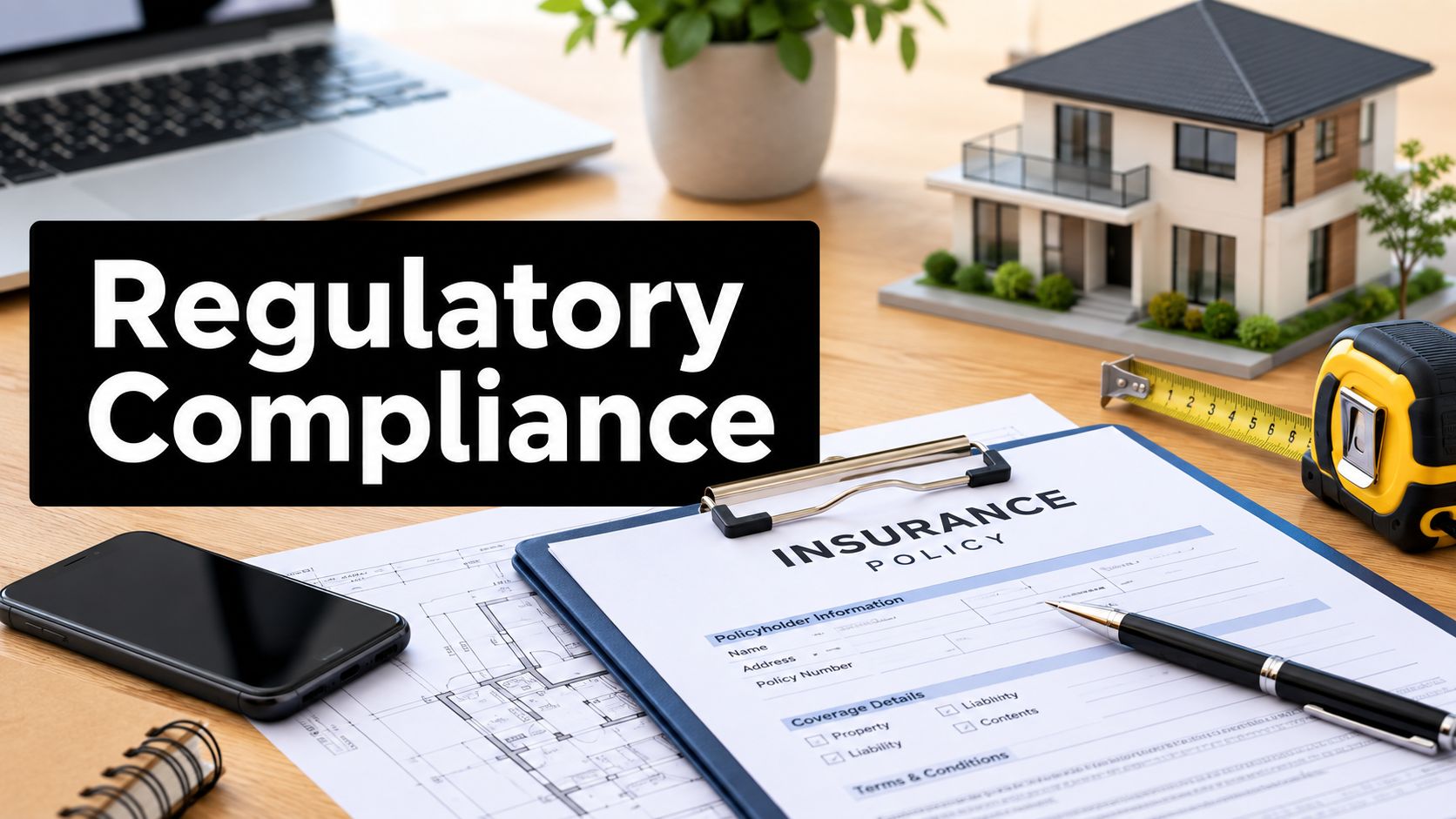
The NAIC Product Filing Review Handbook says reviewers must check whether policy forms clearly identify who's covered, define coverage agreements and limits, disclose exclusions and required provisions, comply with applicable rules, and meet readability requirements. That framework makes the central point clear: policy language must be understandable enough for a policyholder to identify what is and isn't covered.
The declarations page is only the starting point
A homeowner can have a substantial dwelling limit and still face a serious shortfall if the policy pays actual cash value for part of the loss, excludes a cause of damage, applies a restrictive roof endorsement, or lacks an endorsement required by local rebuilding rules. A business can have a property limit that appears sufficient but discover that equipment, stock, outdoor property, leased property, or income losses fall under separate restrictions.
Insurers don't need to remove a coverage limit to narrow protection. They can change a definition, add a condition, alter a deductible, or attach an endorsement at renewal. Those changes may appear in a renewal packet that receives little attention.
Practical rule: Never approve a renewal based only on the premium and declarations page. Compare the current contract with the prior contract and identify every wording change.
The risk isn't theoretical. ReSource Pro reports that fewer than 1% of insurance policies are free of errors, with an average of nine errors per policy in its review data. Its common defects include incorrect locations or addresses, incorrect aggregate or per-occurrence limits, and missing or incorrect coverage. Those findings support an aggressive review mindset. You shouldn't assume your policy is accurate. You should systematically look for defects.
The NAIC also advises consumers to review insurance policies annually, treating review as an ongoing risk-management practice rather than a one-time purchase task. Its readability materials reference a minimum Flesch reading-ease score of 40, illustrating that policy language is subject to measurable standards, not merely an insurer's judgment about clarity. For a useful explanation of how headline limits interact with deductibles and coverage restrictions, review this guide to insurance policy limits.
Gathering and Organizing Every Policy Document
Don't interpret an exclusion until you've assembled the entire contract. A declarations page without its endorsements is not a complete policy. A renewal notice without the revised form won't show you what changed. The original application matters because it reveals the information used to underwrite and rate the risk.
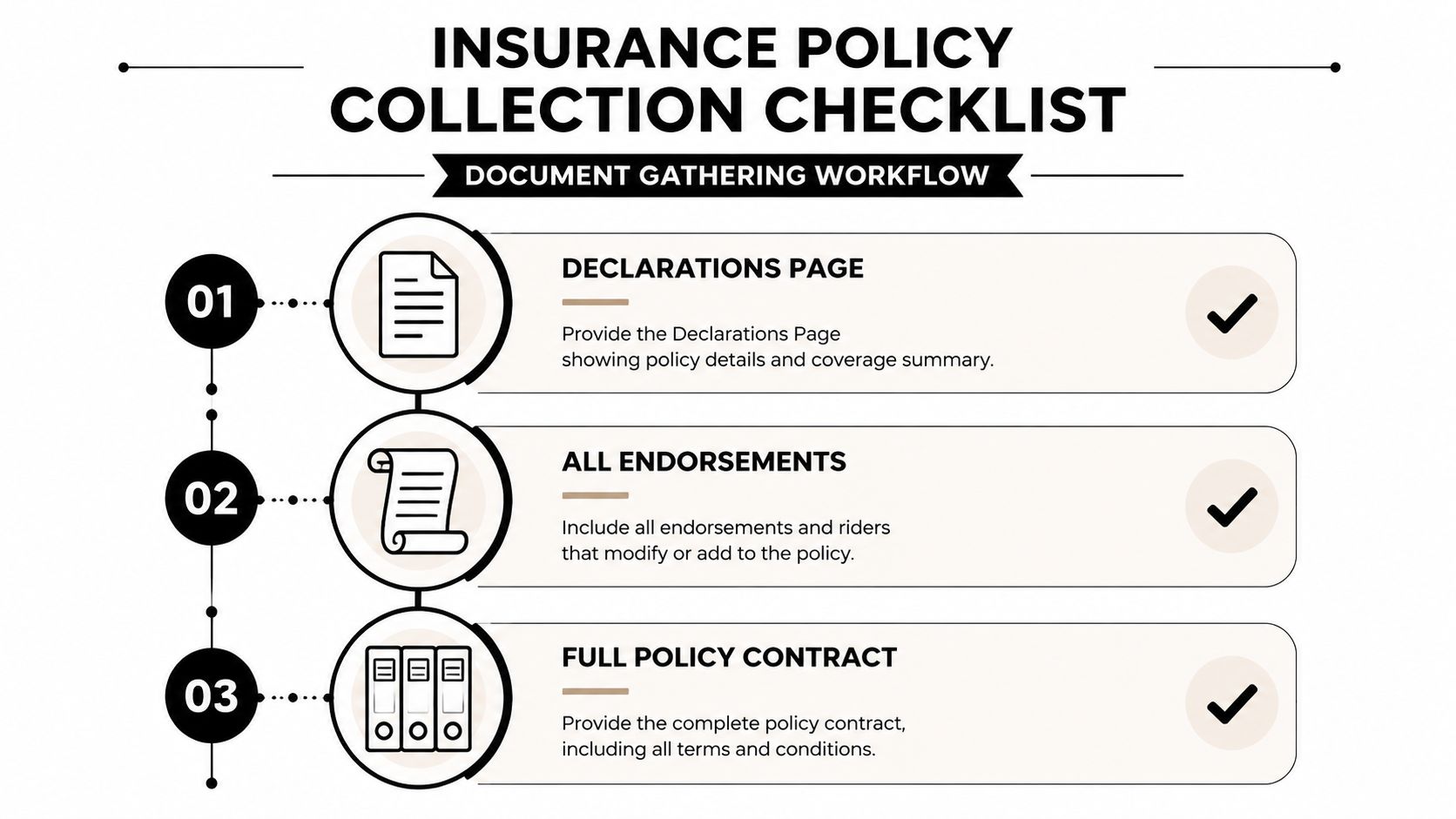
Start by collecting these documents for the current term and prior renewal cycles:
- Declarations pages: Save every page, not just the page showing the main property limit. Check named insureds, locations, mortgagees, deductibles, forms, limits, and policy dates.
- All endorsements: Include endorsements listed on the declarations page, attached amendments, exclusions, coverage buybacks, valuation changes, and form revisions.
- Full policy contract: Obtain the complete base form, including definitions, insuring agreements, exclusions, conditions, duties after loss, and general provisions.
- Renewal change notices: These often identify altered deductibles, exclusions, sublimits, valuation methods, or coverage reductions.
- Original application: Compare occupancy, construction, use, protection systems, business operations, prior losses, and other rating inputs with current conditions.
- Supporting schedules: Gather equipment schedules, jewelry schedules, vehicle schedules, statement-of-values documents, and business income worksheets where applicable.
Build a timeline before you compare language
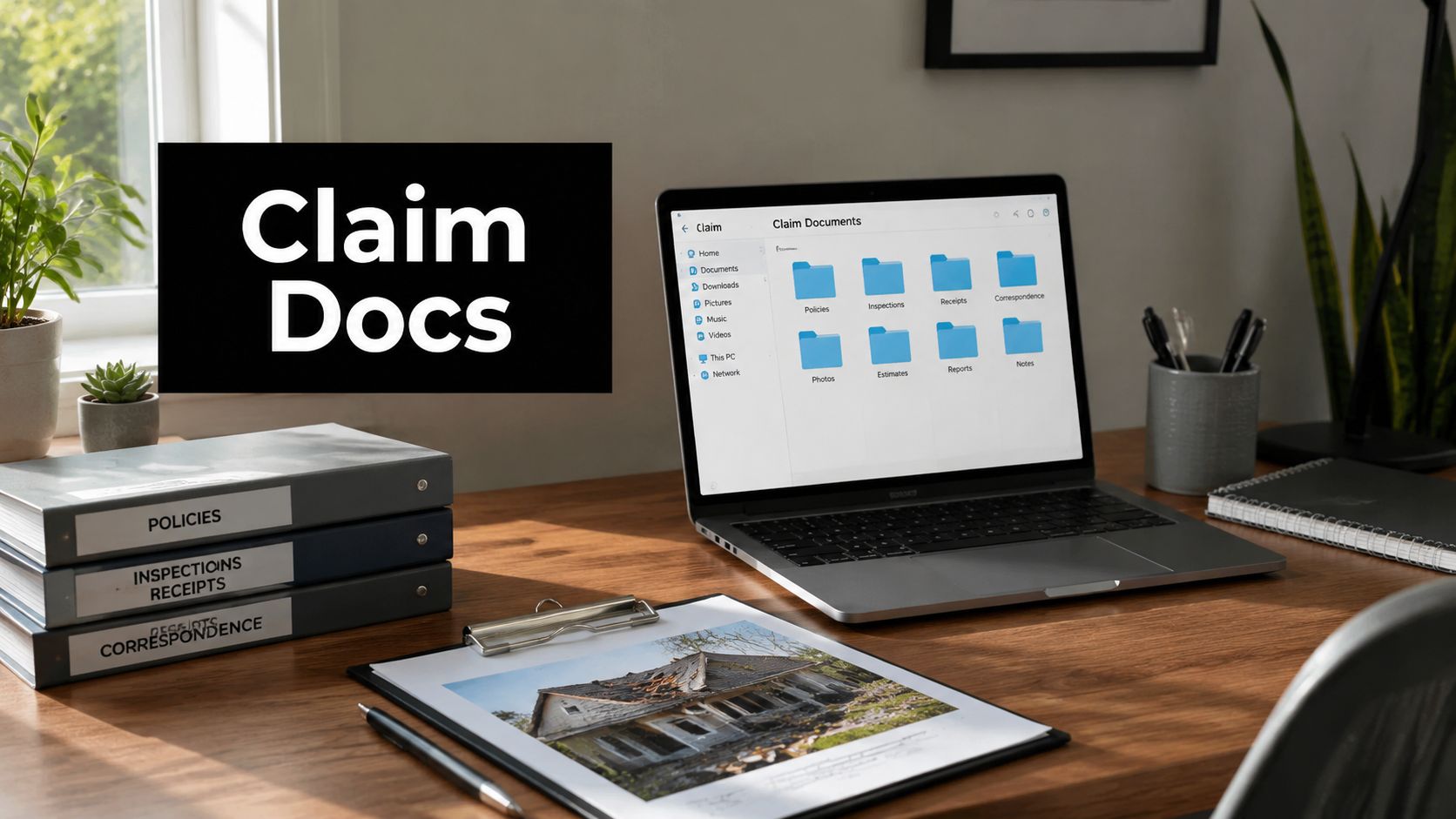
Create a folder for each policy period and use consistent file names. Put the declarations page first, followed by endorsements in listed order, the base policy form, renewal correspondence, and application materials. Keep a separate change log that records the form number, effective date, and practical effect of each amendment.
Then compare documents line by line. Don't rely on a search for words such as “exclusion” or “limit.” A changed definition of “occurrence,” “property damage,” “collapse,” “water,” or “business income” can matter more than a bold heading. Mark language that was added, removed, relocated, or rewritten.
Test the policy against today's exposure
The application describes the risk as it existed when the insurer issued the policy. Your current exposure may be different. Ask whether you've remodeled, added valuable property, changed occupancy, started a home-based business, installed solar equipment, acquired a rental property, stored materials on-site, or changed business operations.
Validate rating inputs and coverage limits against actual conditions. A wrong address, outdated square footage, incorrect construction description, missing protective device, or inaccurate business classification can create trouble during underwriting and claims handling. If a discrepancy exists, ask the insurer or broker to correct it in writing before renewal.
Keep evidence of every request and response. If you later need to prove what you disclosed, an email trail is stronger than memory. The same discipline applies to claim forms and sworn statements. Learn how to preserve and organize a proof of loss form before a carrier requests one under pressure.
Critical Clauses to Inspect During Your Review
The most expensive coverage mistakes usually hide in ordinary-looking provisions. A policy may promise replacement cost, then impose conditions that delay or limit that payment. It may cover a peril in broad terms, then remove it through an endorsement. It may insure a building but restrict code upgrades, debris removal, landscaping, or income loss.
Read these clauses together, not in isolation.
Start with valuation and peril language
Replacement cost versus actual cash value is a fundamental distinction. Replacement cost generally concerns the cost to repair or replace with comparable property, subject to policy conditions. Actual cash value reflects a deduction for depreciation. A roof, mechanical system, damaged contents, or older building component can produce a very different payment depending on which valuation applies.
A policy using open perils generally begins with broader cause-of-loss protection, subject to exclusions. A named perils form covers only the causes specifically listed. The label alone isn't enough. Read the applicable exclusions and confirm whether the loss mechanism fits the coverage grant.
Deductibles also deserve close attention. Check whether the policy applies a flat deductible, a percentage deductible, separate deductibles by peril, or a combination of deductibles. A wind deductible may operate differently from a fire deductible, and a single occurrence may involve more than one alleged cause of damage.
Examine endorsements and code provisions
Endorsements can add coverage, remove coverage, change definitions, impose sublimits, or replace the original wording entirely. Compare the endorsement schedule to the forms attached. Don't assume an endorsement's title tells you whether it helps or harms you.
Ordinance and law coverage is a frequent gap. If a fire damages an older structure and local code requires electrical, structural, accessibility, or energy upgrades during reconstruction, the base property coverage may not pay the full added cost without appropriate language. The practical question is not whether the building was legal before the loss. It's whether the policy pays the extra cost required to rebuild legally afterward.
For commercial policyholders, inspect business interruption, extra expense, waiting periods, period of restoration, extended business income, dependent property, and payroll provisions. A property claim can be adequately insured while the income protection expires before the business can resume normal operations.
| Clause Type | What to Verify | Common Pitfall |
|---|---|---|
| Valuation | Replacement cost, actual cash value, depreciation rules, repair or replacement conditions | Assuming every item receives replacement-cost treatment |
| Deductible | Amount, percentage basis, peril-specific application, occurrence wording | Overlooking a separate or percentage-based storm deductible |
| Perils | Named or open perils, exclusions, concurrent-causation wording | Treating a broad coverage label as proof that every cause is covered |
| Endorsements | Form numbers, effective dates, added limits, exclusions, amended definitions | Reading the endorsement title without comparing its full language |
| Ordinance and law | Code-upgrade coverage, sublimits, demolition and increased-cost provisions | Paying for mandatory upgrades out of pocket |
| Business income | Limits, waiting period, restoration period, extra expense, dependent locations | Reaching the income limit before operations recover |
| Liability terms | Insured parties, additional insureds, occurrence definitions, notice duties | Assuming a certificate or contract automatically creates coverage |
Commercial and nonprofit policyholders should also verify whether contractors, landlords, lenders, or project partners require an additional insured endorsement. A certificate of insurance may summarize coverage, but it doesn't replace the endorsement that changes the policy.
Building Your Documentation and Evidence File
Policy interpretation becomes much easier when you can prove what existed before the loss. Insurers may ask for inventories, photographs, receipts, estimates, repair records, ownership documents, valuations, leases, payroll information, tax records, and business interruption support. Waiting until after a fire or major storm leaves you trying to reconstruct evidence while managing displacement, safety concerns, and insurer deadlines.
Photograph the property as it exists
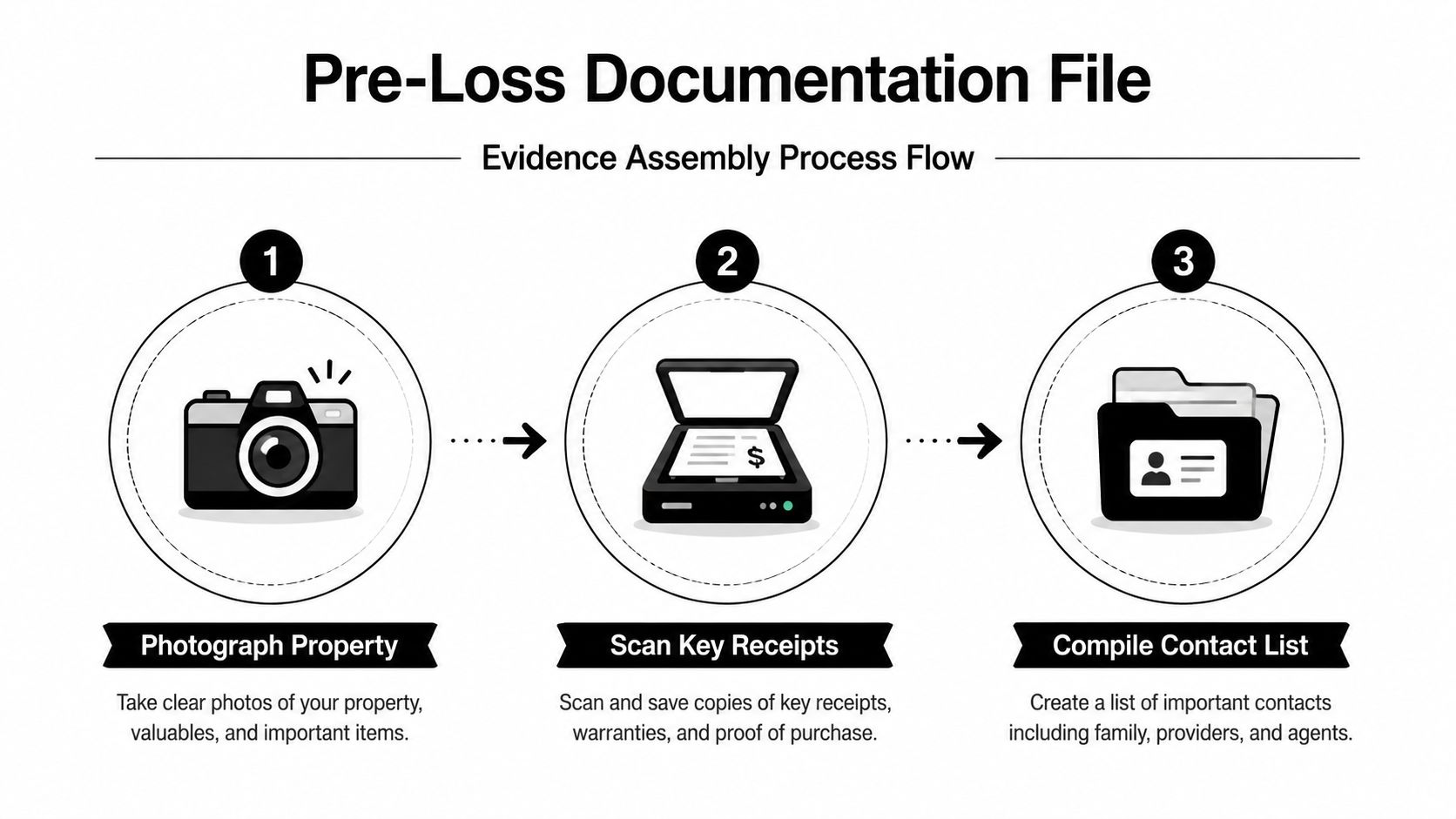
Take clear photographs and video of every room, exterior elevation, roof area, mechanical space, storage area, outbuilding, and business operation. Open cabinets, drawers, closets, safes, and storage containers so the record shows contents that aren't visible in a wide room shot.
Store the files in more than one location. Add dates, room names, item descriptions, model numbers, serial numbers, and purchase information where available. For valuable property, keep appraisals, invoices, certificates, and service records with the image files.
A home inventory doesn't need to be elegant. It needs to be usable. Walk through the property systematically and record ordinary items as well as expensive ones. Clothing, tools, appliances, electronics, furniture, sporting goods, collectibles, and stored materials can become difficult to value from memory.
Preserve receipts and ownership evidence
Scan receipts and save them with a consistent naming system. If a receipt isn't available, retain credit-card statements, warranty registrations, photographs, manuals, appraisals, or other records showing ownership and approximate age.
Business owners need a broader file. Preserve equipment lists, inventory reports, lease documents, vendor invoices, sales records, payroll records, tax filings, customer contracts, production schedules, and continuity plans. These records can help establish both physical property values and the income the business would have earned without the interruption.
Know your duties after loss
Policies commonly require prompt notice, reasonable protection of property from further damage, cooperation with the insurer's investigation, access for inspection, records, and a signed proof of loss within a specified period. The exact requirements depend on the contract and jurisdiction, so read the duties-after-loss section before a claim occurs.
Don't discard damaged property unless safety or public-health concerns require removal. Photograph it first, preserve samples when appropriate, keep invoices for emergency work, and separate damaged items from undamaged items when practical. Record every conversation with the insurer, contractor, engineer, mitigation company, and government agency.
Underinsurance creates another serious problem. Consumer guidance recommends comparing dwelling limits with today's rebuild cost, not purchase price, because construction costs and replacement needs can outpace old limits. Annual review helps, but limits can become stale between renewals in volatile property markets. Check the valuation basis, inflation protection, extended replacement provisions, exclusions, and endorsements before a loss occurs.
Use a dedicated evidence process, such as this guidance on evidence preservation, and keep the file accessible to a trusted household member or business successor.
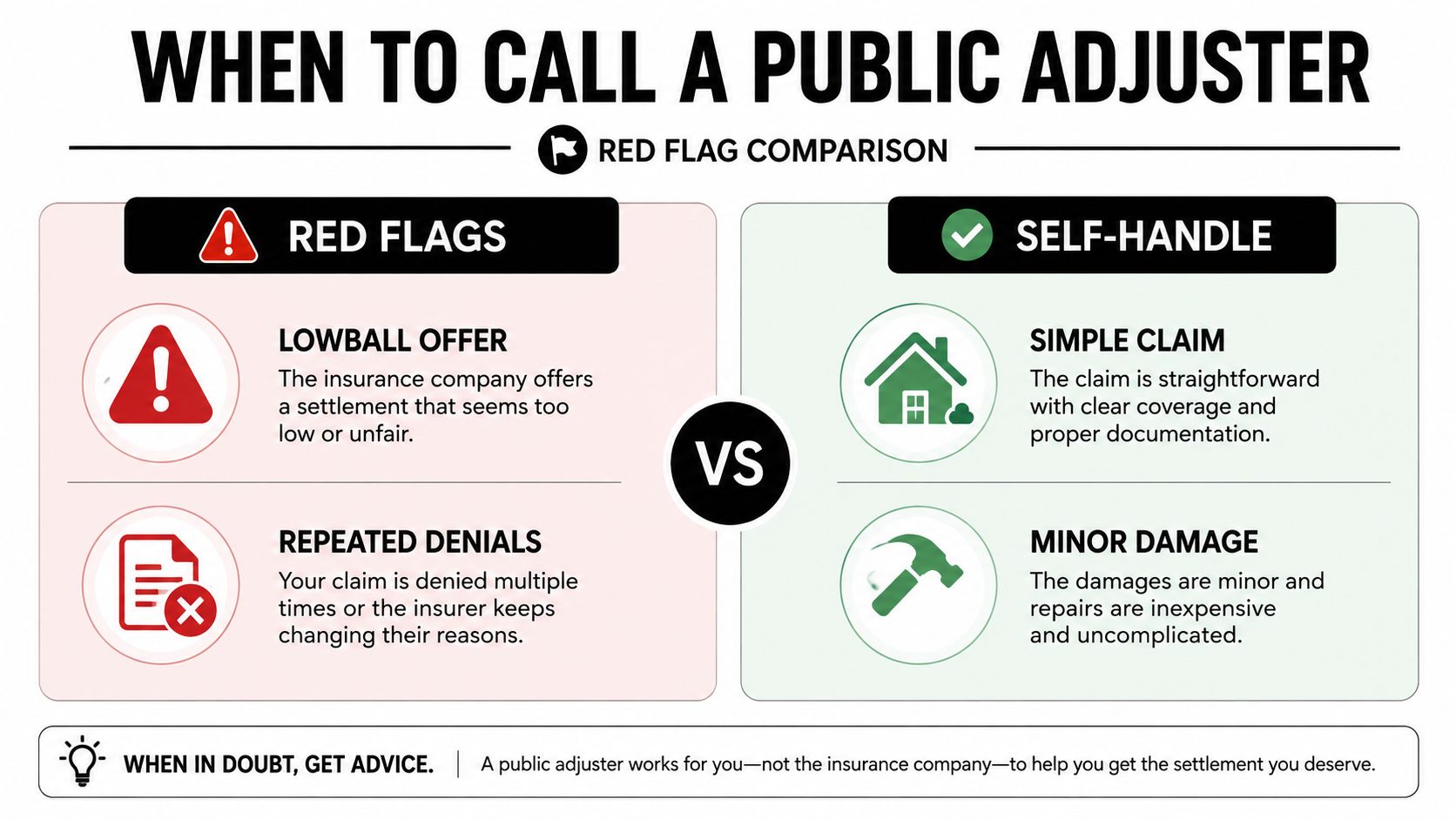
Red Flags That Signal You Need a Public Adjuster
Simple claims can often be handled directly. A broken window, a small isolated loss, or minor damage with clear coverage may not justify professional representation. Complexity changes the calculation quickly, especially when the insurer controls the investigation and the policyholder is expected to prove the amount and cause of loss.
Independent New Jersey market-conduct examinations show why scrutiny matters. One examination found 5 errors in 25 claims files, a 20% error ratio, while another found 36 files in error out of 100 reviewed, a 36% error ratio. The reports define an error as mishandling or unfair treatment, even without a specific statutory violation, and count each file only once even when it contains multiple errors. See the New Jersey claims examination report for the examination framework.
Call for help when the claim becomes a dispute
You should seriously consider an independent public adjuster when:
- The loss is commercial or nonprofit-related: Multiple locations, inventory, equipment, payroll, leases, customers, and income calculations can overwhelm an owner who is also trying to keep operations alive.
- The carrier challenges the valuation: A low estimate, aggressive depreciation, disputed scope, or disagreement over repair versus replacement requires documented counteranalysis.
- The insurer delays or underpays: Repeated requests for the same information, unexplained inactivity, partial payments without a clear basis, or a rushed settlement offer deserve scrutiny.
- Several coverage triggers overlap: A storm may involve wind, water, power interruption, trees, mold, ordinance requirements, and access problems. The insurer may separate these issues to narrow the claim.
- You received a denial that doesn't match the policy: Compare the denial letter with the insuring agreement, exclusions, definitions, endorsements, and facts. Don't accept a conclusion merely because it appears on carrier letterhead.
- You can't manage the process: Displacement, injury, work demands, family responsibilities, or emotional stress can prevent a careful claim presentation.
Tree damage often creates its own questions about removal, structures, debris, access, and resulting damage. A practical resource on tree removal after storm insurance can help you identify issues to document before discussing responsibility with the carrier.
Don't hire representation because a claim feels unpleasant. Hire it when the scope, policy language, valuation, or insurer conduct makes a full recovery difficult to manage alone.
A public adjuster represents the policyholder, not the insurer. Before signing, ask about licensing, scope of services, communication, fees, termination rights, and whether the professional has handled your type of loss in your jurisdiction. This guide to when to hire a public adjuster can help you assess the decision.
How NW Claims Management Protects Your Recovery
A careful policy review identifies possible coverage. A strong claim presentation connects that coverage to the actual damage, documents the amount, addresses exclusions, and responds to the insurer's position with evidence. Those are separate tasks, and a policyholder can lose negotiating power by treating them as one.
NW Claims Management is based in Portland, Oregon, and operates under public adjuster licenses in Oregon and Washington. The firm handles residential, commercial, and nonprofit claims, including property losses involving fire, flood, storm, and vandalism. Its certified adjusters interpret policy language, evaluate structural damage, document covered losses, and negotiate with insurers.
The firm's process can include a line-by-line policy review, damage assessment, contents documentation, repair-scope development, business income analysis, and settlement negotiation. That hands-on approach is designed for policyholders who are overwhelmed or facing a complex claim, rather than for every minor loss.
NW Claims Management offers a free claim evaluation for prospective clients. Its compensation is contingency-based, tying the firm's fee to the claim outcome, and prospective clients should confirm the specific fee terms and engagement conditions before proceeding.
The practical advantage of professional help is control. You have one organized claim file, one damage narrative, a documented valuation, and a representative focused on the policyholder's recovery. That structure can counter incomplete scopes, unsupported depreciation, overlooked endorsements, and settlement pressure while allowing you to focus on your family, property, employees, or mission.
If your policy has changed, your property has been damaged, or an insurer has offered less than the loss appears to justify, request a free claim evaluation from NW Claims Management. Their licensed public adjusters can review the policy, document the damage, and help you decide whether professional representation is appropriate.