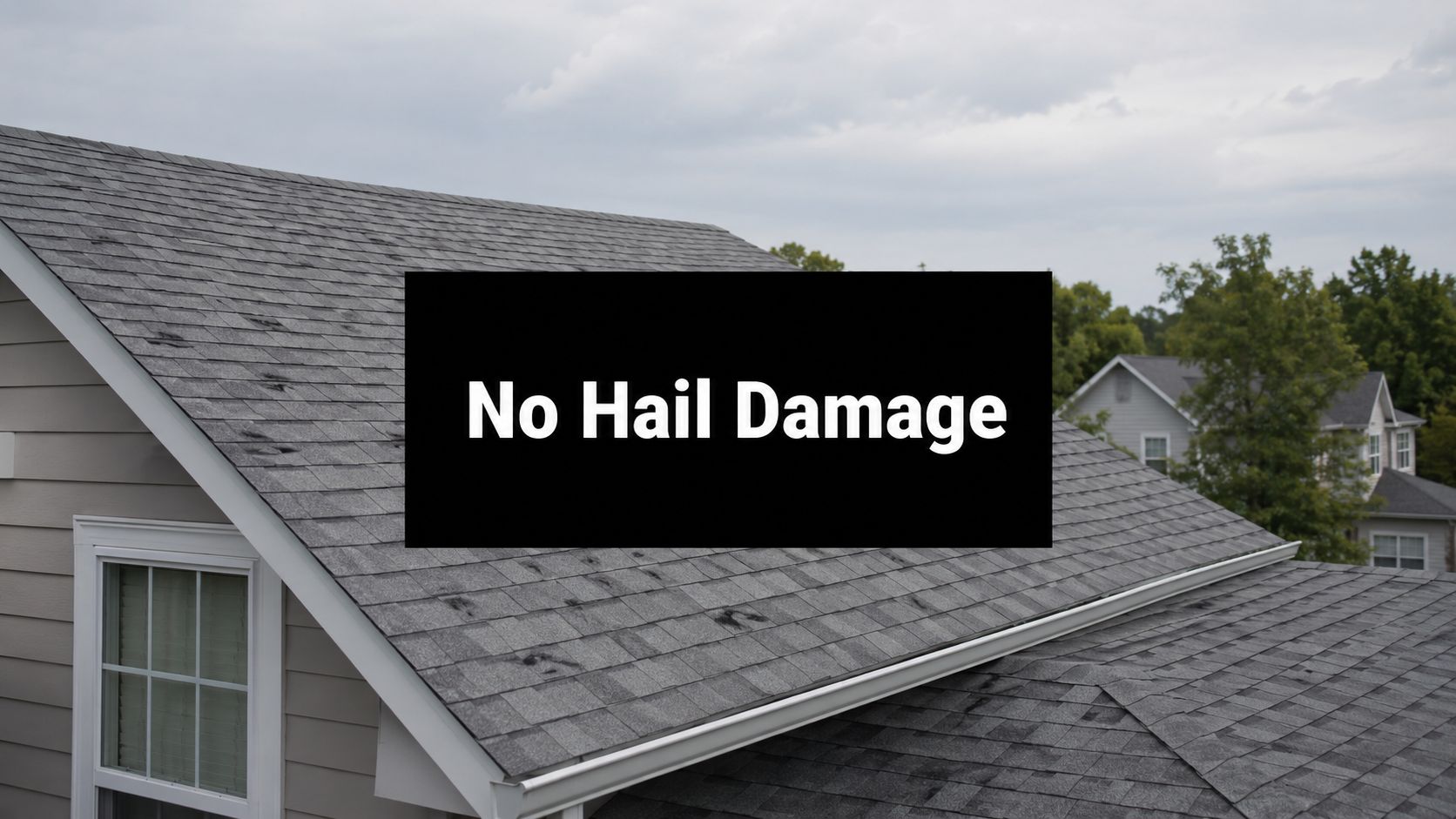
You've just watched an insurance adjuster walk your roof, take a set of photographs, and leave without finding anything the carrier considers payable. The letter arrives soon after: “no recent hail impact,” “pre-existing wear,” “cosmetic damage,” or damage that falls below the deductible. Your roofer sees something different, but the claim file now contains the insurer's version of events.
A denial doesn't necessarily mean hail didn't strike your property. It may mean the carrier disputes when the damage occurred, whether it affects function, whether the roof was already deteriorated, or whether you reported the loss on time. Hail is a major recurring source of property loss. Insurers receive more than 500,000 hail-related property-damage claims each year, while annual hail losses have risen from just over $1 billion in the 1990s to roughly $8 billion to $15 billion per year in recent decades, according to industry analysis of hail risk for property insurers.
The practical response is evidence, not an argument on the doorstep. You need to identify the denial theory, preserve the physical proof, connect the damage to a covered storm, and answer the policy language point by point.
The Moment Your Hail Claim Gets Denied
The adjuster stands beside the driveway and says the roof looks normal. Fifteen photographs later, the visit is over. The follow-up letter says there's “no recent hail impact,” or that the observed marks are “wear and tear below the deductible threshold.” The conversation sounded informal, but the written position now controls the next stage of the claim.
Those phrases carry different meanings. “Weather doesn't match” usually means the carrier doesn't believe you've tied the damage to a covered storm during the policy period. “Pre-existing wear” means the insurer attributes granule loss, cracking, or deterioration to age rather than a sudden event. “Cosmetic only” means the carrier may acknowledge dents or marks but argue they don't impair the covered property's function. Your policy, endorsements, exclusions, and claim correspondence determine whether that position is correct.
A verbal statement on the roof isn't the same as a formal written denial. Ask for the carrier's written coverage decision, complete inspection report, photographs, estimate, and any engineer or weather materials relied upon. You can also review this practical guide to understanding a claim denial letter before responding.
The first 48 hours after the letter
Treat the denial as a preservation problem first. Don't authorize permanent repairs, replace the roof, scrub away marks, or let a contractor “fix it while we're up there” before you've documented the condition. Emergency work to prevent active water intrusion may be necessary, but photograph the area beforehand and keep invoices, removed materials, and work descriptions.
Write down what the adjuster said while the visit is fresh. Don't agree in writing that damage is old, harmless, or unrelated just to end an uncomfortable conversation. Instead, ask the insurer to identify the exact policy provision and factual basis supporting its decision.
Practical rule: A denial is a position in the claim file, not proof that the carrier's inspection was complete or correct.
Compare the adjuster's photographs with every roof slope, vent, gutter, downspout, window screen, skylight, HVAC component, siding area, and interior location you reported. A quick walk-around can miss concealed or system-specific damage. Your next move should be controlled, written, and designed to preserve the evidence the first inspection may have overlooked.
Why Insurers Really Say No Hail Damage
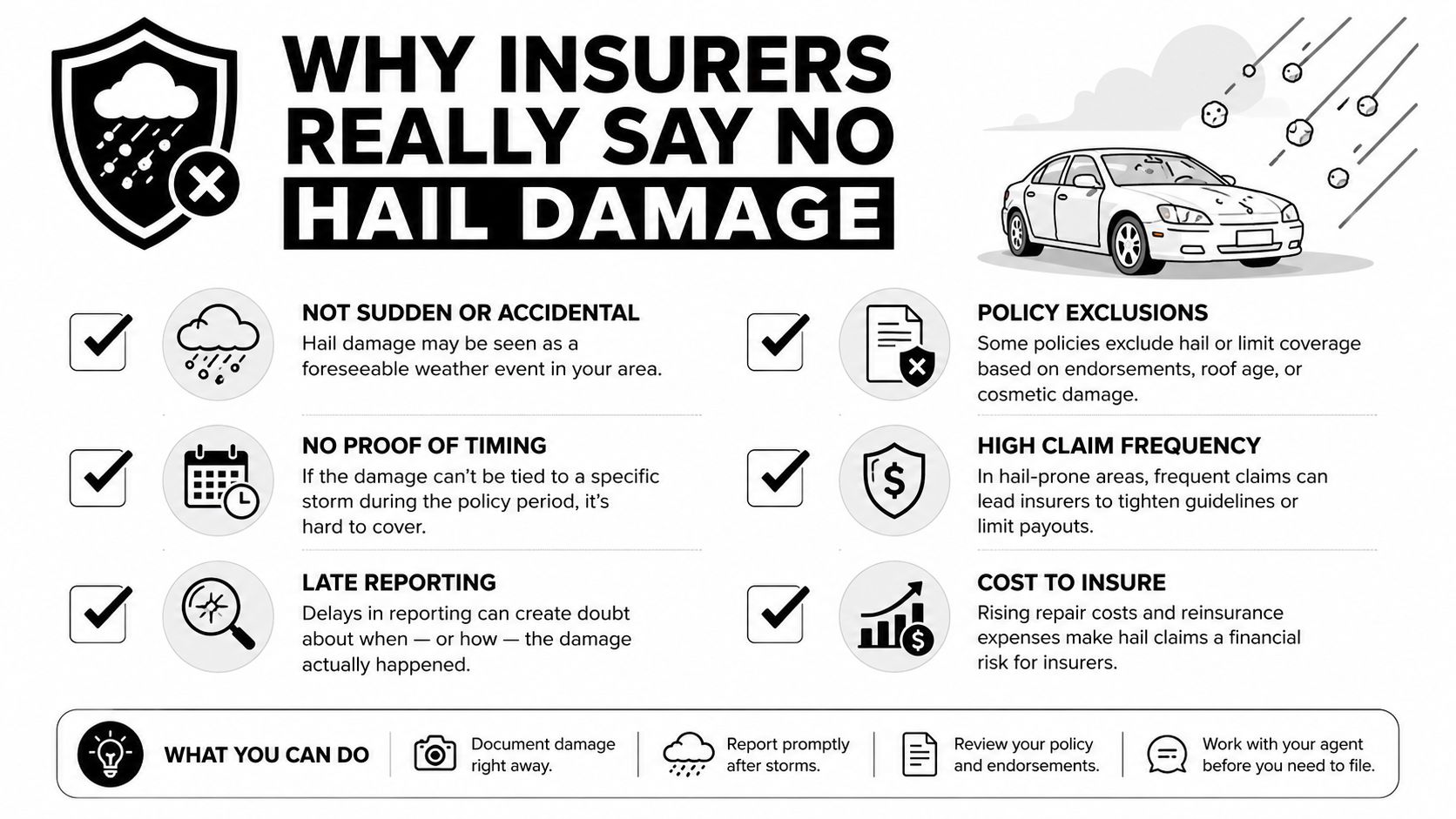
Most hail denials fit a small group of recurring theories. The wording differs by carrier, but the underlying questions are usually the same: Did a covered storm cause this damage? Does the policy cover the kind of damage alleged? Was the condition already present? Did the policyholder comply with notice requirements?
Causation disputes
A carrier may say the reported storm didn't produce hail at your address, the hail was too small, or the observed damage doesn't match the storm's direction and intensity. The denial may attach weather reports, an adjuster's notes, or an engineer's opinion. The response should tie a specific storm to the property through weather verification, photographs taken soon after the event, and a competent roof inspection.
Hail claims are often concentrated in large storm footprints. The National Insurance Crime Bureau recorded 2,116,980 hail loss claims from 2013 through 2015, with Texas accounting for 394,572 during that period, while its 2016 through 2018 reporting identified 2,891,291 claims. Those figures don't prove damage at your house, but they show why storm clusters create complex, high-volume claim conditions. Use guidance on insurer claim-handling tactics to help evaluate whether the inspection addressed causation carefully.
Cosmetic-only positions
The insurer may rely on a cosmetic-damage exclusion or argue that dents to metal, siding, or shingles don't affect performance. The rebuttal depends on the affected material and policy wording. Document functional consequences, compromised coatings, broken seals, fractured shingle mats, water-entry pathways, damaged solar attachments, or impaired HVAC performance where applicable. Don't assume a visible dent automatically establishes coverage, and don't accept “cosmetic” without checking what the contract excludes.
Age and wear arguments
Roof age, brittle shingles, prior repairs, and ordinary granule loss often appear in the carrier's explanation. Installation records, prior inspection reports, maintenance invoices, and photographs from before the storm can help separate long-term deterioration from sudden impact. A forensic inspector should describe the physical characteristics of each condition rather than label the entire roof “old.”
Notice and suit deadlines
Some denials cite late notice, a proof-of-loss requirement, or a contractual deadline to bring suit. Pull the policy's conditions and endorsements, then compare them with your first call, email, claim number, photographs, and certified-mail records. A delay can complicate proof, but it doesn't automatically answer whether the carrier's interpretation is valid.
Run this triage against the letter:
- Storm date: Does the denial identify the event it says did not cause the damage?
- Policy language: Does it cite an exclusion, limitation, or cosmetic-damage provision?
- Roof history: Does it rely on installation date, age, maintenance, or prior loss?
- Deadlines: Does it mention late reporting, proof of loss, appraisal, or suit limitations?
The answer tells you where to spend money. Weather evidence won't resolve a purely cosmetic exclusion, and another roofer's estimate won't solve a missing-loss-date problem by itself.
Proving Hail Damage With the 10×10 Test Square Method
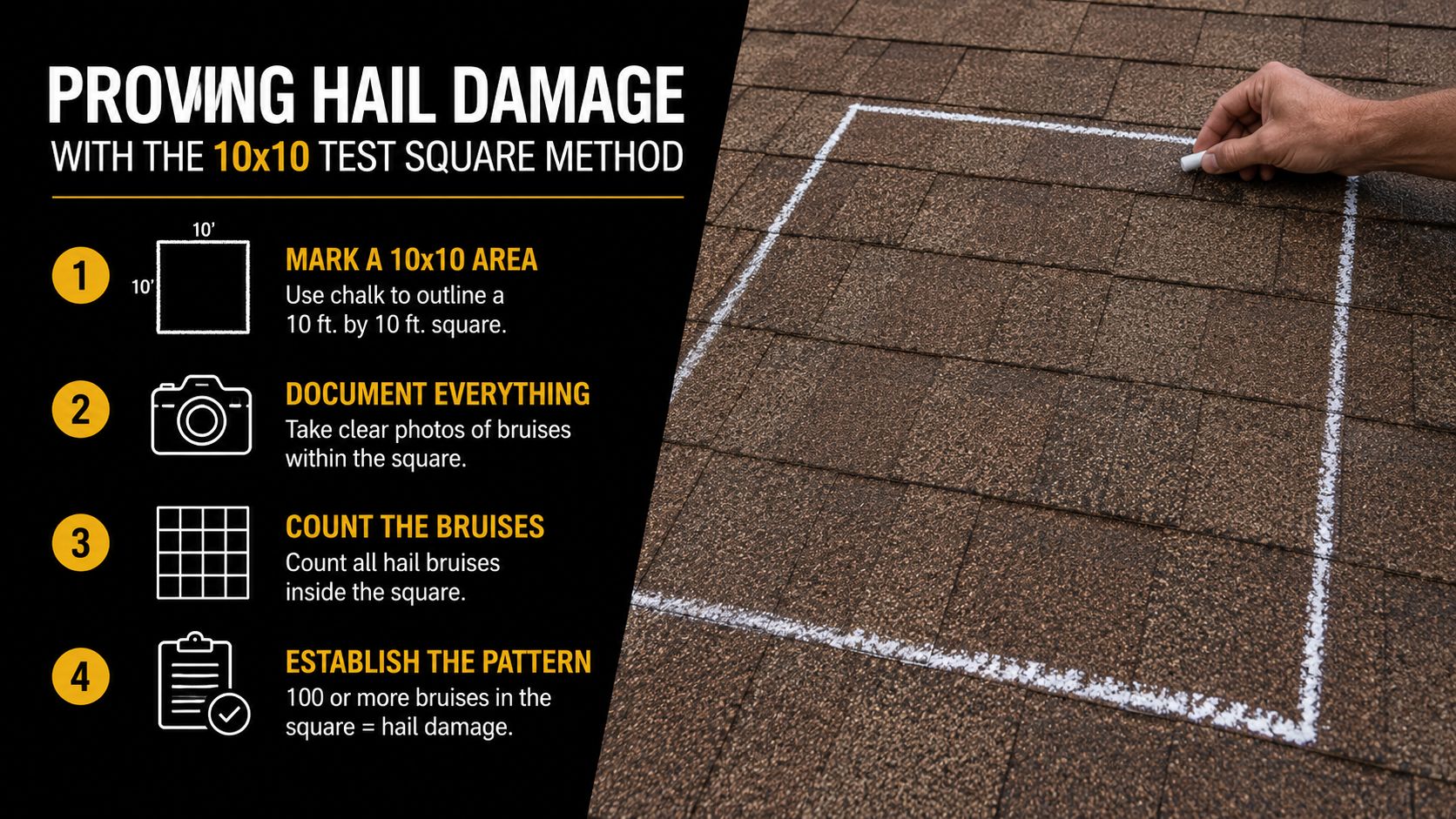
A systematic roof inspection gives a denied claim something a general walk-around often lacks: a repeatable sampling method. The widely used 10 by 10 foot test square covers 100 square feet. The inspector selects representative, unobstructed areas on each roof direction, counts qualifying hail impacts, and uses the findings to assess the broader slope. Haag describes this workflow in its test-square inspection method.
The method matters because hail marks can be subtle. Granule loss may blend into the shingle surface, while a bruised fiberglass mat may feel soft under hand pressure even when the top coating appears intact. The inspector should manipulate suspected areas carefully and distinguish impact damage from blistering, foot traffic, installation defects, weathering, and other conditions.
What a defensible inspection records
Start with the roof plan. Mark every slope, orientation, roof section, penetration, valley, ridge, and area blocked by equipment or access limitations. A test square placed only where the inspector can reach easily may not represent the roof. Document why each sample location was selected and whether any areas couldn't be examined.
Inside each square, record the type and location of each suspected impact. Useful descriptions include granule displacement, mat bruising, puncture, fracture, rupture, or coating damage. Photograph the whole square first, then the suspected hit in context, followed by a close-up with a coin or tape measure for scale. Your photographic documentation checklist should preserve original files and show the roof slope, not just isolated marks.
Collateral evidence can strengthen the causation analysis:
- Soft metals: Photograph dents on gutters, downspouts, flashing, ridge vents, and metal vents.
- Mechanical equipment: Inspect HVAC fins, covers, condenser components, and mounting points.
- Openings and attachments: Check skylights, window screens, solar panels, racking, and penetrations.
- Interior areas: Record ceiling staining, attic moisture, damaged insulation, and the path from roof to interior.
Don't overstate what a test square proves. It's evidence of distribution and condition, not a substitute for reading the policy. A strong report explains the sample locations, the observed impact characteristics, the collateral pattern, and any limitations.
Document as soon as safely possible after the storm. Claims guidance and forensic commentary emphasize preserving evidence within about 48 hours, because later weather and foot traffic can make impact marks harder to distinguish from ordinary aging. The earlier record may also establish what changed before temporary protection or repairs altered the roof.
Building Weather Evidence That Supports Your Claim
A roof report says what happened to the material. Weather evidence helps answer when and how the event occurred. Start with the loss date listed in your claim, but don't force the evidence to fit an uncertain date. If your notes, contractor, and weather records point to different events, resolve that conflict before submitting an appeal.
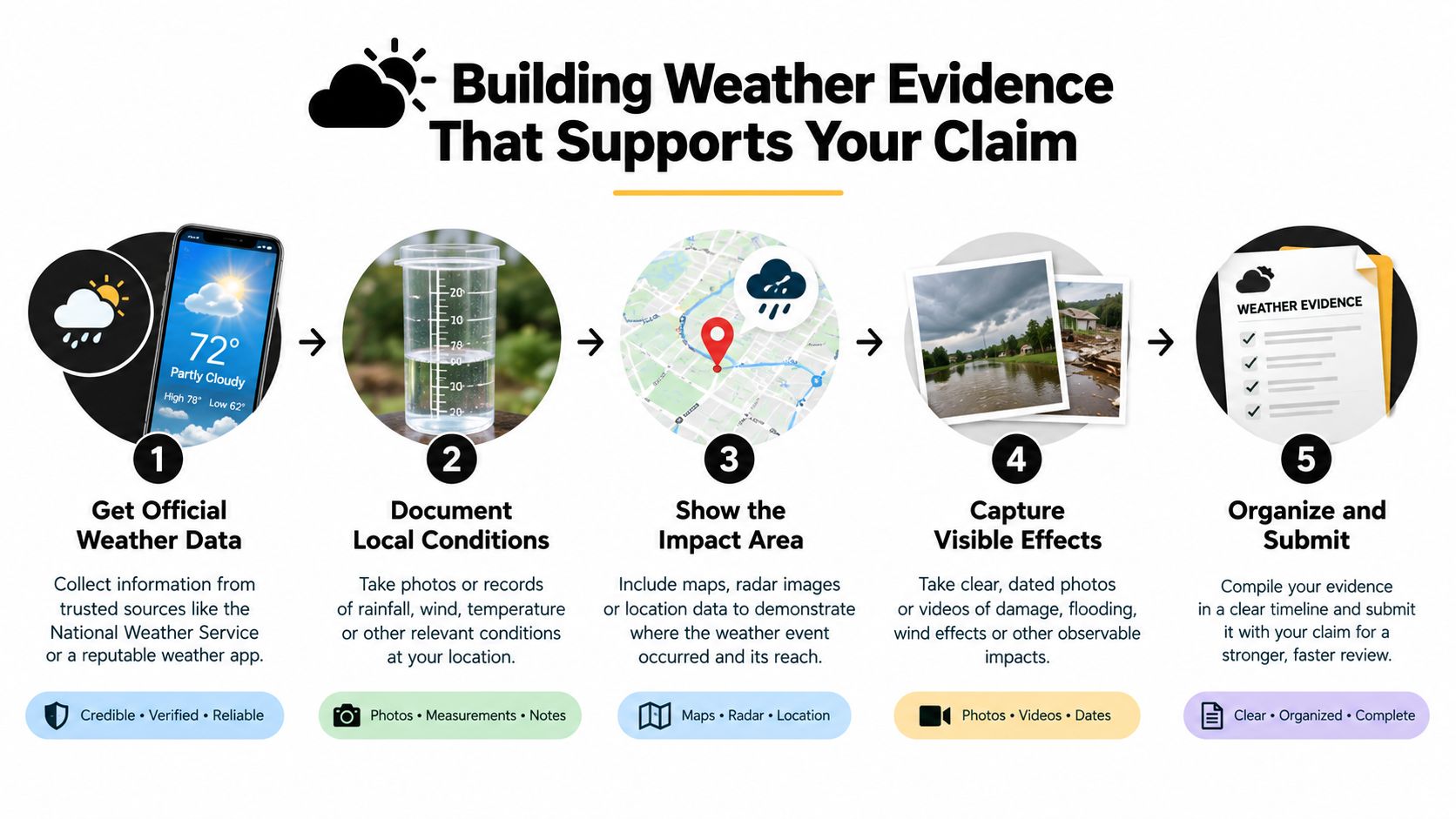
Use public weather resources to build a location-specific file. NOAA's Storm Events Database can help identify reported hail activity, while National Weather Service office records and archived radar products may provide additional context. Local radar, trained spotter reports, neighborhood weather logs, and time-stamped photographs can fill gaps between broad storm reports and your property.
Build the packet in a fixed order
First, preserve the original claim notice, policy period, adjuster correspondence, and all dates you gave the carrier. Next, collect weather records matching the date, approximate time, location, and reported hail characteristics. Then place the weather material beside the roof photographs, test-square report, collateral damage, and contractor or engineer findings.
The strongest packet is triangulated. A radar image alone doesn't show that your shingles were damaged. A roof photograph alone may not establish the storm date. Together, consistent weather records, physical impact patterns, and prompt observations can answer both parts of the causation question.
Carriers may challenge storm data by arguing that a report came from too far away, that hail direction doesn't match the observed marks, or that the reported hail wasn't large enough to cause the claimed condition. Address those objections directly. Identify the distance between the report and property, explain directional evidence from soft metals, and have the inspector describe why the material damage is consistent with impact rather than age.
Organize the records chronologically and label every photograph with its source and date. A property inspection checklist can help keep roof, interior, exterior, and equipment evidence from being separated into disconnected files.
Set aside a focused evidence-building period of roughly 7 to 14 days before sending the supplement, if the property is protected and no contractual deadline requires faster action. That gives you time to request missing records, reconcile dates, and obtain a report that answers the denial instead of merely disagreeing with it.
Choosing Between a Contractor, Roof Inspector, and Public Adjuster
The right professional depends on what the denial contests. A roofer may quickly identify repair needs, but a carrier may give more weight to a report that explains sampling, causation, policy language, and competing explanations. A public adjuster adds claim management and negotiation, but charges for representation and shouldn't be hired automatically for every small dispute.
| Professional | Typical Cost | Turnaround | Best For |
|---|---|---|---|
| Contractor | Free estimate or inspection arrangement varies | Often fast | Repair scope, materials, emergency protection |
| Independent roof inspector or forensic engineer | Cost varies by qualifications and assignment | Depends on availability and testing | Technical causation and rebuttal evidence |
| Public adjuster | Fee structure varies by agreement and applicable rules | Depends on claim complexity | Negotiation, supplements, valuation, and disputed scope |
Contractor
A reputable contractor can identify missing shingles, flashing issues, leaks, and repair requirements. That's useful, especially when the roof needs immediate protection or you're comparing the carrier's scope with the work required. For practical information about repair after a storm, look for guidance that separates emergency stabilization from permanent replacement.
The trade-off is advocacy and technical depth. A contractor's estimate may be repair-focused and may not address the insurer's weather theory, cosmetic exclusion, or age argument. Avoid contractors who promise coverage, ask you to sign an assignment without understanding it, or begin permanent work before evidence is preserved.
Independent inspector or engineer
An independent roof inspector with relevant forensic credentials can document test squares, distinguish impact from wear, inspect hidden areas, and explain why the observed condition is storm-related. This is often the most efficient response to a narrow “no hail damage” denial. Ask for a written report, photographs tied to roof locations, qualifications, methodology, and a clear discussion of alternative causes.
Public adjuster
A licensed public adjuster can review the policy and claim history, coordinate inspections, prepare a supplement, value covered damage, and communicate with the carrier. Representation is most useful when the dispute includes multiple systems, interior damage, business interruption, complex valuation, or repeated carrier inaction. Learn how the roles differ in public adjuster versus insurance adjuster before signing an agreement.
As a working rule, a limited cosmetic dispute may need a qualified independent inspection first. A full-roof denial, concealed damage, or multi-system claim usually benefits from coordinated technical and claim representation.
Writing the Supplement or Appeal That Actually Gets Reopened
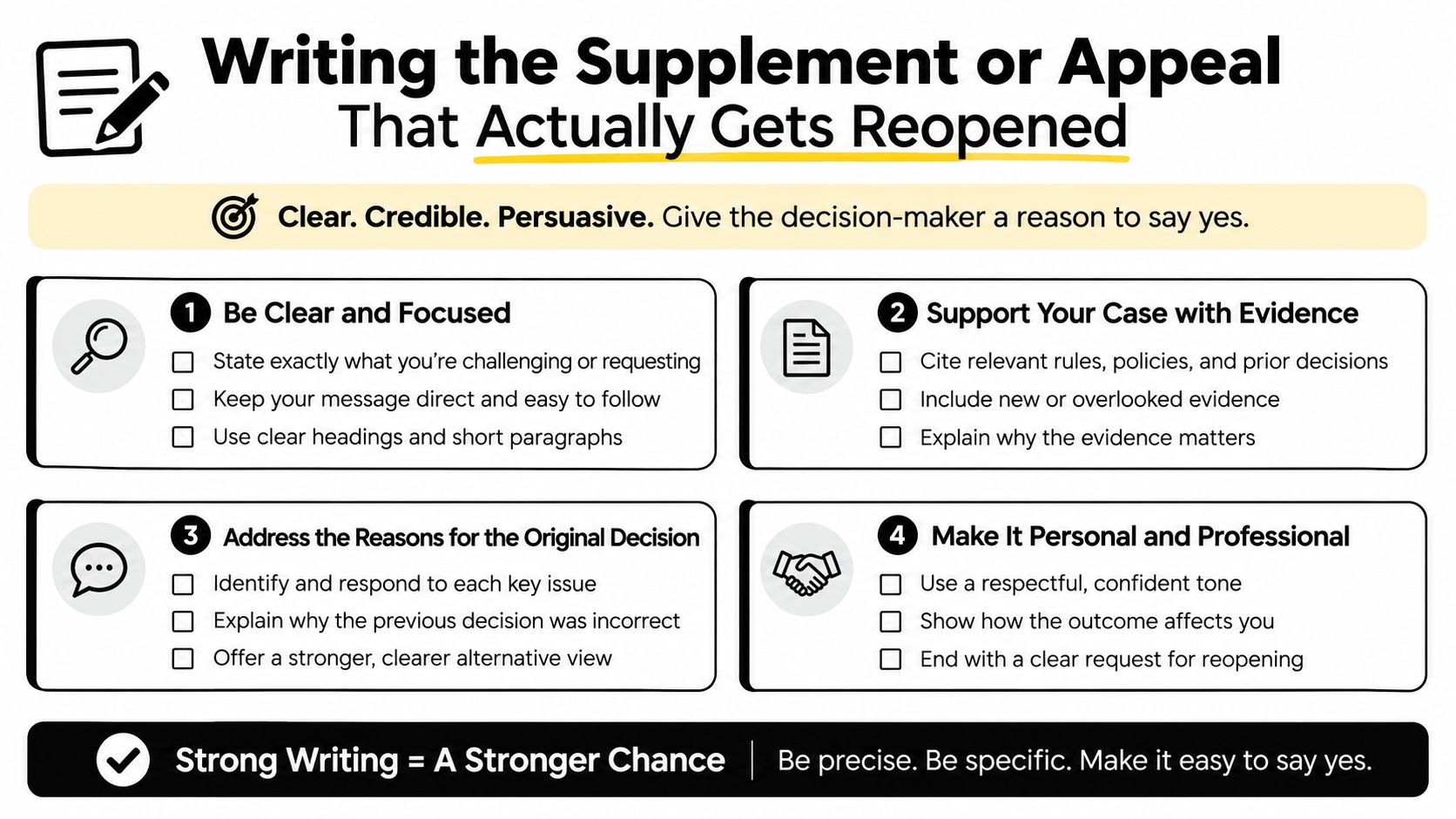
A supplement should read like a controlled rebuttal, not an angry letter. Put the claim number, property address, policy number, date of loss, and original denial date at the top. State the requested action clearly: reopen the claim, provide a reinspection, reconsider coverage, and issue a written response identifying any remaining disagreement.
Oregon and Washington policyholders can reference the states' unfair-claim-practice standards, including ORS 746.230 and RCW 48.30.010, while keeping the letter factual. Don't threaten a regulator or lawsuit before you've assembled the evidence. Cite the provisions accurately and explain how the carrier's investigation failed to address the submitted proof.
Use a packet order the reviewer can follow
Place the documents in this sequence:
- Cover letter: Identify the denial and state the requested resolution.
- Policy excerpts: Include the insuring agreement, exclusions, conditions, and relevant endorsements.
- Inspection report: Attach test-square results, slope diagrams, qualifications, and photographs.
- Weather verification: Include storm records tied to the reported loss date and location.
- Scope and estimate: Show each damaged component, required work, and supporting measurements.
- Line-item rebuttal: Answer every denial reason separately.
Sample language should stay precise:
“The attached inspection documents impact-related bruising and fractures on the north and west slopes, with corresponding collateral marks on exterior metal components. The findings are consistent with the reported storm and are not explained by ordinary surface wear alone.”
For a cosmetic argument, write: “The carrier's letter characterizes the observed condition as cosmetic but does not identify the applicable exclusion or explain how the documented damage affects the covered property under the policy. Please identify the exact provision relied upon and reconsider the scope in light of the attached findings.”
For a notice issue, avoid excuses unsupported by evidence. Explain when you discovered the condition, what emergency steps you took, when you notified the carrier, and why the timing did not prejudice the inspection. Attach emails, claim confirmations, photographs, and certified-mail receipts.
Request a joint reinspection with the original adjuster and a supervisor. Ask the carrier to identify the inspection guidelines applied and to provide written justification for any continuing denial. Oregon policyholders can review the framework associated with ORS 746.600, while Washington policyholders may reference WAC 284-30-330 as part of a careful, fact-specific correspondence.
Send the packet with delivery tracking and keep a claims log. A response request within 14 to 21 days creates a practical review point, though the policy and state requirements control actual deadlines. Record every call, name, promise, document request, and response. If the carrier doesn't reopen the file, that organized record becomes the foundation for regulatory review or legal advice.
Oregon and Washington Escalation and Next Legal Options
A state complaint can be useful when the carrier ignores evidence, fails to explain its position, or mishandles communication. It isn't a substitute for proving physical loss, and the regulator generally won't decide the value of a roof as a private appraiser would. The complaint works best when the file already contains the policy, denial, inspection report, weather verification, estimates, photographs, and a short chronology.
In Oregon, policyholders can contact the Division of Financial Regulation and use the applicable consumer complaint process, including Form 440-3872. Washington policyholders can submit a complaint to the Office of the Insurance Commissioner. Attach the written denial, your appeal, the carrier's response, relevant policy pages, inspection evidence, and delivery proof. Keep the submission focused on claim handling and unanswered evidence rather than broad accusations.
Choose the escalation that matches the dispute
Regulatory complaint: Use this when the insurer hasn't provided a coherent explanation, hasn't addressed submitted materials, or appears to be mishandling the investigation. The regulator can request a response and identify concerns, but it generally can't rewrite the policy or guarantee payment.
Mediation: Mediation can help when both sides understand the evidence but disagree over causation, scope, or valuation. It depends on willingness to participate and the options available under the policy or applicable program.
Appraisal or similar valuation process: This may fit a dispute over the amount of loss when coverage is not the central issue. It usually won't decide whether the policy covers excluded wear, cosmetic damage, or an unproven storm event.
Attorney review: Consult a policyholder attorney when the carrier maintains a denial after a strong technical appeal, raises a suit limitation defense, alleges fraud, threatens litigation, or the claim involves substantial structural, interior, commercial, or third-party issues. A lawyer can analyze contract remedies, bad-faith theories, deadlines, and litigation risk.
Public adjusters and attorneys serve different functions. A public adjuster generally handles claim presentation, documentation, valuation, and negotiation. An attorney handles legal analysis, formal disputes, discovery, and court proceedings. Either professional should review the policy before promising a particular route.
Be careful with contractor arrangements. Oregon statutes, including ORS 725A, and Washington rules concerning contractor solicitation and settlement authority can affect how agreements are structured. Don't sign a document that gives a contractor control over insurance proceeds or settlement decisions without understanding the legal and financial consequences.
Small claims court may be too limited for a roof dispute involving expert causation testimony, policy interpretation, substantial replacement costs, or multiple damaged systems. Before filing, check the applicable jurisdiction, filing deadline, venue, damages limit, appraisal language, and contractual suit limitation. A claim that looks simple from the driveway can become technical once the carrier disputes storm date, material failure, or policy scope.
There isn't a reliable universal settlement increase or reversal rate to promise after a state complaint. Some files reopen when a missing inspection is corrected. Others remain denied because the evidence can't establish a covered event, the policy excludes the condition, or the contractual deadline controls. The rational stopping point comes after you've compared the likely recovery, expert and legal expense, time, stress, and strength of the policy argument.
If your insurance adjuster says no hail damage, don't replace the roof before preserving proof and don't spend on a generic second opinion that never answers the denial. Build the record in the order the carrier, regulator, mediator, or court will need to understand it: policy, storm, physical damage, scope, and a written response to every disputed point.
NW Claims Management reviews denied and underpaid property claims, documents visible and concealed storm damage, and prepares policyholders for carrier negotiations in Oregon and Washington. If your hail file has stalled, visit NW Claims Management to request a claim evaluation and discuss whether professional representation fits your evidence and policy.