Public adjusters commonly charge 5% to 15% of the insurance recovery, with the exact percentage varying by state, claim size, and complexity. The number matters, but the contract's definition of “recovery” matters just as much.
Your insurer's estimate is sitting on the kitchen counter. It covers the obvious roof and siding damage, yet your contractor says the money won't cover matching materials, code upgrades, debris removal, temporary housing, or the contents you lost. You're already deep into the claim, the carrier's representative has stopped returning calls, and a public adjuster offers to take over under a contingency fee arrangement.
That offer can be sensible. You won't pay an hourly bill while the claim is being investigated, and the adjuster's compensation depends on insurance money being recovered. But the fee may be calculated on the entire payment, not merely the amount added to the insurer's first estimate. That distinction can change your net recovery substantially.
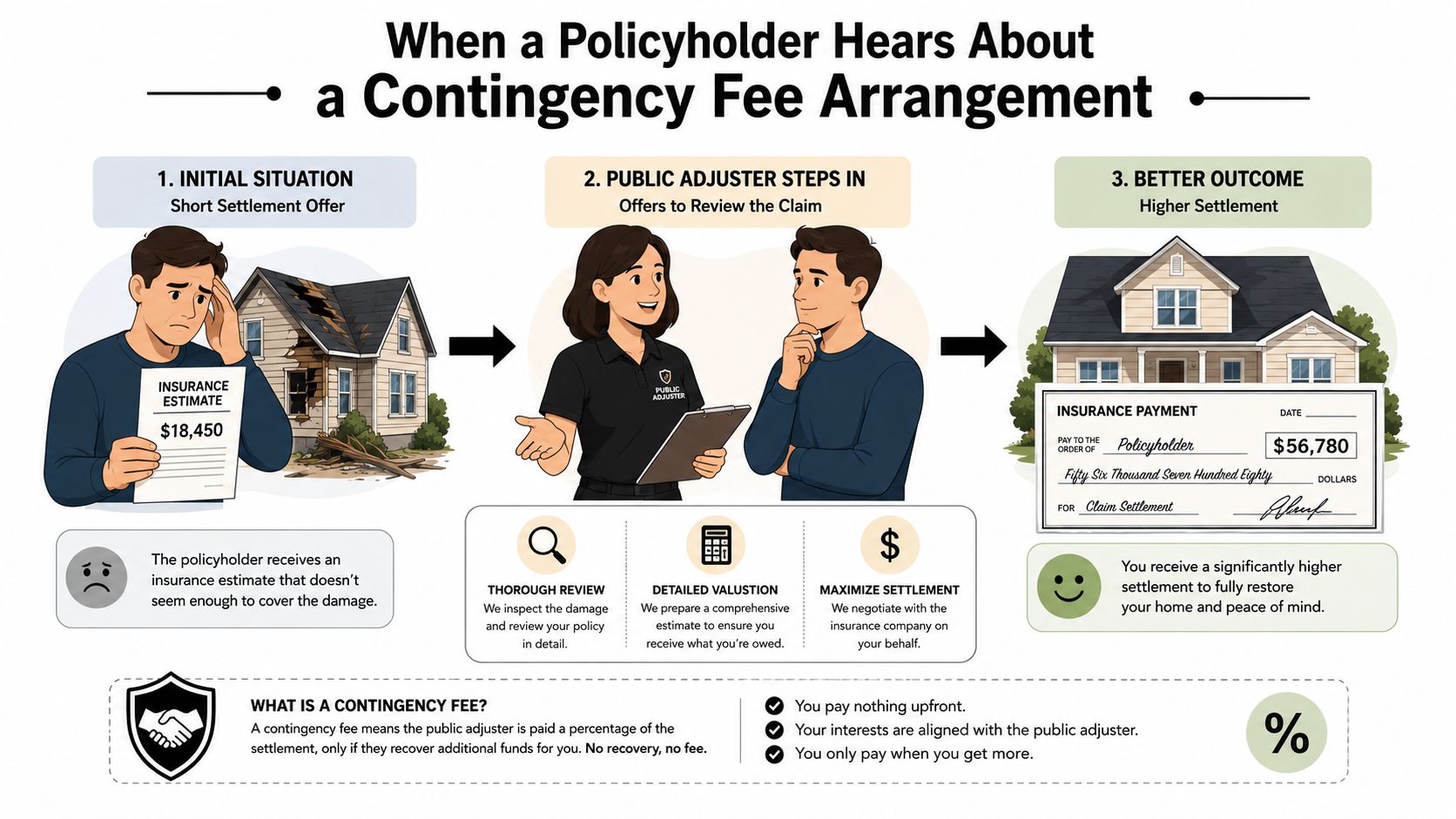
When a Policyholder Hears About a Contingency Fee Arrangement
A homeowner in Oregon receives an initial insurance estimate after a kitchen fire. The carrier has priced the visible smoke damage, but the contractor identifies hidden damage behind the cabinets and says current building requirements may require additional work. The estimate looks substantial until the homeowner compares it with the actual scope of repair.
A public adjuster reviews the file and proposes a 5% to 15% contingency fee, a commonly quoted range that varies with state rules, claim size, and complexity. Instead of paying hourly or handing over a flat retainer, the homeowner agrees that the adjuster will receive a percentage of insurance proceeds recovered through the claim. The arrangement can open the door to professional help when an upfront bill would prevent the homeowner from hiring anyone.
The percentage isn't the whole price
Suppose the insurer has already paid an undisputed amount. A contract charging a fee on all insurance proceeds treats that payment differently from a contract charging only on additional proceeds obtained. Two agreements can show the same percentage while producing very different fees.
Before signing, ask these questions in writing:
- Fee base: Is the percentage applied to the gross insurance payment, the additional amount recovered, or every later supplement?
- Expenses: Are appraisal, engineering, inspection, contents, or document costs included in the fee or reimbursed separately?
- Payment timing: Is the fee due only after the insurer delivers funds?
- No recovery: Does “no recovery, no fee” still allow separately listed costs?
- Termination: What happens if you cancel, change adjusters, or settle directly?
- Authority: Can the adjuster make settlement decisions, or do you retain final approval?
Homeowners who are still deciding whether professional help is appropriate can review this practical guide on when to hire a public adjuster. The right time usually depends on the claim's complexity, documentation burden, and the size of the gap between the policy and the carrier's estimate.
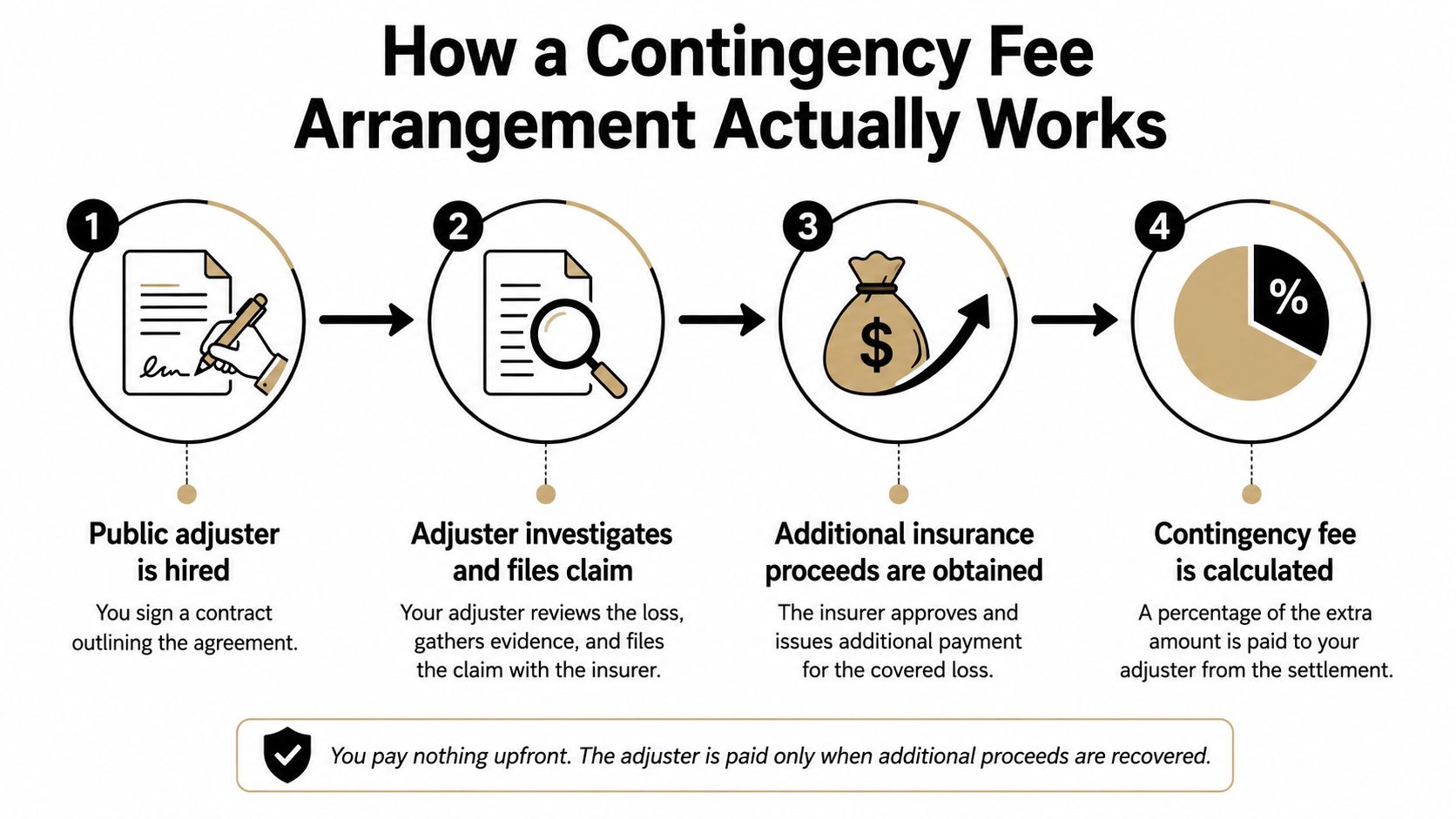
How a Contingency Fee Arrangement Actually Works
Think of the fee as a toll calculated against a clearly marked stretch of road. The contract must identify where that road starts and ends. “Recovery” might mean every dollar the insurer pays, or it might mean only the money obtained beyond the carrier's initial position.
The difference is easy to see:
- The insurer initially offers $180,000.
- The final recovery reaches $250,000.
- A 10% fee on the $70,000 increase equals $7,000.
- A 10% fee on the $250,000 final payment equals $25,000.
Those figures are arithmetic examples based on the stated claim amounts, not a prediction of what any particular adjuster will charge. The lesson is contractual: the denominator controls the economics.
Follow the money through the agreement
A sound contract should explain the sequence from claim work to final payment:
- The policyholder signs an agreement identifying the services and fee formula.
- The adjuster investigates damage, reviews policy language, builds the estimate, and presents supporting documentation.
- The insurer issues additional proceeds, a partial payment, or a negotiated settlement.
- The fee and approved expenses are calculated under the written formula.
Expenses require separate attention. A contract may allow reimbursement for an engineer, appraiser, inspection, copying, or other claim-related work. It should state whether those expenses are deducted before the fee, after the fee, or paid separately by the policyholder.
Practical rule: Never approve a percentage until you can calculate the expected net recovery from the contract language.
The same discipline applies when comparing public adjuster arrangements with legal representation. For a broader explanation of settlement deductions, how much lawyers take from settlement offers useful context, although attorney fees and public adjuster fees are governed by different agreements and rules.
Denials, partial settlements, cancellations, appraisal, and later supplements also belong in the contract. A policyholder researching the payment model can review how public adjusters get paid before accepting any verbal explanation that isn't reflected in the signed agreement.
Oregon and Washington Rules at a Glance
Oregon and Washington both permit public adjusters to use contingency-based compensation, but the rules aren't interchangeable. Oregon generally limits a public adjuster's fee to 10% of the total amount of the insurance claim payment required by the insurer to pay the insured, subject to statutory exceptions described in the applicable law and guidance. A higher percentage may be allowed in specifically defined situations involving appraisal, mediation, litigation, or similar escalation.
Washington generally caps compensation at 10% of the insurance claim payment, measured as a percentage of the total payment to the insured, again with limited statutory exceptions. Washington rules also generally restrict collection of the contingency fee until the insurer has delivered a claim payment, and the contract must contain required disclosures.
| Issue | Oregon | Washington |
|---|---|---|
| General fee limit | Generally 10% of the total claim payment, subject to exceptions | Generally 10% of the total claim payment, subject to exceptions |
| Possible higher fee | May apply in specified appraisal, mediation, lawsuit, or litigation circumstances | Limited statutory exceptions may apply |
| Written agreement | Should identify services, compensation, and relevant conditions | Must contain required disclosures and compensation terms |
| Payment timing | Follow the contract and current state requirements | Contingency fee generally may not be collected until payment is delivered |
| Dual compensation | A public adjuster may not negotiate or receive compensation from both sides on the same claim | The same prohibition applies |
| Legal work | Public adjusters cannot provide legal representation | Public adjusters cannot provide legal representation |
Because licensing status is central to compliance, use a documented process for verifying a licensed public adjuster. Ask for the license information, the complete agreement, and a written explanation of any claimed exception to the general cap.
The safest approach is state-specific review before signature. Rules and administrative guidance can change, and a contract that looks familiar may still use an impermissible fee, disclosure, or authority provision.
Sample Contract Clauses Worth Recognizing
A policyholder shouldn't judge a contingency fee arrangement by its headline percentage alone. Read the operative clauses, especially the words that define gross proceeds, additional proceeds, expenses, and termination.
The fee clause
A contract might say:
“The Public Adjuster shall receive a fee equal to ten percent (10%) of the gross insurance proceeds recovered.”
That wording applies to gross proceeds unless another provision narrows it. A more policyholder-friendly alternative might define the fee as a percentage of additional proceeds obtained after the carrier's documented initial position. The contract should also explain whether later supplements, withheld depreciation, contents payments, and code-related coverage fall inside the fee base.
The service and expense clauses
Look for language identifying what the adjuster will do. The scope might include inspection, damage documentation, estimate preparation, policy analysis, communications with the carrier, and settlement negotiation. If the agreement promises only general assistance, you may have difficulty proving what work the fee covers.
Expenses should be separate and specific:
“Approved third-party claim expenses shall be reimbursed from the recovery only as listed in an attached schedule.”
Ask who selects the engineer or appraiser, who approves the expense, and whether the cost is deducted before or after the adjuster's percentage.
A clear navigation process also helps policyholders understand documentation and claim authority. Lighthouse Consultants claim navigation provides broader context on organizing insurance claim work, though your signed agreement remains controlling.
Cancellation and settlement-control clauses
Cancellation language may impose a fee if the policyholder ends the relationship before payment. Insist on a formula tied to actual recovery or documented work, not an open-ended claim against future insurance proceeds.
Finally, read assignment and subrogation provisions carefully. A policyholder should retain control over whether to accept a settlement and should understand whether the adjuster can sign documents, direct payment, or assert rights against later proceeds. Review claim assignment language before allowing anyone else to control the claim.
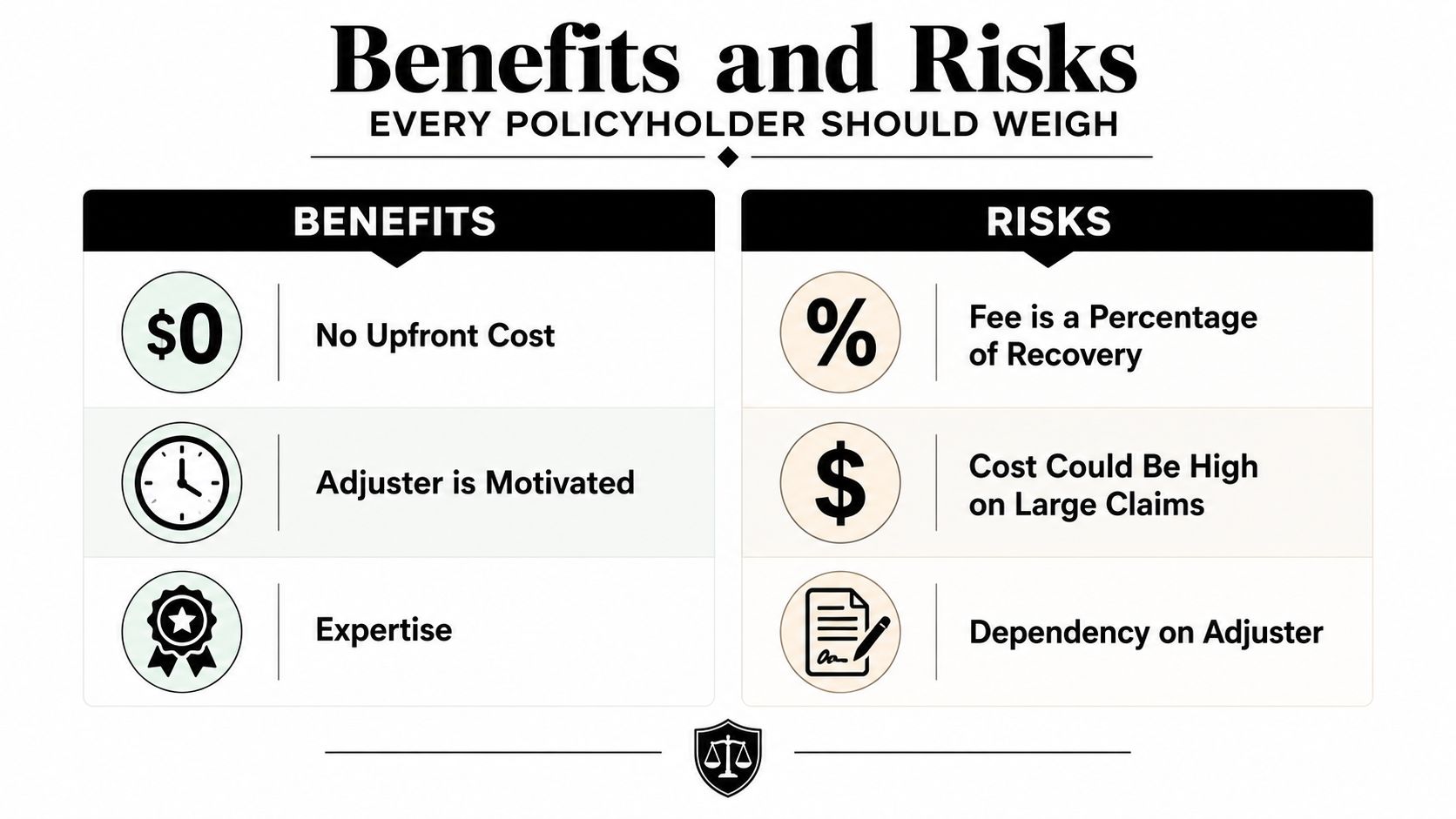
Benefits and Risks Every Policyholder Should Weigh
A contingency fee arrangement can be practical, but it isn't automatically fair. The table below puts the trade-offs beside one another using situations common in Oregon and Washington property claims.
| Benefits | Risks |
|---|---|
| No upfront professional fee: A homeowner dealing with fire damage can obtain claim assistance without paying an hourly bill while the estimate is rebuilt. | The fee reduces the net recovery: A percentage of a large payment can represent a meaningful cost even when the final settlement is strong. |
| Outcome-based compensation: The adjuster has a financial reason to document overlooked damage and pursue available policy benefits. | Gross versus increase confusion: A fee on the entire payment can cost much more than the same percentage applied only to additional proceeds. |
| Time and expertise: A business owner facing a storm loss can delegate inventory, estimates, and carrier communications. | Timing pressure: The adjuster may prefer a quick payment, while the policyholder may need more investigation before settling. |
| A professional advocate: A homeowner who feels outmatched by the insurer's claims team gains someone familiar with scopes, estimates, and policy provisions. | Switching friction: A cancellation clause may create a dispute over fees if the policyholder changes representatives mid-claim. |
| Payment tied to recovery: If the contract truly requires recovery before the fee is earned, the arrangement shifts some financial risk away from the policyholder. | Supplement exposure: A later payment may still trigger a fee if the agreement covers future supplements or proceeds. |
The incentive works best when the fee formula rewards quality and completeness, not merely closure. Ask for status updates, a written claim scope, and a clear explanation of unresolved coverage issues.
A fair arrangement leaves the policyholder with a better informed decision, not just a larger gross check.
When the Incentive Stops Being Aligned
A contingency fee arrangement can align the adjuster with the policyholder on the size of the recovery while leaving timing unresolved. The adjuster needs a successful result, but the policyholder may need a slower investigation, additional testing, or a stronger negotiation position before accepting money.
Consider a Vancouver-area fire claim where an early $180,000 settlement leaves $40,000 in code-upgrade coverage untouched. Those amounts are illustrative claim examples, not verified case outcomes. The concern is straightforward: accepting the first workable payment may close the file before the policyholder understands every available benefit.
A Portland water-loss example raises the opposite question. An early $240,000 offer is eventually replaced by a $310,000 resolution after four months. Again, this is an illustration of the timing problem, not a reported case study. Waiting can produce a stronger outcome, but only when the additional recovery justifies the delay, documentation, and risk.
Three checks before accepting a settlement
- Ask about supplemental payments: Require the adjuster to explain whether future supplements carry the same fee and how new damage will be handled.
- Request the carrier's last position: Get the insurer's offer, estimate, and unresolved-item list in writing before discussing settlement authority.
- Set a walk-away threshold: Negotiate a minimum recovery or cancellation provision under which you can end the relationship without owing a fee unrelated to actual proceeds.
The point isn't that public adjusters are dishonest. It's that compensation design influences behavior, and a policyholder should protect against speed becoming more important than completeness.
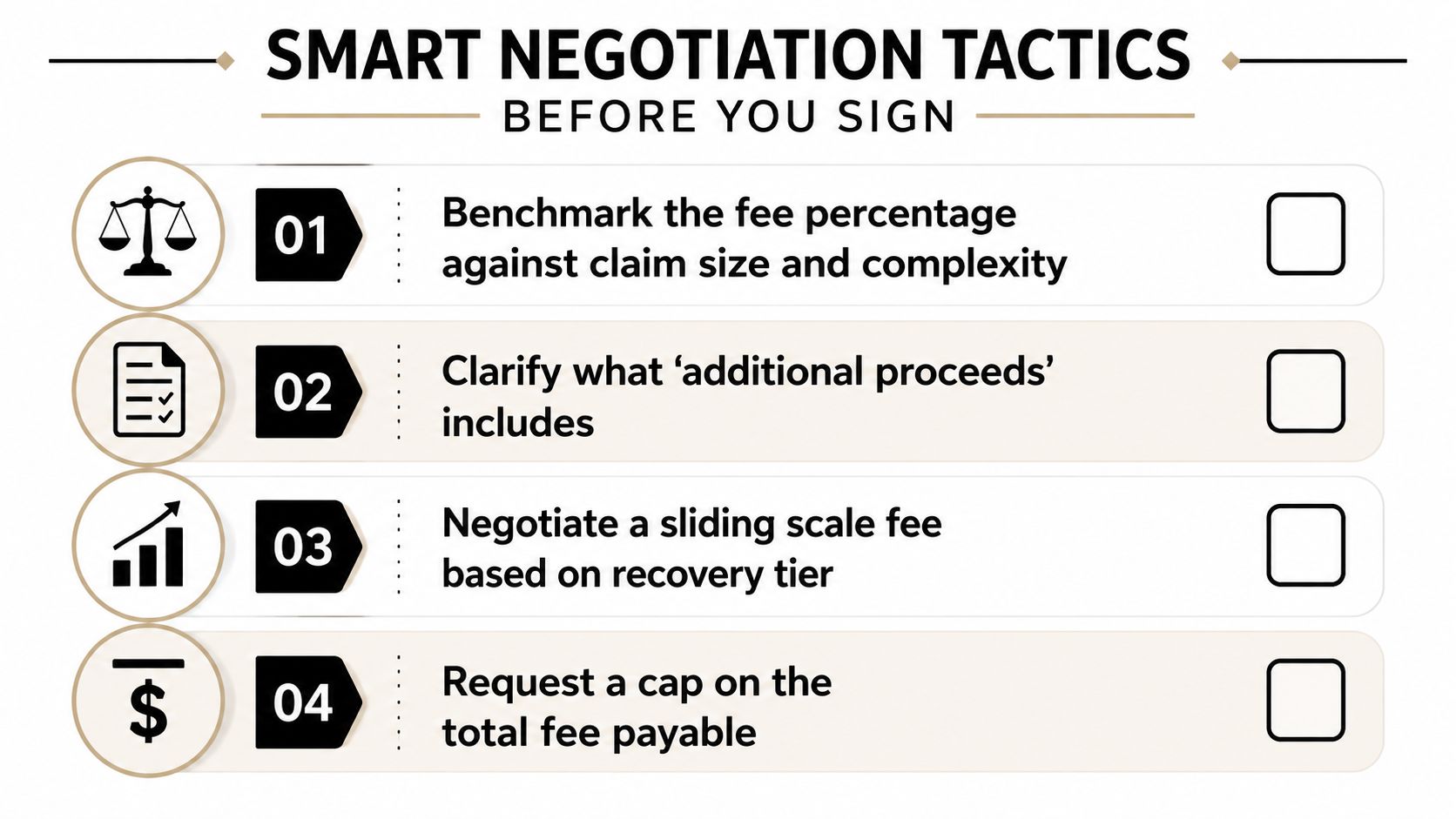
Smart Negotiation Tactics Before You Sign
Treat the contract meeting as a negotiation, not a formality. A public adjuster who won't explain the fee base, expense sequence, or termination terms before signature won't become clearer after the claim becomes contentious.
Start by benchmarking the percentage against the work involved. A modest, well-documented loss may not justify the same rate as a fire, flood, commercial interruption, or disputed valuation claim. Claim size matters too. Smaller claims can support a lower percentage because the adjuster's fee can otherwise consume too much of the recovery.
Separate compensation from expenses. Appraisal or engineering work may be necessary, but the contract should identify the vendor, approval process, reimbursement method, and deduction sequence. Don't accept a vague “costs included” provision that leaves you unable to calculate your net payment.
Terms worth requesting
- Sliding scale: Ask for a lower percentage as the recovery increases, rather than one rate across the entire claim.
- Fee cap: Request a maximum total fee, especially when the contract applies to gross proceeds.
- Increase-based calculation: Propose that the fee apply only to additional proceeds obtained after the carrier's initial written position.
- Supplement clarity: State whether later payments for code, contents, living expenses, or depreciation are included.
- Termination protection: Require a written formula explaining what is owed if you cancel before recovery.
Use a direct counteroffer:
“I'm willing to use a contingency fee arrangement, but the fee must apply to additional proceeds beyond the carrier's written estimate. I also want expenses listed separately, a lower rate for higher recoveries, and no fee if I terminate before any recovery is obtained.”
Walk away if the adjuster refuses to identify the fee base, won't provide a complete contract, claims an exception without documenting it, or demands settlement authority you don't understand. Before initialing, check the license, fee percentage, recovery definition, expense sequence, and cancellation language. You can also compare the structure with this overview of public adjuster cost.
Quick Answers and Your Next Step
Can I negotiate a contingency fee?
Yes. The percentage, fee base, expense treatment, sliding scale, cap, and termination language can all be discussed before signing. Oregon and Washington impose rules that may limit the final structure, so a negotiated term still has to comply with the applicable state requirements.
What happens if the insurer pays nothing?
The agreement should say whether no recovery means no professional fee. Read the expenses clause separately, because “no recovery, no fee” may still leave the policyholder responsible for listed third-party costs.
Can a public adjuster work with my attorney?
Usually, the roles must remain distinct. A public adjuster can assist with property claim presentation and negotiation, but cannot provide legal representation. Ask both professionals who controls settlement decisions, how communications will be coordinated, and whether either agreement creates a fee claim against the same proceeds.
Can the adjuster recover case expenses?
Possibly, if the contract permits it. Appraisal, engineering, inspection, and similar expenses should be identified clearly, with the responsible party, approval requirement, and deduction timing stated in writing.
How are payments reported for tax purposes?
Don't rely on the adjuster's contract to answer tax questions. Insurance proceeds, repairs, business losses, and professional fees can receive different tax treatment, so ask a qualified tax professional to review the payment and expense records for your specific situation.
Is a contingency fee always the right choice?
No. It can make sense when the claim is complex, the carrier's estimate is incomplete, or the policyholder can't manage the documentation and negotiation. It may be less attractive when the claim is already well supported and the contract charges a percentage on money the insurer was going to pay anyway.
The best agreement improves the net recovery, not merely the gross settlement. Before signing, confirm the fee denominator, identify every reimbursable expense, preserve your settlement authority, verify the adjuster's license, and get disputed terms changed in writing.
If you're in Oregon or Washington and want a no-cost way to test whether the proposed percentage is justified, request a free claim evaluation before signing. NW Claims Management reviews the claim scope, policy issues, and contingency fee terms so you can compare the likely benefit with the actual cost. Visit NW Claims Management to discuss your property loss and the arrangement in plain language.