Oregon and Washington law generally require property insurers to pay valid claims within 60 days of receiving acceptable written proof of loss, and late payments can trigger interest under state statute. If your claim has already crossed that line, the issue isn't just frustration anymore, it's a timing problem with legal consequences.
A storm rolls through Portland, or a fire damages a home outside Seattle, and the first few days feel manageable. You file the claim, send photos, answer the adjuster's questions, then the weeks start stacking up. A payment that looked close suddenly turns into silence, and that's usually when homeowners start wondering whether the insurer is stalling or whether the claim is still moving through a normal process.
The answer is usually tied to the time payment of claims provision, not to the date you first reported the loss. The policyholder's real advantage often depends on when the insurer received a complete proof of loss, whether the carrier had a lawful reason to keep investigating, and what remedy applies if the deadline passed. For a plain-language walkthrough of the claim sequence, many homeowners find it useful to review a claim process guide like claims help for Phoenix homeowners alongside their own file and then compare it with their insurer's written timeline. If you want the process mapped step by step, the claim handling outline at this claim processing guide is a helpful reference point.
Why Your Insurance Claim Is Taking So Long
A homeowner can do everything right and still feel stuck. The roof leaks after a windstorm, the kitchen needs smoke cleanup, the insurer opens the file, and then nothing seems to happen except requests for one more document, one more inspection, one more estimate. In that situation, the delay can feel personal, but it usually comes from the claim system itself.
The time payment of claims provision exists to stop payment from drifting forever. It turns a vague promise to handle claims fairly into a deadline that depends on a specific event, usually the insurer's receipt of a proper proof of loss. That matters because a claim isn't just “filed” when you call it in. The clock often starts only when the insurer has the paperwork it says it needs.
Why timing matters more than most people think
A delayed claim can create real pressure fast. Mortgage payments still come due, contractors want deposits, and temporary repairs can't wait indefinitely. Once the claim crosses from ordinary handling into late-payment territory, the policyholder is no longer just asking for service, they're dealing with a legal compliance issue.
Practical rule: if the carrier keeps asking for documents, ask in writing whether your proof of loss is now considered complete and accepted.
That one question matters because it tells you whether the payment clock has started. It also helps you separate a legitimate investigation from avoidable delay. If you're trying to understand where your file sits, keep every email, letter, and notes from every phone call, then line them up against the policy language and the insurer's own deadlines.
For many homeowners, that's the first moment the process becomes clearer. The claim may not be “stuck” in the abstract. It may be waiting for a trigger event that the insurer has not yet acknowledged in writing.
What the Time Payment of Claims Provision Actually Is
The time payment of claims provision is a prompt-payment rule built into insurance contracts and backed by state law. In accident and health policies, it generally requires payment after the insurer receives written proof of loss, and periodic benefits are typically paid at least monthly. In many policy forms, there's also a common benchmark that allows up to a 60-day investigation window before payment becomes due, provided the insurer is still acting within the rules of that policy form and state law. The timing trigger, not the original claim notice, is what usually matters most. A claims timing overview explains that distinction clearly.
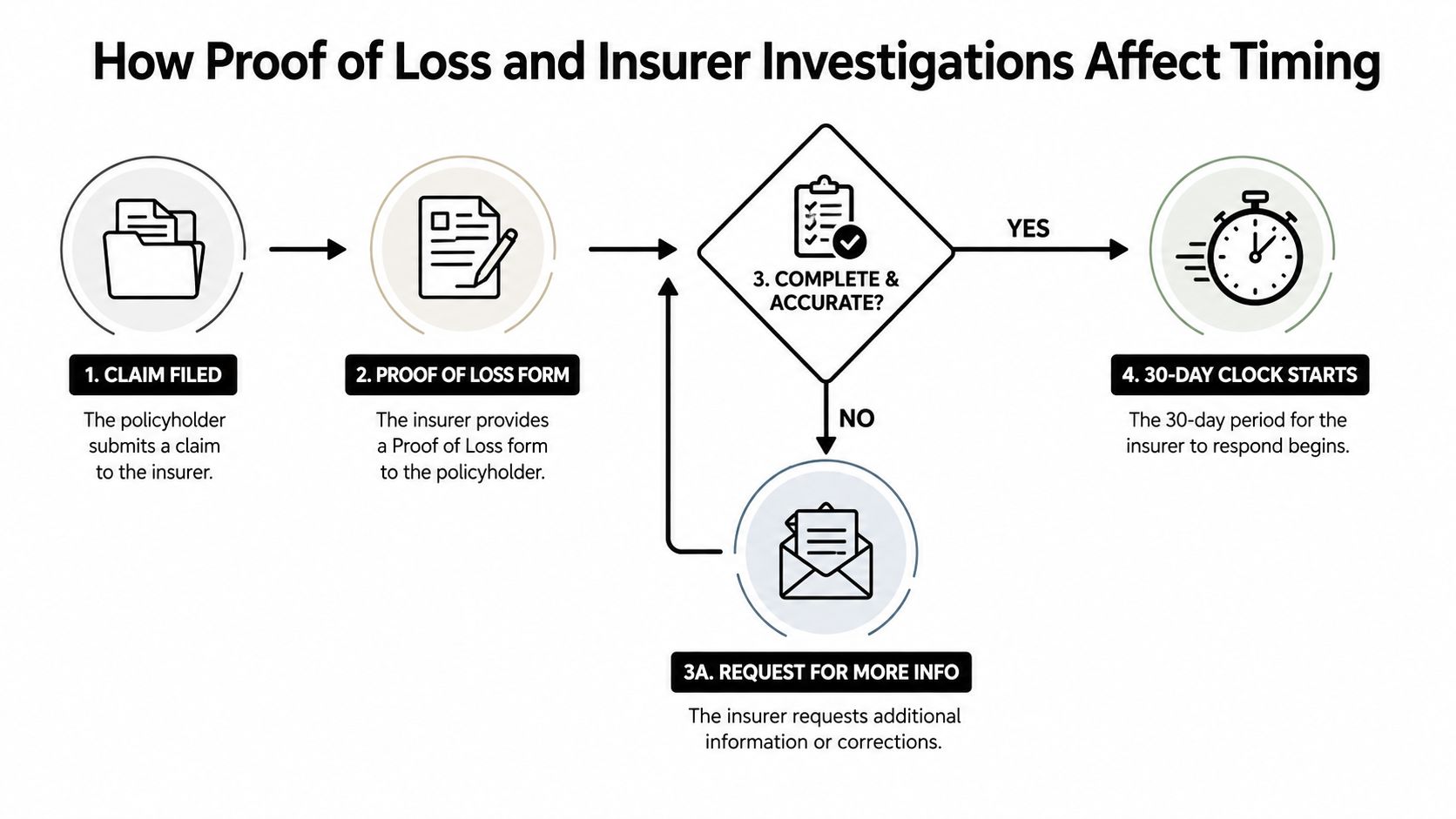
A stopwatch analogy is useful. Filing the claim starts the conversation, but the stopwatch often doesn't start until the insurer has everything it says it needs in the proof of loss. If the form is incomplete, missing documents can lawfully extend the timeline. If the proof is complete, the clock should start right away.
The trigger event controls the deadline
That trigger can be the source of a lot of confusion. A homeowner may believe, “I filed this weeks ago, so why haven't they paid?” The insurer may answer, “We still needed a completed proof of loss,” and in many disputes, that answer decides whether the delay is still permitted.
That's why it helps to treat the proof of loss as more than paperwork. It's the document that often changes the claim from an open file into a time-bound obligation. If you can show the insurer had a complete proof of loss on a certain date, you've usually pinned down the start of the payment clock.
For a helpful reminder of how payment and compensation issues are often framed in claim handling, this compensation payout guide can help you connect policy wording to the way insurers process money on a file.
Oregon and Washington Statutory Deadlines Explained
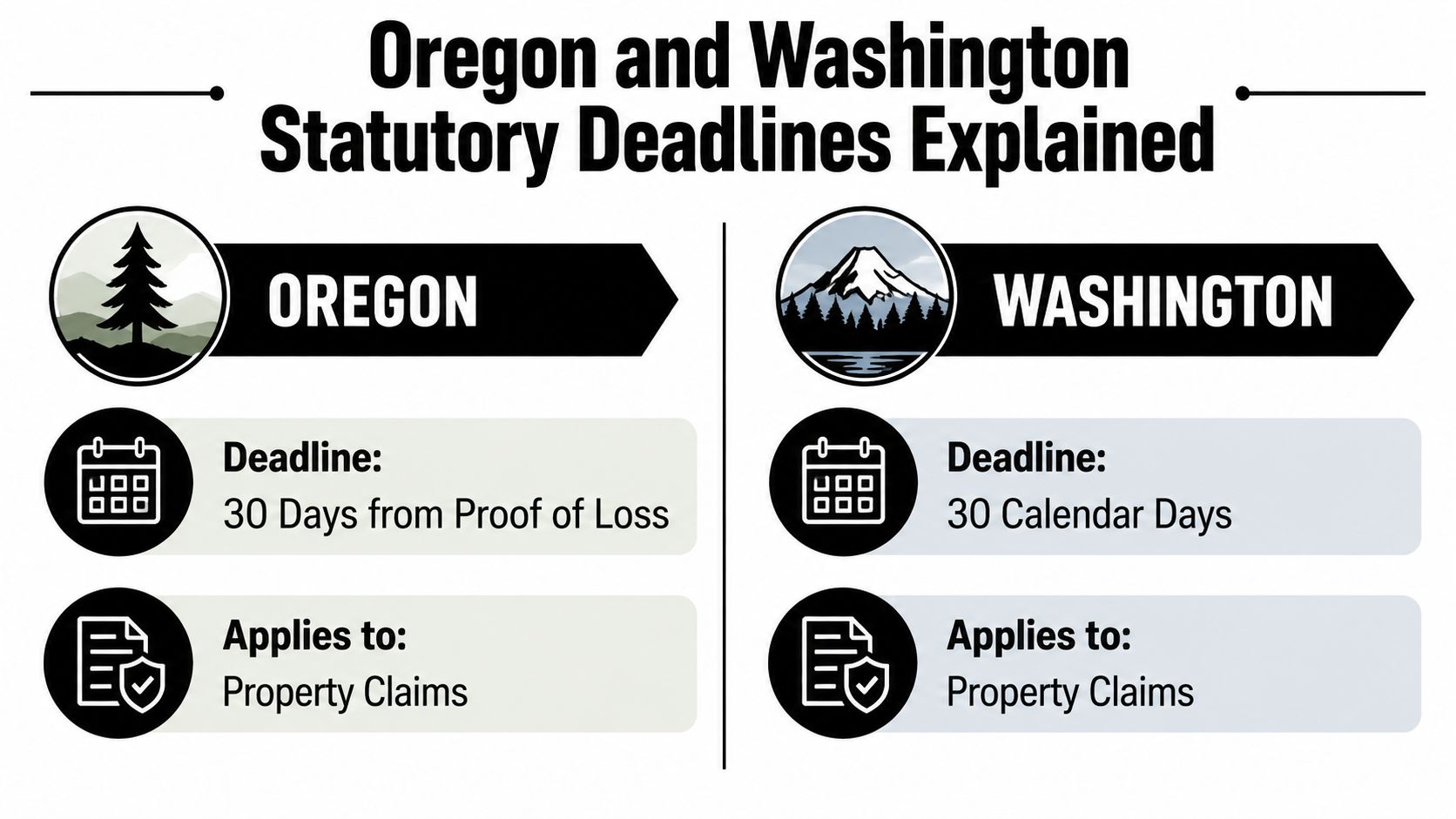
A homeowner in Oregon or Washington may think the question is simple, “How long do they have to pay me?” The answer depends on the claim's trigger point. In these states, the payment clock usually turns on a real event in the file, such as a complete proof of loss, claim acceptance, or the point at which the insurer finishes what it says it needs to investigate.
That detail matters because a claim can look stalled while the carrier says the clock has not started yet. If the proof of loss is incomplete, the insurer may argue that it still has no duty to pay. If the proof is complete and the claim has been accepted, the timing rules shift in the homeowner's favor.
| State | Deadline After Proof of Loss | Interest Penalty if Late |
|---|---|---|
| Oregon | 30 days from proof of loss for property claims, as reflected in the state-oriented comparison materials tied to claim timing rules | Interest may apply when payment is untimely under the governing statute and policy language |
| Washington | 30 calendar days in the state comparison materials for property claims | Interest or other remedies may apply depending on the claim handling posture and policy terms |
The wording matters more than the shortcut. A generic “30 to 60 days” description skips the core issue, which is whether the insurer's deadline starts when the loss is reported, when a proof of loss is received, or when the company says its review is finished. That is the difference between a file that is still being developed and one that is late.
For homeowners trying to track that trigger, what a proof of loss is and how it works can help separate the paperwork from the payment deadline. It is also smart to keep the insurer's acknowledgement letter, the proof-of-loss submission date, and any request for more information in one folder.
The broader pattern also shows why the trigger matters. Arizona's statute ties first-party timing to proof of loss and requires interest on untimely payment from the date the claim was received, while Florida's statute focuses on monthly payment after written proof of loss and payment as soon as proper proof is received (Arizona statutory timing rule, Florida insurance timing language). Oregon and Washington use their own timing rules, but the lesson is the same. The clock depends on the event that starts it, not on the insurer's preferred pace.
The clock starts when proof is complete, not when the loss is reported.
If the file is still moving back and forth, the carrier may say the deadline has not started. If the proof is complete and the claim has been accepted, the homeowner has a much stronger argument that the payment clock is already running. AMPM Restoration claim filing tips can also help homeowners see how clean documentation supports a faster claim review.
How Proof of Loss and Insurer Investigations Affect Timing
The proof of loss is the document that often decides whether the payment clock is running. If the insurer says the proof is incomplete, defective, or missing key support, the deadline can pause or fail to start at all. That's why so many homeowners feel a claim has “gone dark” when, legally, the carrier may be saying the file still isn't ready for payment.
Model-law materials show that timing rules vary widely, with deadlines ranging from 7 days after acceptance in some jurisdictions to 20 to 45 days for some electronic or clean claims in U.S. model-law charts, and up to 60 days in other contexts (NAIC model-law chart). That spread matters because it proves there isn't one universal clock. The deadline depends on the claim form, the trigger event, and whether the insurer can lawfully keep investigating.
How insurers extend the timeline
Insurers often need more than a single form to pay a property claim. They may want photos, repair estimates, inventories, cause-of-loss documentation, or proof of occupancy. If those materials are missing, the carrier can say the proof of loss isn't complete yet.
That's not always a delay tactic. Sometimes it's a legitimate request. The problem starts when the insurer never says, in writing, what is missing or whether the proof submitted has been accepted. A homeowner should not guess.
Ask for written confirmation that the proof of loss was received, and ask whether it is complete.
That one step helps you lock in the timing issue. If the carrier accepts the proof, the payment clock should be visible. If it rejects the proof, the insurer should be able to explain why. Without that clarity, policyholders are left arguing about dates instead of working toward payment.
For claim preparation help, these claim filing tips are useful because they reinforce the discipline of documenting damage early and keeping the record clean. If you want to understand the proof form itself, this proof-of-loss overview is a practical companion.
Remedies When Insurers Miss the Deadline
A late claim changes the task. The question is no longer only whether the insurer will pay, it is what the policyholder can do when the carrier lets the clock run past the deadline. The first remedy is often statutory interest, which gives the delay a dollar cost. Under Arizona's timing rule, untimely first-party payment can trigger interest at the legal rate from the date the claim was received under the state's timing provision.
That matters because the late-payment issue stops being abstract. The insurer may still owe the claim amount, but it can also owe more because it did not pay on time. Some states build that result directly into the claims statute. Other states leave more room for complaint escalation, interest arguments, or bad-faith claims, depending on the facts and the law that applies.
A homeowner should keep the response simple and in writing.
- Ask for the deadline in writing. Request the exact date the proof of loss was received and ask whether the carrier considers it complete.
- Request statutory interest if your state allows it. Tie the request to the due date and ask the insurer to show its calculation.
- File a complaint with the department of insurance. A formal complaint creates a record that the file missed timing or stalled without a clear explanation.
- Keep evidence of the delay. Save letters, voicemail logs, estimates, photos, and every request for more information in one place.
Insurers sometimes describe a late file as a small paperwork issue. Policyholders should treat it as a recordkeeping issue. The cleaner the paper trail, the easier it is to show when the carrier had enough information to pay and still did not do it.
A denial or partial denial letter often reveals the core issue. How to read a claim denial letter helps you view that document as part of the claim file, not as the final word. That matters because timing disputes and coverage disputes often appear in the same letter.
When to Hire a Public Adjuster Like NW Claims Management
A claim can reach the point where the paperwork, the timeline, and the policy language all need a second set of eyes. That's usually when a public adjuster makes sense. A public adjuster works for the policyholder, not the insurer, and helps document loss, interpret policy language, evaluate damage, and negotiate the settlement.
The clearest sign you need help is a claim that has stalled past the expected deadline without a clean explanation. Another sign is a dispute over whether the proof of loss was complete in the first place. Low settlement offers can also point to a timing problem, especially when the insurer seems to be moving quickly to close the file but slowly to pay it.
Situations that justify bringing in help
Not every claim needs outside representation, but some do.
- The file has been idle past the deadline. If the insurer has had complete documentation for a while and still hasn't paid, the timing issue is no longer minor.
- The carrier keeps questioning completeness. Repeated requests for the same information often mean the process needs tighter documentation.
- The loss is complex. Fire, flood, storm, vandalism, commercial losses, nonprofit properties, and municipal claims all tend to generate more moving parts.
- The settlement doesn't match the damage record. If the estimate ignores visible damage or policy benefits, the claim may need professional negotiation.
Public adjusters also help homeowners stay organized. They build the claim file, track deadlines, and translate the policy into terms that are easier to use in a dispute. That can be especially important when the insurer's position hinges on whether the proof of loss started the clock or whether the investigation lawfully paused it.
NW Claims Management is a licensed public adjusting firm based in Portland, Oregon, serving property owners across Oregon and Washington through its licensed public adjuster services. For homeowners and property owners who are tired of guessing where the claim stands, that kind of representation can turn a confusing delay into a documented case.
Key Takeaways and Next Steps
The time payment of claims provision matters because it changes late payment from a customer-service complaint into a measurable deadline problem. For Oregon and Washington policyholders, the key issue is not just whether the insurer owes money, but whether the insurer has already received a complete proof of loss that started the clock. If the deadline passed, interest and other remedies may come into play.
The practical checklist is simple. Confirm the proof-of-loss date, keep the insurer's written acknowledgements, compare the file to the state deadline, and document every request for more information. If the claim is stalled, the timing issue should be addressed before the file drifts further.
The claim clock only helps you if you know when it started.
If your claim is delayed, don't keep waiting in the dark. Review your dates, save every document, and take the next step before the insurer controls the whole timeline.
NW Claims Management helps Oregon and Washington property owners document losses, challenge stalled claims, and push for timely payment when the insurer drags out the process. If your claim is tied up around proof of loss, investigation delays, or a missed payment deadline, visit NW Claims Management to schedule a free evaluation and get clear guidance on what to do next.