You've just received your insurance settlement letter after a windstorm, roof leak, fire, or other property loss. The document lists an RCV amount, an ACV payment, and recoverable depreciation, but the check in your hands is much smaller than the repair estimate. You're left wondering whether the insurer has underpaid you or whether this is how the claim works.
For homeowners and business owners in Oregon and Washington, RCV and ACV determine whether depreciation remains your responsibility or can be recovered after repairs. The difference affects your immediate cash flow, contractor negotiations, and final settlement. The terms may look like accounting language, but they control the money available to restore your property.
Why Your Insurance Settlement Letter Mentions RCV and ACV
A homeowner in Portland might receive a settlement letter showing a roof replacement at current repair cost, followed by a separate line for depreciation and a much smaller initial payment. A Seattle property owner dealing with water damage may see the same structure on a contents or building estimate. The letter can look contradictory because the insurer acknowledges the full repair cost while initially paying only a portion of it.
That confusion is understandable. You're already dealing with damaged rooms, contractors, temporary living arrangements, business interruption, or urgent safety work. Then the claim paperwork introduces Replacement Cost Value, Actual Cash Value, deductible, and recoverable depreciation without explaining how those figures interact.

The two valuation paths
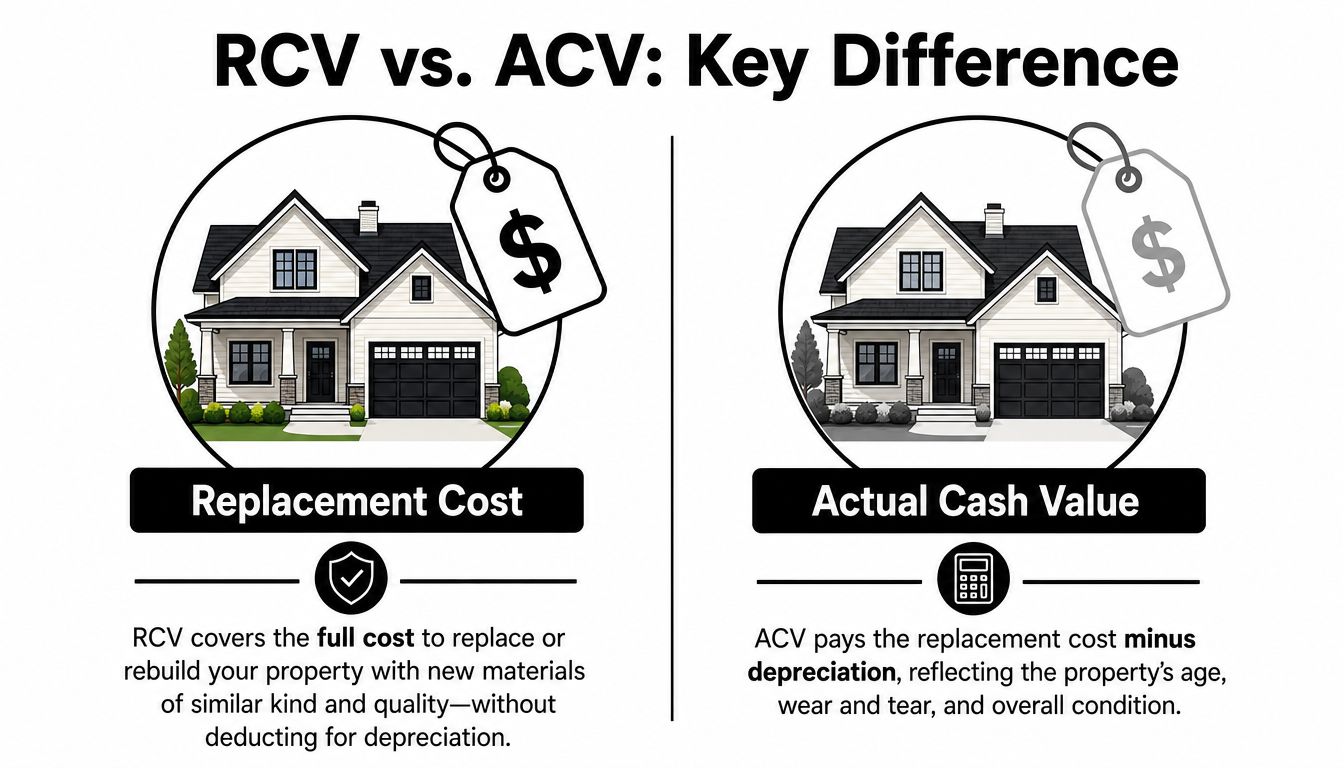
RCV represents the cost to repair or replace damaged property with materials of like kind and quality at today's prices, without subtracting depreciation. ACV uses that same replacement cost but subtracts depreciation for age, wear, condition, or obsolescence. The National Association of Insurance Commissioners explains the distinction between actual cash value coverage and replacement cost coverage, including the important point that replacement cost isn't the same as market value.
The settlement letter may therefore contain three separate figures:
- RCV estimate: The insurer's calculation of the current cost to complete covered repairs or replacement.
- ACV payment: The amount payable after depreciation has been deducted.
- Recoverable depreciation: The withheld amount that may become payable after you complete eligible repairs and provide the required proof.
A policy with RCV coverage often produces an initial ACV payment, followed by a second payment after repairs or replacement are documented. An ACV-only provision generally stops at the depreciated amount, subject to the policy and deductible.
What you should do before accepting the check
Don't treat the first payment as the final value of your claim. Compare the settlement letter with your policy declarations, coverage forms, contractor estimate, and photographs of the damage. A clear insurance claim estimate should identify the damaged items, quantities, materials, labor, depreciation, deductible, and payment status.
Your immediate objective is simple: determine whether the insurer calculated the right scope, applied reasonable depreciation, and followed the payment conditions in your policy. If any of those pieces are wrong, the first check may be only the beginning of the negotiation.
Replacement Cost Value vs Actual Cash Value Explained
The cleanest way to understand the difference is to separate cost of restoration from depreciated value.
Suppose a fifteen-year-old roof needs replacement. A comparable new roof costs what current contractors charge for materials and labor. Under RCV, the claim calculation targets that current replacement cost, subject to the policy's deductible, exclusions, limits, and repair requirements. Under ACV, the insurer subtracts the roof's lost value from age, use, condition, or obsolescence before calculating payment.
The North Carolina Department of Insurance describes ACV as the money needed to fix a home minus the decrease in value caused by age or use. It describes RCV as the amount needed to repair at today's building-supply prices or replace belongings at today's cost. That distinction is also addressed in practical loss valuation methods used to prepare property claims.
RCV vs ACV at a Glance
| Feature | RCV, Replacement Cost Value | ACV, Actual Cash Value |
|---|---|---|
| Basic calculation | Current cost to repair or replace with like kind and quality | Current replacement cost minus depreciation |
| Depreciation | Usually withheld initially and potentially recoverable after qualifying repairs | Deducted from the settlement and generally not returned |
| Payment timing | Often paid in stages, first ACV and later recoverable depreciation | Usually paid at the depreciated amount, subject to policy terms |
| Effect on restoration | Can provide fuller funding for covered restoration | Leaves the policyholder responsible for the depreciation gap |
| Policy wording | Requires compliance with repair, documentation, and timing conditions | May apply to specific property, roofs, contents, or entire claims |
| What it doesn't cover | Upgrades, excluded damage, or costs outside policy terms | The same exclusions and limits still apply |
RCV isn't a blank check
Policyholders sometimes hear “replacement cost” and assume the insurer must pay every contractor invoice. That's wrong. RCV remains controlled by the policy, including covered causes of loss, exclusions, limits, matching requirements, code provisions, deductibles, and documentation conditions.
The insurer also doesn't owe market value. Market value can include land and real-estate conditions, while RCV focuses on repair or replacement cost. If you're reviewing broader ownership expenses alongside claim planning, a resource covering average home insurance premiums can help separate ordinary policy costs from the valuation rules that apply after damage.
Read the endorsements, not just the declarations page. A property may have RCV for the structure but ACV for certain personal property or an older roof. The label on the policy summary doesn't answer every valuation question.
Sample Claim Calculations That Show the Real Dollar Difference
The math becomes easier once you isolate replacement cost, depreciation, and the deductible. Consider a roof with a current replacement cost of $10,000 and depreciation of 50%, using the example explained by the Texas Department of Insurance in its guidance on replacement cost and actual cash value.
ACV calculation
The replacement cost is $10,000. Depreciation at 50% equals $5,000, leaving an ACV of $5,000 before the deductible.
Using a $1,000 deductible for illustration:
- Replacement cost: $10,000
- Less depreciation: $5,000
- ACV before deductible: $5,000
- Less deductible: $1,000
- Net ACV payment: $4,000
Under an ACV provision, that may be the full claim payment for the roof, assuming the scope and coverage are otherwise accepted. Completing the work doesn't automatically create another payment because the policy has already valued the damaged component after depreciation.
RCV calculation
The same roof has the same replacement cost and depreciation. Under an RCV provision, the insurer may calculate the initial payment this way:
- Replacement cost: $10,000
- Less withheld depreciation: $5,000
- ACV payment before deductible: $5,000
- Less deductible: $1,000
- Initial payment: $4,000
After you complete the covered replacement and submit acceptable documentation, the insurer may release the $5,000 recoverable depreciation. The total insurance proceeds would then be:
- Initial payment: $4,000
- Recoverable depreciation: $5,000
- Total insurance proceeds: $9,000
The policyholder still absorbs the $1,000 deductible. The final recovery is also limited by the actual covered scope and the policy's conditions. If the work costs more because of upgrades, uncovered damage, or contractor errors, RCV doesn't automatically cover those additions.
Why the first check causes trouble
The initial RCV payment looks like an ACV settlement because it is based on the depreciated amount. That's why homeowners sometimes sign a contractor agreement, discover they need more cash than expected, and assume the insurer has denied replacement cost coverage.
The withheld amount is not available solely because the estimate lists it. You must satisfy the policy's recovery conditions. Keep a detailed replacement cost calculation and compare it with the insurer's estimate before work begins.
How the Two-Step RCV Payment Process Affects Your Cash Flow
The biggest practical problem with RCV claims is timing. The policy may promise recovery of current replacement cost, but the insurer often releases part of that value only after you complete repairs and prove what you paid.
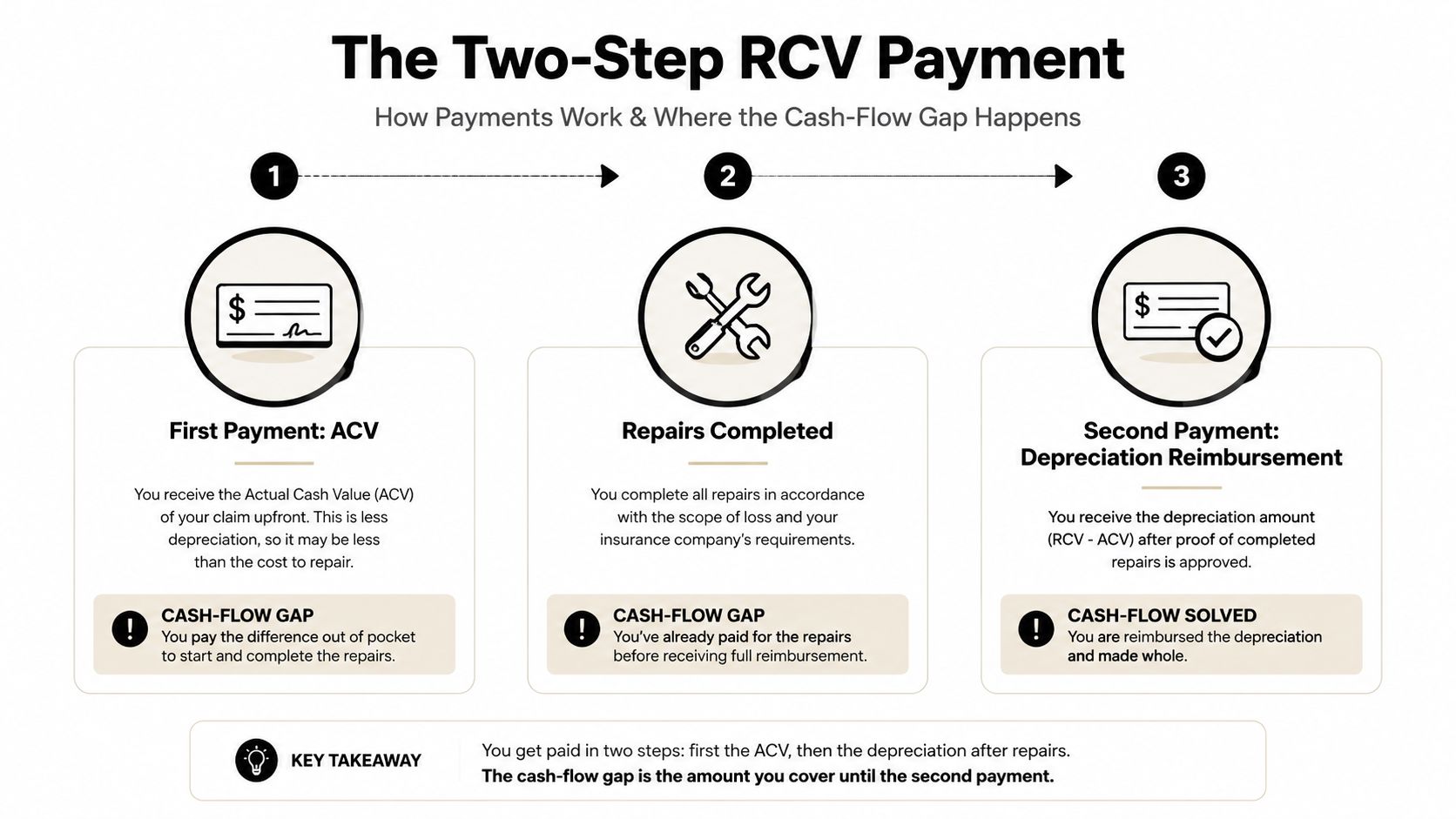
The usual sequence
- The claim is reported. You notify the insurer, protect the property from further damage, and preserve evidence.
- The damage is inspected. The carrier or its adjuster prepares a scope and applies depreciation to eligible items.
- The first payment is issued. On many RCV claims, this is an ACV-level payment, less the deductible and any applicable limits.
- Repairs are performed. You hire qualified contractors and complete the covered work using materials of like kind and quality.
- Proof is submitted. The insurer may request invoices, receipts, contracts, completion photographs, permits, or other documentation.
- The depreciation request is reviewed. The carrier checks whether the repairs satisfy the policy conditions.
- The second payment is released. Approved recoverable depreciation is paid according to the policy and claim process.
That sequence creates a cash-flow gap. You may need to fund deposits, materials, labor, emergency mitigation, and temporary protection before the withheld depreciation arrives. The gap can strain a household or business even when the final RCV calculation appears adequate.
Build the documentation file before repairs finish
Ask your contractor for a written scope, proposal, invoices, proof of payment, material descriptions, and completion photographs. Preserve photos before work starts, during demolition, after concealed damage is exposed, and when the finished work is complete.
A strong file also includes:
- Payment records: Keep receipts, canceled checks, financing records, and contractor payment confirmations.
- Repair milestones: Record dates for demolition, drying, installation, inspection, and completion.
- Material evidence: Identify product type, quality, dimensions, and any required matching materials.
- Written correspondence: Send depreciation requests by email or another trackable method.
- Unresolved items: List damaged components that remain omitted, disputed, or awaiting approval.
Practical rule: Never assume the insurer will connect a contractor invoice to the withheld depreciation without a clear written request.
Negotiate the gap instead of absorbing it
Ask contractors whether they'll align payment stages with the insurer's expected payment schedule. Don't authorize upgrades merely to obtain a preferred appearance, because the additional cost may fall outside the covered RCV.
Submit the depreciation package as soon as the policy allows. If the carrier delays, ask for the specific missing document, the policy provision being applied, and a written explanation of any reduction. Vague requests for “more information” shouldn't remain vague.
Common Insurer Tactics That Reduce Your RCV or ACV Payout
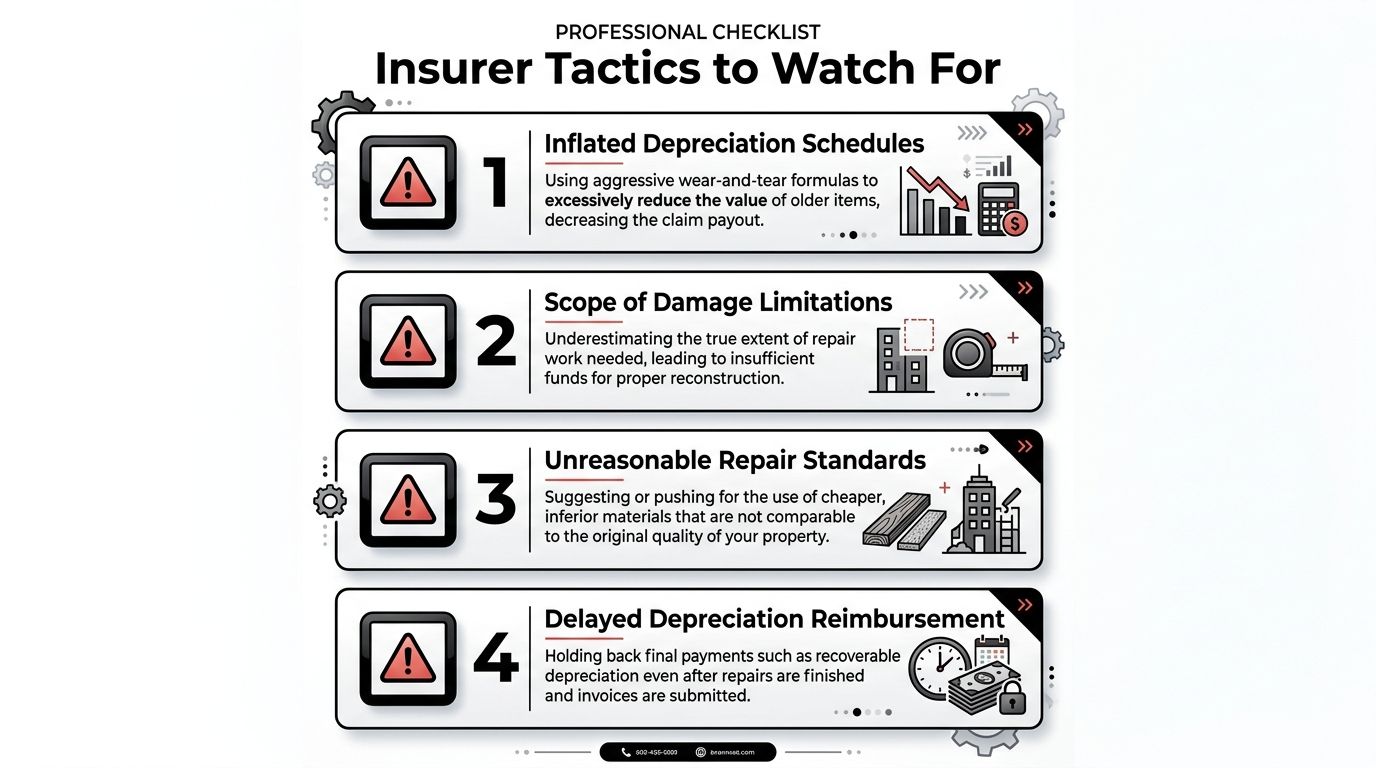
RCV coverage doesn't protect you from a weak scope or an unsupported depreciation calculation. The insurer can acknowledge coverage while still reducing the amount through estimating choices, omissions, and payment delays.
Depreciation that doesn't match the property
An adjuster may apply a depreciation schedule that treats a component as older or more worn than the evidence supports. Age matters, but so do condition, maintenance, material quality, and useful life under the policy's valuation method.
Request the itemized depreciation for every disputed line. Compare the reported age and condition with purchase records, inspection documents, maintenance history, photographs, and contractor observations. If the insurer can't explain the calculation, challenge it in writing rather than accepting the figure as automatic.
A scope that leaves damage outside the estimate
Low estimates often begin with missing work. The carrier may include the visible roof surface but omit flashing, ventilation, decking, interior staining, insulation, paint, trim, or code-related work that requires separate consideration.
Use room-by-room and system-by-system documentation. Timestamped photographs, videos, moisture readings, invoices from mitigation vendors, and a detailed contractor estimate help establish what was damaged and what work is reasonably required.
Current pricing replaced with unrealistic pricing
An estimate can use a cheaper material, an unavailable product, or labor pricing that doesn't reflect the local market. RCV is tied to the cost of comparable restoration at current prices, not a hypothetical job using inferior materials or a contractor who can't perform the work.
Ask the insurer to identify the product and labor assumptions behind each contested line. Provide a local estimate that states quantities, material specifications, access conditions, disposal, permit needs, and labor requirements. The goal is to compare assumptions, not argue over a single total.
Depreciation reimbursement that stalls
Once repairs are complete, some policyholders wait because they submit only a final invoice or assume the adjuster will initiate the second payment. Send a complete depreciation release package with a cover letter identifying the claim, completed work, withheld amount, and attached proof.
If the carrier reduces or denies the release, ask for the exact policy language and line-item explanation. Don't let a verbal statement end the discussion. Written documentation creates a record for further review, mediation, regulatory communication, or professional representation.
Insurer approval is not the same as a complete claim evaluation. Check the scope, pricing, depreciation, and payment status independently.
Oregon and Washington Considerations for Property Claims
Oregon and Washington policyholders face claim conditions that make accurate valuation especially important. Wind, heavy rain, freeze-related damage, wildfire, falling trees, and resulting water intrusion can affect multiple building systems at once. A carrier may focus on the most visible damage while the complete repair scope involves roofing, siding, insulation, framing, electrical work, contents, and interior finishes.
Local pricing matters too. RCV reflects the cost to restore the property with comparable materials and labor in the relevant market. A national estimate may not account for contractor availability, access constraints, disposal requirements, permit expenses, or material pricing in Portland, Seattle, Eugene, Vancouver, Spokane, or other communities.
Read the policy and state requirements together
Oregon and Washington have their own insurance laws, claim-handling rules, licensing requirements, and consumer protections. Those rules don't replace the policy's valuation provisions, but they can affect how disputes, communications, deadlines, and professional representation should be handled.
Don't rely on a general internet explanation when the claim involves a major loss, a disputed cause, extensive code work, or a specialized policy provision. Review the declarations page, endorsements, exclusions, loss settlement language, and any roof or cosmetic damage limitation. If the loss raises questions about valued policy laws, get advice specific to the property and policy rather than assuming a rule applies.
Pacific Northwest conditions can complicate depreciation
A roof or exterior component may have prior wear, but that doesn't automatically justify treating all storm-related damage as pre-existing. Separate maintenance issues from the covered event with photographs, inspection notes, contractor findings, weather records, and a clear chronology.
For wildfire or smoke losses, contents valuation can become just as important as structural repair. Build an inventory with descriptions, brands, model information, purchase records, photographs, and replacement research. For water losses, preserve drying logs and evidence of concealed damage before materials are removed.
The strongest Oregon and Washington claims combine policy analysis with local construction knowledge. That's where a qualified public adjuster, contractor, engineer, or attorney may add value, depending on the dispute.
When to Contact a Public Adjuster for Your RCV or ACV Claim
Handle a straightforward, well-documented claim yourself if the scope is complete, the depreciation is reasonable, the first payment is adequate, and the insurer responds promptly. Bring in a licensed public adjuster when the claim becomes a valuation dispute instead of a simple payment process.
Professional help makes sense when:
- The loss is extensive: Multiple rooms, structures, contents categories, or business operations require coordinated documentation.
- The scope is incomplete: The insurer omitted damage, disputes causation, or refuses necessary repair components.
- The depreciation is aggressive: The carrier's age, condition, or material assumptions don't match the evidence.
- The RCV payment is delayed: Repairs are complete, the required documents were submitted, and recoverable depreciation remains unpaid.
- The policy is complex: Commercial, nonprofit, municipal, school, layered, or specialty coverage creates multiple valuation questions.
A public adjuster represents you in the claim process, prepares or reviews damage documentation, analyzes policy language, and negotiates with the insurer. Compensation is commonly structured on a contingency basis, so the firm's fee is tied to the settlement outcome. Review the written agreement, fee terms, scope of services, and state licensing before signing.
If you're comparing professional support tools, an AI legal assistant for lawyers may help attorneys organize legal research and workflows, but it isn't a substitute for a licensed public adjuster's property inspection, estimating, and claim negotiation. For a practical decision guide, review when to hire a public adjuster.
NW Claims Management is one option for Oregon and Washington property owners who need claim evaluation, loss documentation, valuation analysis, and insurer negotiation. The firm handles residential, commercial, and nonprofit claims, offers free claim evaluations, and uses contingency-based compensation.
If your settlement letter shows RCV, ACV, or recoverable depreciation, don't spend the first check until you understand the complete payment path. NW Claims Management offers free claim evaluations and representation for Oregon and Washington property owners who need help documenting damage, challenging incomplete estimates, and recovering eligible depreciation.