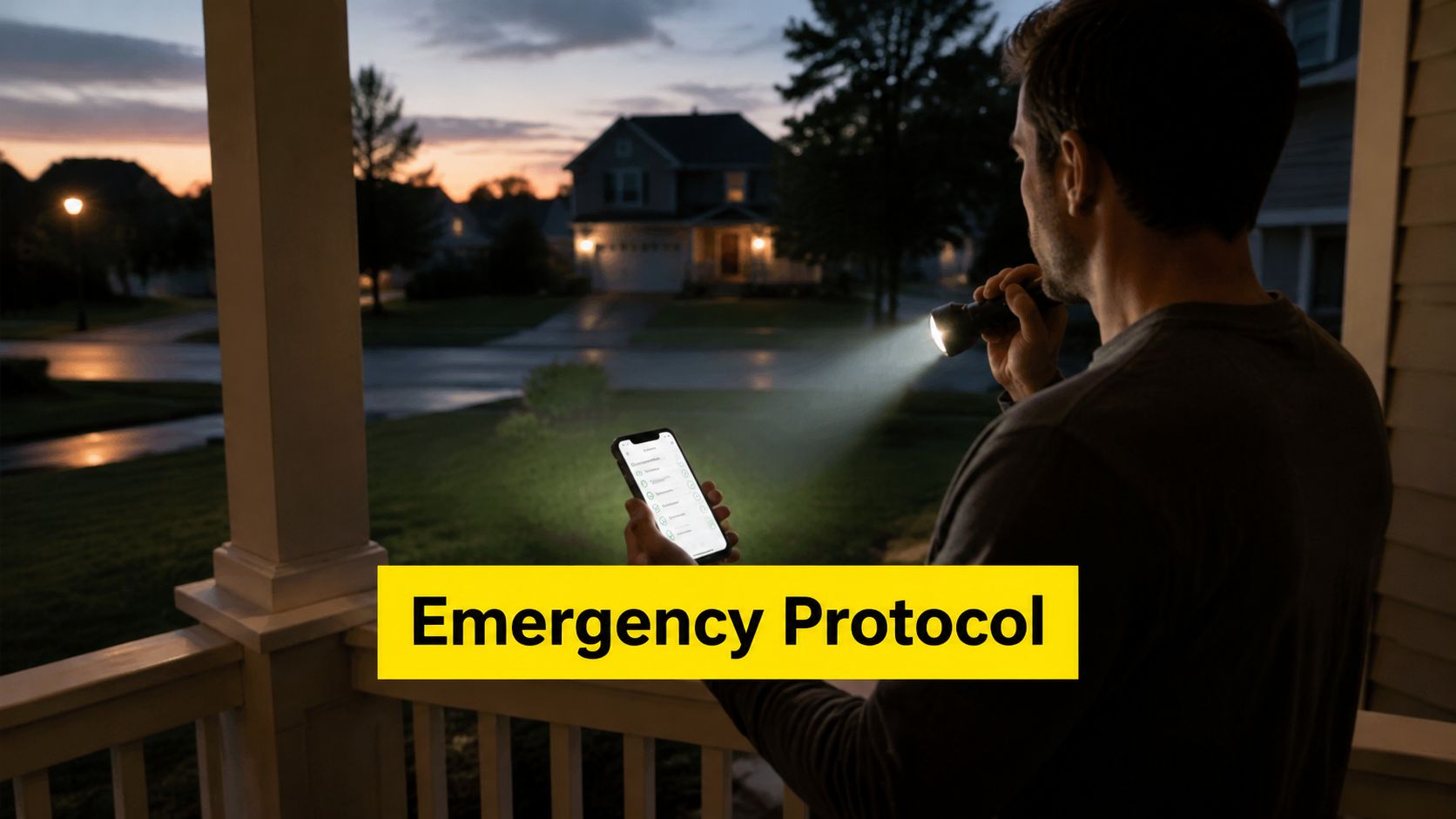
A pipe breaks above the kitchen ceiling on a rainy Portland night. Water is running across the floor, your family is trying to move furniture, and someone is asking whether to call the insurer before touching anything. In another home, smoke has cleared but the odor remains, a window is shattered after a storm, or sewage has backed up into a finished basement in Vancouver.
The first decisions protect more than people and property. They also create the record an insurer will later use to evaluate cause, scope, mitigation, contents, additional living expenses, and replacement cost. An emergency response protocol gives you a repeatable way to act safely while preserving the evidence and policy rights that support a complete claim.
What an Emergency Response Protocol Actually Means for a Property Owner
An emergency response protocol isn't just “call 911 and clean up.” For a property owner, it's a documented sequence of decisions that begins when damage is discovered and continues through mitigation, claim filing, estimating, negotiation, and resolution. The protocol connects the emergency scene to the insurance file.
That connection matters in Oregon and Washington because property policies commonly require the insured to prevent further damage, notify the carrier promptly, cooperate with the investigation, protect damaged property from additional harm, and provide supporting information. The exact wording controls, so owners should read the policy and declarations page before a loss occurs. A practical risk management policy should identify who makes decisions, who can access the building, which contractors may be called, and where policy records are stored.
The chain of command changes with the property
A single-family homeowner may be the person who discovers the loss, shuts off a valve, calls emergency services, and reports the claim. A mixed-use building requires a different arrangement. The owner, property manager, commercial tenants, building engineer, security provider, and restoration contractor may all have separate responsibilities.
Schools, healthcare facilities, and nonprofit institutions need still more structure. Their protocol must account for occupants who need assistance, restricted areas, medication or records, infection-control concerns, alternate operations, and communications with public agencies. A role-based command model helps prevent contradictory instructions. The modern incident command system was developed in Southern California through FIRESCOPE after wildfire coordination failures exposed incompatible communications and unclear authority. FIRESCOPE formally introduced ICS by 1972, and state and federal wildland fire agencies widely accepted it by 1981, according to this history of the Incident Command System.
Practical rule: The person who can make a safe emergency decision isn't always the person who should authorize permanent repairs or settle the claim.
Build the protocol before damage occurs
Write down the first contacts, utility locations, access instructions, tenant notification process, preferred mitigation vendors, document storage location, and insurer contact information. Include a backup communication method if the building loses power or cellular service.
Owners operating across jurisdictions can also review how to navigate California emergency compliance for a useful comparison of formal emergency planning requirements. The governing policy and local obligations differ, but the underlying lesson is consistent: a protocol should assign decisions before stress makes every question urgent.
First 60 Minutes After a Loss
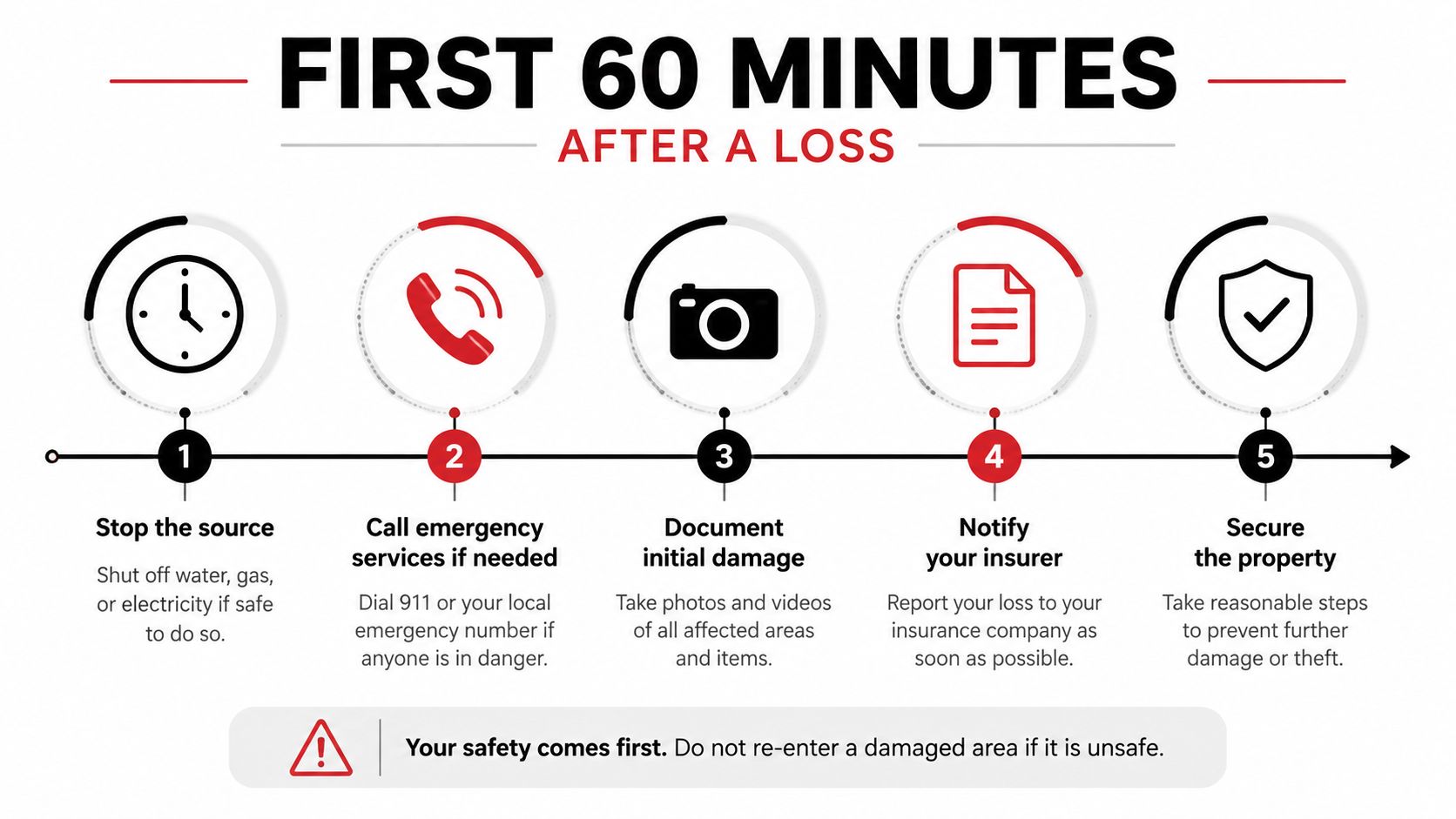
The first hour should be calm and factual. A homeowner, manager, or facility employee has a limited job: protect people, stop an active source when it can be done safely, preserve initial evidence, and bring in the right responders. Firefighters, utility crews, and mitigation contractors handle specialized hazards and technical work. Don't enter a smoke-damaged, electrically compromised, contaminated, or structurally unstable area to take photographs.
Minutes 0 through 10
Confirm that everyone is out of immediate danger. If there is fire, smoke, a medical emergency, suspected gas, structural instability, live electrical equipment, or another threat to life, call 911 and follow the responder's instructions. Don't speculate about the cause, blame a tenant, accuse a contractor, or guess whether a pipe, appliance, storm, or electrical component caused the loss.
If it's safe and you know how, shut off water or gas at the source. Turn off only affected electrical circuits when necessary and safe to do so. Don't manipulate damaged electrical equipment, gas systems, or contaminated water. Record what you observed, such as “water was flowing from the ceiling near the hallway light,” rather than making a conclusion about responsibility.
Minutes 10 through 30
Call the pre-identified emergency contacts. For a residence, that may be the insurer, property manager, plumber, electrician, or restoration company. A commercial or institutional property may need a facilities lead, security contact, tenant representative, board officer, risk manager, or public agency liaison.
Take initial photographs and video from a safe location before cleanup begins. Show the overall room, the source area, affected surfaces, standing water, smoke or soot patterns, broken openings, and nearby personal property. If the situation requires immediate extraction, boarding, tarping, or other protective work, document the condition as thoroughly as conditions permit. The companion guide on evidence preservation can help organize what must remain available for inspection.
Minutes 30 through 60
Notify the insurer or broker using the policy's reporting instructions. Ask for the claim number, assigned adjuster, emergency vendor process, and instructions for preserving damaged property. Keep the first report limited to known facts, and don't provide a recorded statement until you've reviewed the policy and understand what the carrier is asking.
A restoration vendor may begin emergency stabilization, but the vendor shouldn't decide coverage, accept a settlement, or make broad statements about the cause on your behalf. If you're unsure whether standing water requires immediate professional extraction, review guidance on when to call water pros. Save every call log, text message, email, invoice, and instruction from the carrier or contractor.
Protecting the Property Without Giving Up Your Claim
A homeowner in Beaverton discovers water spreading from a failed supply line. The family shuts off the valve, photographs the wet flooring and cabinet bases, calls a mitigation contractor, and places unaffected contents in a dry area. The contractor extracts water, creates a room-by-room moisture record, and removes materials that cannot reasonably be saved. Before demolition, the homeowner photographs the layers and emails the images, invoice, and work authorization to the insurer.
That is reasonable mitigation. The homeowner acted to prevent additional damage without deciding the final repair scope or discarding evidence.
Mitigation is not the same as permanent repair
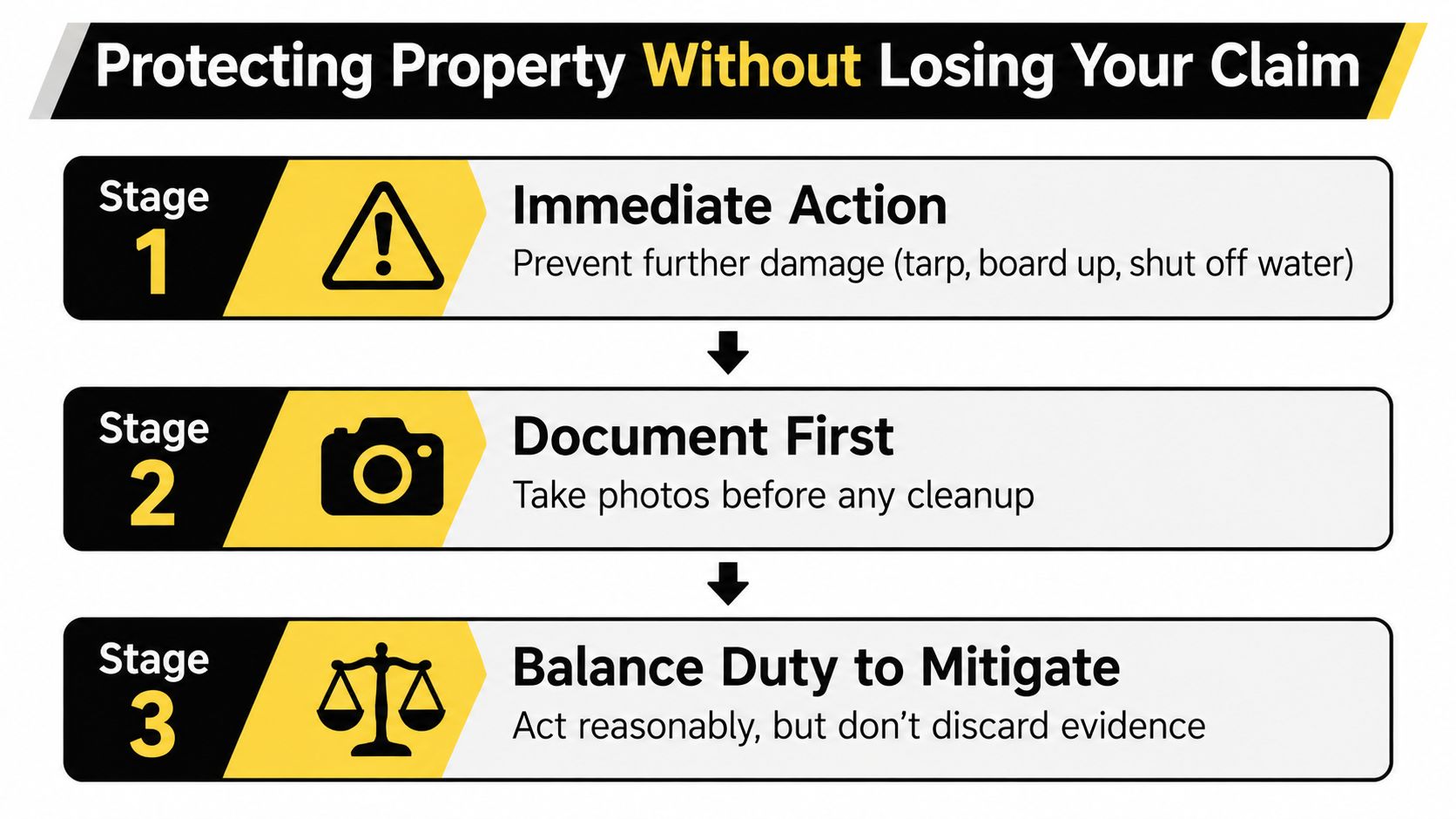
Reasonable protective work may include tarping a damaged roof, boarding a broken window, extracting standing water, moving contents, placing temporary barriers, and removing saturated materials when delay would worsen the loss. Keep the work limited to what the emergency requires.
Premature scope work creates avoidable disputes. Replacing all drywall, rebuilding cabinets, discarding damaged contents, signing a broad repair contract, or authorizing upgrades before the carrier has inspected can make it harder to establish what existed, what was damaged, and what was necessary. A contractor may recommend a repair method, but the insurer's estimate isn't the final word and the contractor's proposal isn't automatically covered.
Create a mitigation file
For every action, preserve:
- Before-and-after images: Photograph the condition before work, during removal, and after temporary stabilization.
- Vendor records: Keep licenses or credentials provided by the contractor, estimates, invoices, moisture readings, disposal records, and daily notes.
- Written instructions: Save messages in which the insurer acknowledges the need for emergency mitigation or directs you to use a particular vendor.
- Physical evidence: Retain removed materials and damaged contents when safe and practical, or document why disposal was necessary.
The policyholder's duty is generally to act reasonably, not to freeze the property until an adjuster arrives. A focused explanation of that balance is available in this guide to mitigation of damages. The strongest file shows urgency, restraint, and a clear trail from each emergency expense to the damage it addressed.
Documenting Damage the Way Adjusters Respect
Insurance claims are decided through evidence, not memory. Start a written event log with the date and time discovered, weather or operating conditions, who was present, what was observed, actions taken, and when each person or company was contacted. Use factual descriptions. “Soot covered the upper wall and entered the return-air grille” is stronger than “the fire destroyed the entire room” when the full scope hasn't been established.
Photograph in layers
Take the same subject from several distances:
- Wide views establish the room, floor plan, adjacent areas, and relationship between damaged and undamaged property.
- Mid-range views show the affected wall, ceiling, floor, cabinet run, appliance, or mechanical system in context.
- Close-ups capture wet materials, smoke patterns, soot migration, cracks, labels, serial numbers, model tags, and visible contamination.
Photograph standing-water levels before extraction where safe. For smoke losses, record residue paths, odor-affected areas, HVAC registers, insulation exposure, and contents in nearby rooms. A slow video walkthrough with spoken narration can preserve sequence and context that individual images miss. State the date, location, and visible condition without guessing the repair cost.
The photographic documentation guide provides a useful filing structure. Keep original files so phone metadata remains available, and don't edit or apply filters to the originals. Email a copy of the complete set to yourself the same night, then store it in a cloud folder and an offline location.
Preserve every expense category
Save receipts for emergency mitigation, temporary lodging, meals or essential replacement items when the policy permits reimbursement, cleaning, storage, transportation, and other loss-related costs. Additional living expense coverage, often associated with Coverage D in a homeowners policy, depends on the policy language and the facts of the displacement. A receipt without an explanation may be challenged, so write the claim number and purpose on each record.
Adjusters often question whether an item was damaged, whether it belonged to the property, whether the condition predated the loss, whether the expense was necessary, and whether the claimed quantity or quality is supported. Capture contents in place before moving them. For high-value items, collect purchase records, manuals, photographs, appraisals, and model information from existing files.
A clean first record is harder to discount than a reconstructed story assembled after demolition.
Filing the Claim in Oregon or Washington the Right Way
The first notice of loss should be prompt, accurate, and narrow. Give the carrier the location, date discovered, apparent type of damage, safety conditions, emergency measures, and contact information. Ask for the policy and declarations page, claim number, inspection process, applicable deadlines, and whether the carrier expects a recorded statement or proof of loss.
Don't volunteer theories about negligence, coverage, policy exclusions, contractor fault, or the final repair cost. You can state what you saw and what you did. If the insurer asks for a recorded statement, review the policy and organize the timeline first. A public adjuster can prepare the claim presentation and negotiate scope, while an attorney addresses legal advice, coverage litigation, privilege, and potential bad-faith disputes. A contractor diagnoses or repairs the physical loss, but shouldn't speak for you on coverage.
Filing Claim Oregon vs. Washington
| Filing Step | Oregon (ORS 746) | Washington (RCW 48.18) |
|---|---|---|
| First notice | Report the loss through the carrier's stated process and keep a written record of the report. | Report promptly through the carrier's stated process and preserve confirmation of the notice. |
| Policy review | Request the policy, declarations, endorsements, duties after loss, and applicable conditions. | Request the policy, declarations, endorsements, duties after loss, and applicable conditions. |
| Written claim | Separate structure, contents, additional living expense, mitigation, and code-related items instead of presenting one unsupported total. | Use the same separate categories and identify supporting documents for each claimed item. |
| Settlement conduct | Oregon's insurance standards include ORS 746.230, which shapes expectations around fair claim handling. | RCW 48.18.560 shapes expectations for prompt payment and claim handling. |
| Dispute path | Request a written explanation, supplement disputed scope, and review policy appraisal or other available remedies. | Request a written explanation, supplement disputed scope, and review policy appraisal or other available remedies. |
Keep the claim modular
Submit the written proof and supporting schedule in sections. Structure should identify rooms, assemblies, labor, materials, and code-related work. Contents should identify item, description, age if known, condition, replacement information, and supporting proof. Additional living expense should connect each cost to displacement and policy terms. Business losses require separate operational records and financial analysis.
Don't sign a blanket authorization that gives a contractor or vendor unrestricted control of the claim. Don't accept the first estimate merely because it arrives quickly. Compare the estimate to the documented damage, identify missing line items, track depreciation methodology, and request supplements in writing. The homeowners claim filing guide can serve as a practical checklist while you build the file.
When a Public Adjuster Changes the Outcome
A public adjuster represents the policyholder, not the insurer. The adjuster investigates the loss, interprets relevant policy provisions, measures and documents damage, prepares the claim, evaluates contents or additional living expense, identifies overlooked scope, and negotiates with the carrier's adjuster. That role is different from a contractor, who estimates and performs repairs, and from an attorney, who advises on legal disputes and may litigate coverage or bad-faith claims.
Public adjuster compensation is generally tied to the claim settlement and regulated by state law. Washington rules cap fees under specified conditions, and both Oregon and Washington impose licensing and conduct requirements. Before signing, confirm the license, fee structure, services included, termination terms, and whether the agreement covers supplements or only the initial payment.
Choose the professional for the problem
| Need | Best fit | What that professional should not replace |
|---|---|---|
| Emergency stabilization | Qualified mitigation contractor | Policy analysis or settlement negotiation |
| Repair diagnosis and construction | Licensed contractor or engineer | Independent coverage advice |
| Claim valuation and negotiation | Public adjuster | Legal representation in litigation |
| Coverage interpretation or lawsuit | Insurance attorney | Physical repair management |
| Financial loss analysis | Accountant or forensic financial specialist | Building damage inspection |
Early involvement can matter when the first estimate omits rooms or systems, when the carrier disputes the amount of additional living expense or business interruption, when code upgrades receive no treatment, or when an ambiguous exclusion produces a denial. The public adjuster doesn't guarantee coverage. The value comes from organizing the facts, matching them to the policy, and forcing unresolved scope questions into a documented negotiation.
Use a decision checklist
Consider retaining a public adjuster when:
- The estimate is incomplete: Compare the carrier's line items against your photographs, contractor findings, and damaged areas.
- The loss has multiple categories: Fire, water, smoke, commercial operations, contents, code work, and displacement create separate valuation tasks.
- The carrier controls the narrative: If the adjuster inspected after cleanup or relies on assumptions you can't correct, independent documentation becomes more important.
- The claim is consuming operations: A business owner or facility manager may lose more by managing calls, inventories, and supplements alone than by delegating the file.
- Coverage is disputed: Ask an attorney about legal representation if the carrier issues a denial, reserves rights, or threatens litigation.
An adjuster should explain what has been documented, what remains uncertain, and which policy provisions support each request. Don't hire someone solely because they promise a maximum recovery. Hire based on licensing, scope of service, communication, and a written agreement.
Your 72-Hour Emergency Response Protocol Checklist
The first 72 hours establish the condition of the property, the sequence of decisions, and the credibility of the claim record. The following protocol is designed for a homeowner, property manager, business owner, or facility lead. Assign the responsible person in advance, and document when each task is completed.
Hours 0 through 1
Owner or on-site lead
- Protect people: Evacuate or isolate unsafe areas. Call 911 for fire, medical danger, suspected gas, structural instability, or other life-safety threats.
- Stop the active source: Shut off water or gas if trained and it can be done safely. Isolate affected power only when necessary and safe.
- State facts: Tell responders what you observed, when you noticed it, and what actions you took. Don't guess at cause or fault.
- Start the record: Photograph and video the original condition from a safe location before mitigation changes it.
- Make the first calls: Contact the insurer, property manager, emergency contact list, and required building personnel.
Responders and utilities
- Control hazards: Firefighters, utility crews, and other responders determine whether the site is safe and manage specialized hazards.
- Record official involvement: Keep incident numbers, names, arrival information, instructions, and reports when available.
These actions preserve life safety and establish a defensible event timeline. A late or incomplete notice can give the carrier an argument that it couldn't investigate promptly.
Hours 1 through 24
Owner or facility manager
- Authorize emergency stabilization only: Approve extraction, temporary roofing, boarding, containment, or other work necessary to prevent additional damage.
- Protect unaffected property: Move contents to a dry, secure location and record what was moved and why.
- Preserve evidence: Retain damaged materials and contents when safe and practical. If disposal is necessary, photograph, describe, and document the reason.
- Collect vendor records: Save estimates, work authorizations, invoices, credentials, moisture records, disposal logs, and communications.
- Notify occupants: Tell tenants, employees, residents, or program participants which areas are closed and who may enter.
Mitigation contractor
- Separate emergency work from reconstruction: Identify what was done to stabilize the property and what remains a proposed permanent repair.
- Use measured observations: Record affected materials, moisture or smoke conditions, containment areas, and inaccessible locations.
The policyholder should act quickly, but an emergency vendor shouldn't receive authority to settle coverage or permanently alter the property without a documented reason.
Hours 24 through 48
Claim file owner
- Complete the visual record: Take wide, mid-range, and close-up images of rooms, systems, contents, labels, patterns, and dimensions as conditions permit.
- Create an inventory: List damaged contents by room, description, quantity, age if known, replacement information, and supporting proof.
- Secure receipts: Organize mitigation, lodging, storage, essential purchases, meals, transportation, and other potentially covered expenses.
- Back up originals: Preserve unedited photographs and videos, retain metadata, and email a complete copy to yourself or another secure account.
- Review communications: Confirm what the insurer acknowledged, what inspection is scheduled, what documents it requested, and what deadlines appear in the policy.
Business or institutional owner
- Protect operating records: Preserve payroll, sales, occupancy, grant, program, inventory, maintenance, and financial information if the loss affects operations.
- Keep continuity notes: Record closures, relocations, canceled work, alternate facilities, and expenses caused by the interruption.
A regulated environment can still have preparedness gaps. A CDC survey found that 94.6% of U.S. hospitals had evacuation plans, while 11.1% conducted no internal drills in the prior year, and the median number of full-scale internal simulations was one, according to the CDC hospital preparedness survey. The lesson for property owners is practical: a written plan matters only when people can execute and document it.
Hours 48 through 72
Owner or designated claim lead
- Give formal notice: Confirm the claim is open, obtain the claim number, and ask how the carrier wants proof, photographs, invoices, and inspection access delivered.
- Request the governing documents: Obtain the policy, declarations page, endorsements, duties after loss, valuation provisions, deductible, depreciation terms, additional living expense language, and code-upgrade provisions.
- Build separate schedules: Organize structure, contents, mitigation, additional living expense, business interruption, and code-related costs rather than combining them into one figure.
- Evaluate representation: Consider a licensed public adjuster if the loss is complex, the estimate is low, the claim includes operational or displacement losses, or you can't manage the file while recovering.
- Avoid premature commitments: Don't sign a blanket authorization, accept an incomplete estimate, discard evidence, or approve permanent repairs before the scope is documented.
Public adjuster, contractor, or attorney
- Public adjuster: Quantifies and presents the policyholder's covered loss and negotiates the amount.
- Contractor: Estimates construction and performs authorized work, subject to the owner's contract and applicable permits.
- Attorney: Advises on legal rights and handles coverage disputes, litigation, and potential bad-faith claims.
Weak procedures and incomplete after-action learning cause recurring operational problems. An OECD review identified unclear roles, inconsistent procedures, and inadequate training as common accident-response failures, while the U.S. GAO reported that FEMA completed after-action reviews for only 29% of disasters from 2017 through 2019, as documented in the OECD emergency preparedness review. Apply that lesson to the claim: after stabilization, close the loop by recording what happened, what was missed, and which part of the protocol must change.
The first 72 hours don't determine every coverage question, but they often determine who controls the factual narrative. A disciplined owner preserves safety, evidence, mitigation costs, and policy rights before the insurer's estimate becomes the only organized version of the loss.
NW Claims Management helps Oregon and Washington property owners document damage, interpret complex policy language, prepare complete claim schedules, and negotiate with insurers after fire, water, storm, flood, or vandalism losses. Visit NW Claims Management for a claim evaluation and practical guidance on protecting your recovery from the first emergency call through settlement.