You opened the policy after a fire, storm, or leak, saw replacement cost, and expected the rebuild money to make sense. Then the estimate landed, and it felt like someone had shaved the number down line by line before you ever saw it.
That reaction is common because most homeowners are handed a clean-looking figure, while the claim file underneath it is built from assumptions, exclusions, and pricing shortcuts. A better replacement cost calculation starts with what the insurer counts, what it omits, and what you can document before the loss so the number is harder to shrink later.
Why Your Insurer's Replacement Cost Number Feels Wrong
A homeowner in the middle of a loss usually sees the same pattern. The policy looked broad at purchase, the declarations page said replacement cost, and the first estimate still came in short of what a real rebuild would require. That gap is not always fraud or bad faith, it often starts with the way the number was built in the first place.
The number is shaped before the loss is settled
Insurers often start with a fast estimate that is good enough for underwriting, but not always good enough for a claim. In practice, they lean on square-foot pricing and then adjust from there, which is why a policy can feel generous on paper and thin in the field. The homeowner usually only sees the final offer, not the assumptions behind it.
A strong documentation file changes that dynamic. If you're building a storm or fire packet, the Ocala storm claim documentation guide is a useful reminder of how to preserve photos, estimates, and communication in a way that helps at settlement.
The first number is rarely the last number
What trips people up is that the insurer's “replacement cost” figure is often a starting point, not a promise that every rebuild expense will be paid without dispute. The claim file gets trimmed through scope decisions, pricing choices, and line-item exclusions. That's why the number can feel far lower than what a contractor says it would take to put the property back together.
If you want to see how claim software drives some of those estimates, the Xactimate free trial is worth looking at because it shows the same kind of pricing structure many adjusters work from internally. You don't need to become a software user to understand the mechanics, but it helps to know the system that generates the worksheet.
Practical rule: if the first estimate doesn't include the work you'd have to hire out after a loss, it's not a rebuild budget yet, it's only a claim starting point.
What Replacement Cost Actually Means in a Policy
Replacement cost value, or RCV, means the amount needed to repair or rebuild property at today's prices using like-kind materials. It is not the home's resale value, and it is not what a buyer would pay for the property on the open market. The policy promise is about restoring the damaged structure, not pricing the land underneath it.
Replacing a totaled car. You're not asking what the dealer would offer on a trade-in, you're asking what it costs to get a comparable vehicle back on the road. That same logic applies in property claims, except the rebuild also has to account for building systems, code requirements, and site conditions.
RCV is not market value or actual cash value
Market value mixes the structure, land, neighborhood demand, and buyer behavior. RCV does not. It's a reconstruction concept, not a sales concept. That distinction matters because a lot of homeowners assume their policy should reflect what the property could sell for, when the contract is really about what it would cost to restore the insured structure.
The same split shows up with actual cash value, or ACV. ACV is where depreciation enters the picture, which is why a claim based on ACV can feel dramatically lower than a replacement-cost claim even when the damage is identical. Land value never belongs in the RCV number, because you're not rebuilding land.
What policy language usually signals
The words on the declarations page and in the dwelling form tell you what bucket you're in. If the language says replacement cost, it usually points toward paying the cost to repair or rebuild like kind and quality. If it says actual cash value, the insurer is likely starting from replacement pricing and then reducing for depreciation.
For a close read on policy wording around add-ons and coverage boundaries, the cheat sheet for protection plan claims is a good example of how coverage language controls the outcome more than the marketing label does. The same lesson applies here, the label matters less than the operative terms.
The Components Insurers Quietly Leave Out
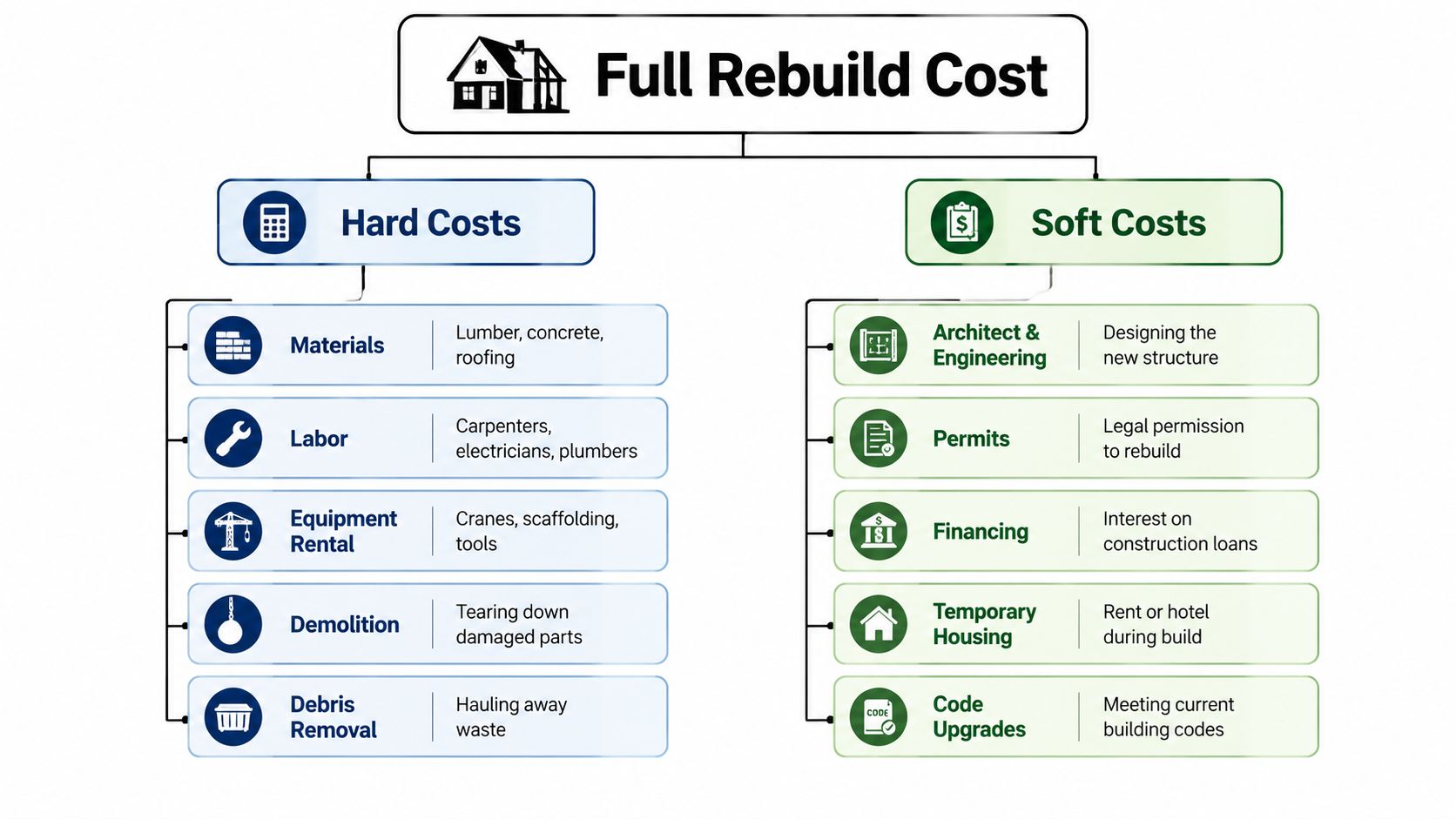
A rebuild estimate that looks complete on paper can still come in light once the claim is adjusted. Hard costs cover the visible work, the materials and labor that put the structure back together. The gap usually shows up in the items that sit outside the obvious line items, the parts insurers often trim first when they are building their number behind the scenes.
The budget stack is broader than framing and finishes
A real replacement cost figure is built from several layers, not just lumber and finish work. It can include hard costs, soft costs, contingency, and, in some settings, profit or developer overhead. Residential claims work the same way in practice, even if the labels shift. If those layers are stripped out, the estimate may still look orderly while leaving the homeowner short on actual rebuild funds.
That missing margin matters most when the job is not a clean like-for-like repair. Permits, architectural work, temporary housing, financing friction, and trade coordination costs do not show up in the simplest worksheets, but they affect what it takes to restore the property to pre-loss condition. Insurers know this. They also know these are the first items many claim files fail to document well.
A contractor's scope usually exposes that difference faster than an insurer's shortcut. The flooring installation cost calculator guide shows why line-item pricing beats a broad estimate when labor, material quality, and job conditions vary from one property to the next.
The items that get trimmed first
The first cuts are usually the same ones that create the biggest real-world gap:
- Demolition and debris removal: damaged material still has to be torn out, hauled off, and disposed of before new work can start.
- Permits and architectural work: local approvals and design services do not vanish because a loss happened.
- Code upgrades: if current code applies to the rebuild, that work belongs in the claim scope, and coverage for those items often depends on the policy wording and code upgrade coverage.
- Temporary housing: a displaced family still has living expenses while the home is under repair.
- Contractor profit and overhead: a builder has to cover supervision, scheduling, warranty responsibility, and job risk.
Those are not fringe details. They are part of what a real rebuild costs, and they are often the exact places where an insurer's worksheet gets cleaned up too aggressively.
A claim file that only lists visible repairs can look tidy and still underpay the loss. The policyholder who documents demolition, code work, and temporary living costs upfront gives the adjuster less room to shave the number later.
Two Ways Insurers Run the Numbers
A homeowner can get two very different replacement cost figures from the same insurer. One number is built for speed and underwriting. The other is built for a claim file after the loss has already happened. That gap is where a lot of underpayment starts.
The shortcut works for screening, not for rebuild pricing
The common shortcut is the comparative-unit method, usually a per-square-foot benchmark. Insurers use it because it is fast, easy to apply, and good enough for a rough check on whether a dwelling limit looks obviously out of line.
It also leaves out the details that drive a real rebuild. Site access, demolition, debris haul-away, labor shortages, permit work, and code-triggered changes do not fit neatly into a blanket rate. Two homes with the same square footage can land in very different claim ranges once the estimate has to reflect the actual work on the ground.
The cost stack is closer to what a contractor prices
A more defensible approach is the cost stack, or quantity-based method. It breaks the rebuild into parts instead of flattening everything into one rate, which is why it tracks a claim worksheet better than a broad benchmark.
That matters because soft costs and contingency are not small add-ons. They sit on top of the hard construction work, and they are often the first pieces trimmed when an insurer wants the number to come in lower. A useful reference on how those pieces are commonly treated is the loss valuation methods page, which explains how the method chosen up front changes the settlement position before any negotiation starts.
Here's the practical split:
- Square-foot benchmark: useful for a quick policy review.
- Cost stack or quantity takeoff: better for a claim worksheet.
- Contractor-backed scope: strongest when the loss is large or the site has code issues.
For a policyholder, the benchmark can reveal obvious underinsurance. For a claim, the detailed scope usually carries more weight because it shows what the rebuild requires, line by line.
Replacement Cost vs Actual Cash Value vs Agreed Value
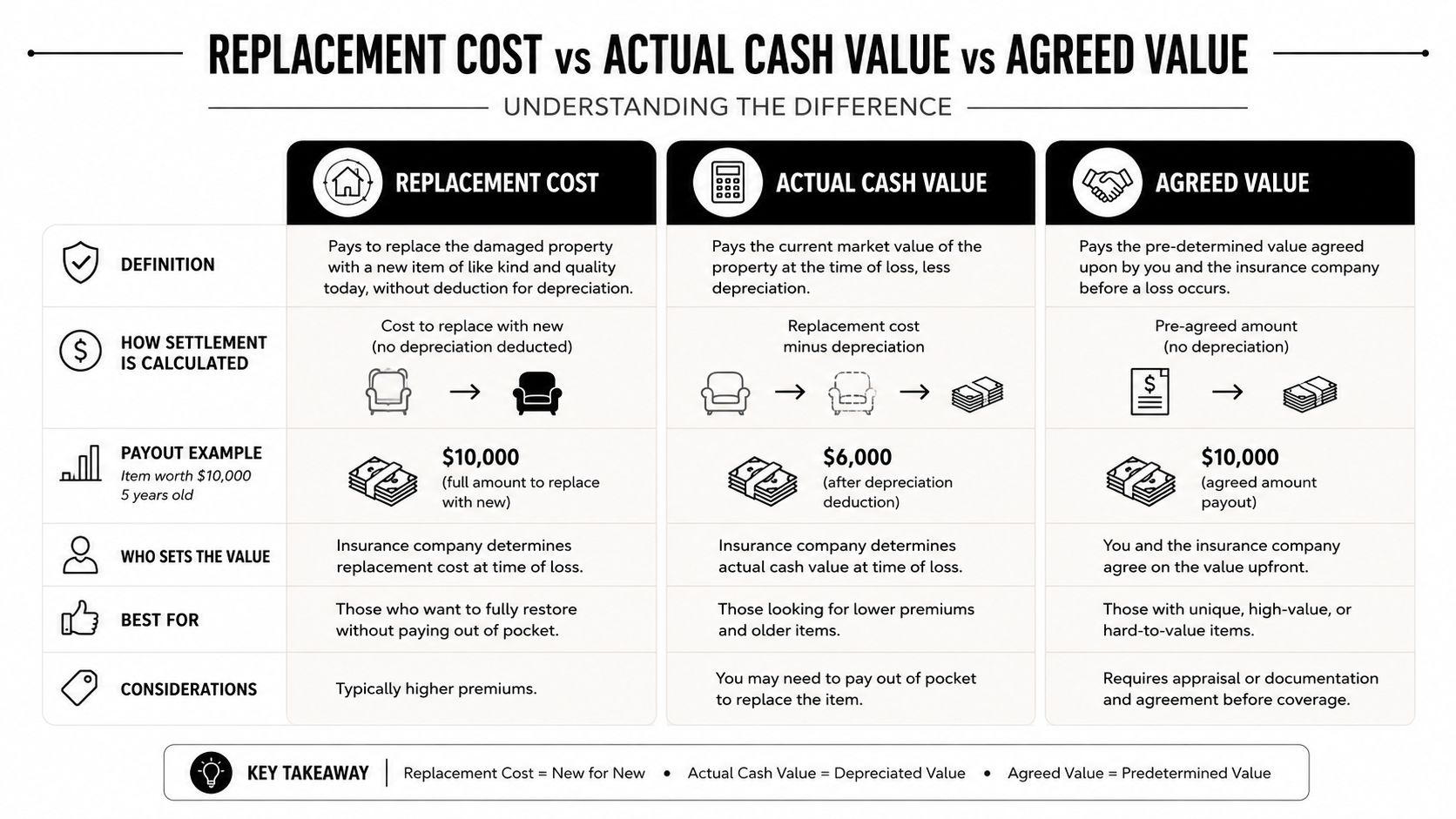
These three coverage forms sound similar until a claim happens. Then the differences matter a lot. The policy language decides whether depreciation hits your settlement, whether the amount was fixed in advance, or whether the insurer is paying to restore the structure at current cost.
Replacement cost pays to restore, not to age out
With replacement cost, the insurer starts from the cost to repair or rebuild like kind and quality. That means the focus is on the structure you had, not the depreciated condition of individual parts. In valuation practice, this is the current cost to reproduce or replace the asset before any depreciation is considered, which is why it's the most homeowner-friendly standard when the policy is drafted well.
Actual cash value reduces for depreciation
Actual cash value uses the same starting point but subtracts depreciation. That is where underinsurance disputes usually begin, because depreciation can be applied to materials and, in some claim practices, labor arguments enter the conversation as well. The result is that the payout can be far below the cost of hiring a contractor to replace the damaged part today.
Agreed value locks the number early
Agreed value is different. The number is set in advance, usually after some form of professional valuation, and the policy is written around that figure. It's less common for ordinary homeowners, but when it's used well, it reduces surprise at claim time because the valuation fight happened before the loss, not after it.
If you're reviewing policy language in the Pacific Northwest, the time payment of claims provision is useful because timing rules affect when and how money moves after the estimate is accepted. Coverage form and payment timing are separate issues, but they collide fast during a claim.
Oregon and Washington Policy Provisions Worth Knowing
A replacement cost estimate can still miss the mark in Oregon and Washington if the policy does not account for code upgrades or if payment rules slow the rebuild down. The numbers may look fine on the worksheet, yet the homeowner still faces out-of-pocket costs when the loss triggers ordinance requirements or when the insurer controls the pace of payment.
Endorsements that matter before a loss
Check whether the policy includes ordinance or law coverage. That endorsement helps pay for code-driven upgrades when the rebuild has to meet current standards, not the standards that existed when the house was built. Without it, the estimate can cover the damaged part and still leave the owner responsible for the code-related gap.
Review extended replacement cost and how it works with any inflation guard feature. Extended replacement cost gives the dwelling limit some room when local repair prices move faster than the last renewal estimate. Inflation guard raises the limit over time, but it does not replace a real review of the home's rebuild exposure or the parts of the project that are commonly left out.
Questions to ask before renewal
Bring these questions to your agent:
- Does the dwelling form include ordinance or law coverage?
- Does extended replacement cost apply, and how is it triggered?
- Is inflation guard automatic, or does it require a manual update?
- Are vacancy rules changing my coverage if the home is empty?
- Are wildfire-zone underwriting rules affecting my limits or renewal options?
Payment timing deserves the same attention. The time payment of claims provision can affect cash flow while repairs are waiting on scope approval, permits, or lender sign-off. Coverage terms and payment timing are separate issues, but in a real claim they usually affect the same repair schedule.
How Insurers Underpay Even Accurate Replacement Cost Claims
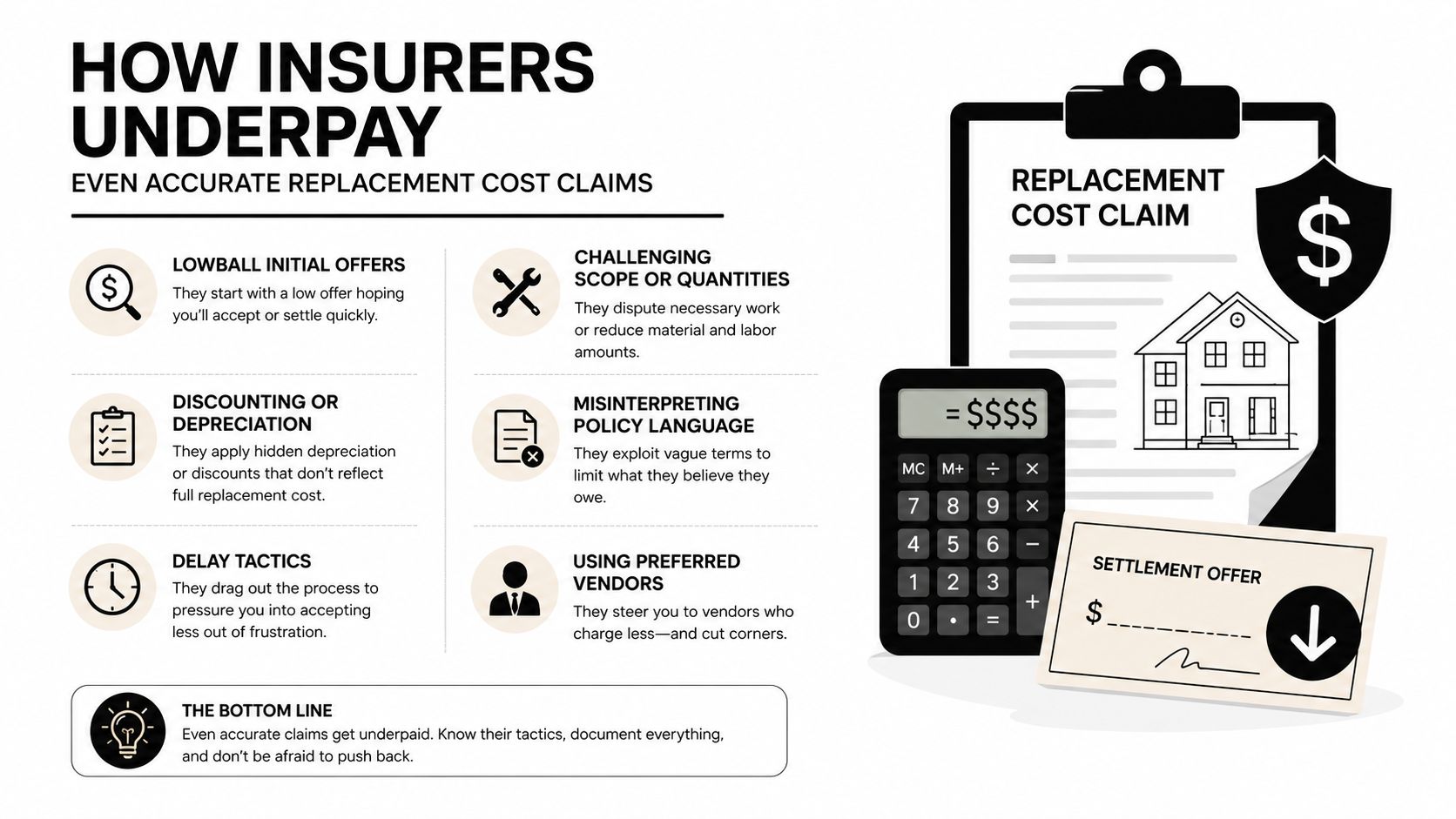
A claim can be priced “correctly” and still be underpaid. That happens when the insurer accepts the broad idea of replacement cost but trims the scope, delays depreciation recovery, or leaves out work that should have been in the estimate from the start. The fight usually isn't over whether the house was damaged, it's over what counts as part of the rebuild.
The common shrink points are easy to miss
One tactic is scope trimming, where the adjuster says a piece of the damage was pre-existing or not tied to the loss. Another is leaving depreciation unpaid until the repair is finished, which can starve the project of cash when the owner needs it most. Soft costs get challenged too, especially permits, professional design, and code-related work.
A third common issue is the match question. When a damaged area gets repaired but the adjacent undamaged area doesn't match, the insurer may resist paying to blend the finish or extend the work. That's where homeowners often feel the gap between a paper estimate and a livable result.
Documentation is the lever you control
The strongest response is line-by-line proof. Dated photos, contractor estimates that separate materials and labor, code references, and clean email chains all help. If a specific item was excluded, you want to know exactly why it was excluded and what evidence the carrier used to justify the exclusion.
A good rule is simple: every line item the insurer deletes should be tied to a document, a code section, or a policy exclusion, not just an adjuster's preference. That doesn't guarantee payment, but it makes the conversation harder to keep vague.
When a Public Adjuster Changes the Math
A public adjuster matters most when the carrier's estimate has already been built and the homeowner is being asked to accept it. That's the point where policy interpretation, valuation method, and negotiation all start to matter at once. A licensed adjuster can rebuild the scope independently, challenge omissions, and push the claim toward a number that reflects the actual work needed.
Independent valuation changes the baseline
The biggest shift usually comes from using a better estimate method. A cost-stack or quantity-based review tends to uncover items that a shortcut missed, especially when there are code-triggered upgrades, demolition, and site-specific labor issues. Once those items are documented, the settlement conversation changes from “why is the estimate so high” to “why weren't these costs included in the first place.”
In Oregon and Washington, licensing also matters because it gives the claim file a credibility marker. The policyholder is not just sending a bigger number, they're sending a reviewed estimate from someone who works claims every day and knows which line items tend to get cut.
The timing of help matters
The best moment to bring in help is after the initial carrier estimate, but before the repair scope hardens into a final settlement position. That's when there's still room to correct missed items, challenge depreciation handling, and press for soft costs that should have been recognized from the start. Waiting until the file is nearly closed usually means you're fighting uphill.
If you want a closer look at what a professional advocate does in a claim file, the insurance claim public adjuster page lays out the role clearly. It's the cleanest comparison to the homeowner side of the process.
A strong public adjuster doesn't change the policy, but they can change the math the insurer uses to apply it.
If your settlement figure doesn't line up with what it would take to rebuild, NW Claims Management can review the claim, inspect the estimate, and help you understand where the gap is coming from. Visit NW Claims Management to request a free evaluation and get a claim review built around the replacement cost calculation, not the shortcut version.