A winter storm knocks out power, a pipe freezes, and by morning your crawlspace is wet, your drywall is stained, and your phone is full of advice that doesn't quite fit your situation. Or it's August in Central Oregon, smoke is in the air, and you're wondering whether your home, rental, church, or commercial building is ready for the next fast-moving fire. Most property owners don't feel undertrained until the day they need to make high-stakes decisions quickly.
That's where risk management training stops being a corporate phrase and becomes personal. For property owners in Oregon and Washington, the right training isn't about box-checking. It's about knowing what to prevent, what to document, what to say, and what not to say when an insurer starts asking questions.
Your Foundation for Property Resilience
Generic preparedness advice creates a false sense of control. It tells people to “review your policy” and “make a home inventory,” but it rarely accounts for Pacific Northwest realities like wildfire exposure in the urban-wildland interface, winter water damage, river flooding, wind-driven rain, or the claim handling patterns that show up after regional disasters.
That gap matters. Research on risk training gaps in high-risk regions points to a significant lack of region-specific risk management training for places like Oregon and Washington, where local hazards, local regulations, and insurer tactics can differ sharply from national boilerplate guidance.
A practical training plan starts at the property level. A Portland bungalow with an aging roof and overhanging fir trees needs a different playbook than a Salem nonprofit with older electrical systems, or a warehouse in Washington with drainage issues and business personal property stacked near grade level. The risk isn't abstract. It's tied to your building, your use, your records, and your policy language.
What useful training looks like in Oregon and Washington
Effective risk management training for property owners should answer questions like these:
- What hazards are most likely at this address: Not in your state generally, but on your parcel, in your building type, and during your season of highest exposure.
- What does your policy require after a loss: Deadlines, documentation duties, mitigation obligations, and proof standards.
- What can you do before a loss to strengthen a future claim: Photo records, maintenance logs, inventories, contractor contacts, and emergency authority lines.
- How do you reduce preventable fire exposure: For a solid starting point, Survey Merchant's advice on home safety offers practical fire-risk reduction ideas property owners can use.
Practical rule: If your training could apply just as easily to a generic office park in another region, it probably isn't specific enough for Oregon or Washington property risk.
A written framework helps. Property owners who want a planning baseline can use a risk management policy guide to organize roles, response expectations, and documentation habits before anything goes wrong.
The goal isn't to turn every owner into an adjuster. It's to make sure you don't face a major loss with nothing but a vague checklist and a stack of unanswered emails.
Why Standard Training Fails Property Owners
Most standard training fails because it treats a property claim like a paperwork task. It isn't. It's a disruption event. Your building may be damaged, tenants may be calling, your routine is broken, and every decision suddenly has money attached to it.
That's why insurer pamphlets and broad online courses often miss the mark. They focus on technical tasks, but they don't prepare people for the mental fog that follows a fire, flood, storm, or vandalism loss.
The missing piece is claim trauma. A human-centered review of disaster survivor preparedness.pdf) notes that 42% of US disaster survivors report anxiety, and that psychological preparedness can lead to 25% faster settlements by improving documentation accuracy under stress. That point lines up with what many property owners experience in real claims. They don't ignore details because they're careless. They miss details because they're overwhelmed.
What bad training teaches by accident
Weak training tends to encourage the wrong habits:
- Rushing the first conversation: Owners answer broad insurer questions before they've reviewed the damage fully.
- Under-documenting early conditions: They take a few photos, then start cleanup without preserving the full scope.
- Treating the insurer's process as neutral: They assume every request is complete, every interpretation is generous, and every timeline works in their favor.
- Forgetting the administrative load: Someone still has to keep receipts, schedule vendors, track temporary repairs, and reconcile inconsistent estimates.
That's why a property owner can be diligent and still end up underprepared.
The emotional side changes the quality of decisions
Stress narrows attention. People focus on whatever looks urgent that hour. They may save a soaked couch receipt but forget to photograph the warped subfloor under it. They may remember to call in the claim but fail to ask for the exact basis of a reservation, limitation, or document request.
A stronger version of risk management training includes emotional operating rules, not just technical steps. It teaches owners to slow the first response down enough to protect the claim.
Don't rely on memory after a loss. Use written logs, photo folders, saved voicemail files, and a single point person for insurer communication.
That instruction sounds simple, but it has a major effect. It reduces contradictions, duplicate work, and missing support for line items that later become disputed.
What standard materials rarely cover
There are a few topics that generic training usually skips:
- How to function when the property is uninhabitable or partially closed
- How to separate emergency mitigation from permanent repairs
- How to respond when the insurer asks for information in a format you don't currently have
- How to preserve credibility without volunteering unnecessary conclusions
- How local weather patterns and building practices affect causation arguments
Owners who need a stronger prevention and inspection routine before a loss can benefit from structured loss control inspection guidance, especially when multiple hazards overlap.
The best training doesn't just make you informed. It makes you calmer, more organized, and harder to push off course when the process becomes adversarial.
Designing Your Custom Training Curriculum
Good risk management training is modular. It has to fit the property, the people using it, and the kinds of losses most likely to happen there. A homeowner in Bend needs a different curriculum than a school, church, apartment owner, or manufacturing site along a flood-prone corridor.
The strongest framework I've seen starts with a sequence rather than a pile of tips. A structured training methodology for risk decision-making recommends identifying risks through historical data, scoring them with a likelihood and impact matrix, and planning mitigation through simulations. In that source, this kind of data-driven training is associated with a 40% reduction in overlooked risks, 25-30% faster crisis resolution, and 20% higher settlement recoveries when organizations track performance closely.
That matters because most owners don't need more information. They need an order of operations.
Start with the property, not the template
Before building a curriculum, define the training audience:
- Single-family homeowners need simple, repeatable routines and clear family roles.
- Commercial owners need lease awareness, vendor chains, and business interruption discipline.
- Nonprofits and schools need authority mapping, board reporting, and mission continuity.
- Landlords need unit condition records, tenant communication procedures, and habitability awareness.
If you want a practical outside perspective on building learning materials that fit a real organization instead of a generic audience, GroupOS has a useful piece on designing educational content for organizations.
The four modules that belong in almost every program
Some modules are nearly universal in Oregon and Washington property risk.
| Module | Learning Objective | Sample Activities |
|---|---|---|
| Property-specific hazard awareness | Identify the hazards most likely to affect the property and how they would show up in a claim | Map nearby wildfire exposure, review drainage patterns, inspect roof age and tree contact, note vulnerable utility areas |
| Proactive mitigation | Reduce avoidable damage before a loss and create records that show responsible upkeep | Build a maintenance log, photograph key systems, trim vegetation, test sump pumps, review shutoff locations |
| Emergency response protocols | Make the first day after a loss orderly, safe, and well documented | Run a tabletop exercise for water loss, assign family or staff roles, create contact sheets, define temporary repair authority |
| Post-loss claim procedures | Preserve evidence, organize support, and avoid common claim handling mistakes | Create inventory categories, build a receipt folder system, draft a communication log, rehearse insurer call notes |
How to score what matters
Not every risk deserves the same effort. A practical curriculum should rank exposures by two questions: how likely is this event here, and how damaging would it be if it happened?
A simple matrix works well for property owners:
- High likelihood, high impact: Prioritize immediately. Think repeated drainage overflow, old supply lines, or known wildfire exposure.
- Low likelihood, high impact: Train for response discipline. Think major structure fire or severe wind event.
- High likelihood, lower impact: Build maintenance habits. Think smaller leaks, minor vandalism, or recurring freeze issues.
- Low likelihood, lower impact: Document and revisit annually.
A planning framework becomes more useful when it's written down in a form your household, staff, or board can revisit. A good starting point is this five-step property risk management outline, which can help translate broad goals into assignable tasks.
Training fails when it assumes everyone sees the property the same way. The owner sees value, the facilities person sees systems, the tenant sees disruption, and the insurer sees proof.
Build exercises that feel like the real event
Lecture-only training doesn't hold up well after a real loss. Use exercises that force decisions.
A few examples:
Water loss drill
Someone discovers a leak behind a wall at 6:30 a.m. Who shuts off water, who calls mitigation, who starts the photo record, and who reviews the policy?Wildfire evacuation packet review
What records are stored off-site, what photos exist of interior rooms, and who has authority to move key documents or high-value items?Storm claim communications exercise
One person plays the insurer representative and asks broad questions. Another practices giving accurate, limited, organized answers while logging every request.
Customize by property type
A curriculum should also account for what's inside the structure.
Homeowners should emphasize room-by-room inventory habits, temporary housing records, and maintenance proof.
Commercial operators need separate modules for stock, tenant improvements, equipment, extra expense, and downtime documentation.
Nonprofits and municipalities often need training on grants, board communication, procurement rules, and preserving mission-critical operations while the claim is open.
Training becomes useful when it changes behavior before the loss. If it only produces a binder, it isn't training. It's storage.
Mastering Documentation and Insurer Interaction
A claim is won or lost in the record. Not just in the policy, and not just in the inspection. The record decides whether the loss appears isolated or widespread, temporary or permanent, minor or properly valued.
That's why documentation deserves its own risk management training module. The owners who do this well don't create one long list and hope for the best. They create layers of proof.
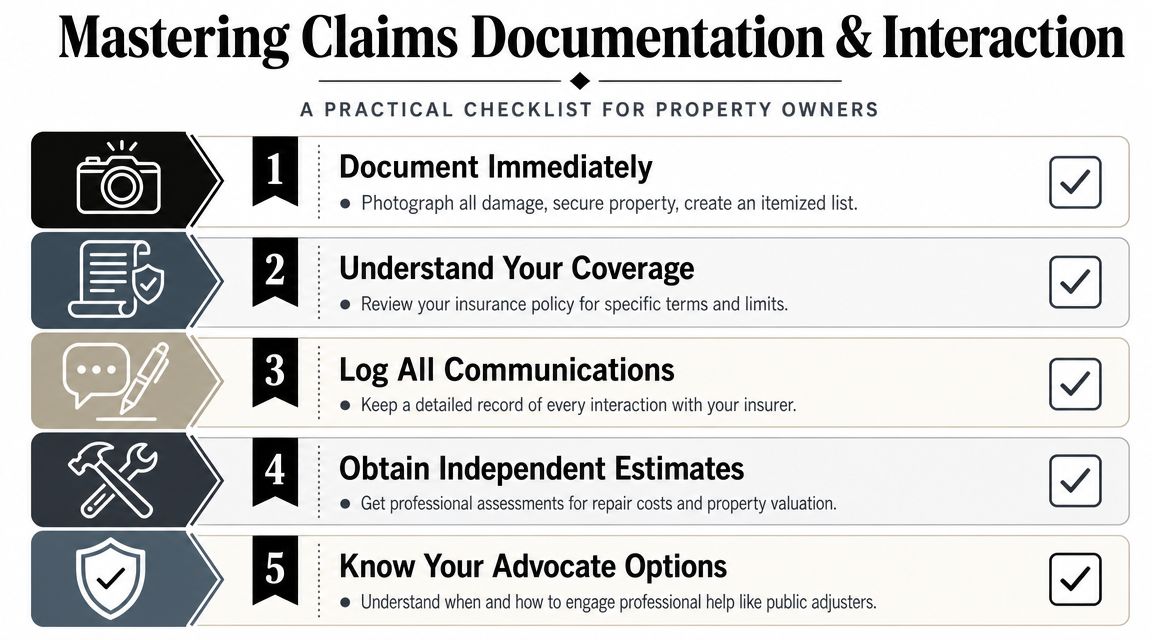
The technology side matters more than it used to. PwC-related risk management statistics summarized by Secureframe report that 47% of organizations are prioritizing upskilling their workforce on emerging technologies, and 68% of organizations now use AI and analytics in risk management. For property claims, the takeaway is practical. Owners who can use digital documentation tools, policy search tools, and structured photo records are better positioned to support the full value of a claim.
Build an unshakeable file
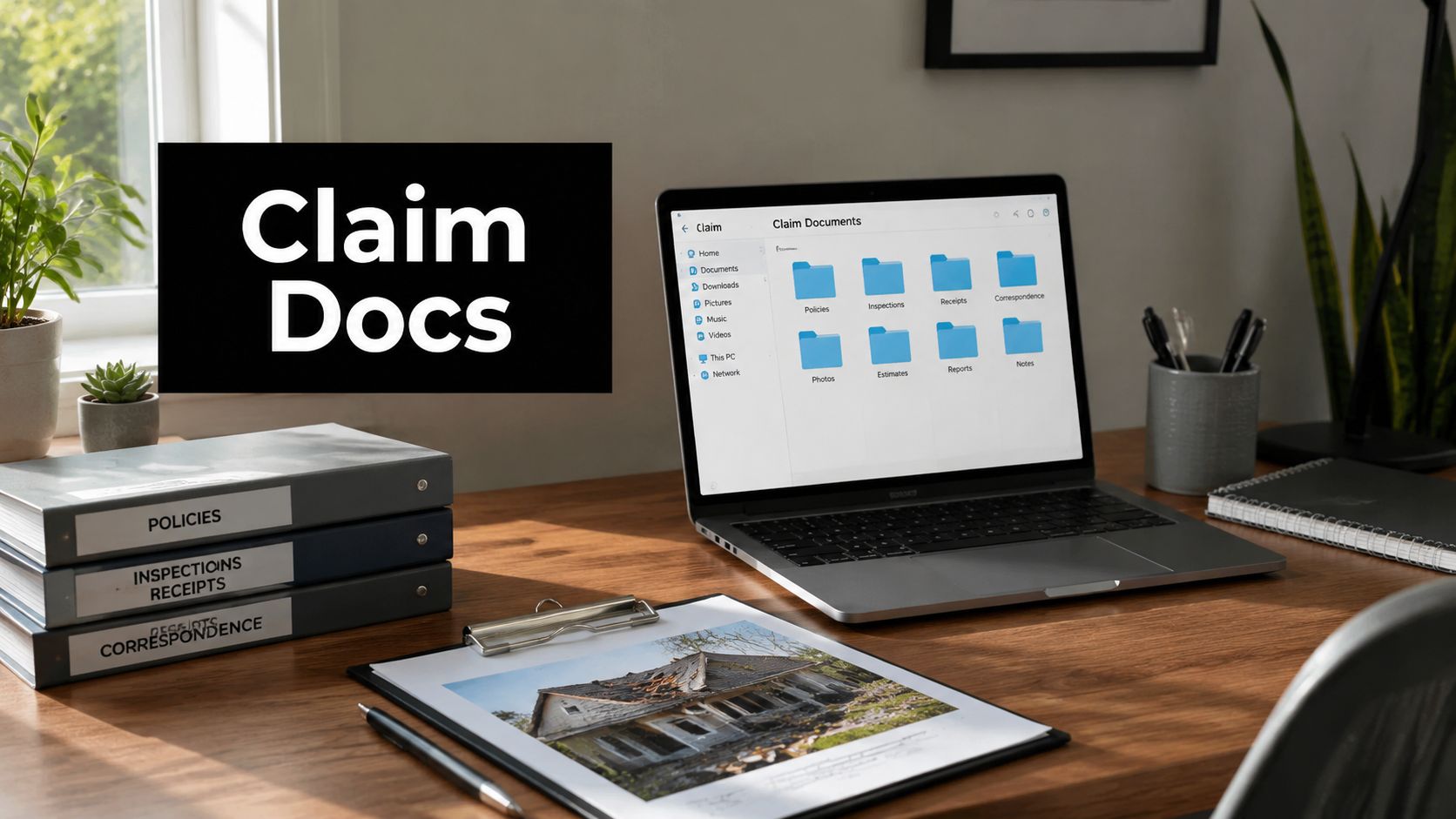
A strong claim file has separate buckets. Don't mix them.
Use this structure:
- Damage evidence folder with date-stamped photos, videos, inspection notes, and area labels
- Mitigation folder with emergency invoices, drying logs, moisture readings, and authorization forms
- Repair and replacement folder with estimates, scopes, code-related notes, and contractor correspondence
- Contents or business personal property folder with item descriptions, age, condition, replacement support, and receipts where available
- Communication log with dates, names, titles, phone numbers, email summaries, and open requests
- Policy and coverage folder with the full policy, endorsements, declarations, and any insurer letters
A smartphone is fine if the file system is disciplined. Name folders by room or building area. Save files off-device. Keep originals. Don't overwrite earlier images with edited versions.
The difference between an inventory and a proof package
A simple inventory says “Dining table, six chairs, sofa.” That's a start.
A proof package says what the item was, where it was, what condition it was in before the loss, how it was damaged, what replacement standard applies, and what support exists for value. For businesses and nonprofits, the same principle applies to equipment, inventory, supplies, and specialized contents.
Essential documents to gather early
The first days after a loss should produce a predictable document set:
- Policy documents including endorsements and recent renewals
- Ownership or occupancy records such as deeds, leases, or operating agreements where relevant
- Pre-loss maintenance records for roofing, plumbing, electrical, HVAC, and prior repairs
- Emergency mitigation invoices and vendor work authorizations
- Photos and video from before and after the event
- Utility or incident records if they help establish timing or cause
- Room-by-room or category-by-category inventory worksheets
- All insurer correspondence from the first notice onward
Property owners who want a more disciplined inspection and valuation process can organize their evidence around a formal property damage assessment approach.
Use this phrase: “Please identify in writing any additional documents you need, the purpose for each request, and any deadlines tied to my response.”
That sentence does two things. It creates a record, and it reduces the chance that important requests drift through scattered calls.
How to talk to the insurance company without hurting your claim
Owners often damage good claims by talking too broadly.
Say less, but say it clearly. Confirm what you know. Separate observation from conclusion. If you don't know something yet, say you're still documenting.
“I'm continuing to document the full scope of damage. I'll provide supporting materials as they are organized.”
That's better than guessing. It preserves accuracy.
Avoid these habits:
- Speculating about cause before inspection is complete
- Describing damage as minor before opening walls, floors, or concealed spaces
- Agreeing verbally to narrow scopes
- Letting calls end without written recap
- Treating the insurer's estimate as the final definition of loss
A clean communication habit works better than charisma. Keep messages short. Follow up in writing. Ask for confirmation. Save every exchange.
Delivering and Measuring Your Training Program
A training plan only matters if people use it. In property risk, that means delivery has to fit real schedules and real decision-makers. A homeowners association won't train like a church board. A family-run business won't train like a school district.
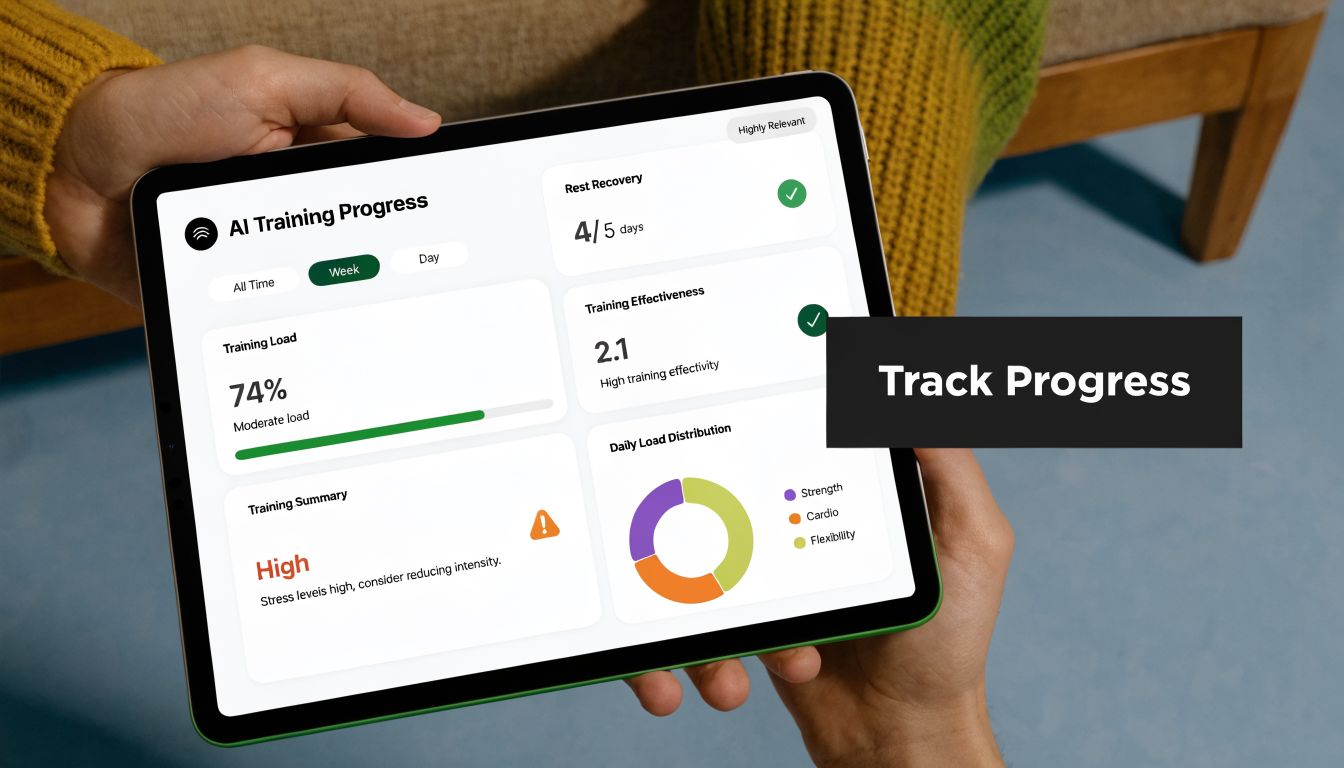
The format can be small and still work. A Saturday workshop, a quarterly review, or an annual pre-season inspection meeting can all support meaningful risk management training if the sessions are focused, assigned, and documented.
Delivery models that work in practice
Different owners need different rhythms.
Homeowners and family properties
A homeowner program works best in short bursts:
- Spring review for roof, drainage, trees, and exterior vulnerabilities
- Summer wildfire review for defensible space, photo updates, and go-bag records
- Fall water-loss review for shutoffs, insulation trouble spots, and emergency vendor contacts
- Post-renewal policy review after each insurance renewal
Commercial and mixed-use buildings
Commercial properties usually benefit from calendar-based accountability:
| Setting | Delivery style | Focus |
|---|---|---|
| Small business property | Quarterly operations meeting | Maintenance proof, vendor readiness, downtime records |
| Multi-tenant building | Semiannual management review | Tenant communication, common area risks, claim responsibility map |
| Nonprofit or school | Board and facilities session | Authority lines, emergency spending, mission continuity records |
Measure behavior, not attendance
Attendance is the weakest metric in property training. It tells you who showed up, not who can execute.
Better measures include:
- Completion of a current photo inventory
- Updated contact list for mitigation, restoration, and legal or financial support
- Verified shutoff maps and building access procedures
- Maintained repair and maintenance logs
- Documented annual policy review with key endorsements flagged
- Mock claim drill completed with communication log
The broader safety case for engagement is strong. Workplace risk management statistics highlighting Gallup data report that organizations with highly engaged employees experience 63% fewer workplace accidents. That principle carries over to property ownership. Trained and engaged people notice hazards sooner, report them more consistently, and document losses with more discipline.
If the training doesn't change what gets inspected, recorded, or escalated, it won't change the outcome after a loss.
Link training to financial results
Property owners often ask whether training pays off. The answer depends on what you track.
A useful scorecard includes questions like these:
Did training reduce preventable damage?
Think fewer missed leaks, faster shutdowns, cleaner maintenance histories.Did training improve claim readiness?
Look at how quickly the file came together, whether records were easy to find, and whether scope support was credible.Did training reduce uninsured or poorly documented costs?
Owners often absorb more out-of-pocket loss when records are scattered or damage is incompletely presented.Did training reduce confusion during the first week of the claim?
This shows up in fewer contradictory statements, fewer missed deadlines, and fewer avoidable delays.
For households, the return may be less chaos and better preservation of value. For commercial buildings and nonprofits, it may show up in cleaner operations, stronger continuity, and fewer disputes over what was damaged, when, and how badly.
Next Steps From Training to Action with a Public Adjuster
Training gives you a playbook. It helps you spot hazards earlier, keep better records, respond more calmly, and avoid the mistakes that weaken claims. But there's a point where training alone isn't enough.
That point usually arrives when the loss becomes large, technical, disputed, or too time-consuming to manage well on your own. Fire losses, complex water losses, storm claims with hidden damage, vandalism involving multiple scopes, and commercial losses with operational disruption can all cross that line quickly.

When outside representation starts to make sense
A public adjuster works for the policyholder, not the insurance company. That changes the job entirely. The role is to interpret policy language, document the full scope of loss, assemble support for valuation, challenge incomplete estimates, and negotiate toward a fair settlement.
You should consider that level of help when:
- The insurer's scope feels incomplete
- You're struggling to document contents or business property
- The claim involves code upgrades, hidden damage, or multiple trades
- You don't have time to manage the process well
- Communications are becoming adversarial or confusing
- You want a second set of expert eyes before positions harden
What a well-run handoff looks like
Good representation doesn't replace your preparation. It builds on it.
The strongest handoff happens when the owner already has:
- a clear event timeline,
- organized photos,
- the full policy set,
- mitigation records,
- and a communication log.
That foundation lets a public adjuster move faster and argue from a cleaner record.
A strong claim is rarely about one dramatic document. It's usually about a disciplined stack of ordinary records that all point in the same direction.
A practical decision test
If you're still deciding whether to manage a claim alone, ask three questions:
| Question | If the answer is yes | What it suggests |
|---|---|---|
| Is the claim large enough that mistakes will be expensive? | The margin for error is small | Get expert review early |
| Is the documentation burden already interfering with home or business recovery? | The claim is consuming your bandwidth | Consider handing off the process |
| Do you feel pressured to agree before the full scope is clear? | The timeline may not be working in your favor | Slow down and get independent guidance |
If that sounds familiar, it helps to review guidance on when to hire a public adjuster before the file gets harder to unwind.
Training prepares you to act. Professional advocacy can protect the value of that preparation when the stakes rise. For many Oregon and Washington property owners, that combination is what turns a chaotic claim into a controlled recovery.
If you're dealing with property damage in Oregon or Washington and need a clear read on your options, NW Claims Management offers free claim evaluations for homeowners, businesses, nonprofits, and public entities. The firm works only for policyholders, not insurers, and handles documentation, policy review, damage assessment, and settlement negotiation on a contingency basis. That means you can get experienced guidance without adding upfront pressure while you're already trying to recover.