Think of a risk management policy as less of a stuffy document and more of a strategic playbook for your property's financial health. It’s your official, written-down plan for how you’ll spot, evaluate, and handle potential threats before they turn into costly disasters.
Why Every Property Owner Needs a Risk Management Policy

If your property is a ship, then a risk management policy is your navigation chart, compass, and emergency plan rolled into one. It’s not about creating more paperwork; it’s a living strategy to protect your most valuable asset from financial storms. For those of us owning property in Oregon and Washington, this isn't just a good idea—it's essential.
This policy becomes your first line of defense against the specific threats we face in the Pacific Northwest. Whether it's winter storm damage, wildfire exposure, sudden flooding, or even legal liabilities, having a documented plan transforms you from a reactive victim into a prepared, resilient owner.
From Proactive Defense to Claim Success
The real value of a risk management policy snaps into focus the moment disaster strikes. The work you do before a loss is what truly dictates the success of your insurance claim after. It just makes sense: an insurer will have a much harder time disputing a claim on a well-maintained property with a documented history of care.
This proactive approach arms you with the hard evidence you’ll need. A strong policy is supported by:
- Maintenance Logs: Concrete proof of routine upkeep, like annual roof inspections or plumbing system checks.
- Asset Inventories: A detailed catalog, with photos and valuations, of your personal belongings and structural features.
- Safety Procedures: A record of the steps you actively take to prevent damage or accidents on your property.
When you have to file a claim, this collection of documents is your single most powerful asset. It provides a clear, factual record of your loss, making it incredibly difficult for an insurance adjuster to undervalue the damage or allege pre-existing issues. Understanding https://nwclaimsmanagement.com/insurance-policy-limits-explained/ is the first step, and having this documentation is the second.
To put it simply, a good policy doesn't just manage risk—it builds a stronger case. Below is a table that breaks down the core functions it performs.
Core Functions of a Risk Management Policy
| Function | Description for Property Owners |
|---|---|
| Identify Threats | Systematically pinpoints potential hazards specific to your property, from leaky pipes to wildfire risk. |
| Assess Impact | Evaluates the potential financial and operational fallout if a specific risk were to occur. |
| Mitigate Damage | Outlines proactive steps (like maintenance or upgrades) to reduce the likelihood or severity of a loss. |
| Document Value | Creates an undeniable record of your property's condition and the value of your assets before a loss happens. |
| Streamline Recovery | Provides a clear roadmap and the necessary paperwork to expedite the insurance claims process. |
Each of these functions works together to create a powerful shield, protecting your investment and ensuring you have the tools you need when you need them most.
Staying Ahead in a Complex Environment
The world of risk never stands still. Regulations are updated, new technologies create unforeseen vulnerabilities, and even our regional weather patterns are becoming less predictable. Trying to keep up with it all can feel overwhelming.
In fact, a recent PwC Pulse Survey found that 75% of organizations feel they can't keep pace with the speed of evolving risk management demands. This is precisely why having a certified expert in your corner is so critical—they can accurately document your losses and negotiate a fair settlement when an insurer attempts to minimize your claim.
In our connected world, the risks to your physical property often intersect with digital ones. Even for a residential property, understanding the benefits of IT risk management sheds light on why a truly comprehensive policy is vital for protecting your assets and ensuring your life isn't derailed by a disaster.
Ultimately, a risk management policy gives you more than just a plan for the worst-case scenario. It offers genuine peace of mind, strengthens your financial position, and gives you a powerful upper hand when it’s time to file a claim. It’s the very foundation of a successful property damage recovery.
The Essential Components of Your Policy
A truly effective risk management policy isn't some dusty binder on a shelf. It’s a living system made of a few core building blocks that all work together. Think of it less like a rigid instruction manual and more like a game plan that adapts to protect your property.
Let's break down what those key pieces are. When you understand how they connect, you can turn this abstract idea into a practical shield for your home or business.
Risk Identification: Spotting Potential Dangers
First things first: you can't guard against a threat you don't see. This initial step, risk identification, is all about taking a hard, honest look at your property to find anything that could potentially cause a loss. It's a bit like being a detective, methodically scanning for clues before a problem even starts.
For a homeowner in Washington, this could be as simple as noticing the heavy, overgrown tree limbs hanging over your roof before a big winter storm hits. For a commercial property manager in Portland, it might mean identifying the seismic vulnerabilities of an older brick building.
You need to look for trouble in a few key areas:
- Property Hazards: Things like old, frayed wiring, slow-leaking pipes, a visibly aging roof, or cracks in the foundation.
- Environmental Threats: Is your property near a floodplain? Are you in a wildfire-prone part of the state? What about proximity to seismic fault lines?
- Security Risks: This covers everything from poor outdoor lighting and broken window locks to having no alarm system.
- Liability Issues: Uneven sidewalks that could cause a fall, an unfenced pool, or any other on-site condition that could lead to someone getting hurt.
This process has to be thorough. A detailed inspection gives you a baseline—a clear snapshot of where your risks stand right now—and forms the very foundation of your risk management policy.
Risk Assessment: Judging Likelihood and Impact
Once you have your list of potential risks, it’s time for risk assessment. This is where you put on your analyst hat. For each threat, you need to determine how likely it is to happen and how bad the damage would be if it did. This isn't about gazing into a crystal ball; it's about making educated judgments based on your property's history, its location, and its specific condition.
Imagine you own a beautiful home right on a river in Oregon. The likelihood of a major flood might be relatively low in any single year, but the impact would be absolutely catastrophic. On the other hand, a minor pipe leak under the sink has a much higher likelihood of happening but a far smaller financial impact.
A critical part of modern risk assessment involves understanding digital threats. As the World Economic Forum's Global Risks Report highlights, cyber attacks and business interruptions are top short-term risks that can directly complicate property restoration efforts. For a business recovering from a storm, a simultaneous cyber attack could cripple its ability to coordinate repairs. You can explore more expert insights on global risks from their detailed analysis.
This evaluation step is all about prioritization. It helps you focus your time, money, and energy on the biggest threats—the ones that are either most likely to occur or would cause the most devastating harm. For businesses especially, a crucial element among the essential components of your policy is robust security incident response planning to prepare for and react to such events.
Risk Mitigation: Creating Smart Plans to Reduce Threats
With your risks identified and prioritized, we get to the action-oriented part: risk mitigation. Here, you create and execute strategies to either reduce or completely eliminate the threats you’ve flagged. Mitigation isn't just about stopping something from happening; it’s also about having a plan to minimize the damage if it does.
Mitigation plans generally fall into one of four buckets:
- Risk Avoidance: This is when you decide an activity is just too risky to engage in. For example, choosing not to install a wood-burning stove in a home located in a high-fire-risk zone.
- Risk Reduction: These are the proactive steps you take to lower a risk's probability or potential impact. Think regular roof maintenance, installing a fire sprinkler system, or clearing defensible space around a rural property.
- Risk Transfer: The most common form of this is shifting the financial consequences of a risk to someone else—primarily, your insurance company. This is a cornerstone of any property owner's strategy.
- Risk Acceptance: Sometimes, a risk is so minor or the cost to mitigate it is so high that you decide to simply live with it. You acknowledge it exists and accept the small potential for loss.
Ultimately, these components work in a continuous cycle. After you’ve put mitigation plans in place, you have to monitor them. This means you’ll periodically re-identify and re-assess risks to ensure your risk management policy remains a living, effective shield. A detailed and accurate review of your property's condition is foundational, which is why a professional property damage assessment is often a wise investment.
Navigating Oregon and Washington's Legal Landscape

If you own property in the Pacific Northwest, you’re not just managing a building; you’re navigating a complex maze of state and local regulations. For property owners in Oregon and Washington, a solid risk management policy isn't just "good business." It’s your front-line defense for staying compliant and protected.
These rules aren’t optional. From state-mandated insurance laws to city-specific building codes, every regulation tells you how to maintain your property. And if you don't follow them, the legal and financial fallout can be severe.
Proving Due Diligence with Documentation
Let’s play out a common scenario: a visitor slips on an icy patch of your commercial property’s walkway. When the lawsuit arrives, the first question their lawyer will ask is, “What did you do to prevent this?” Your risk management policy is your answer.
When you document your procedures—from seasonal de-icing schedules to routine safety checks and hazard removal logs—you build a clear record of due diligence. It’s concrete proof that you took reasonable steps to keep people safe.
Without that formal plan, you look unprepared and potentially negligent. That makes defending against a liability claim incredibly difficult. A well-kept policy, on the other hand, tells a story of proactive care that can dramatically limit your financial exposure when the unexpected happens.
A documented risk management policy is your evidence. It proves you're focused on prevention, not just reaction. In a legal dispute or an insurance negotiation, that distinction can make all the difference.
This is more important than ever, as the rules themselves are constantly shifting. In fact, Aon’s 2026 Global Risk Management Survey ranks regulatory changes as the fourth biggest global risk for businesses. That volatility is especially pronounced for property owners in the Pacific Northwest, where specialized state rules define the entire claims process. For a closer look at how businesses are adapting worldwide, PwC offers an insightful study on global compliance trends.
The Insurance Connection and Expert Guidance
Being compliant isn't just about sidestepping lawsuits; it has a direct effect on your insurance. Carriers love to see property owners with a structured, documented approach to minimizing risk. A formal policy often translates into real-world benefits:
- Better Insurance Rates: When you can prove you’re a lower risk, carriers are more likely to offer competitive premiums.
- Smoother Claims Processing: Your policy’s documentation—maintenance logs, safety checklists, and incident reports—backs up your claim and heads off disputes before they start.
- A Stronger Hand in Negotiations: If your insurer tries to undervalue a settlement, a detailed history of proactive care undermines their arguments and strengthens your position.
Keeping up with the legal nuances in Oregon and Washington can feel like a full-time job. State insurance laws are very specific, and local building codes change all the time. This is where bringing in an expert who lives and breathes this stuff gives you a serious advantage.
A licensed public adjuster, for instance, is fluent in these exact regulations. When it’s time to file a claim, they don't just calculate the damage. They build your entire case around state law, local codes, and the proof of diligence documented in your policy. To really grasp their role, it helps to understand how a public adjuster's duties differ from an insurance adjuster's. This expert advocacy is what turns your proactive risk management efforts into a fair and complete financial recovery.
Your Customizable Risk Management Policy Template
Knowing the theory behind a risk management policy is one thing, but actually sitting down to write one can feel daunting. Let's bridge that gap and turn those concepts into a concrete plan. Below is a simple, customizable framework you can adapt for your specific property, whether it’s a family home, a commercial building, or a nonprofit’s headquarters.
Forget about slogging through pages of dense legalese. This template is built for real-world use. Think of it less like a formal document and more like a practical playbook for protecting your property and making sure you're ready for anything.
Section 1: Policy Introduction and Purpose
Every solid plan starts with a clear sense of purpose. Your first section should state exactly what the document is for, which property it covers, and what you hope to achieve with it. This sets the tone and makes sure anyone who picks it up knows what’s at stake.
Sample Language:
"This document is the official risk management policy for the property at [Your Property Address]. Its purpose is to establish a system for identifying, assessing, and mitigating risks. Our goal is to protect the property's financial value, ensure occupant safety, and facilitate a fast, complete recovery after any loss."
This simple paragraph immediately frames the policy as a serious and deliberate strategy. It signals clear intent, which is a powerful first step in demonstrating due diligence to your insurer.
Section 2: Roles and Responsibilities
A plan is just words on paper until people are assigned to execute it. This is where you answer the critical question of "who does what." For a single-family home, this might be one or two people. For a business, you might assign these duties to a property manager, a C-level executive, or a dedicated safety officer.
- Policy Owner: The person ultimately accountable for keeping this policy current and effective. (e.g., Jane Doe, Homeowner; or Property Manager, XYZ Corp).
- Maintenance Lead: The point person responsible for scheduling and logging all routine maintenance and inspections.
- Emergency Coordinator: The go-to contact during a crisis, tasked with carrying out emergency procedures and communications.
Defining roles isn't about bureaucracy; it's about eliminating chaos. When a pipe bursts or an alarm goes off, you won't waste precious minutes figuring out who should be making the calls.
Section 3: Risk Identification and Assessment Checklist
Here’s the heart of your proactive work. This section is a living checklist you'll use to regularly inspect your property for potential issues. Organizing it by category makes the process methodical and much harder to miss something important.
Sample Checklist Format:
Structural and Systems
- Annual Roof Inspection (Logged: [Date])
- Biannual HVAC System Servicing (Logged: [Date])
- Quarterly Plumbing System Check for Leaks (Logged: [Date])
- Electrical System Review by a certified electrician (Logged: [Every 3-5 years])
Safety and Liability
- Walkways and stairs clear of trip hazards? (Yes/No)
- Smoke and Carbon Monoxide Detectors tested? (Logged: [Date])
- Fire Extinguishers inspected and in the green? (Yes/No)
- All exterior lighting functional? (Yes/No)
This isn’t just a to-do list—it’s your evidence. Being able to show an insurance adjuster a detailed log of consistent, documented care can dramatically strengthen your position when you file a claim.
Section 4: Mitigation and Incident Response Protocols
This section lays out exactly what to do before an event to minimize its impact and what to do during one to manage the chaos. The key is to create simple, step-by-step instructions for your most likely risks.
Example Protocol: Fire Incident
- Ensure all occupants are safe. Evacuate to the pre-determined meeting point.
- Call 911 immediately.
- Only if it is clearly safe, use a Class ABC fire extinguisher on a small, contained fire.
- Once authorities have the scene under control, notify the Policy Owner.
- As soon as it’s safe, take photos and videos to document the scene and initial damage.
In a high-stress situation, people don't rise to the occasion—they fall back on their training. These clear steps provide a simple roadmap to follow when adrenaline is high and every second counts.
Section 5: Key Contacts and Documentation
Finally, your policy needs to act as a central command center for all critical information. In an emergency, you don't want to be scrambling to find a policy number or your roofer's contact info.
Essential Information to Include:
- Emergency Services: Fire, Police, Ambulance (911)
- Insurance Company: Policy Number and 24/7 Claims Hotline
- Public Adjuster: Name and Contact Information (e.g., NW Claims Management)
- Key Vendors: Plumber, Electrician, HVAC Tech, Roofing Contractor
- Asset Inventory Link: A direct link to your cloud-based photo/video inventory of the property and its contents (e.g., Google Drive, Dropbox).
Having this data organized in one place is a game-changer. It turns a moment of panic into a structured response, making your risk management policy a truly powerful and practical tool for recovery.
Putting Your Risk Management Policy into Action
Let’s be honest: a risk management policy sitting in a drawer or saved in a forgotten folder is just paper. It offers absolutely no protection when a crisis hits. The real work—and the real value—begins when you turn that static document into a living, breathing part of how you manage your property.
The first step is simple but critical: talk to people. Walk your employees, family members, or tenants through the plan. When everyone knows their role in an emergency, you replace panic and confusion with clear, decisive action. That clarity can make all the difference when the clock is ticking.
Establishing a Maintenance and Review Cadence
A great policy isn't a "set it and forget it" document. It needs regular attention to stay relevant and effective. Think of it like routine maintenance on your car; a few check-ups along the way can prevent a catastrophic breakdown on the side of the road.
Here’s a realistic schedule to keep your policy sharp:
- Annual Policy Review: Once a year, do a full, top-to-bottom review. Have things changed? Does the plan still cover all your bases?
- Quarterly Drills: Run through key procedures, like what to do during a fire or how the emergency contact chain works. This builds muscle memory so people react instinctively.
- Event-Driven Updates: Your policy needs to change when your property does. After a major renovation, the purchase of a new piece of expensive equipment, or even a change in how the property is used, update your plan immediately.
This rhythm of consistent updates does more than just keep you prepared. It creates a documented history of diligent care. When you need to file a claim, that paper trail is your proof. It shows the insurance company you’ve been proactive, which can be a powerful counterpoint to the common insurance adjuster tricks they might use to minimize a payout.
Evolving Your Policy for Modern Threats
The risks your property faces are constantly changing. A decade ago, a policy focused on fire, flood, and theft was enough. Today, that’s no longer the case. A truly comprehensive risk management policy must now grapple with the invisible world of cyber threats.
The process flow below illustrates how a simple, repeatable framework of checklists, reporting, and contact updates keeps your policy agile and responsive to any threat, new or old.
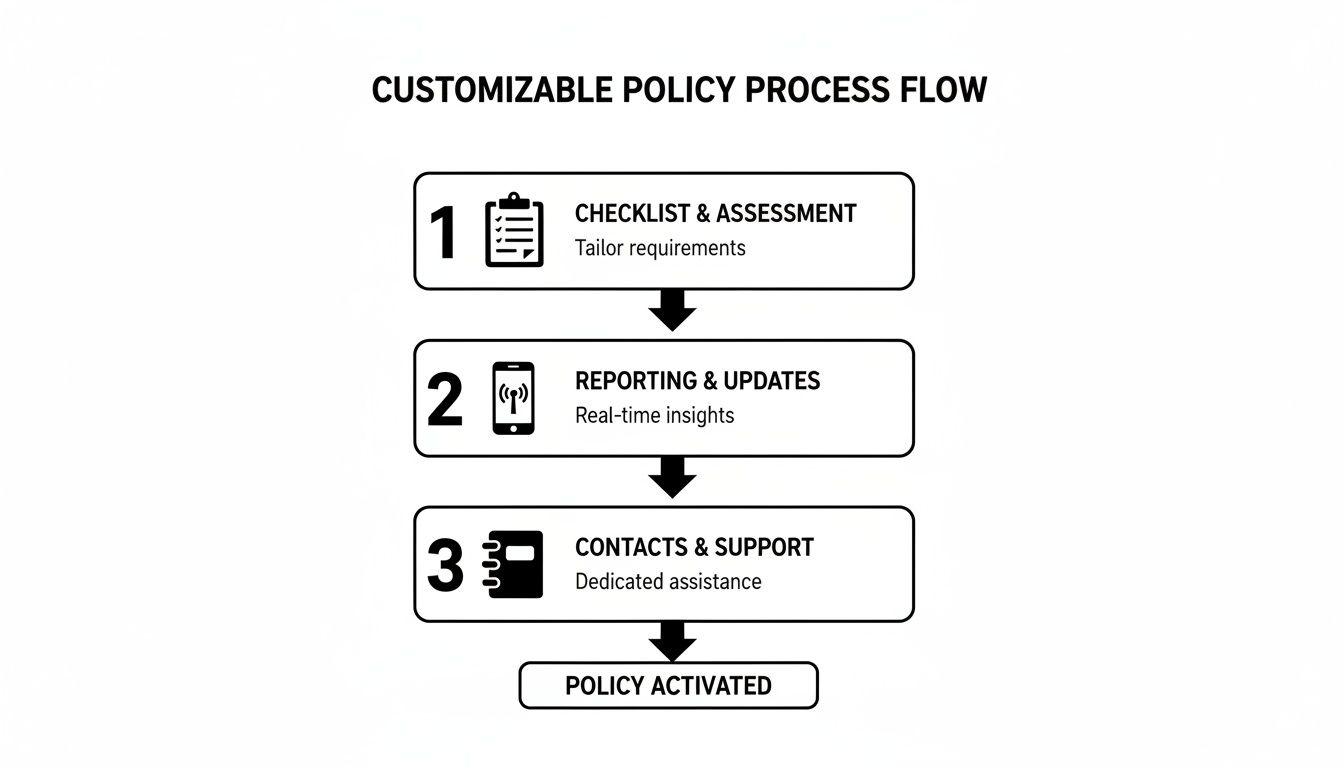
Vulnerabilities can come from anywhere—a smart thermostat, a networked security camera, or your business’s computer system. A hacker gaining control of your building's "smart" features is no longer a sci-fi plot; it's a real-world risk that demands a plan. For businesses, the stakes are even higher.
Industry experts are sounding the alarm. According to Aon's Global Risk Management Survey, cyber risks are on track to be the #1 global threat through 2028. Research from Forrester backs this up, finding that 37% of enterprise risk managers now see information security as their top concern. That’s because nearly 75% of enterprises experienced a critical risk event last year—and most were cyberattacks or IT failures.
What does this mean for your policy? It means integrating basic cyber hygiene:
- Routinely updating passwords on every device connected to the internet.
- Securing your Wi-Fi network with strong encryption.
- Mapping out a response plan for a data breach with the same seriousness you would for a physical break-in.
By actively maintaining and evolving your policy, you’re not just checking a box. You’re building a powerful, relevant shield that protects your property from both familiar hazards and the threats of tomorrow. It becomes your best evidence that you are a responsible, diligent property owner—exactly the kind of evidence you need when it’s time to file a claim.
Connecting Your Policy to a Successful Insurance Claim

All the planning in your risk management policy snaps into focus the moment a disaster hits. Suddenly, that document isn't just a defensive measure—it becomes your most powerful tool for financial recovery. After a fire, major storm, or flood, this policy is no longer about what if. It's about what now.
This is because your policy serves as the official record of your property's value and condition before the loss occurred. Insurance companies will question every detail, and without solid proof, a claim can easily get bogged down in a frustrating back-and-forth. Your policy provides the hard evidence needed to shut down those disputes before they even start.
Your Policy as Indisputable Proof
Let's play out a common scenario. An adjuster inspects your property after a severe hailstorm and suggests the roof damage looks like it came from years of neglect, not the recent storm. Without proof, that's a tough argument to counter.
Now, imagine you pull out your risk management policy and show them a maintenance log with dated photos from a professional inspection just six months prior, proving the roof was in excellent shape. The entire conversation changes.
This is the real-world power of documentation. Your policy’s contents give you the irrefutable evidence you need to build a rock-solid claim:
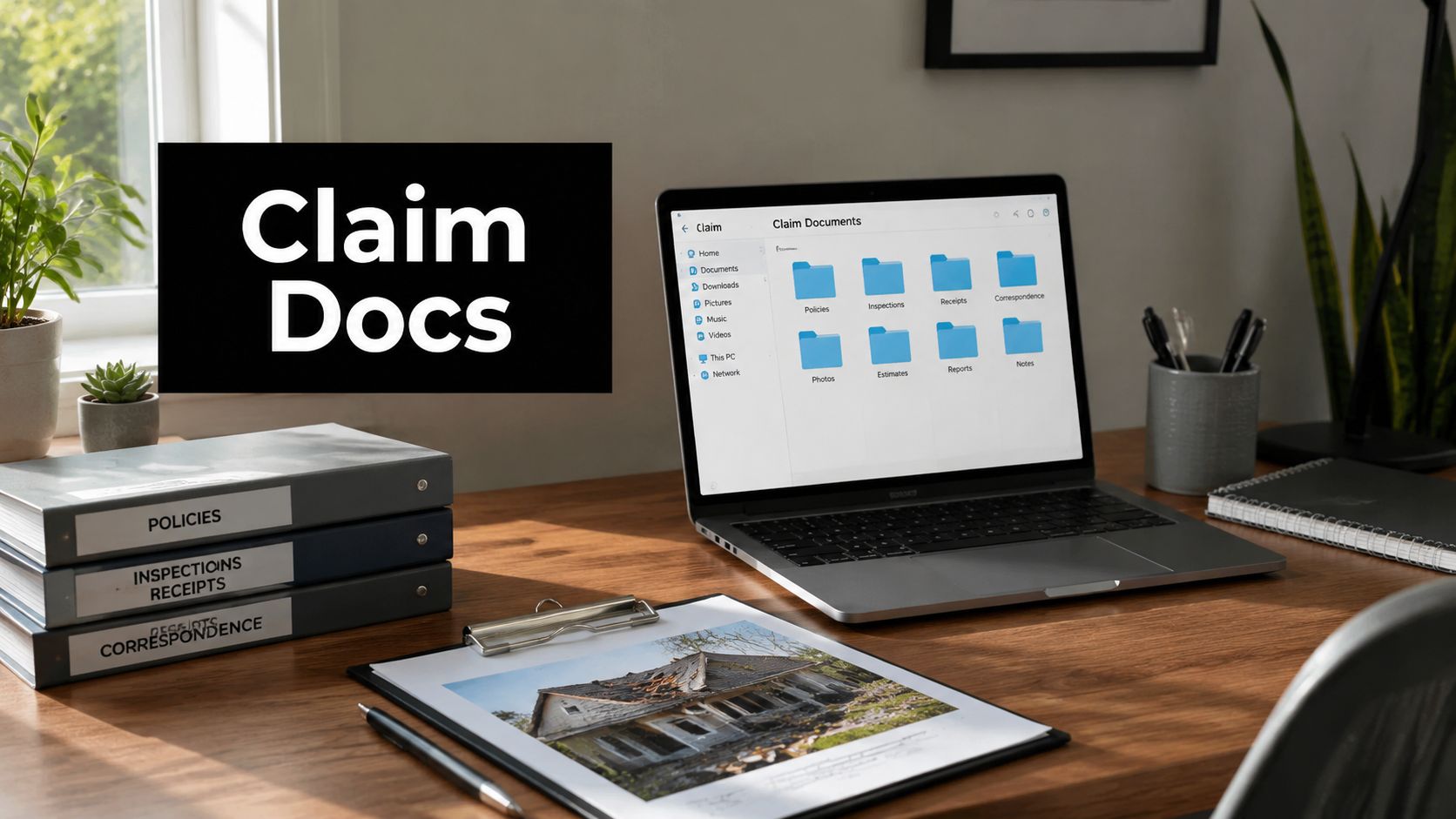
- Asset Inventories: A detailed catalog with photos, videos, and receipts leaves no room for an insurer to guess at—or undervalue—your damaged and destroyed property.
- Maintenance Logs: These records are your best defense against claims of pre-existing damage or poor upkeep. They prove you’ve been a responsible property owner.
- Incident Reports: Documenting the event as it happens creates a clear, immediate timeline that anchors your entire claim narrative.
Having this organized evidence ready to go makes the claims process smoother and faster. It cuts through the ambiguity and forces the insurance company to deal with the facts of your loss, not stall with tactics designed to delay or underpay your settlement. You can see exactly how this documentation fits into the big picture in our guide on how to file a property damage claim.
How a Public Adjuster Activates Your Plan
In the aftermath of a major loss, your focus should be on recovery, not on deciphering complex insurance policies and managing a mountain of paperwork. This is where a licensed public adjuster comes in, using your risk management policy as their playbook to take the administrative weight off your shoulders.
A public adjuster is much more than a paper-pusher; they are your expert advocate. They translate dense insurance language, find all the coverage you're entitled to, and build a comprehensive claim package based on the proof you've already gathered.
Their job is to negotiate aggressively on your behalf, using every piece of documentation in your policy to get you the maximum possible settlement. With regulations constantly changing—a recent PwC global compliance study found that 36% of organizations are investing more in compliance—having an expert advocate is more critical than ever.
By bringing in a public adjuster, you’re not just handing over a binder of documents; you're activating a pre-planned strategy for success. They put your preparation into action, ensuring every loss is valued correctly and that the insurance company fulfills its promise. This is how your foresight turns into a real financial outcome, giving you the resources to rebuild completely.
Your Risk Management Policy Questions, Answered
Alright, we’ve covered the theory behind a risk management policy. Now, let’s get practical. Property owners understandably have questions about how this works in the real world. Let's tackle a few of the most common ones we hear from our clients in Oregon and Washington.
Is a Formal Policy Really Necessary for My Home?
"Formal" might be a strong word, but a smart plan is absolutely essential. You don’t need a 50-page binder for a single-family home. What you need is a simple, organized system.
Think of it as your "in case of emergency, break glass" folder. This could be a straightforward document with emergency contacts, a complete photo or video inventory of your belongings, and a basic seasonal maintenance checklist you follow. When a pipe bursts or a storm hits, this simple preparation is what helps a public adjuster prove what you lost and show that you were a responsible property owner.
How Exactly Does This Policy Help My Public Adjuster?
A well-documented risk management policy is the single most powerful tool we can have in our arsenal when fighting for you. It immediately shifts the dynamic of an insurance claim.
Without it, a claim can devolve into a frustrating "he said, she said" debate with the insurance company's adjuster. They might argue about pre-existing damage or undervalue your possessions. With your policy in hand, we have a clear, dated record of your property's condition, maintenance history, and assets before the loss. It becomes a factual discussion, not an emotional one.
This documentation is what allows us to shut down bad-faith arguments, accelerate the entire claims process, and ensure every single loss is accounted for. It's the foundation for maximizing your final settlement.
This organized proof forces the insurer to deal with the reality of your loss, not their own assumptions, which is a game-changer for your financial recovery.
How Often Should I Be Updating My Policy?
Things change, and your policy needs to change with them. We strongly recommend a full review of your risk management policy at least once a year. More importantly, you need to update it immediately after any significant event.
What counts as a "significant event"?
- Completing a major renovation or adding a room
- Purchasing high-value items, like fine art, jewelry, or specialized equipment
- Changing how your property is used (e.g., starting a home-based business)
Keeping your policy current is not just busywork. It ensures the document accurately reflects your true risk and property value at any given moment. An outdated policy has gaps, and those gaps are exactly where insurance companies find reasons to underpay a claim.
Navigating the complexities of a property damage claim is a daunting task, but you don't have to face it alone. The expert team at NW Claims Management is here to manage the entire process for you, ensuring you receive the full and fair settlement you are rightfully owed. Get a free claim evaluation today by visiting us at https://nwclaimsmanagement.com.