When you file a property damage claim, it doesn't just land on a single person's desk. It enters the insurance company’s insurance claim management system—a massive software platform that acts as the digital brain for their entire operation.
Think of it as the carrier’s command center for handling every photo, report, email, and decision tied to your case.
What Is an Insurance Claim Management System?
From the moment you report a loss, your claim is logged into this sophisticated system. It’s the backbone of the insurer’s process, built to take in a flood of information and push your claim down a carefully designed path, from the first call to the final check.
A good analogy is an automated shipping facility. The system scans the "label" (your policy information), weighs the "package" (the evidence you provide), and sends it down a conveyor belt designed for one thing: carrier efficiency.
The Insurer's Digital Command Center
This platform is much more than a simple database. It’s a dynamic environment where company adjusters, their managers, and powerful software algorithms all interact. Every note from a phone call, every photo from an inspection, and every cost estimate is logged and tracked in one place. The goal is to create a predictable, documented, and repeatable process for them.
Behind the scenes, this command center is busy:
- Intake and Triage: It takes your initial report and automatically assigns it to an adjuster based on preset rules, like your location or the type of damage.
- Task Management: The system generates a to-do list for the adjuster, prompting them to perform specific tasks like "schedule inspection" or "request documentation."
- Data Collection: It acts as a digital vault, storing every piece of information related to your claim, from contractor bids to your personal property lists.
- Financial Processing: It manages the financial side, setting aside reserves (the money earmarked for your claim) and processing payments.
At its heart, an insurance claim management system is built to enforce the insurance company's internal rules, control financial exposure, and close claims with maximum efficiency. While it provides structure, its primary purpose is to protect the company's bottom line.
Why This System Matters to You
It’s critical to understand that your claim is being managed by a system, not just a person. These platforms are designed with the insurer’s financial interests as the top priority. They rely on automated tools to calculate damages and rigid workflows to standardize results, which can quickly put you at a serious disadvantage. This is a big reason why navigating the property damage claim process requires expertise.
For example, the software might spit out a repair estimate using national cost averages that completely ignore the higher price of labor and materials in Portland or Seattle. An automated workflow could also cause frustrating delays, leaving you in the dark while your claim sits in a digital queue.
This is exactly where having an expert on your side—like a public adjuster—makes all the difference. We know how these systems work, we know their limitations, and we know how to push back against their automated, often lowball, conclusions. Knowing the technology you’re up against is the first step in fighting for the full and fair settlement you’re entitled to.
How the Insurer's Claim System Actually Works
To truly understand how your insurance company handles a claim, you have to peek behind the curtain at their insurance claim management system. It’s not just one piece of software; it's more like a digital assembly line. Each station is designed to keep your claim moving along a predetermined path—one that’s built for the insurer's efficiency, not necessarily your best interest.
Let's pull apart this machinery and see what each component really does.
This flow chart gives you a bird's-eye view of how your claim travels from that first call or message to a final decision inside the insurer's system.
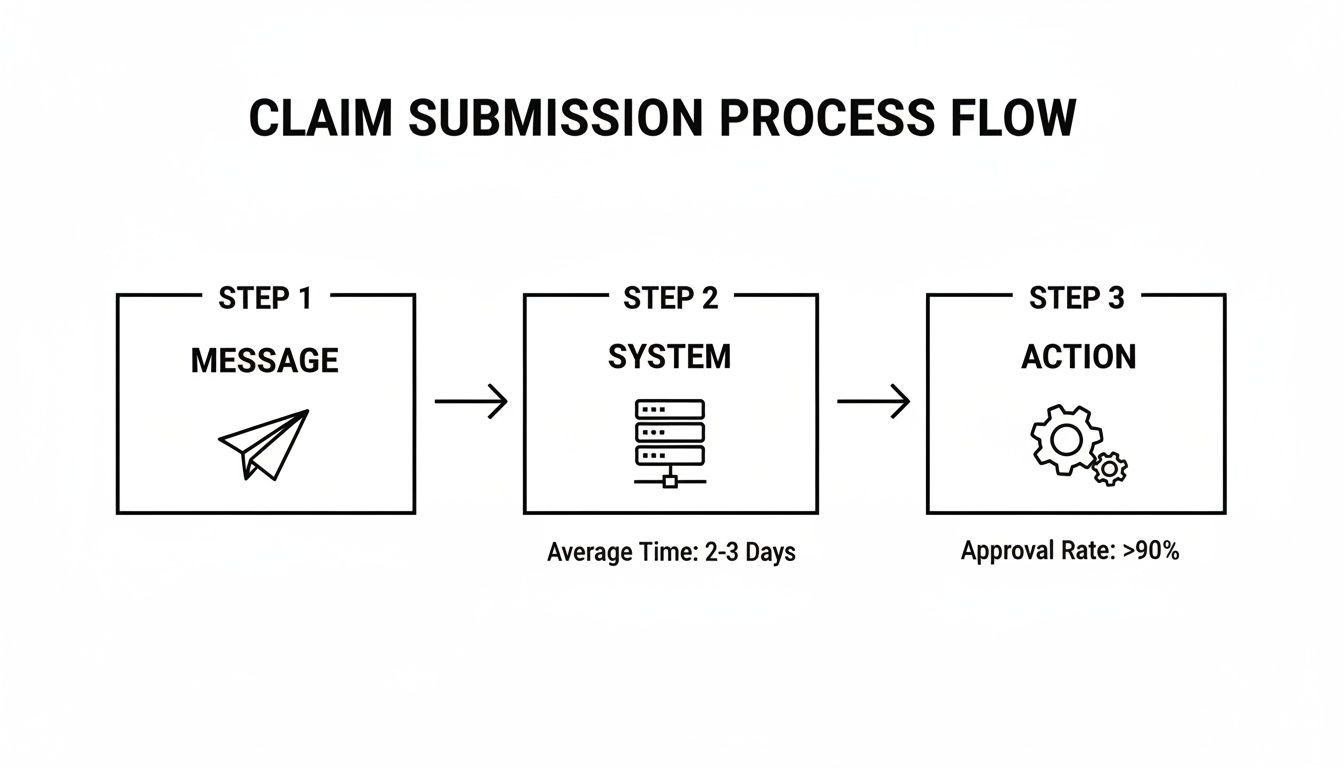
As you can see, the entire process is geared toward standardization and speed. That approach can easily gloss over the specific, unique details of your property damage and what it really takes to make you whole again.
Document Management: The Digital Filing Cabinet
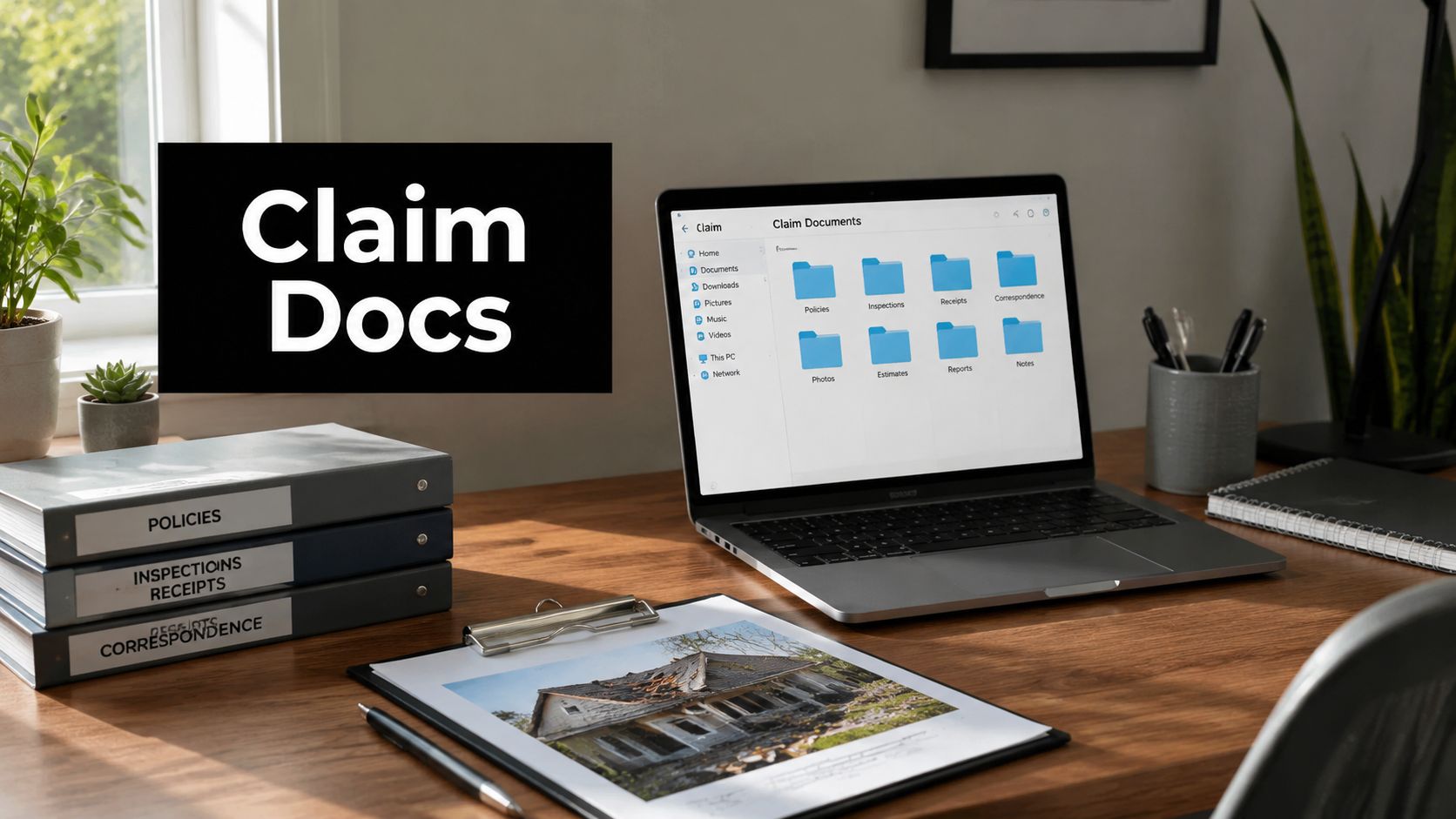
At its heart, the system is a massive, centralized digital filing cabinet. Every single thing you send in gets uploaded, tagged, and filed away. We’re talking about your initial report, photos of the damage, contractor bids, and that detailed inventory of your lost personal belongings.
This gives every company employee involved in your claim instant access to your file. But here’s the catch: the system only knows what’s put into it. If a critical photo is missing or a document doesn't get uploaded, the system moves forward with incomplete data, almost always leading to an undervalued settlement. It's also crucial to know which Insurance Industry Documents require specific handling, like notarization for a proof of loss form, to be considered valid.
Workflow Automation: The Conveyor Belt
This is where automation really kicks in, acting as the brains of the operation. The system follows a set of pre-programmed rules to push your claim from one desk to the next without human intervention.
- Intake & Assignment: As soon as you file, the system automatically assigns your claim to an adjuster, usually based on geography or the type of loss.
- Task Generation: It then populates a to-do list for that adjuster: "Schedule inspection within 48 hours," "Send reservation of rights letter," "Follow up with policyholder."
- Automated Triggers: Actions create reactions. For example, when the field adjuster uploads their report, the system might automatically flag it for a supervisor's review if the repair estimate is over a certain dollar amount.
The real danger here is the system's inflexibility. It’s built for cookie-cutter claims. If your situation is complex or unusual, it can get stuck in a loop or completely stalled because it doesn't fit the standard mold. This is one of the classic https://nwclaimsmanagement.com/insurance-adjuster-tricks/ that works against you without you even realizing it.
Communications Hub: The Official Record
Think of this part of the system as the official court record for your claim. Every email, note from a phone call, text message, and letter is logged and time-stamped. The goal is to build a complete, legally defensible history of every interaction.
This creates an official timeline the insurance company can—and will—use to justify its decisions. If you had a crucial phone conversation that wasn't properly noted in their system, then from their perspective, it never happened. This is why keeping your own detailed records and communicating in writing is absolutely non-negotiable for policyholders.
Estimating and Valuation Tools: The Cost Calculator
This is where things get really contentious. Insurers rely on powerful software, most commonly Xactimate, to calculate the cost of your repairs. The adjuster plugs in measurements and details about the damage, and the software spits out a line-item estimate based on its internal price list.
So, what's the problem? These price lists are often built on national or regional averages that simply don't match the on-the-ground reality of labor and material costs, especially in markets like Portland or Seattle. The software might price your roof repair using costs for basic asphalt shingles when you actually have expensive architectural tile. The result is a lowball offer that isn't even in the same ballpark as your actual replacement costs.
Now, technology is taking this a step further. Projections show AI will cut insurance claim processing times by up to 40% by 2026 by automating these reviews. While faster sounds better, it means even more reliance on algorithms programmed for cost-cutting, not accuracy. This is exactly where a public adjuster’s human expertise becomes indispensable—we know how to spot and challenge these flawed, computer-generated assessments to fight for what you’re truly owed.
How Your Insurance Company's Software Can Work Against You
Your insurance company will talk a big game about its “fair and efficient” claims process. And for them, it is efficient. But what you need to understand is that their insurance claim management system isn't built to make you whole. It’s built to protect their bottom line by standardizing payouts and minimizing costs on every single claim—including yours.
This creates a fundamental conflict of interest from the very start. These platforms are designed to settle claims as quickly and cheaply as they can, which often means your claim’s accuracy and completeness take a backseat.
The Problem With Cookie-Cutter Estimates
One of the biggest traps for homeowners is the automated valuation software these systems rely on. When the insurance adjuster walks through your fire-damaged home, they’re not just taking notes; they’re plugging data points into a program that spits out a repair estimate. The problem? This software almost always uses generic, national-average pricing.
This immediately puts you at a disadvantage. The actual cost of good contractors, quality lumber, and local permits in places like Portland or Seattle can be worlds apart from a national average. The software simply doesn't—and can't—calculate the true cost to rebuild your specific home to its pre-loss condition using local tradespeople and materials.
What you get is a computer-generated report that looks incredibly official and detailed, but is built on a faulty foundation. It's a lowball offer dressed up as an objective calculation, and if you don't know what to look for, it's almost impossible to fight.
This systemic undervaluation is exactly why an independent advocate is so critical. A public adjuster pushes back against these automated numbers with our own detailed estimates, using real, local pricing to reflect the true scope of your damages. To do this effectively, it's vital to know exactly what your policy covers. For a closer look, you can check out our guide on insurance policy limits.
The Real-World Cost of a Flawed System
This isn't just numbers on a page. The bias baked into an insurance claim management system has real, often devastating, consequences for families trying to put their lives back together after a disaster.
Take a recent fire damage claim we handled. The insurance company's adjuster used their software to generate a quick repair estimate. But the system’s simple, checklist-style process completely missed the hidden smoke and soot contamination that had worked its way deep into wall cavities and insulation. Their initial offer only covered what was easy to see, ignoring a serious problem that would have led to persistent odors and potential health risks down the road.
This is where the push for speed and simplicity completely fails homeowners. The system is programmed for the typical, not the thorough.
Here’s how these systems consistently shortchange you:
- Ignoring What’s Hidden: Software is terrible at spotting complex problems. It won't flag hidden water damage behind drywall, subtle structural issues, or pervasive smoke contamination.
- Choosing a "Patch" Over a "Proper" Fix: The system often defaults to the cheapest repair method, like patching a damaged wall instead of replacing the entire section, which is often what's needed for a lasting, quality restoration.
- Pushing Aggressive Timelines: Adjusters are under pressure from the system to close files quickly. This discourages them from taking the time needed to dig deep and conduct a truly comprehensive investigation of your loss.
It's a global issue. A 2026 market study on the European insurance industry found that true claims automation is surprisingly far behind. Over 80% of insurers admitted to having low automation levels, and only 17% have what's considered a mature, modern system, mostly because they're stuck with outdated technology. Now, 85% of them say modernizing their core claims systems is a top priority. What this means for you in the Pacific Northwest is that you’re often up against systems that are either too old to be effective or too automated to be fair. You can see the full 2026 report on the state of claims to learn more.
At the end of the day, the insurer's claims system is a powerful tool built for one purpose: to serve their interests. It tilts the playing field in their favor from day one. Bringing in a public adjuster is the single most effective way to level that field and ensure your claim is settled based on reality—not a cost-saving algorithm.
How a Public Adjuster Levels the Playing Field

Think of the insurance company’s claim process as their home-field advantage. Their insurance claim management system and their entire team are aligned to protect their bottom line. A public adjuster is the expert advocate who shows up to play for your team, evening the odds.
As licensed professionals who work exclusively for policyholders, our one and only job is to counter the insurer's cost-minimizing system. We do this with our own expertise, tools, and unwavering dedication to getting you the full amount you're entitled to.
Challenging the System with Expertise
A public adjuster’s main purpose is to step in on your behalf, helping you understand your policy and effectively negotiate with an insurance adjuster for a fair settlement. We don't just poke holes in the insurer's lowball offer; we build an entirely new, more accurate case from the ground up.
This isn't about arguing. It's about presenting undeniable facts. Instead of just accepting what their software spits out, we build an independent, meticulously documented claim that captures the true scope of your loss.
A public adjuster is your translator and your champion. They decipher complex policy language, manage the overwhelming paperwork, and handle all communications with the insurance company so you don’t have to.
Having this expert in your corner brings incredible peace of mind during what is already an incredibly stressful time. You're no longer alone, trying to make your case to a massive corporation. You have a seasoned professional fighting for your best interests every step of the way.
The fundamental difference in approach is striking. The insurer's system is built to serve their interests, while a public adjuster's advocacy is built to serve yours.
Insurer's System vs Public Adjuster Advocacy
| Aspect | Insurer's Claim Management System | Public Adjuster (NW Claims Management) |
|---|---|---|
| Primary Goal | Minimize claim payout to protect profits. | Maximize your claim settlement to ensure full recovery. |
| Damage Assessment | Relies on standardized software and quick inspections. | Conducts a forensic, on-site investigation for all damage. |
| Cost Estimates | Uses generic, often outdated pricing databases. | Creates detailed estimates using current, local labor and material costs. |
| Policy Interpretation | Applies coverage narrowly, often overlooking entitlements. | Scours the policy to find and apply all available coverage. |
| Advocacy | The adjuster works for and represents the insurance company. | We work for and represent you, the policyholder, exclusively. |
This table highlights the core conflict: you cannot rely on the opposing team's system to give you a fair score. You need your own advocate.
Documenting What the Software Misses
Where an insurer’s system is designed for speed and generalization, our process is built for detail and precision. We don't just do a walkthrough; we conduct a forensic investigation of your property.
- Comprehensive Damage Assessment: We meticulously document every single item of damage. This is especially crucial for the hidden issues automated software almost always misses, like smoke contamination inside walls or subtle foundation cracks after a storm.
- Detailed Cost Estimation: We develop our own line-item estimates using current, local pricing for materials and labor right here in your community, whether that's Portland or a small town in rural Washington.
- Policy Expertise: We dig deep into your insurance policy to find and apply every clause that benefits you, including coverage for things like code upgrades or additional living expenses that you might not even know exist.
This aggressive, detailed documentation has never been more critical. The property and casualty insurance sector is facing significant financial pressure from rising claims severity. For property owners in Oregon and Washington, this squeeze often means insurers are more motivated than ever to use their systems to keep payouts low. A public adjuster provides the certified expertise needed to push back and demand a full, fair settlement.
By building such a robust, evidence-backed claim, we shift the entire conversation. The negotiation is no longer about their system-generated numbers; it’s about the real-world facts of your loss. This powerful advocacy is one of the most significant benefits of hiring a public adjuster.
Protecting Your Rights in Oregon and Washington

When you file an insurance claim, you’re not just dealing with your carrier’s internal policies. You’re operating within a legal framework defined by your state. Both Oregon and Washington have specific laws that spell out your rights as a policyholder, serving as your primary shield against unfair delays or claim denials.
While the carrier’s insurance claim management system is programmed to comply with these rules, its main purpose is to process claims efficiently for the company's bottom line. Knowing your legal rights gives you the power to make sure that system—and the human adjuster behind it—is treating you fairly.
Key Deadlines for Insurers in Oregon
Oregon has very clear rules for how insurance companies must act once a claim is filed. These regulations, found in the Oregon Administrative Rules and Revised Statutes, are designed to keep the process moving and prevent carriers from dragging their feet.
Here’s what that looks like in practice. Once they receive notice of your loss, your insurer must:
- Acknowledge the Claim: Respond to you within 15 days.
- Provide Paperwork: Send you the necessary claim forms and instructions, also within 15 days.
- Investigate Promptly: Complete their investigation of the claim within 30 days. If for some reason they can't, they are required to notify you about the delay and continue to update you every 45 days until it's finished.
One of the most critical rules governs how quickly you get paid. Once you and the insurer agree on a settlement, they have just 30 days to issue payment. Missing any of these deadlines is a direct violation of Oregon’s Unfair Claim Settlement Practices Act.
As public adjusters, we use this legal framework as a core part of our strategy. We monitor these deadlines relentlessly at NW Claims Management, making sure the insurance company is held accountable every step of the way.
Understanding Your Rights in Washington
Washington provides similar protections for consumers through its own Unfair Practices Act, detailed in the Washington Administrative Code (WAC). These regulations set firm expectations for how insurers must communicate and handle claims.
After you report a claim in Washington, your carrier is obligated to:
- Respond Promptly: Acknowledge your claim and supply the required paperwork within 10 working days.
- Communicate in Writing: If your claim is denied or only partially paid, they must give you a written explanation. This isn't just a simple "no"—it has to reference the specific policy language they're using to justify their decision.
- Fair Investigation: Insurers are legally forbidden from trying to force you into litigation by offering a settlement that is substantially less than what the claim is actually worth.
These aren't just polite suggestions; they are legal requirements. An insurance claim management system might be set up to send automated letters, but it takes a human expert to ensure those communications are transparent and fully compliant with state law.
The team at NW Claims Management uses our deep knowledge of these state-specific rules to protect you. We measure every action the insurance company takes against these legal standards. If they miss a deadline or their explanation is vague, we use it as leverage to advocate more strongly on your behalf, ensuring your rights are never ignored in their rush to close a file.
How to Get Started with NW Claims Management
Dealing with property damage is stressful enough. When you’re also up against an insurance company and its complex insurance claim management system, it’s easy to feel outmatched and completely overwhelmed.
If you’re ready to get an expert in your corner, the good news is that starting the process is simple. We've designed it to get you the help you need right away, without any upfront cost or risk.
Your Initial Claim Consultation
It all begins with a conversation. We offer a free, no-obligation consultation where you can talk to one of our licensed public adjusters. This isn’t a sales pitch; it's a chance for us to hear what happened, review the details of your property damage, and give you a clear-eyed assessment of your situation.
This first call is incredibly important. We’ll talk through:
- The specifics of your loss, whether it was a fire, major water leak, storm damage, or anything else.
- Where you are in the process and what your interactions with the insurance company have been like so far.
- Any settlement offers you've received or the frustrating delays you might be facing.
- Your immediate needs and biggest worries.
This is your time to ask us anything. We want to pull back the curtain on the claims process and show you that a better outcome is not only possible but expected when you have the right advocate.
We operate on a contingency-fee basis. This is our promise to you: we don't get paid unless you get paid. There are absolutely no upfront fees for our services. Our success is directly tied to yours.
Building Your Custom Claim Strategy
Once you decide to bring us on board, we get to work immediately. This is where our decades of experience really shine. We don’t just accept the insurance company’s assessment; we build our own case from the ground up, designed specifically for your unique claim.
First, we do a forensic policy review. We comb through your entire insurance contract to find every bit of coverage you're entitled to—and we often find sources of funds that policyholders never even knew existed.
Next comes the detailed on-site damage inspection. Our team goes far beyond the quick, surface-level look you got from the company adjuster. We document everything, from the obvious structural damage to the hidden issues, like smoke particles in your ventilation or moisture trapped behind walls, that their systems are often designed to overlook.
With this deep well of evidence, we assemble a comprehensive proof of loss and take over all negotiations. We handle the phone calls, the paperwork, and the deadlines so you don’t have to. Our job is to fight for the maximum settlement you are owed, giving you the space to focus on what’s truly important: putting your life back together.
Frequently Asked Questions
After your property is damaged, you’re bound to have a lot of questions. The insurance process can feel confusing and overwhelming, so we’ve put together answers to the questions we hear most often from homeowners just like you.
What Is the Main Difference Between the Insurers Adjuster and a Public Adjuster?
It really boils down to who they work for. The adjuster sent by your insurance company is their employee, and their job is to protect the company’s bottom line while operating within its insurance claim management system.
A public adjuster, on the other hand, is an independent professional you hire to represent you and only you. At NW Claims Management, our sole focus is advocating for your best interests. We’re on your side of the table, fighting to make sure you get the full and fair settlement you’re owed according to your policy.
Can I Still Hire a Public Adjuster if My Claim Is Already in Progress?
Yes, and it’s incredibly common. We often get calls from homeowners who are weeks or even months into a claim. They’re usually frustrated by the delays, the confusing requests for information, or an initial settlement offer that doesn't come close to covering the real cost of repairs.
A public adjuster can step in at any point. We can review your claim from the beginning, reassess the damage to find what the company adjuster overlooked, and reopen negotiations to secure a better outcome. It’s almost never too late to bring in a professional advocate.
The most common reason clients hire us mid-claim is after receiving a lowball offer. They realize the insurer's system is not designed to be generous and that they need a professional to challenge the initial assessment and advocate for a fair number.
How Much Does a Public Adjuster Cost?
This is an important question, and the answer should give you some peace of mind. NW Claims Management works on a contingency fee basis, which means you pay nothing upfront. There are no retainers or out-of-pocket expenses.
We are paid a small, agreed-upon percentage of the final settlement we recover for you. If we can’t increase your claim payout, you owe us nothing. This approach ensures our goals are perfectly aligned with yours—we only succeed when you do. To see a full breakdown, you can learn about public adjuster costs in our detailed guide.
Is an Insurance Claim Management System Designed to Help Me?
Frankly, no. While these systems make an insurer’s internal process more efficient, they are built to serve the company's protocols and financial interests, not the policyholder’s.
These platforms often rely on automated tools and standardized pricing that can undervalue complex or unique property damage. A public adjuster provides the critical human expertise needed to challenge the system’s often-inadequate output and fight for a valuation that is truly fair to you.
Are you feeling overwhelmed by your property claim or concerned you're not being offered a fair settlement? The expert team at NW Claims Management is ready to help. Contact us today for a free, no-obligation consultation to take back control of your claim. Learn more at nwclaimsmanagement.com.