When disaster strikes your property, one of the first people you'll meet is an adjuster from your insurance company. But it’s crucial to understand they aren’t there to be your friend. They work for the insurer. An insurance claim public adjuster, on the other hand, is a licensed expert you hire to be in your corner exclusively.
Think of it this way: a public adjuster is like having a seasoned attorney represent you in court. They are your dedicated advocate, focused entirely on fighting for the best possible outcome for you and you alone.
Who Fights for You After a Property Loss
After you file a claim, the insurance world can suddenly feel like a confusing maze of unfamiliar faces and conflicting interests. It's easy to assume everyone is there to help, but you need to know who is truly on your team.
The adjuster your insurance provider sends out works for them. Their job is to evaluate the damage and close the claim based on the insurance company's guidelines and financial interests. This creates a natural conflict of interest, as their goal is often to minimize what the company has to pay out.
Your Guide to Insurance Adjusters
To make sense of it all, it helps to break down the three types of adjusters you might run into. While their titles may sound similar, their loyalties are worlds apart. This table clarifies who works for whom.
| Adjuster Type | Who They Represent | Primary Goal |
|---|---|---|
| Company Adjuster | The Insurance Company | Settle the claim efficiently and cost-effectively for their employer. |
| Independent Adjuster | The Insurance Company | Act as a third-party contractor for the insurer, with the same goal as a company adjuster. |
| Public Adjuster | You, the Policyholder | Maximize your settlement by thoroughly documenting your loss and advocating for your rights. |
As you can see, only one of these professionals has a legal and ethical duty to protect your interests.
A public adjuster levels the playing field. They bring expert knowledge of policy language and claims negotiation to ensure your side of the story is fully represented and expertly argued.
When dealing with a complex issue like a complete guide to a wind damaged roof insurance claim, having an expert on your side is invaluable. They take on the burden of compiling evidence, interpreting dense policy language, and negotiating with the insurer.
The bottom line is simple: the adjuster sent by your insurance company is not a neutral party. Our internal guide dives deeper into this distinction, but to learn more about who truly represents your interests, just remember who signs their paycheck.
Hiring your own insurance claim public adjuster is the only way to guarantee you have an expert fighting for your maximum recovery right from the start.
What Does a Public Adjuster Actually Do for Your Claim?
After a fire, flood, or major storm, you're not just dealing with the damage—you're dealing with the shock and the overwhelming task of putting your life back together. In the middle of all that chaos, a public adjuster steps in with a single, clear mission: to make sure you get every single dollar you are entitled to from your insurance company.
Their job is so much more than just filling out forms. Think of them as your personal claim expert, fluent in the complex language of insurance policies and a master negotiator in a system that can often feel stacked against you.
We Speak Their Language: Decoding Your Policy
Insurance policies are dense legal contracts, often written in confusing language that heavily favors the company that wrote them. We know exactly where to look for coverage you probably don't even know you have. It could be a hidden endorsement for debris removal, a specific provision for bringing your property up to current building codes, or other benefits buried in the fine print.
A public adjuster levels the playing field. We bring the same level of expertise to your side of the table that the insurance company has on theirs. This ensures your story is heard, expertly documented, and argued, so you aren't steamrolled by a massive corporation.
Building Your Case: The Deep Dive into Damage Assessment
The adjuster your insurance company sends out might do a quick walkthrough and call it a day. That’s not how we work. A public adjuster’s inspection is forensic in its detail because we know from experience that the worst damage is often the damage you can't see.
Our job is to build an undeniable case for your loss, which involves a deep, systematic investigation.
- Finding What's Hidden: We use specialized tools like thermal imaging cameras and moisture meters to uncover water damage lurking behind walls or find soot and smoke contamination that has settled deep into attics and crawlspaces.
- Calculating the True Cost: For a business, this means accurately calculating business interruption losses—a complex process that insurance companies are notorious for undervaluing. For homeowners, it means accounting for every single item, from the couch down to the contents of your junk drawer.
- Creating Rock-Solid Documentation: A key piece of evidence is a professional property inspection report template, which documents every detail of the damage. This leaves no room for doubt.
We compile all this evidence into a comprehensive Proof of Loss package. This isn't just a simple list of damaged items; it's a meticulously constructed argument, backed by photos, expert reports, and precise estimates that leaves the insurance company very little room to argue. You can get a better sense of our detailed approach by reading about our professional property damage assessment services.
The Real Value? Getting Your Life Back
Frankly, managing a major insurance claim is a full-time job. It’s a grind of constant phone calls, endless paperwork, and stressful negotiations—all while you’re trying to recover from a disaster.
Hiring a public adjuster takes that entire weight off your shoulders.
You’re free to focus on what really matters: taking care of your family, getting your business running again, and moving forward. We handle the frustrating phone calls, the back-and-forth emails, and the tough conversations. It gives you the space and peace of mind you need to actually recover.
Your Claim Journey with a Public Adjuster
It’s one thing to read about what a public adjuster does, but it’s another thing entirely to see how they work. To really get a feel for the process, let's follow a real-world example of how an expert advocate can completely change the outcome of a claim.
Picture this: a family—we'll call them the Smiths—is jolted awake by a house fire. The immediate danger is over, but the aftermath is devastating. Nearly every room is covered in soot, and the water used to fight the flames has soaked their walls, floors, and belongings. They're displaced, overwhelmed, and have no idea what to do next. This is exactly where an insurance claim public adjuster steps in.
The Initial, No-Cost Claim Review
The first step isn't about signing a contract; it's about getting some honest answers. The Smiths schedule a free, no-obligation consultation with a public adjuster. During this meeting, the adjuster sits down with them, goes over their insurance policy line by line, and does an initial walkthrough of the damaged home.
This single conversation gives the Smiths a clear, professional assessment of the situation. The adjuster confirms the damage is extensive and complex—far more than just what's visible. For the first time since the fire, the Smiths feel a sense of clarity and control, knowing they have an expert who can help them navigate the road ahead.
The infographic below shows the core steps a public adjuster takes to deliver value and reduce your stress.
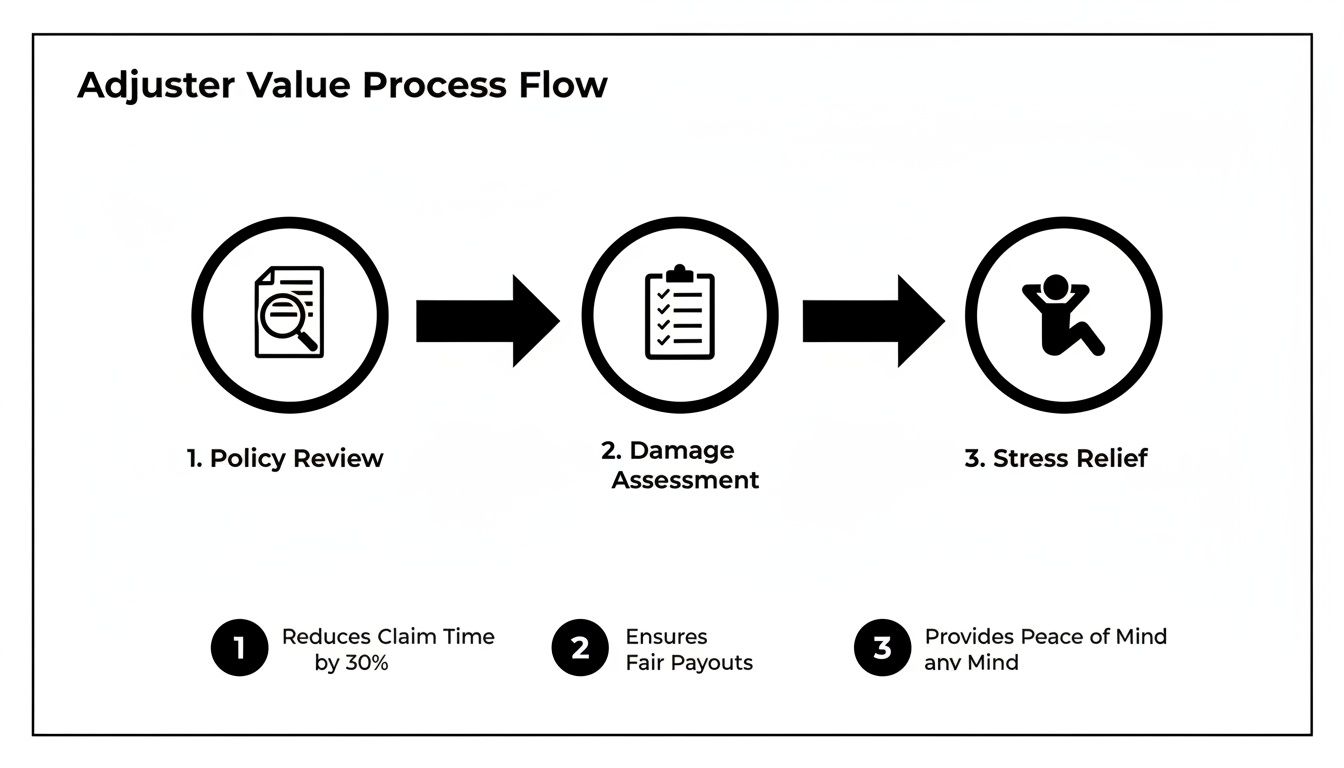
As you can see, the process moves from a deep dive into your policy to a meticulous damage assessment. The goal is always the same: to take the burden off your shoulders.
Comprehensive Damage Documentation
With the go-ahead from the Smiths, the public adjuster begins the real work: a deep, investigative inspection of the property. This goes miles beyond the quick look-over that an insurance company's adjuster might perform. It’s about uncovering every bit of damage, both obvious and hidden.
- Advanced Tools: The adjuster uses thermal imaging cameras to find trapped moisture behind drywall and specialized moisture meters to map out the full extent of the water damage.
- Expert Analysis: They pinpoint how far smoke and soot have traveled, identifying contamination in the attic, inside walls, and throughout the HVAC system. This is the kind of damage that's often missed but can lead to mold and long-term health problems if not addressed.
- Detailed Inventory: A painstaking inventory of every single lost or damaged item begins. We're talking everything from the couch and TV down to every shirt in the closet and utensil in the kitchen drawer, with the correct replacement cost documented for each.
Building and Negotiating the Claim
Armed with a staggering amount of detailed evidence, the public adjuster assembles a formal Proof of Loss document. This isn't just a claim form; it's a comprehensive, evidence-backed report that details every facet of the damage and the exact costs to make the Smiths whole again. It’s built to leave no room for argument.
This is where the public adjuster's expertise really comes into play. When the insurance company returns with a low offer, the adjuster is ready. They counter it with indisputable proof, quoting specific language from the Smiths' own policy to justify every dollar requested. This expert handling of the property damage claim process is precisely how a public adjuster earns their fee.
After some skilled back-and-forth, a fair settlement is finally agreed upon. The public adjuster meticulously reviews the final numbers to ensure everything is correct before the check is cut. For the Smiths, this means receiving the full amount they are rightfully owed—enough to rebuild their home properly and replace what they lost. A chaotic, traumatic event was transformed into a structured and complete recovery.
Understanding the Cost and Your Financial Return

When you're already dealing with the financial stress of property damage, the last thing you want is another big bill. That’s why one of the first questions we always hear is, "So, what's this going to cost me?" It's a fair question, and the answer might surprise you.
Reputable public adjusters don't charge you by the hour or ask for a hefty retainer. Instead, we work on a contingency fee basis. In simple terms, this means we only get paid if you get paid. Our fee is a small, pre-approved percentage of the claim settlement we secure for you.
There are no upfront costs to get us on your side. This model aligns our goals completely with yours—we are 100% motivated to get you the absolute best possible settlement. If you don't recover any money, you don't owe us a dime.
A Strategic Investment, Not an Expense
It's easy to see the adjuster's fee as just another expense, but it’s more accurate to think of it as an investment in your financial recovery. While your insurance policy doesn't pay for our fee, the value we bring to the table almost always means you walk away with a much larger settlement, even after our fee is accounted for. We dive deeper into what goes into our fees in our guide to public adjuster costs.
Let's break down how this works with a real-world example.
Real-World ROI Example
Imagine your insurer offers an initial settlement of $100,000 for major water damage. On the surface, it seems like a decent amount, but your gut tells you it’s not nearly enough to make things right. You decide to hire a public adjuster.
We come in, document everything meticulously, find damages the company adjuster missed, and build an airtight case for a higher payout.
- Insurer’s Initial Offer: $100,000
- Public Adjuster's Final Settlement: $170,000 (a 70% increase)
- Public Adjuster Fee (10%): $17,000
After our fee, you receive $153,000. That’s $53,000 more than the insurance company’s original offer. This is the money that pays for proper repairs without cutting corners, covers hidden costs, and truly helps you recover.
Hiring a public adjuster isn’t about giving up a piece of your settlement. It’s about making the entire settlement pie bigger so that your final slice is substantially larger than what you would’ve gotten on your own. You get an expert advocate, peace of mind, and a much better financial result.
Knowing When You Need to Hire a Public Adjuster
When it comes to a property damage claim, timing can make all the difference. While a public adjuster can step in to help at any point, the absolute best time to hire one is right after the damage happens.
Getting a professional on your side from the very beginning allows them to manage the entire process, steering you clear of common pitfalls that can jeopardize your claim later on.
This is especially true before you give a recorded statement. Your insurance company’s adjuster is trained to ask questions in a very specific way, and anything you say can be used to limit your payout. Having an insurance claim public adjuster guiding you ensures you don't accidentally say something that undermines your own case.
Of course, many property owners don't realize they're in trouble until problems start piling up. If you're facing any of the issues below, it’s a strong signal that you need a professional advocate in your corner.
Red Flags That Signal You Need an Advocate
Learning to spot when your insurance company isn't acting in your best interest is the first step to getting your claim back on track. If any of these situations feel familiar, it's time to bring in an expert.
- Significant Claim Delays: Is the insurance company taking forever to respond? Are they constantly "losing" paperwork or going silent for weeks at a time? These are classic delay tactics, often used to wear you down so you'll accept a low offer out of sheer frustration.
- A Shockingly Low Settlement Offer: This is one of the biggest red flags. If the insurer's initial offer won't even cover the basic cost of repairs, they are betting that you don't have the expertise to challenge their numbers. Don't fall for it.
- A Complex or Large-Scale Loss: A major fire, a severe storm, or extensive water damage creates an incredibly complex claim. These events involve layers of hidden damage, local building code requirements, and competing scopes of work that demand an expert eye to properly document.
- An Unfair Claim Denial: Sometimes an insurer will deny a claim based on a confusing or technical interpretation of the policy's fine print. A public adjuster can dissect your policy, analyze the reason for the denial, and build a powerful case to overturn it if it's been handled wrongfully.
A lowball offer or an outright denial isn't the end of the road. It's an invitation to bring in an expert who knows how to build a case that the insurance company can't ignore.
Whether you're a homeowner dealing with the aftermath of a fire or a business owner whose property was flooded, these warning signs mean you're no longer on a level playing field. To dig deeper into your specific situation, you can read our detailed guide explaining when to hire a public adjuster.
Don't wait until the situation feels hopeless. An expert advocate can step in at any stage to turn the tide in your favor.
Navigating the Rules in Oregon and Washington
When you're dealing with an insurance claim, where you live matters. The rules that govern insurance settlements aren't the same everywhere; they can change dramatically once you cross a state line. This is especially true in the Pacific Northwest, where both Oregon and Washington have put specific consumer protections in place.
That’s why you can't just hire any public adjuster—you need someone who lives and breathes the local regulations. In both Oregon and Washington, public adjusters are required to be officially licensed and bonded. This isn't just red tape. It's your guarantee that the professional you're trusting is recognized by the state and held to a high ethical standard.
How Local Rules Protect You
Working with a local public adjuster gives you a real home-field advantage. They're not just reading a rulebook; they have hands-on experience navigating the specific laws that can make or break a claim's outcome in our region.
Choosing a licensed adjuster in your state means you're not just hiring an expert; you're hiring a professional who is legally accountable for representing your best interests under local law.
This in-depth knowledge of state-specific regulations is what gives your claim a solid footing from day one. Here are just a couple of examples of how these local rules work in your favor:
- Fee Caps: Some states, like Oregon, put a ceiling on what a public adjuster can charge. This protects you from unfair or excessive fees and ensures the focus stays on maximizing your settlement.
- Contract Requirements: State law outlines exactly what needs to be in a public adjuster’s contract, including your right to cancel the agreement within a certain number of days.
This kind of local expertise is about more than just checking boxes. It’s about building a claim that’s compliant, strong, and ready for negotiation, giving you a powerful edge when you need it most.
Common Questions We Hear About Public Adjusters
When you're facing a major property loss, deciding whether to hire a public adjuster is a big step. It’s completely normal to have questions. Your home and financial stability are on the line, so you need answers you can trust. Let's walk through some of the most common concerns we hear from property owners just like you.
What’s the Real Difference Between a Public Adjuster and the One My Insurance Company Sent?
This is probably the most important question you can ask, and the answer comes down to one word: loyalty.
Think of it this way: the adjuster your insurance company sends out works for them. They are on the insurance company's payroll, and their job is to protect their employer’s bottom line. This means their goal is often to close your claim as quickly and for as little money as possible. It's an inherent conflict of interest.
A public adjuster, on the other hand, works for you and only you. We are your exclusive representative in the claim process. Our legal and professional duty is to you, the policyholder, and our primary objective is to make sure you receive the maximum settlement you're entitled to. Our success is directly tied to yours.
I Already Filed My Claim. Is It Too Late to Get Help?
Absolutely not. We often hear from clients who are frustrated, stuck, or feel like they're getting the runaround. It is never too late to bring in a professional advocate.
We can jump in at any point in the claims process. Many property owners call us when they need an expert to:
- Take over stalled or difficult negotiations.
- Re-open a claim that was underpaid to fight for the money that was left on the table.
- Challenge a wrongful claim denial and work to get it overturned.
Even if you’ve already cashed a check from the insurance company, we can still perform a detailed review. If you were short-changed, we can go back and recover the difference.
Your claim isn't truly "over" until you've been paid fairly and in full. If you have any doubt that you have been, it's not too late for a second opinion.
Is My Claim Big Enough to Justify Hiring a Public Adjuster?
You might be surprised. What looks like a "small" claim at first can quickly spiral into something much more complex and expensive. Issues like hidden water damage behind walls, widespread smoke contamination, or complicated building code requirements can turn a seemingly straightforward repair into a major project.
You don't have to make this call on your own.
The best way to find out is to have an expert take a look. We provide a free, no-obligation claim review to give you a clear and honest assessment. This no-risk first step will tell you whether professional representation could significantly increase your financial recovery.
Don't let your insurance company be the one to decide what your property loss is worth. Let the experts at NW Claims Management fight for the full, fair settlement you deserve. Get your free claim evaluation by visiting https://nwclaimsmanagement.com today.