A contractor takes your deposit, framing goes up, and then the phone goes dead. No crews show up. No call backs. Now you're standing in a half-finished home or storefront, trying to figure out whether the words bonded and insured mean you still have a path to recover money, or whether they were just part of a sales pitch.
That confusion is common because people often treat contractor bonding insurance as one thing. It isn't. A bond and an insurance policy protect against different kinds of loss, pay different people, and trigger for different reasons. If you're an owner in Oregon or Washington, that difference can decide whether you pursue the contractor, the surety, the insurer, or all three. If the job has already gone sideways, preserving records and job-site evidence right away matters, and a practical starting point is this evidence preservation guide.
When the Contractor Disappears and What Comes Next
The worst part of a walk-off job is rarely just the money. It's the unanswered questions. You're left with demo dust, materials sitting in the driveway, and a project that now has to be explained to your lender, your spouse, your tenants, or your HOA.
Start with the documents, not the argument
The first impulse is usually to call and text until somebody picks up. That's understandable, but the better move is to gather the contract, change orders, payment receipts, photos, permits, and every message that shows what was promised and what happened. If the contractor vanished, the paper trail becomes the key evidence.
A lot of owners also assume they can just file “a claim against the insurance.” That's where the confusion starts. If the contractor's problem is unfinished work, the relevant instrument may be a surety bond, not a liability policy. If the problem is a busted pipe, a ladder accident, or a truck into the garage, that's a different lane entirely.
Practical rule: unfinished work points first to a bond question, while accidents and damage point first to insurance.
The title bonded and insured sounds reassuring, but it hides two separate promises. One is about completing or paying for the job. The other is about accidental loss. If you learn nothing else before signing the next contract, learn that the same project can involve both, and each one reacts to a different kind of failure.
What a Surety Bond Actually Is and How It Differs from Insurance
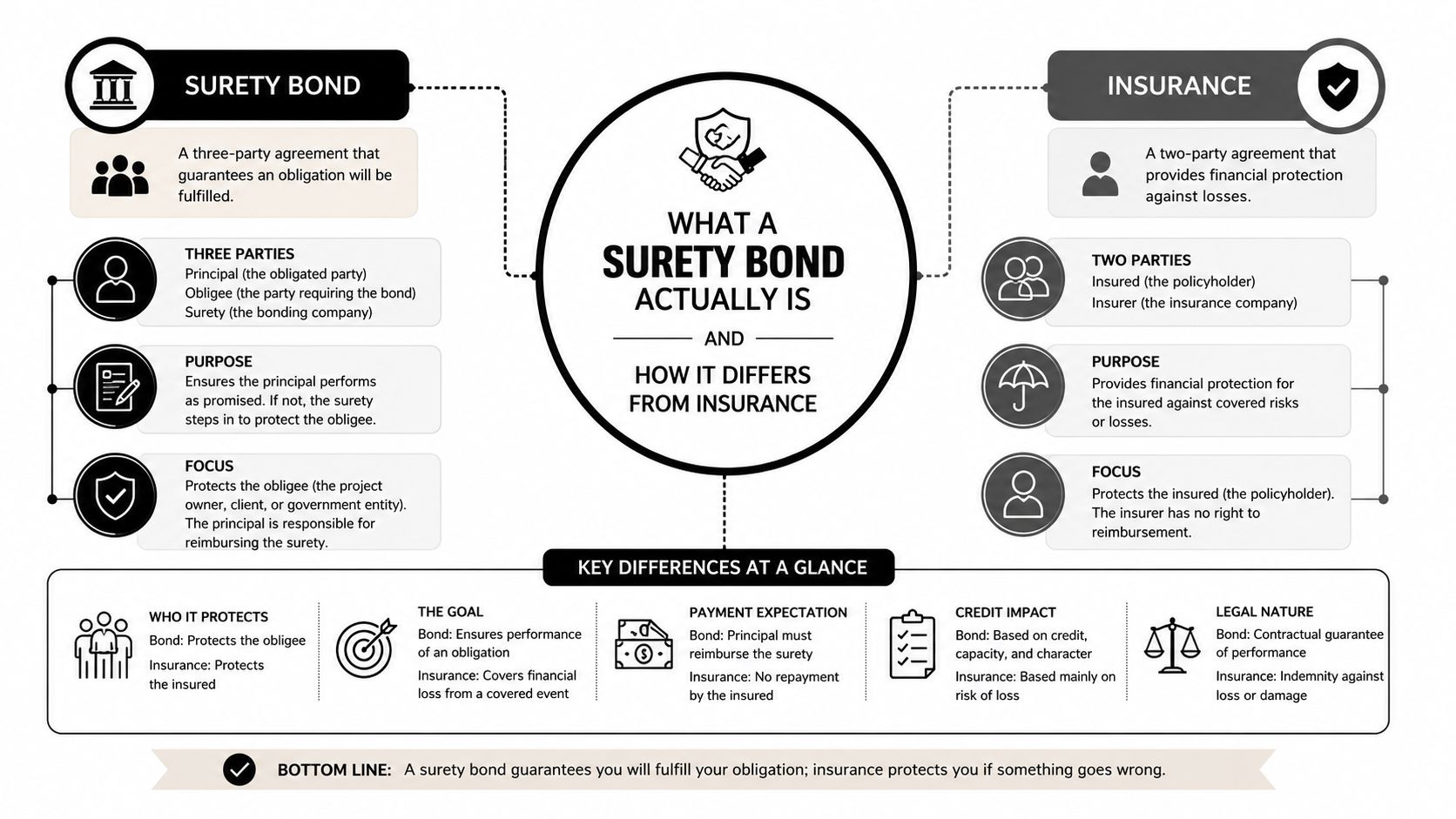
A surety bond is a three-party agreement. The principal is the contractor, the obligee is the owner or public agency, and the surety is the company that issues the bond. That structure matters because the bond is not a simple payout to the contractor, it is a financial guarantee that the contractor will do what was promised.
Think co-signer, not safety net
The easiest analogy is a co-signer on a loan. If the borrower doesn't perform, the co-signer may have to step in, and then seek repayment from the borrower. That's much closer to a surety bond than a typical insurance policy. The surety is not taking on the contractor's business risk the way an insurer takes on covered losses.
That reimbursement right is the big difference. If a surety pays a valid claim, it can come back against the contractor for the loss. In other words, the contractor still owns the problem even after the surety steps in. That's why a bond feels more like credit support than classic risk transfer.
Insurance works on a different fault line
Insurance is generally a two-party risk-transfer product. The policyholder pays premiums, and the insurer pays for covered losses tied to accidents, injuries, or property damage. The contractor's liability policy doesn't exist to guarantee that the job gets finished. It exists to respond when a covered event happens.
That distinction becomes critical when owners search for contractor bonding insurance and expect one product to do everything. It won't. A bond can help when the contractor defaults on a contractual promise. Insurance can help when someone gets hurt or property gets damaged. If you want a broader explanation of where those lines get blurred in practice, the comparison in this coverage gap guide is useful.
A bond says the contractor should perform, and if they don't, the surety may step in. Insurance says a covered loss happened, and the insurer may pay for that loss.
The Four Bond Types and the Four Insurance Policies That Matter
Owners usually don't need a law degree to sort this out. They need a map. If the problem is bad workmanship, an unpaid subcontractor, a license issue, or a worker injury, the right instrument is usually obvious once you know the categories.
| Instrument | Type | Who It Pays | What Triggers It |
|---|---|---|---|
| Performance bond | Bond | The owner or obligee | Contractor fails to finish or meet contract terms |
| Payment bond | Bond | Subcontractors or suppliers | Contractor doesn't pay the people who furnished labor or materials |
| License or permit bond | Bond | The public or a state agency, depending on statute | Regulatory or licensing noncompliance |
| Maintenance bond | Bond | The owner | Defects or failures during an agreed warranty period |
| Commercial general liability | Insurance | Third parties injured or damaged by the contractor's operations | Accidental bodily injury or property damage |
| Professional liability | Insurance | The insured contractor, for covered professional mistakes | Negligence in design, advising, or similar services |
| Workers' compensation | Insurance | Injured employees | Work-related injury or illness |
| Commercial auto | Insurance | Third parties or insured parties, depending on coverage | A covered vehicle loss or auto accident |
A homeowner cares about this because the trigger tells you where to look. If the tile is installed badly and the contractor refuses to fix it, a bond question may arise. If a subcontractor never gets paid, that's a payment bond issue. If a worker falls off a ladder, that's a workers' compensation matter. If a truck backs into the driveway, that's usually a commercial auto or liability issue.
The owner's view is simpler than the paperwork
The legal labels can get dense, but the lived experience is plain. You want to know who can make the project whole. You also want to know who cannot. A bond can push the contractor toward performance or reimbursement. A liability policy can pay for covered damage. Neither one is a blank check for every problem on the site.
For a contractor-facing breakdown of policy shopping and budgeting, this contractor insurance cost checklist is a helpful companion. It's especially useful if you're trying to understand why one contractor presents a cleaner risk profile than another.
A quick owner's test
If you're staring at a dispute, ask three questions:
- Did the contractor fail to do what the contract required?
- Did someone get hurt or did property get damaged?
- Was the loss caused by default, or by an accident?
Those questions usually point you to the right bucket. If you want a related discussion of public liability and professional indemnity concepts, this overview helps separate those insurance concepts from bonding.
When Oregon and Washington Require a Bond or Insurance
A contractor can have a clean-looking proposal and still fail the owner's real risk test. In Oregon and Washington, the question is not whether the paperwork looks complete, it is whether the project has the right backstop if the contractor stops showing up or if the job creates covered damage. Public works in this region often require performance and payment bonds because government owners need a built-in fallback when a contractor defaults. That approach follows the Miller Act of 1935, which set the federal framework for performance and payment bonds on many federal construction projects. The point is straightforward. Public money should not be left exposed when a job falls apart.
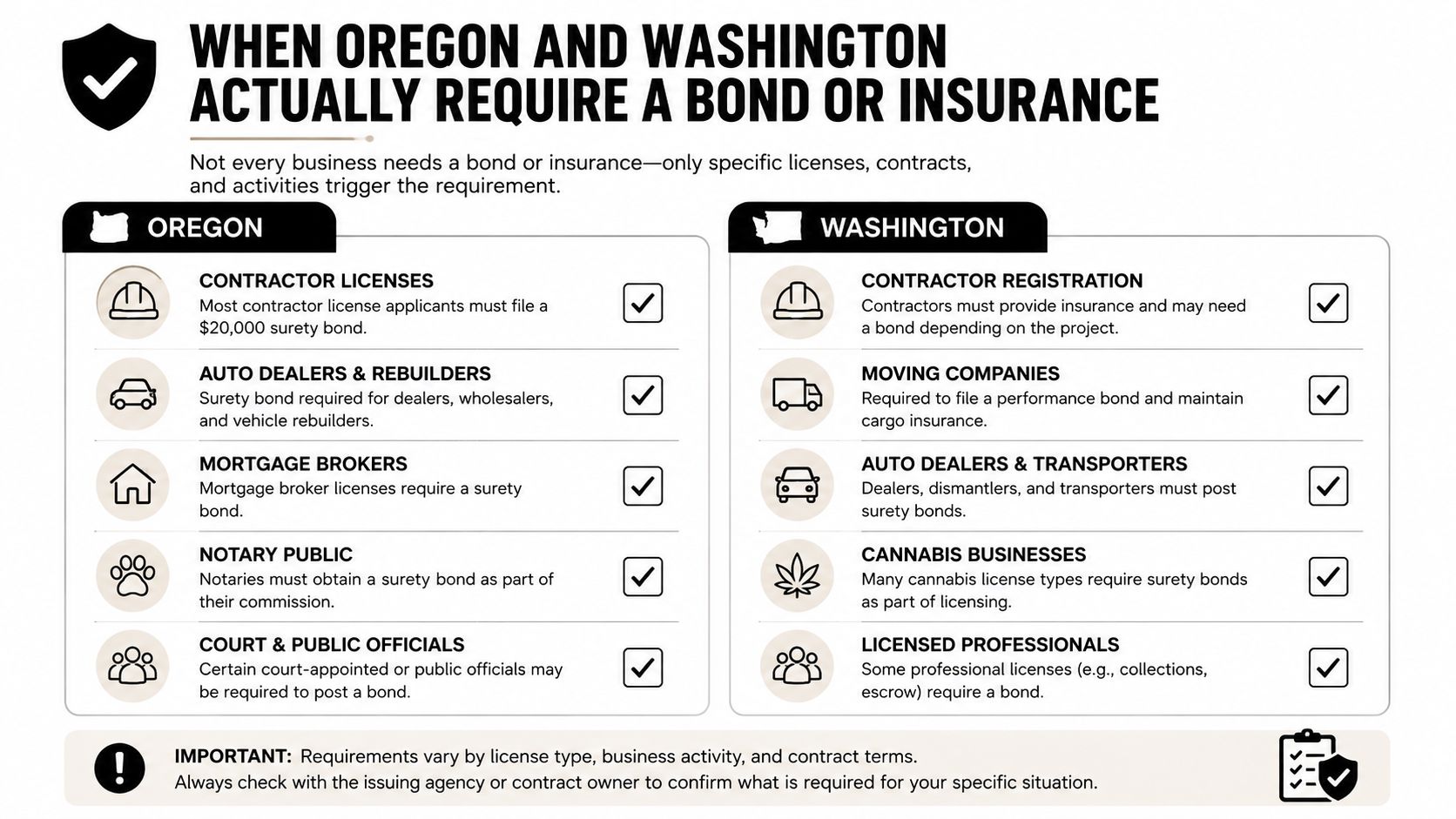
Bonds and insurance show up in different boxes
Owners and contractors often see both items in the same bid packet, which is where confusion starts. A bond answers the question, “Will the work get finished, or will the surety step in if the contractor defaults?” Insurance answers a different question, “If someone gets hurt or property is damaged, which policy pays for that loss?” Public and institutional project specs commonly require commercial general liability at $1 million per occurrence and $2 million general aggregate, plus commercial auto liability at $1 million combined single limit. Those are insurance limits, not bond limits. A performance bond is there for incomplete work, while liability insurance responds to accidents and property damage.
That difference matters the first time a contractor says, “We're covered.” Covered for what? A contractor can carry the right liability insurance and still lack the bond capacity needed to bid the job. The reverse can happen too. A contractor may qualify for bonding and still miss the insurance requirements tied to the project. For a practical look at how cost pressures can change what contractors can afford to carry, construction cost inflation can shift both pricing and underwriting decisions. If you are comparing contractors, My Safety Manager cost tips can also help explain why one firm looks safer on paper than another.
Why owners in Oregon and Washington should care
For municipal work and commercially financed work, both the bond and the certificate of insurance can act like gatekeepers. If either one is missing or too weak, the contractor may not be allowed to start. That protects owners, because it filters some risk before the first payment leaves your account.
For a property owner, the contract package should be read the way a lender reads a file, line by line. If the project is public-facing, lender-influenced, or tied to a larger institutional build, the bond and the insurance certificate are part of the project's actual risk controls.
If the paperwork only shows insurance and says nothing about bonding, do not assume the owner-side exposure is covered.
A contractor can be excellent at framing, roofing, or concrete and still fail to meet a bond requirement. That is not a question of skill alone. It is a question of whether the surety is willing to stand behind the contractor's promise.
What Drives the Cost of Bonds and Insurance for Contractors
A contractor's price for bonding usually comes down to how much financial trust the surety is willing to extend. For contractors who qualify, the premium is often around 1% to 3% of the bond amount. Stronger financials, cleaner credit, and a steadier project history usually lead to better terms, while weaker files can push the quote higher or shut the door altogether. The surety is not pricing the bond like a standard insurance policy. It is reviewing whether the contractor can be trusted to finish the job and repay the surety if a claim is paid.
That caution makes sense in a business where contractor survival can be uneven. A public summary from the Arizona DOT, citing BizMiner, reported a 29.3% failure rate among 1,021,350 general, heavy, and specialty trade contractors tracked from 2014 to 2016. The same source also showed earlier failure rates of 28.5%, 23.6%, 20.4%, 21.7%, and 25.4%, which helps explain why sureties watch financial strength so closely. The surety market has also stayed active, with direct premiums written up 11.2% in 2023, $2.2 billion in underwriting income, and an estimated $180 billion U.S. surety bond market in 2023, while construction surety bonds made up 60% of U.S. surety premiums in 2023. Those figures show a market that keeps growing, while underwriting stays selective. Business Wire market report
Why a good builder can still get a tough quote
A contractor can do solid work in the field and still look risky on paper. Thin working capital, incomplete financial statements, weak credit, and messy job-cost reporting can all make bonding harder. The difference is like a lender looking at a borrower's file. One company may build well but still struggle to convince the surety that it has enough cushion to absorb a problem.
Insurance pricing follows a different path. Trade class, payroll, loss history, vehicle exposure, and coverage limits all matter. A contractor running dump trucks, sending crews out every day, or carrying a heavier injury exposure will often pay differently than a small remodeling firm with a lighter footprint. For a practical look at how vehicle-related expenses affect pricing, My Safety Manager cost tips can help explain why two contractors with similar sales can still face very different insurance quotes.
For project owners, that split matters. A low bond premium does not automatically mean the contractor is safer, and a higher insurance bill does not automatically mean the contractor is a poor choice. Each price reflects a different risk: the bond reflects default risk, while the policy reflects accident and liability exposure.
Cost pressure doesn't prove bad workmanship
Owners sometimes read a higher bond quote as a sign that the contractor is unreliable. The quote more often points to financial strain, not poor craftsmanship. A crew can be skilled at framing, roofing, or concrete work and still have a thin balance sheet, uneven credit, or limited bonding capacity. That is why a contractor can do good work on site and still get priced like a tighter credit risk.
Construction cost inflation can add to that pressure by squeezing margins and making cash flow harder to predict. construction cost inflation can shift what a contractor can carry, what a surety will accept, and how much room there is left for insurance costs, equipment, and payroll. When margins get tighter, the contractor may not fail because of bad trade work. The problem may be that the business no longer has enough room to absorb delays, claims, or a project dispute.
How a Claim Actually Moves Through a Bond and an Insurance Policy
A contractor walks off a remodel in the middle of winter. The owner files a performance bond claim because the contract is incomplete and the project needs another crew to finish it. The surety reviews the file, investigates the default, and then decides whether to arrange completion, pay to complete, or resolve the matter some other way. If the surety pays, it doesn't become the owner's permanent payer. It opens reimbursement against the contractor.
One project, two different claim paths
The same job then has a second problem. A subcontractor falls and files a workers' compensation claim. Later, a tool or scaffold damages a neighboring property, which may trigger commercial general liability if the policy applies. Those claims move through the insurance side, not the bond side, because they are accident-based losses rather than default-based losses.
That split is why the same contractor can be the center of both a bond claim and an insurance claim, but for different reasons. The bond reacts to the refusal or inability to perform the job. The policies react to covered injuries or damage.
Why owners get stuck in the middle
From the owner's seat, the hardest part is often not finding the right label. It's proving the facts. The surety wants the contract, proof of default, and evidence that the work was not completed as agreed. The insurer wants proof of coverage, damage, and a covered cause. Each side asks different questions, and each side may push back on a different part of the loss.
If the contractor blames weather, subs, supply delays, or the owner, the file can turn into a fight over causation, not just money.
The practical result is that owners may need to pursue more than one avenue at once. A bond claim can pressure completion or reimbursement. An insurance claim can cover a separate accident loss. Neither one automatically fixes the other.
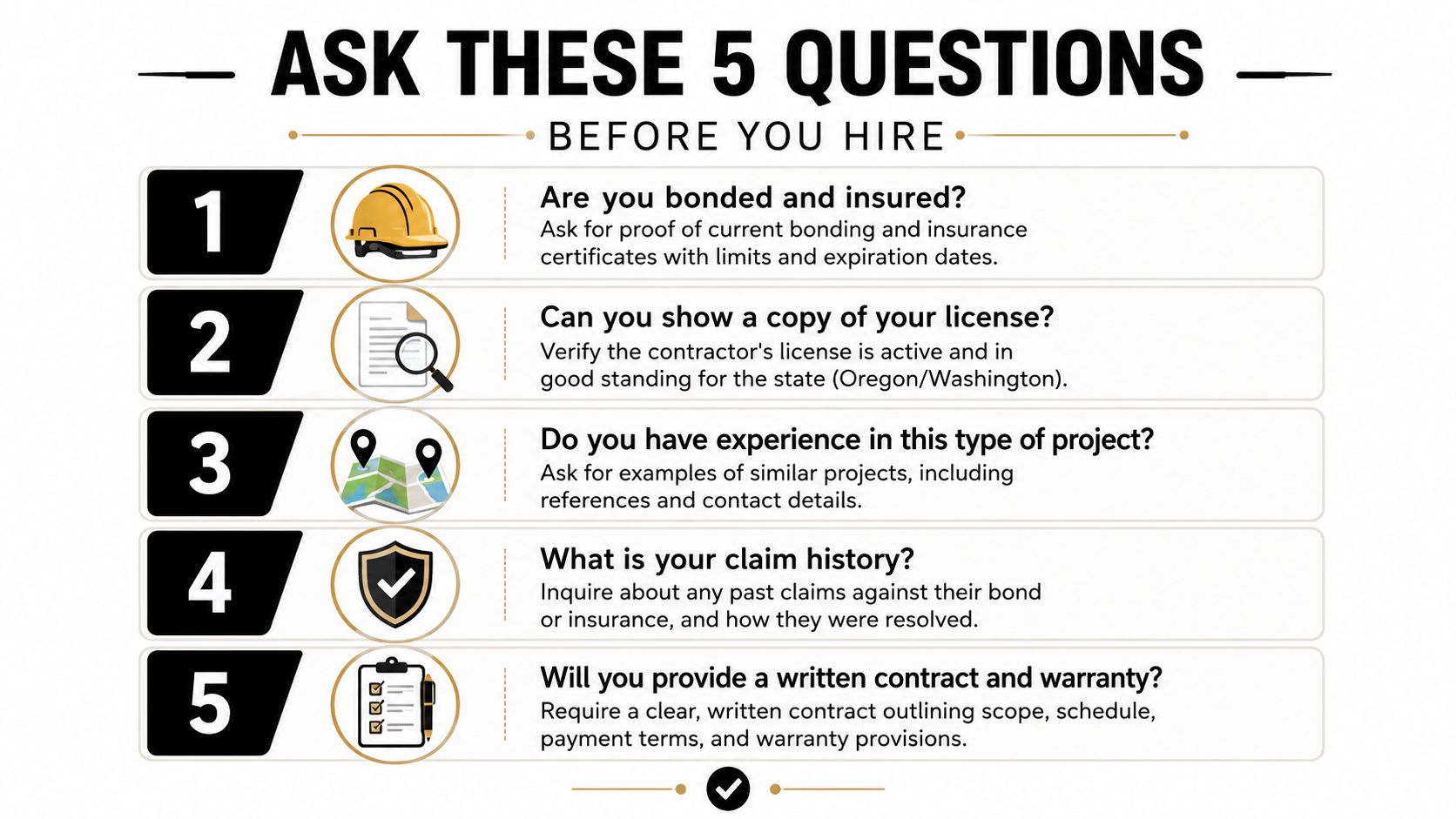
A Property Owner's Pre-Hire Checklist Before Signing the Contract
Before you pay a deposit, ask for the bond and insurance documents in writing. Don't settle for “we're covered.” Ask for the certificate, the surety name, the bond type, and the expiration dates. Then match the legal business name on the paperwork to the name on the contract.
Questions that expose the real risk
- Are you bonded, and for what type of bond? A contractor saying “yes” isn't enough. You want to know whether it's a license bond, performance bond, payment bond, or something else.
- Can you provide a certificate of insurance? Ask for commercial general liability, workers' compensation, and commercial auto if the project involves vehicles or transport.
- Who is the surety company? That tells you who stands behind the bond if a claim is needed.
- Have any bond or insurance claims been filed against you? You're not asking for gossip. You're asking whether there's a history of unresolved problems.
- Can I verify your license and bond status with the state? In Oregon and Washington, that check should be part of your pre-signing routine.
If you receive an ACORD certificate of insurance, read it carefully. It shows the named insured, the policy type, the dates, and the stated limits, but it's not the policy itself. If the certificate is expired, missing a required line, or issued for the wrong entity, treat that as a warning sign.
What the checklist is really protecting you from
Each question maps to a failure mode. A bond question protects you from incomplete work. An insurance question protects you from injury or property damage. A license check protects you from hiring someone who can't legally do the work. A written contract protects you from scope drift, payment confusion, and warranty arguments later.
For a homeowner, that's the value of contractor bonding insurance literacy. It isn't about memorizing jargon. It's about catching the gap before it becomes your loss.
When to Bring in a Public Adjuster and What That Changes
A bond or insurance claim can still leave a gap. The contractor may dispute responsibility. The carrier may understate the repair scope. A damaged line item may be left off the estimate. The owner may know the job is wrong, but not know how to prove it in the format the claim decision-maker wants to see. That's where a public adjuster becomes useful.
The timing matters. If you're already in a coverage dispute, or if the insurer is narrowing the loss in ways that don't match the damage you're seeing, this guide on when to hire a public adjuster helps you decide whether the next move should be a contractor, an attorney, or a claims professional who works for you.
What changes when a public adjuster steps in
A public adjuster documents the loss, interprets policy language, and negotiates with the insurer on the property owner's behalf. That shifts the burden away from guesswork and toward a structured claim file. In a bond dispute, that same discipline helps organize the contractor-default record so the claim is harder to dismiss casually.
For owners, the distinction is simple. Bonds protect against the contractor's failure. Insurance protects against accidents. A public adjuster protects the property owner against the insurer's interpretation of the policy.
That matters most when the paperwork and the reality of the damage don't match. It also matters when you're already exhausted from chasing answers and don't want to learn the claims process the hard way.
If you're facing a stalled construction claim in Oregon or Washington, NW Claims Management can help you organize the loss, review the coverage issues, and push the claim toward a fair outcome. Visit NW Claims Management to request a claim review and get guidance on the next step for your bond or insurance dispute.