If you're reading this, you're probably in one of two spots. You're either looking for a career that pays for skill, judgment, and grit, or you've been around claims long enough to realize you'd rather represent policyholders than insurers.
That's a legitimate path. It's also one people misunderstand.
A lot of guides on how to become a public insurance adjuster make the process sound simple: take a class, pass an exam, file paperwork, start earning. In practice, the exam is the easy part. The harder part is becoming the kind of adjuster a homeowner trusts after a fire, or a business owner trusts when operations are stalled and every day matters.
In Oregon and Washington, that difference matters even more. These aren't markets where you can bluff your way through a property loss. You need to understand buildings, moisture, smoke migration, repair scopes, documentation, negotiation, and how to keep a client calm when the claim feels personal. That's the core of the trade.
Is a Public Adjusting Career Right for You
A homeowner calls after a tree punches through the roof during a windstorm. Water is moving into insulation, drywall, and flooring. The carrier has assigned an adjuster. Contractors are busy. The policyholder doesn't know what to document first, what the policy covers, or how to present the loss cleanly.
That moment is where public adjusters earn their place. You step in for the policyholder, organize the facts, document damage, read the policy, and keep the claim from turning into a paperwork mess. For a lot of people, that's the draw of the profession. You're not selling a gadget or pushing a script. You're helping someone through a financially and emotionally loaded event.
It also has to make sense as a career. The median annual wage for claims adjusters, examiners, and investigators in the United States was $76,790 as of May 2024, according to the Bureau of Labor Statistics claims adjuster outlook. The same source projects a 5 percent decline in overall employment from 2024 to 2034, while still estimating about 21,600 openings annually on average, mostly from replacement needs.
Those numbers tell you two things.
First, there is real income potential if you become useful. Second, this isn't a field where average effort carries you. Openings still exist, but competition gets sharper when growth slows. In the Pacific Northwest, that usually means the people who stay busy are the ones who document thoroughly, write clearly, answer clients fast, and can walk into a damaged building without getting lost.
Signs the work fits you
A public adjusting career tends to fit people who are comfortable with all of the following:
- Messy real-world problems: Claims don't arrive in tidy categories. Water affects insulation, framing, finishes, and timelines all at once.
- Difficult conversations: Clients are stressed. Carriers push back. Contractors disagree. You need a steady voice.
- Field work and desk work: You'll inspect loss sites, then spend hours organizing photos, estimates, notes, and policy language.
- Long learning curves: If you're looking for instant mastery after a license exam, this isn't it.
Practical rule: If you enjoy solving technical problems for people under pressure, public adjusting can be a strong fit. If you hate documentation, conflict, or ambiguity, it usually isn't.
If you're still interested, look at real claims management job paths and pay attention to what employers want. The useful clue isn't the license alone. It's the combination of field judgment, writing ability, and claim discipline.
The Foundation Understanding the Public Adjuster Role
Most beginners confuse adjuster titles. That creates bad career decisions early.
A public adjuster works for the policyholder. A company adjuster works for the insurer. An independent adjuster typically works on behalf of insurers through contract assignments. Those aren't cosmetic distinctions. They determine who you owe loyalty to, how you evaluate a claim, and how you communicate.
If you want a clean breakdown, NW Claims Management has a useful page that helps define a public adjuster in practical terms.

What the job actually looks like
The highest-value operational skill set is claim documentation. Public adjusters are hired to read coverage, estimate repair costs, and negotiate settlements. Before work begins, a signed contract is required, and the adjuster's fee is usually a percentage of the claim, as explained by the Pennsylvania public adjuster consumer guide.
That sounds straightforward until you do it on a live file.
A real claim can require you to separate covered damage from pre-existing conditions, build an accurate inventory, coordinate contractor input, and present the loss in a way the carrier can evaluate without unnecessary confusion. If the file is sloppy, negotiation gets harder. If the file is strong, the conversation changes.
The unwritten standard
In Oregon and Washington, new adjusters often overvalue persuasion and undervalue reconstruction. Negotiation matters, but most claim outcomes are shaped before the first serious back-and-forth with the carrier. The adjuster who wins trust is usually the one who can reconstruct the loss cleanly.
That means you need to get good at:
- Policy reading: You can't advocate well if you don't understand coverage language, exclusions, conditions, and duties after loss.
- Scope writing: Repair cost disputes often start with missed line items, weak measurements, or poor sequencing.
- Photo logic: Photos aren't just proof that damage exists. They need to tell the story of cause, extent, and affected components.
- Client communication: Policyholders need updates in plain English, not jargon and vague optimism.
A public adjuster isn't just a negotiator. The job is closer to part investigator, part estimator, part project historian.
Ethics aren't optional
This profession gives you access to people at vulnerable moments. That's why contract discipline matters so much. If the agreement is vague, if the scope keeps drifting, or if expectations aren't managed early, the relationship can deteriorate even when coverage exists.
Good adjusters don't promise outcomes they can't control. They explain process, document facts, and keep the client grounded in what the policy and evidence support.
That's the standard worth aiming for if you're serious about learning how to become a public insurance adjuster, not just how to get licensed.
Navigating the Licensing Maze in Oregon and Washington
Licensing matters, but people often approach it backward. They focus on the exam first, then scramble through fingerprints, applications, and bond requirements in no particular order.
That usually creates delays.
The general process to become a licensed public adjuster involves passing a state exam with at least a 70% score, undergoing an FBI background check via fingerprints, and purchasing a surety bond. The initial cost is typically at least $230, including application fees, exam fees ranging from $50 to $100, and background checks, based on the verified licensing summary in Source Citation 3.
Start with sequence, not motivation
In practical terms, your path in Oregon or Washington should follow this order:
- Confirm current state requirements through the licensing authority and approved vendors.
- Complete any required pre-licensing education if the state requires it.
- Schedule the exam early and study against the actual tested material.
- Handle fingerprinting and the background process as soon as your timing is clear.
- Secure the required bond before filing anything that depends on it.
- Submit the application only when the gating items are done.
That order keeps you from paying twice, missing a validity window, or sitting on a passed exam while your application package is incomplete.
For candidates who want structured preparation, claims adjuster training resources can help you organize study, workflow habits, and licensing steps without treating the exam like the whole profession.
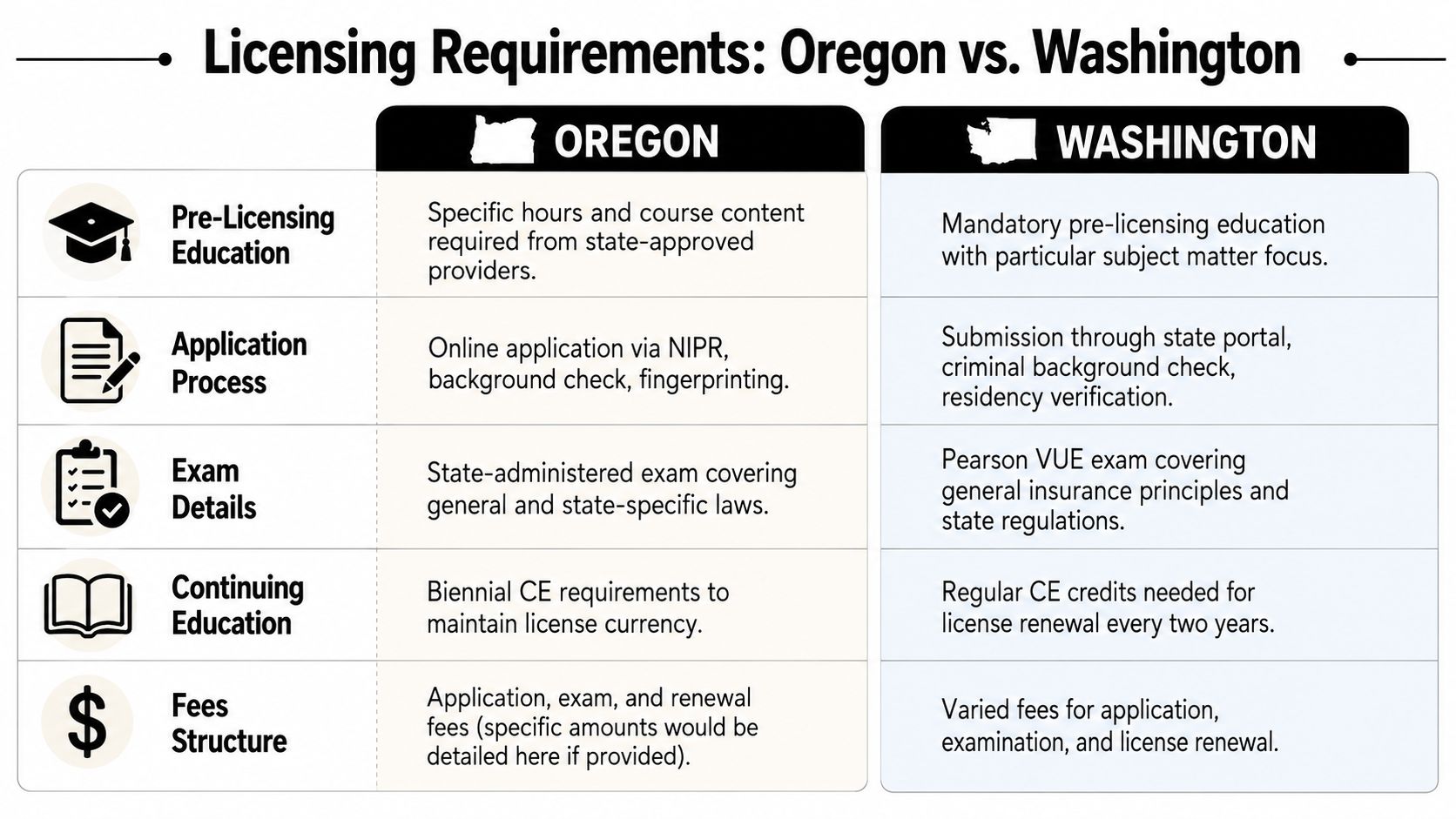
Oregon and Washington side by side
Because this guide focuses on Oregon and Washington, here's the most honest way to compare them with the facts available. Some state-specific details belong on the regulator's current application page, and if a number isn't verified here, it shouldn't be invented.
| Requirement | Oregon | Washington |
|---|---|---|
| General licensing path | State-specific process that typically includes education if required, exam, fingerprints/background review, bond, and application | State-specific process that typically includes education if required, exam, background review, bond, and application |
| Exam benchmark | Passing score generally follows the verified 70% benchmark in the general licensing framework | Passing score generally follows the verified 70% benchmark in the general licensing framework |
| Fingerprinting | Background screening is part of the standard licensing path | Background screening is part of the standard licensing path |
| Surety bond | Required as part of the standard licensing pathway | Required as part of the standard licensing pathway |
| Initial cost | Expect the process to cost at least $230 overall under the verified baseline, with exact state totals depending on current fees | Expect the process to cost at least $230 overall under the verified baseline, with exact state totals depending on current fees |
| Continuing education and renewal | Follow current state renewal and continuing education rules | Follow current state renewal and continuing education rules |
What candidates usually get wrong
The biggest mistake isn't failing the exam. It's treating the license as the finish line.
Another common mistake is relying on generic national advice. Oregon and Washington candidates need to verify live state rules directly before paying for courses, fingerprints, or bond paperwork. Requirements can change in how they are administered, even when the broad process stays familiar.
A third mistake is weak document handling. Keep copies of everything from the start:
- Education records: Save completion certificates and provider details.
- Exam records: Keep the pass notice and test date.
- Background documents: Track fingerprint submission and confirmations.
- Bond paperwork: Store the bond form and effective dates together.
- Application file: Keep a complete copy of what you submitted.
Field note: Licensing delays are often administrative, not intellectual. The people who move through faster are usually the ones who maintain a clean file from day one.
Why mobility matters even if you stay local
Even if you plan to work mainly in Portland, Vancouver, Salem, Eugene, Tacoma, or Seattle-area markets, don't think only in zip codes. Catastrophe work, border-area practice, and referral relationships often depend on where else you can legally operate.
The verified guidance on Texas is useful here because it shows how licensing sequence and mobility matter in real life. Texas requires exam passage before a resident public adjuster application, uses a $50 application fee, and requires a surety bond of at least $10,000. It also highlights the importance of reciprocal licensing for multi-state work, as outlined by the Texas Department of Insurance public adjuster application page.
The broader lesson applies in the Northwest too. If you want a resilient career, build for mobility early.
Beyond the License Building Real-World Competency
At this stage, most new adjusters either become professionals or stall out.
Passing a licensing exam proves you can absorb tested information. It doesn't prove you can walk a smoke loss, sort primary from secondary damage, build a supportable estimate, or explain business interruption documentation to an owner who's already exhausted. That's why so many newly licensed people struggle in their first real files.
Massachusetts makes this issue unusually clear. Applicants must show 2 years of experience in property-loss adjusting or closely related work such as construction or estimating, according to the Massachusetts public insurance adjuster licensing requirements. That requirement points to a truth that applies far beyond Massachusetts. The main obstacle usually isn't the test. It's building and proving competence.
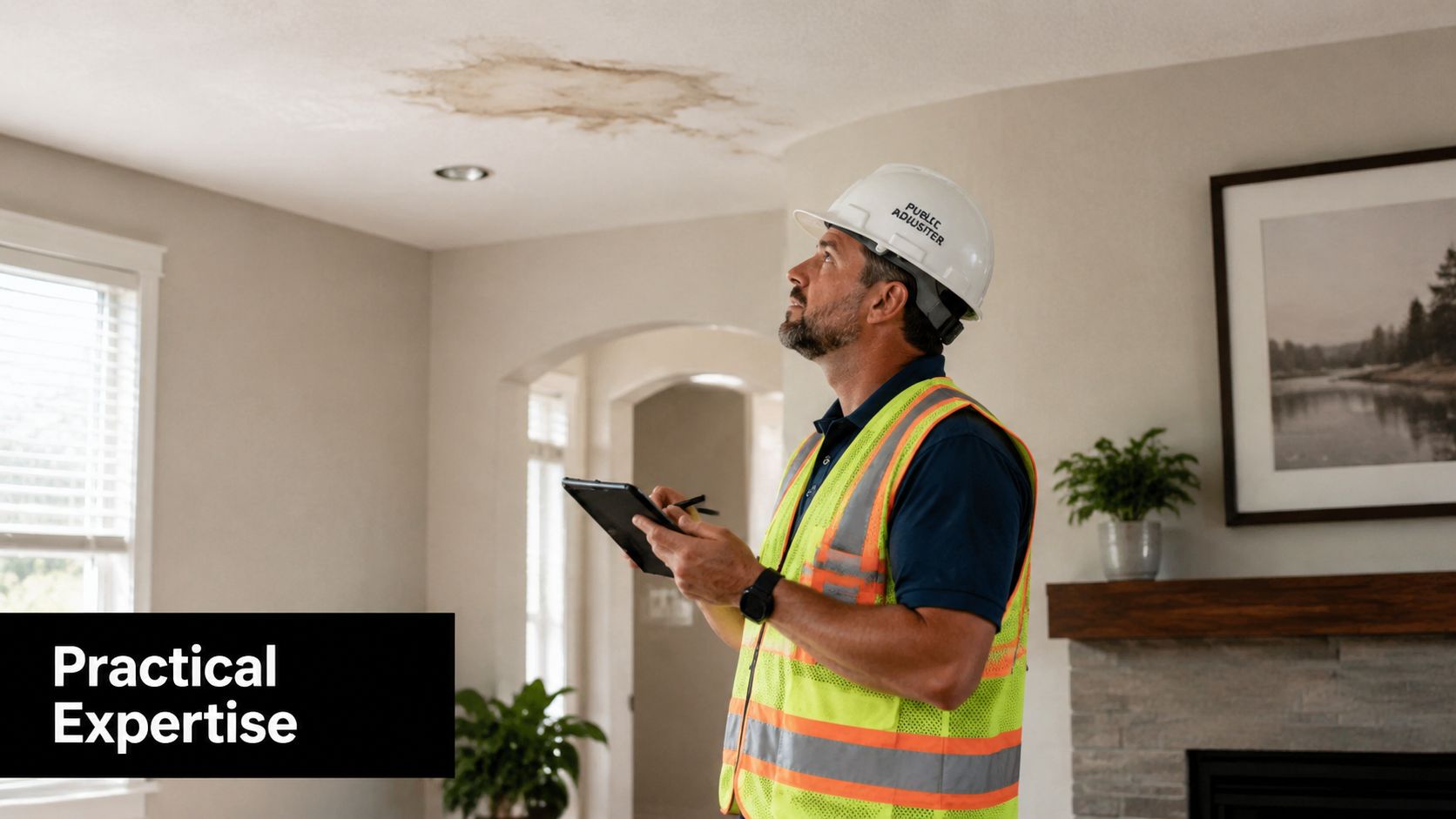
The skills that separate useful adjusters from licensed beginners
In Oregon and Washington, a credible beginner needs to become dangerous in four areas fast.
Construction literacy
You don't need to arrive as a general contractor. You do need to understand how buildings go together, what gets affected when water or smoke moves, and how repairs sequence in practice. If you can't tell the difference between cosmetic staining and material compromise, you'll struggle to build a claim file anyone takes seriously.
Related backgrounds help a lot:
- Construction estimating
- Restoration work
- Property inspection
- Roofing or exterior trades
- Contents inventory and valuation work
Estimating discipline
Many new adjusters know software screens but not estimating logic. That's a problem. Xactimate is useful because it's common, but the tool doesn't think for you. You still have to measure accurately, pick the right line items, understand drying versus replacement, and keep line notes defensible.
If you're serious about becoming employable, invest time in Verisk Xactimate training. Not because a certificate alone wins claims, but because speed and accuracy improve when you stop fighting the software.
Documentation workflow
A strong claim file usually has a predictable rhythm:
- Initial intake: Loss date, cause, affected areas, emergency mitigation, policy documents.
- Site inspection: Photos, measurements, moisture or visible condition notes, interviews.
- Scope development: Room-by-room damage logic with support.
- Estimate build: Accurate quantities, sequencing, and code-aware reasoning where applicable.
- Negotiation package: Organized submission that lets the carrier follow the story without guessing.
Beginners often skip steps because they want to get to negotiation. That's backwards. Negotiation is easier when the documentation already did half the work.
The adjuster who seems persuasive usually isn't improvising. They've already built a file that is hard to dismiss.
How to get experience if you're changing careers
If you're coming from outside insurance, don't ask, "How do I look experienced?" Ask, "How do I become useful to an experienced adjuster?"
That's the shift that matters.
A practical path looks like this:
- Shadow inspections whenever possible. Watching how a seasoned adjuster moves through a property is more valuable than another generic webinar.
- Take support roles first. Photo organization, file setup, inventory work, and estimate prep teach claim structure.
- Learn one claim type thoroughly. Water losses are often a good training ground because they force you to understand materials, mitigation, and documentation.
- Keep a work log. Save examples of tasks you've handled, the types of losses you've seen, and the tools you used.
- Ask for correction, not praise. Early growth comes from seeing where your observations are incomplete.
Soft skills do real damage when they're missing
Technical gaps can be trained. Character gaps are harder.
A public adjuster has to return calls, explain delays, calm people down, and say no when a client wants a position the evidence doesn't support. In the Northwest, where local reputation travels fast, weak communication can cost you more than a weak estimate.
Competency is what turns a license into a career. Without it, you're just legally allowed to be overwhelmed.
Launching Your Career Business or Employment
Once you're licensed and starting to build competence, you have a practical fork in the road. You can join an existing firm, or you can build your own shop.
Neither path is automatically better. The right choice depends on how much structure, risk, and responsibility you want in your first few years.
Joining a firm
For most beginners, employment is the smarter start.
A good firm gives you file exposure, review pressure, and faster feedback. You learn how claims move from intake to settlement, how contracts are handled, how client updates are timed, and how stronger adjusters defend scope decisions. That's hard to replicate on your own.
When you evaluate an employer, look for these signs:
- Training depth: Will they let you shadow inspections, review estimates, and participate in negotiations?
- File quality: Are their claim packages organized and supportable, or chaotic and reactive?
- Supervision style: Can you get line-by-line feedback, or are you expected to figure it out alone?
- Compensation clarity: Make sure you understand whether the role is salary, commission, or a hybrid.
- Licensing support: Some firms help with reciprocity planning and ongoing compliance.
If you're exploring that route, review actual insurance trainee positions and compare the responsibilities, not just the job title.
Starting your own practice
Going solo gives you control, but it also exposes every weakness you still have.
You'll need to handle contracts, intake, inspections, estimating, negotiation, billing, compliance, and marketing. You also need enough judgment to reject bad files, manage client expectations, and avoid overcommitting. A lot of new licensees underestimate how much business discipline the solo route requires.
Before opening your own practice, make sure you can answer yes to most of these questions:
| Decision point | Join a firm first | Start your own practice |
|---|---|---|
| Need hands-on mentorship | Strong fit | Weak fit unless you already have it elsewhere |
| Comfortable with inconsistent workflow | Less necessary | Essential |
| Able to create compliant contracts and process | Learned on the job | Must handle immediately |
| Ready to find your own clients | Helpful but not required | Non-negotiable |
| Want immediate autonomy | Limited | High |
If you do plan to market independently, don't wing it. A practical resource is this comprehensive 2026 client acquisition guide, especially for thinking through referral development, local visibility, and follow-up systems in a service business.
Think regionally, not just locally
The Pacific Northwest rewards strong local knowledge, but long-term stability often comes from mobility. The verified Texas example shows why. Once licensed, adjusters often need reciprocal licenses in other states. Texas requires the exam before application, a $50 fee, and a surety bond of at least $10,000, which illustrates how planning for multi-state work supports catastrophe deployment and regional practice.
The lesson isn't that you need Texas specifically. It's that smart adjusters build options before they need them.
Your First Year A Timeline for Success
The first year goes better when you stop chasing the image of being established and start building repeatable habits. Most new adjusters don't fail because they're lazy. They fail because they bounce between licensing tasks, field work, software learning, and client communication without a system.
A workable first year is simpler than people think. Get licensed. Get supervised exposure. Build clean documentation habits. Improve your estimating speed. Protect your reputation.
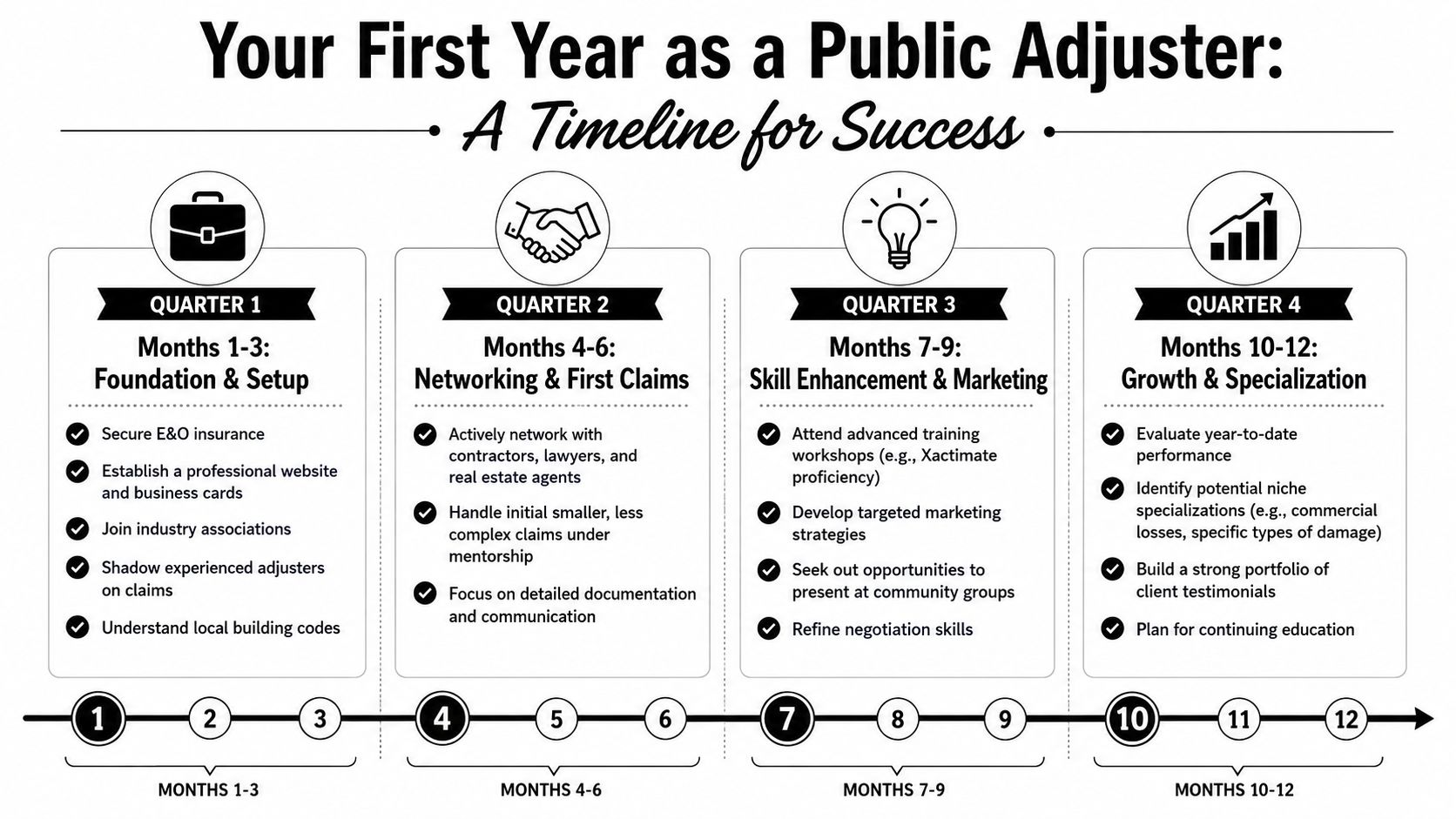
A practical first-year roadmap
Months one through three
Focus on setup and observation. Learn how files are opened, how inspection notes are structured, and how experienced adjusters speak with policyholders. If you're in Oregon or Washington, spend time understanding the local property types and the damage patterns common to the region.
Months four through six
Take on controlled responsibility. Write portions of estimates, organize support documents, and handle smaller communication tasks with review. In doing so, your confidence should come from repetition, not bravado.
Mentor check: If you can't explain why an item is in your estimate, you aren't ready to defend it in negotiation.
Months seven through nine
Sharpen one technical area on purpose. That might be Xactimate speed, water-loss scoping, smoke documentation, contents work, or better client update routines. Don't try to improve everything at once.
Months ten through twelve
Look back at your files and find patterns. Where do you slow down? Where do corrections keep showing up? Which claim types make sense to pursue more often? That review is where a real professional identity starts to take shape.
What success actually looks like
By the end of year one, a strong newcomer should be able to do the following consistently:
- Inspect methodically: Move through a property without missing obvious affected areas.
- Document clearly: Build files another reviewer can follow.
- Estimate credibly: Produce scopes that reflect real repair logic.
- Communicate calmly: Keep clients informed without creating false expectations.
- Operate ethically: Stay inside the evidence, the policy, and the contract.
If you can do that, you're no longer just learning how to become a public insurance adjuster. You're becoming one in the only way that matters: through disciplined work on real claims.
If you're in Oregon or Washington and want to learn the profession from the claim side that serves policyholders, NW Claims Management is one place to study how licensed public adjusting work is done in residential, commercial, and nonprofit property losses. Review the firm's resources, compare the role carefully, and use that information to decide whether this career fits your skills and the kind of work you want to do.