Six weeks after a windstorm, the temporary repairs are holding, but the insurer's estimate still leaves out roof sections, interior moisture damage, and the cost of bringing the property up to current code. You've sent photographs, contractor estimates, and invoices. The adjuster has answered with a short email and a payment that doesn't match the scope of work.
That's where many Oregon and Washington property owners reach for a settlement demand letter. A well-built letter can focus the dispute, preserve your position, and create a serious opening for negotiation. A rushed letter, however, can repeat the same unsupported number the insurer already rejected.
Property claims are evidence disputes as much as they are coverage disputes. The letter works when it connects the policy language to a defensible scope, a documented valuation, and a clear next step.
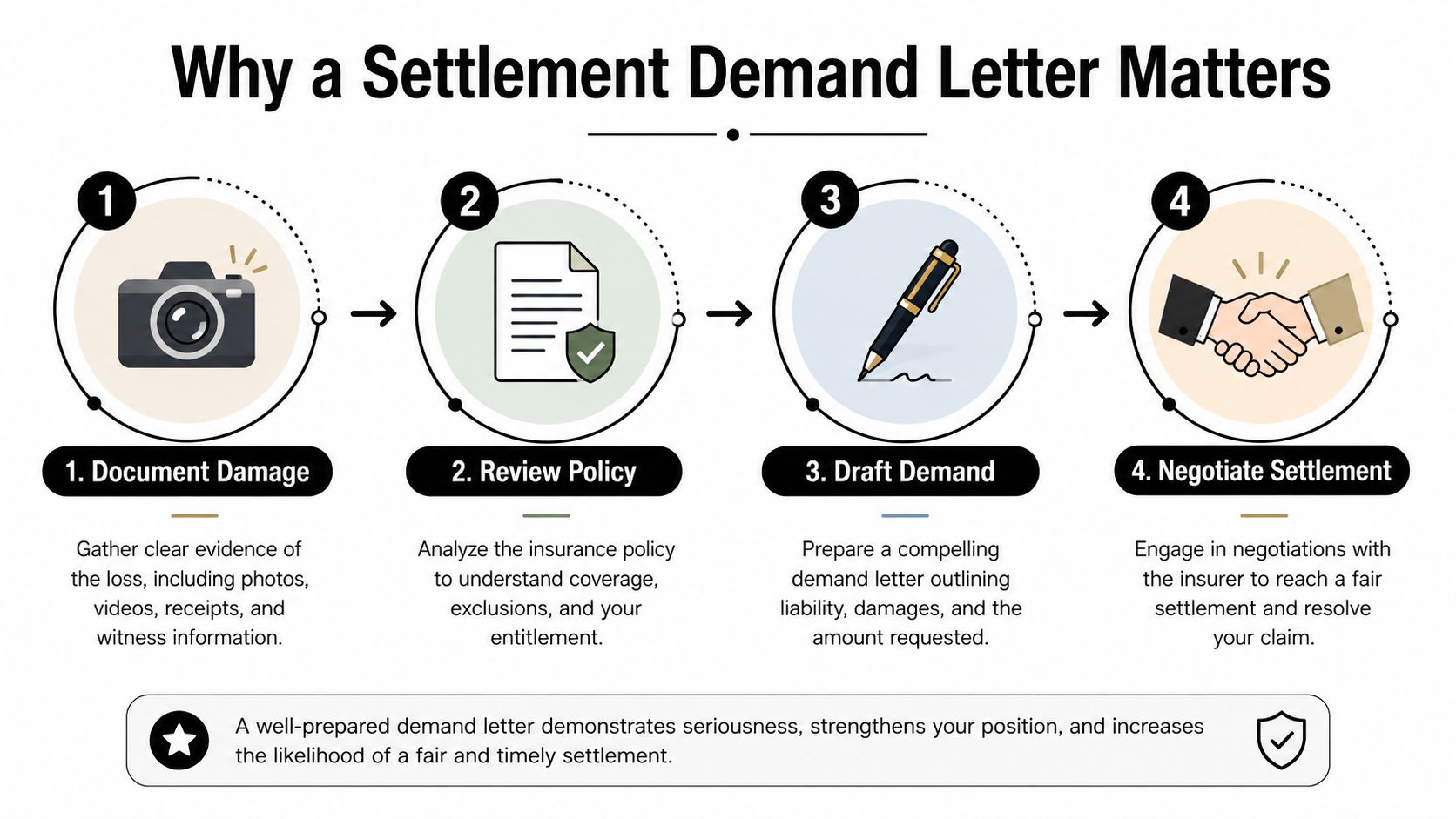
Why a Settlement Demand Letter Matters in a Property Claim
A small business owner may spend weeks keeping operations open after a fire, only to receive an estimate that prices basic repairs while excluding smoke cleaning, damaged contents, and lost income. A homeowner may have a contractor's scope that includes hidden water damage while the carrier's estimate addresses only what was visible during the first inspection. In both situations, the demand letter belongs after the facts have been developed, not before.
The letter is a negotiation milestone, not a magic payment request. It should tell the adjuster exactly what remains disputed, identify the records supporting each amount, and explain why the carrier's current position doesn't resolve the claim. It may also prompt a fresh coverage review, supervisor involvement, or a request for additional documentation.
A demand letter isn't the same as a proof of loss. A proof of loss is a policy-driven submission that usually follows the insurer's required form and procedure. It isn't the same as a supplemental claim, either. A supplemental claim adds newly documented damage, revised pricing, or omitted scope to the existing claim. An appeal or reconsideration responds to a denial or coverage position.
The demand letter can refer to all of those materials, but it shouldn't replace them. Before drafting, confirm the claim status, review the policy's notice and proof-of-loss provisions, and map the insurer's estimate against the contractor's scope. The property claim processing steps can help establish where the letter fits in the larger workflow.
There's also a legal reason to take the letter seriously. In New York insurance coverage litigation, a court found that a pre-suit demand letter qualified as a claim under the policy, and the Second Circuit affirmed that position in 2024. The discussion of that decision explains why written demands can trigger coverage analysis and notice obligations before a complaint is filed.
Practical rule: Don't send a demand until you can explain every major disputed line item with a document, an estimate, or a policy provision.
Core Elements of a Property Damage Demand Letter
A property-focused letter should read like a concise claim package. The adjuster shouldn't have to search through an inbox to determine what happened, what coverage applies, or how you calculated the requested payment.
Begin with the claim and coverage framework
Identify the insured property, date and type of loss, claim number, policy number, and the person or department handling the file. State the coverage issue in plain language. For example, explain that the demand concerns additional dwelling and other-structures benefits for storm damage, or building, contents, and business-income coverage after a commercial fire.
Then describe the event without exaggeration. A useful liability or causation statement might say that wind damaged the roof covering, allowing water to enter the building, and that the attached roofing report and moisture documentation support the claimed repair scope. Avoid accusing the adjuster of dishonesty unless you're prepared to support that allegation.
Tie each amount to evidence
Break damages into recognizable categories:
- Building repairs: Identify the affected rooms, assemblies, and construction tasks. Separate emergency mitigation from permanent repair.
- Contents: Attach an inventory showing the item, condition, age, replacement basis, and supporting photographs or purchase records where available.
- Additional expenses: Include mitigation, temporary housing, storage, security, debris handling, and other covered costs with invoices.
- Business interruption: Explain the calculation using accounting records, operational data, payroll information, and the applicable policy terms.
- Code-related work: Identify the ordinance or code requirement and explain why the work is necessary to complete the covered repair.
The letter should distinguish agreed amounts from disputed amounts. If the insurer accepted part of the roof replacement but omitted interior work, say so directly. A comparison between the carrier's estimate, the contractor's estimate, and the requested revision is more persuasive than a single unexplained total.
For a practical starting point, use this repair estimate template to organize line items before drafting. If the letter will be prepared across multiple claims or reviewed by a legal team, a scalable legal drafting system can help standardize formatting and review controls.
Request information and state the proposed resolution
Cite the relevant policy provisions, but quote only the language that matters. Explain how the provision applies to the disputed work, and identify exclusions the insurer has relied on if coverage is contested. Where relevant, request policy-limits information and ask the carrier to identify the specific factual or policy basis for any continuing disagreement.
End with a precise request. State the amount sought, the documents enclosed, and the date by which you want a written response. Keep the tone measured. The strongest demand is a documented negotiation package, not an emotional narrative.
Documentation Checklist to Support Your Demand
A persuasive letter can fail when its exhibits are incomplete or impossible to reconcile. Adjusters need to match the requested amount to the property, the claimed event, the policy, and a supporting record. Organize the file so that matching takes minutes rather than repeated correspondence.
Emergency mitigation
Start with the first response after the loss. Include water extraction or drying invoices, emergency boarding records, tarping receipts, contents manipulation charges, temporary power records, and photographs taken before and during mitigation. Note who performed the work, when it occurred, what areas were treated, and why the work was necessary to prevent further damage.
If a contractor removed damaged materials, preserve photographs and disposal records before demolition. Don't rely on a final invoice alone. The insurer may question work it can't connect to a documented condition.
Structural damage and scope
Create a photo and video log with dates, room or elevation identifiers, and short descriptions. Pair each visual record with the contractor's estimate, engineering or roofing report, moisture map, material specification, and any change order. For commercial and nonprofit properties, identify each building, tenant area, operational space, and affected system separately.
A good estimate explains labor, materials, access, protection, disposal, matching, testing, and necessary sequencing. A weak estimate states that the property needs repair. The evidence preservation guidance is especially useful when damaged materials may need to remain available for inspection.
Contents and specialty categories
Use a contents inventory rather than a narrative list. Record the item, location, condition, replacement source, and whether the claim is based on repair, replacement, or actual cash value under the policy. Add photographs, receipts, manuals, appraisals, or other ownership records when available.
For business interruption, preserve income statements, sales records, payroll reports, tax materials, extra-expense invoices, and a written explanation of how the loss affected operations. Don't mix business-income calculations into the building estimate without labeling the separate coverage basis.
Code upgrades and organization
Document permits, municipal notices, code citations, architect or engineer recommendations, and contractor explanations for ordinance-related work. Code compliance is easier to evaluate when the file shows the original condition, the required upgrade, and the cost difference.
Use a numbered exhibit index. Label files consistently, such as “Exhibit 3, Roof Estimate” or “Exhibit 7, Mitigation Invoice.” For general defect-recording ideas, the homeowner documentation checklist from Awesim Building Consultants offers a useful organizational model, although Oregon and Washington policy requirements still control your claim.
Setting a Response Deadline That Insurers Actually Honor
Generic demand-letter advice often treats 30 days as a universal answer. In property claims, that deadline is better understood as a professional target than an automatic enforcement mechanism. Insurers may respond quickly on a clean, well-supported file, while complex losses involving multiple buildings, code work, business interruption, or disputed causation can take weeks or months to review.
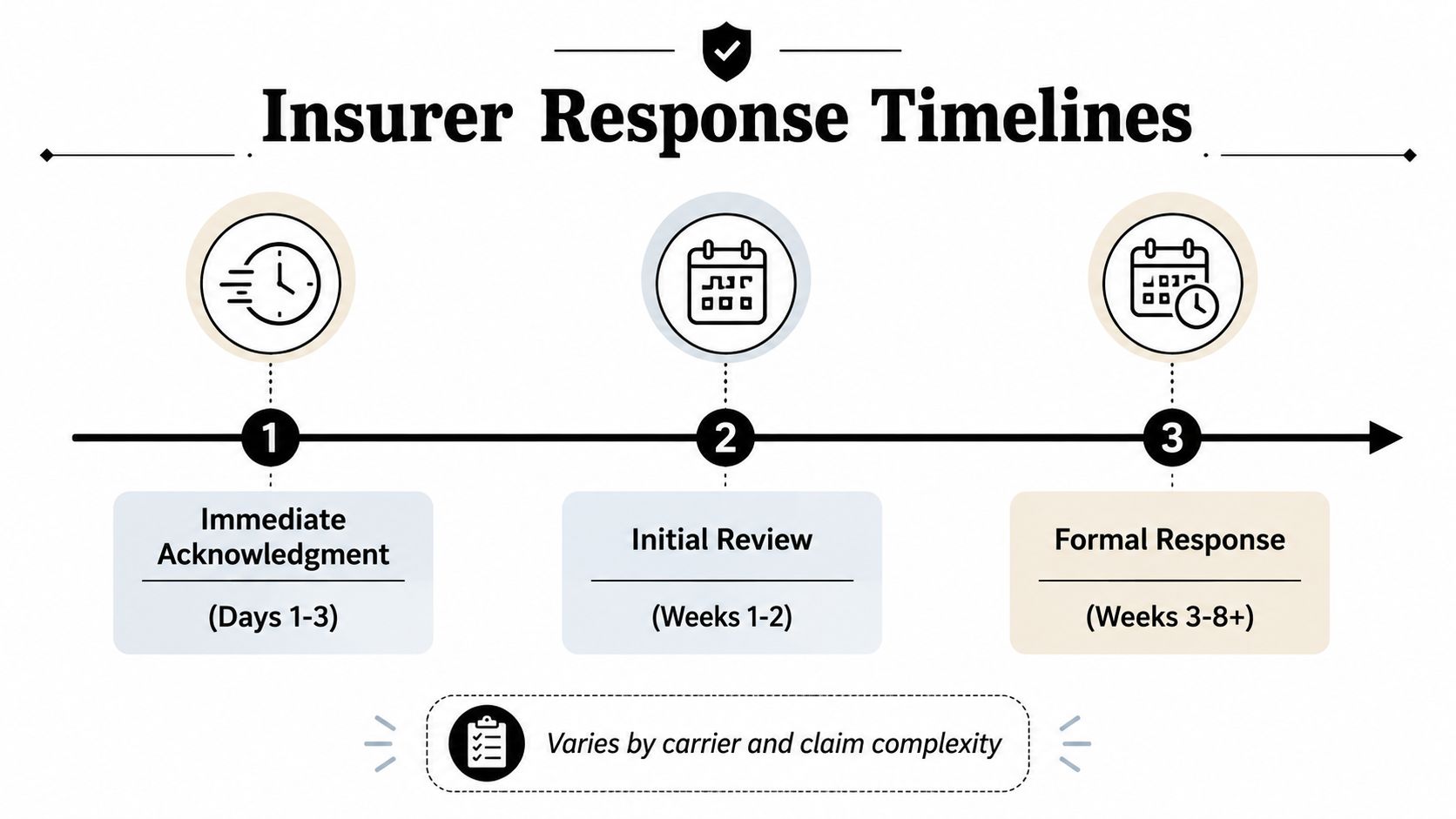
The deadline should match the package. A focused supplemental demand about a missed interior repair may justify a shorter response window than a commercial fire claim with extensive accounting records. The letter can request a written coverage and valuation response by a stated date, while recognizing that the carrier may need specific additional information.
A deadline has value only when you know what you'll do after it passes.
Symbolic versus meaningful deadlines
A symbolic deadline creates a date but no consequence. It often says the insurer must respond immediately, threatens action the policyholder won't take, or ignores the claim's complexity. Adjusters recognize that language and may treat it as routine correspondence.
A meaningful deadline connects the date to a credible next move:
| Insurer response | Your next move |
|---|---|
| Written agreement | Confirm payment terms and any release language |
| Partial agreement | Identify unpaid line items and submit a focused supplement |
| Coverage explanation | Review the cited policy language and consider professional or legal advice |
| No response | Send a documented follow-up and evaluate complaint, appraisal, mediation, or litigation options |
| Request for more time | Ask for the reason, missing materials, and a firm revised date |
The time and payment provisions guide can help you assess whether the carrier's handling obligations and the policy's payment language require closer attention. Oregon and Washington policyholders should also distinguish a demand-letter deadline from any statutory, regulatory, proof-of-loss, appraisal, or suit-limitation deadline. One doesn't automatically extend another.
Write the date in a way that preserves flexibility: request a written response by the stated date and ask the adjuster to identify any specific missing information. Don't promise to file a complaint, invoke appraisal, or file suit unless you've confirmed that the procedure fits the policy and you're prepared to follow through.
Common Pitfalls That Undermine a Demand Letter
The most damaging mistake isn't a letter that's too short. It's a letter that asks the insurer to trust a conclusion instead of reviewing evidence.
Unsupported valuation
A homeowner may demand the full amount of a contractor's estimate without explaining why the scope differs from the carrier's estimate. The adjuster can respond that the number is inflated, even if the contractor's work is legitimate. Fix that problem with a line-by-line comparison, photographs, and a short explanation of each disputed task.
Emotional accusations
A statement that the insurer is “stealing” or acting in bad faith may reflect genuine frustration, but it rarely helps the adjuster evaluate the repair scope. Use factual language instead. Identify the inspection date, omitted item, policy provision, document, and requested correction.
Missing proof-of-loss materials
A demand letter doesn't cure an incomplete proof-of-loss submission. If the policy requires a signed proof of loss or other formal documentation, confirm that it has been submitted correctly. State whether the demand supplements that filing or seeks payment on items already accepted as covered.
An overloaded exhibit bundle
Sending hundreds of unindexed photographs and invoices can bury the most important proof. Create a short exhibit index, group records by damage category, and put the strongest evidence first. A moisture report should sit near the interior repair estimate it supports, not in an unrelated folder.
An opening demand without a credible range
A negotiation package should leave room for discussion while remaining anchored to documented loss. An unrealistic demand can reduce credibility, particularly when the letter doesn't explain policy limits, depreciation, scope differences, or disputed causation. Before sending, ask whether an independent reviewer could trace every major figure back to the file.
When to Bring In a Public Adjuster Instead of Going It Alone
DIY letters can work when the loss is limited, coverage is clear, the scope is stable, and the policyholder has time to maintain a detailed claim file. They become less effective when the insurer's estimate omits major work, the cause of loss is contested, several coverages overlap, or the property has complex systems and operations.
A public adjuster represents the policyholder in the insurance claim. An insurer's adjuster represents the carrier. An independent adjuster may be hired by the carrier but isn't the same as a public adjuster. An attorney is generally the right professional for legal advice, litigation, coverage litigation, or a dispute requiring legal representation. A public adjuster focuses on claim preparation, damage assessment, documentation, valuation, and negotiation.
Situations that justify professional claim advocacy
Consider help when:
- The scope is unstable: Repeated supplements, hidden damage, matching issues, or code upgrades make the estimate difficult to control.
- The loss is complex: Commercial, municipal, school, nonprofit, fire, flood, and large storm claims often involve multiple buildings, contents, extra expense, and business interruption.
- Coverage is disputed: A public adjuster can organize the factual claim presentation, while an attorney can advise on legal rights and coverage interpretation.
- The insurer has underpaid or denied the claim: A structured reinspection, estimate comparison, and supplemental submission may be more effective than sending another general complaint.
- The policyholder lacks time or capacity: After a serious loss, managing contractors, records, temporary operations, and insurer communications can overwhelm an owner or family.
Public adjuster licensing and contract requirements are state-specific. In Oregon and Washington, verify the professional's license status, written fee arrangement, services, cancellation provisions, and authority before signing. Contingency-based compensation is common in the field, but the exact fee and any expenses must be clear in the contract.
For a plain-language overview of what a public adjuster does, review the role before comparing firms. NW Claims Management is one Oregon and Washington option for residential, commercial, and nonprofit property claims, offering claim documentation, valuation, and negotiation support through its licensed public adjusting practice. Its public adjuster representation information can help policyholders evaluate whether professional assistance fits their situation.
A demand letter may be enough when the dispute is narrow and the proof is already complete. It may need to become a supplemental claim, appraisal request, mediation effort, regulatory complaint, or legal strategy when the carrier's position doesn't change after receiving a credible package. The right move depends on the policy, the response, the documentation, and any deadlines already running.
Your Property Claim Demand Letter Playbook
Treat the demand as a controlled file transfer, not a dramatic final message. Assemble the letter, policy excerpts, estimate comparison, proof-of-loss materials, photographs, invoices, and supporting reports in a numbered package. Send it through a trackable method, and email it as well when the carrier accepts electronic submissions.
Record the delivery date, response deadline, adjuster, and every follow-up. When the insurer answers, classify the response before reacting:
- Agreement: Confirm the amount, payment timing, depreciation treatment, and release terms in writing.
- Partial payment: Build a targeted supplement around the omitted scope.
- Coverage denial: Analyze the cited exclusion or limitation and consider qualified professional advice.
- No meaningful response: Follow up once in writing, then evaluate appraisal, mediation, complaint, or litigation options.
A demand letter succeeds when it gives the insurer a reasoned path to pay. Keep the file current as repairs reveal new damage, and don't sign a final release until you understand what claims and future rights it affects.

If your letter doesn't move the claim, that doesn't automatically mean it failed. It may have clarified the dispute well enough to show that the next lever is a supplemental estimate, appraisal, mediation, formal complaint, or attorney involvement.
NW Claims Management helps Oregon and Washington property owners document building, contents, mitigation, code-upgrade, and business-interruption losses, then presents those damages in a structured claim package. Visit NW Claims Management to request a claim evaluation and discuss whether professional public adjusting support is appropriate for your settlement demand.