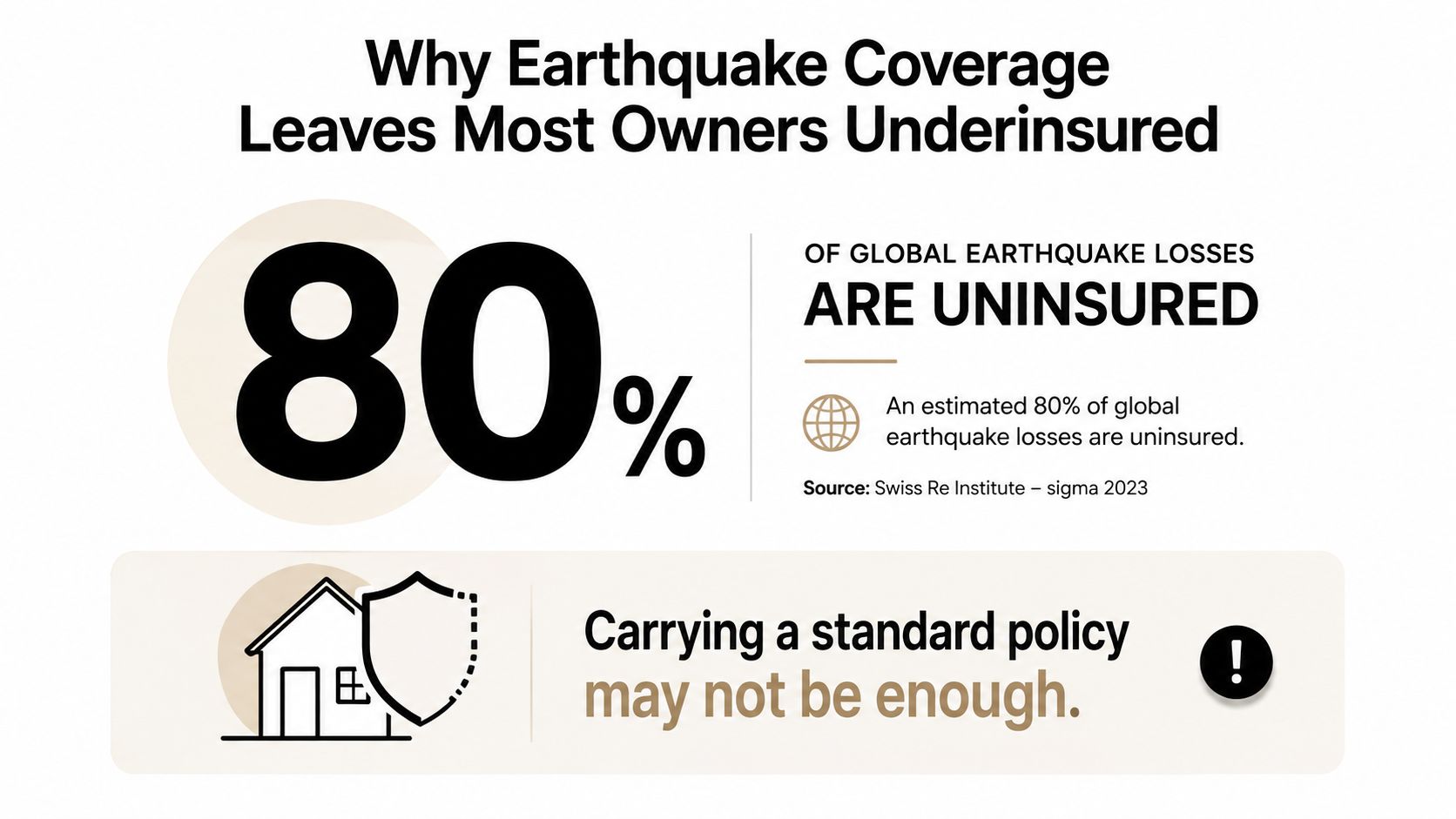
During 2010–2019, earthquakes caused US$535 billion in direct economic losses worldwide, but insurers covered only US$102 billion, leaving 81% of losses uninsured according to the NAIC earthquake protection gap analysis. That figure should change how Oregon and Washington property owners think about earthquake coverage. A homeowners or commercial property policy in your file doesn't mean your building, foundation, contents, or temporary housing costs are protected.
Earthquake claims fail in two places. First, the owner may have no earthquake coverage at all because standard property policies generally exclude earth movement. Second, the owner may carry a policy that looks adequate until the deductible, valuation method, sublimits, and causation language reduce the meaningful recovery. The policy exists, but the payout doesn't match the loss.
Why Earthquake Coverage Leaves Most Owners Underinsured
Only 19% of direct earthquake losses were insured during 2010–2019, leaving households, businesses, governments, and lenders to absorb the rest, according to the same industry analysis. That protection gap applies directly to Oregon and Washington property owners. Ordinary homeowners insurance generally excludes damage caused by land movement, so having a property policy in your file does not mean you have earthquake protection.
Without a separate earthquake policy or a specific endorsement, an owner may have no structural recovery for shaking damage, foundation failure, soil liquefaction, or related earth movement. A policy may still cover a separate peril, such as fire, but that does not make earthquake damage an insured loss. Mixed-peril claims require a clear causation analysis, because the insurer may argue that excluded earth movement, rather than a covered event, caused the damage.
FEMA's market data show the difference between recognizing seismic risk and carrying usable coverage. California experiences about 90% of the earthquakes in the United States, yet only 10% of California residents had earthquake insurance in 2014, rising to 13% in 2019. Washington had 11.3% coverage in 2017, despite being the second-largest seismic insurance market, according to FEMA's earthquake insurance guidance.
The policy can exist without meaningful protection
A purchased policy still demands close review. Earthquake deductibles commonly apply as a percentage of the insured replacement-cost limit, not the repair bill. That math can leave an owner paying a substantial share of the loss before the insurer owes anything. A large building limit can therefore produce a deductible that makes moderate damage practically unrecoverable.
Practical rule: Read the declarations page and endorsement together. The declarations page shows what you bought. The form controls what the insurer will pay.
Secondary damage creates another fight. A policy may cover direct physical loss from shaking, including damage to foundations, walls, and attached structures, while excluding flood, landslide, subsidence, erosion, mudflow, or certain underground systems unless the earthquake directly caused the damage. FMH policy language shows why engineers must separate primary shaking damage from excluded water or slope-failure damage.
Review the policy before a loss through a professional review of your coverage gaps. Confirm the deductible, insured value, covered structures, valuation method, and causation language now. After the ground stops moving, the insurer will use those terms to define the claim. A public adjuster can document the damage, test the insurer's causation position, and build the claim around the recovery your policy permits.
Standalone Policies Versus Endorsements
Oregon and Washington owners generally encounter earthquake coverage in two forms. A standalone earthquake policy is written separately through a specialty insurer or surplus lines carrier. An endorsement, sometimes called a rider, attaches earthquake protection to an existing homeowners or commercial policy.
The cheaper option isn't automatically the safer option. An endorsement may be easier to bind and may fit a modest residential risk, but its limits and sublimits can leave major components underinsured. A standalone policy may offer more room to tailor dwelling, contents, additional living expense, valuation, and related peril terms, but it requires a more deliberate underwriting review.
| Feature | Standalone Policy | Endorsement (Rider) |
|---|---|---|
| Policy structure | Separate catastrophe policy | Added to an existing property policy |
| Limits | Often more flexible for larger risks | May be restricted by the underlying policy |
| Earth movement terms | May offer broader definitions, subject to the form | May use tighter definitions and exclusions |
| Liquefaction or landslide | Must be confirmed in the wording | Often limited or excluded |
| Masonry and chimneys | May provide negotiated limits | Frequently subject to sublimits |
| Detached structures | Can be scheduled more broadly | May have restrictive limits |
| Business interruption | May be available under the form | Frequently absent or restricted |
| Ordinance and law | May be available by endorsement or form | Often limited in package policies |
| Administration | Separate premium, renewal, and claim analysis | Simpler billing and policy management |
The correct comparison is not premium against premium. Compare the retention, the maximum payable amount, the valuation basis, and the exclusions. A policy with a lower annual cost may leave you unable to repair a foundation, replace a chimney, or comply with current building requirements.
Residential owners need a written side-by-side review
Ask for the actual form, not just a quote summary. Confirm whether the dwelling limit reflects replacement cost, whether attached and detached structures share one limit, and whether masonry veneer, chimneys, retaining walls, pools, landscaping, and personal property have separate restrictions.
Commercial owners need a broader review. A blanket earthquake endorsement on a commercial package may protect buildings while omitting business interruption, ordinance-and-law coverage, equipment, tenant improvements, or debris-related expenses. A business can therefore face a covered physical loss and still lack the funds needed to reopen or rebuild to current requirements.
A professional insurance policy review can identify those gaps before an earthquake turns them into claim arguments. For either policy type, insist on clear answers in writing. If the agent can't explain how the deductible applies to each building and coverage part, you don't yet understand the protection you're buying.
Deductibles, Valuation Methods, and Hidden Exclusions
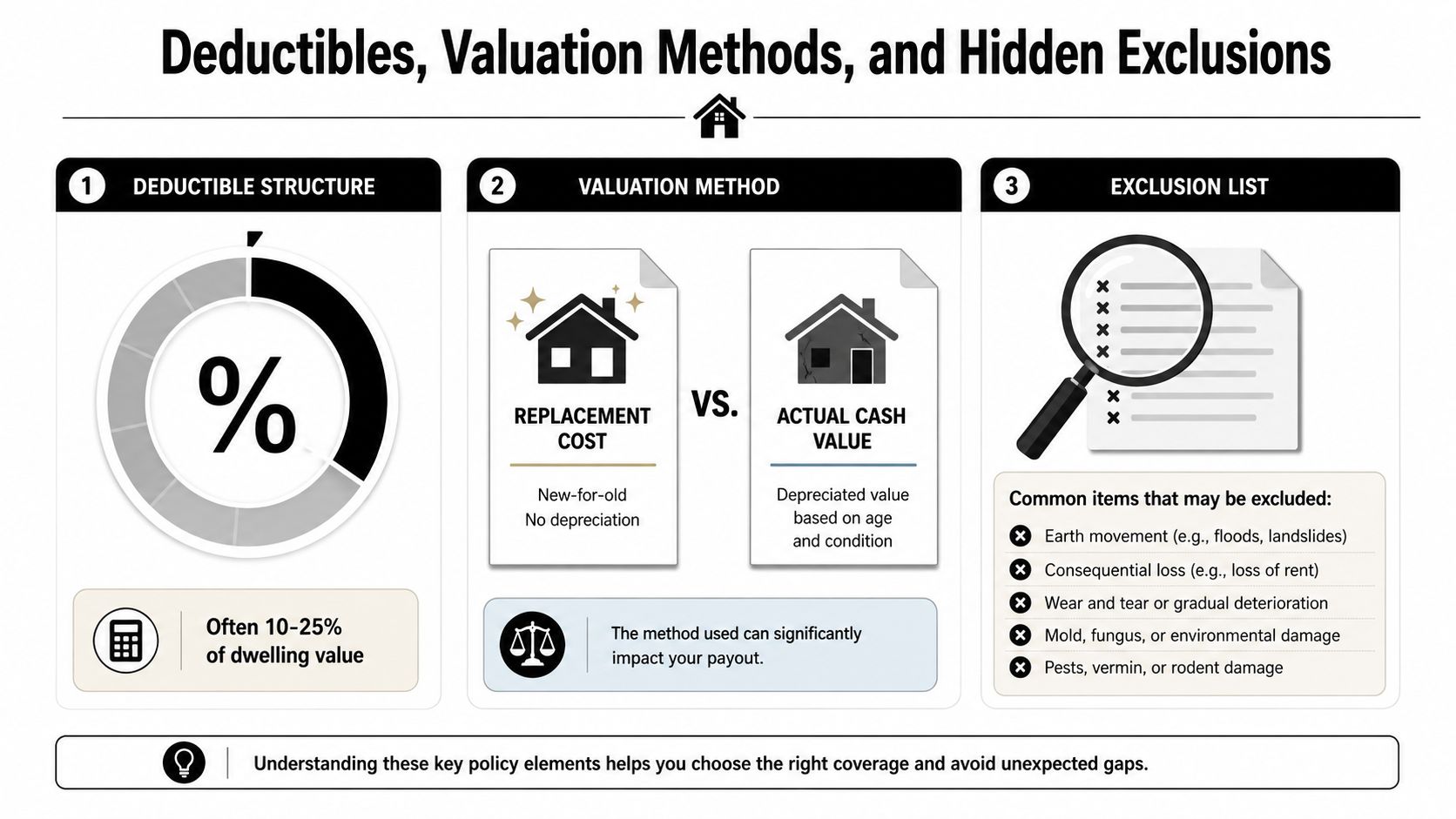
Three policy mechanics determine whether earthquake coverage produces a meaningful recovery: the deductible, the valuation method, and the exclusions. Owners who focus only on the coverage limit often miss the provisions that control the check.
Deductible math comes first
Earthquake deductibles are commonly calculated as a percentage of the dwelling or building limit. Industry guidance describes percentage deductibles commonly ranging from 5% to 20% of the coverage limit in its earthquake insurance discussion.
Suppose a building has a replacement-cost limit of $300,000 and a 15% deductible. The retention is $45,000, regardless of whether the repair invoice is modest or substantial. The deductible is tied to the insured limit, not to the amount of damage.
Before a loss, calculate this number for every covered building. If the retention would force you to borrow money or abandon repairs, the policy may be technically valid but financially inadequate.
Valuation changes the recovery
A replacement-cost provision generally measures the cost to repair or replace with comparable new materials, subject to policy conditions. Actual cash value subtracts depreciation for age and condition. That difference becomes important for roofs, flooring, cabinets, mechanical systems, and contents.
An adjuster may prepare a scope using depreciated values while you assume the policy will fund new work. Check whether recoverable depreciation is available, whether repairs must be completed before it is released, and whether the policy imposes separate limits on contents or older construction.
Exclusions create mixed-peril problems
Earthquake damage rarely arrives in a neat category. Shaking may crack a foundation, rupture a water line, destabilize a slope, and allow rain or groundwater to enter. The insurer may accept the shaking damage while arguing that the later water intrusion or slope movement falls outside the earthquake form.
Review the policy for:
- Earth movement: Landslide, subsidence, erosion, mudflow, and related ground failure may be excluded or narrowly defined.
- Water damage: Flood, tidal wave, tsunami, and water released through certain systems may require separate coverage or a direct-causation analysis.
- Structural components: Foundations, underground water lines, septic systems, retaining features, and detached structures may have special treatment.
- Existing conditions: Pre-existing cracks, settlement, deferred maintenance, or prior repairs may become causation arguments.
- Code requirements: Ordinance-and-law coverage may be absent, limited, or available only through a separate provision.
Use a written loss valuation review to compare the policy's definitions against the engineer's findings and the contractor's scope. Don't accept a broad denial when the loss contains several causes. The critical question is which damage was directly caused by the earthquake, which damage came from an excluded peril, and whether the policy has an applicable ensuing-loss provision.
What to Do Immediately After an Earthquake
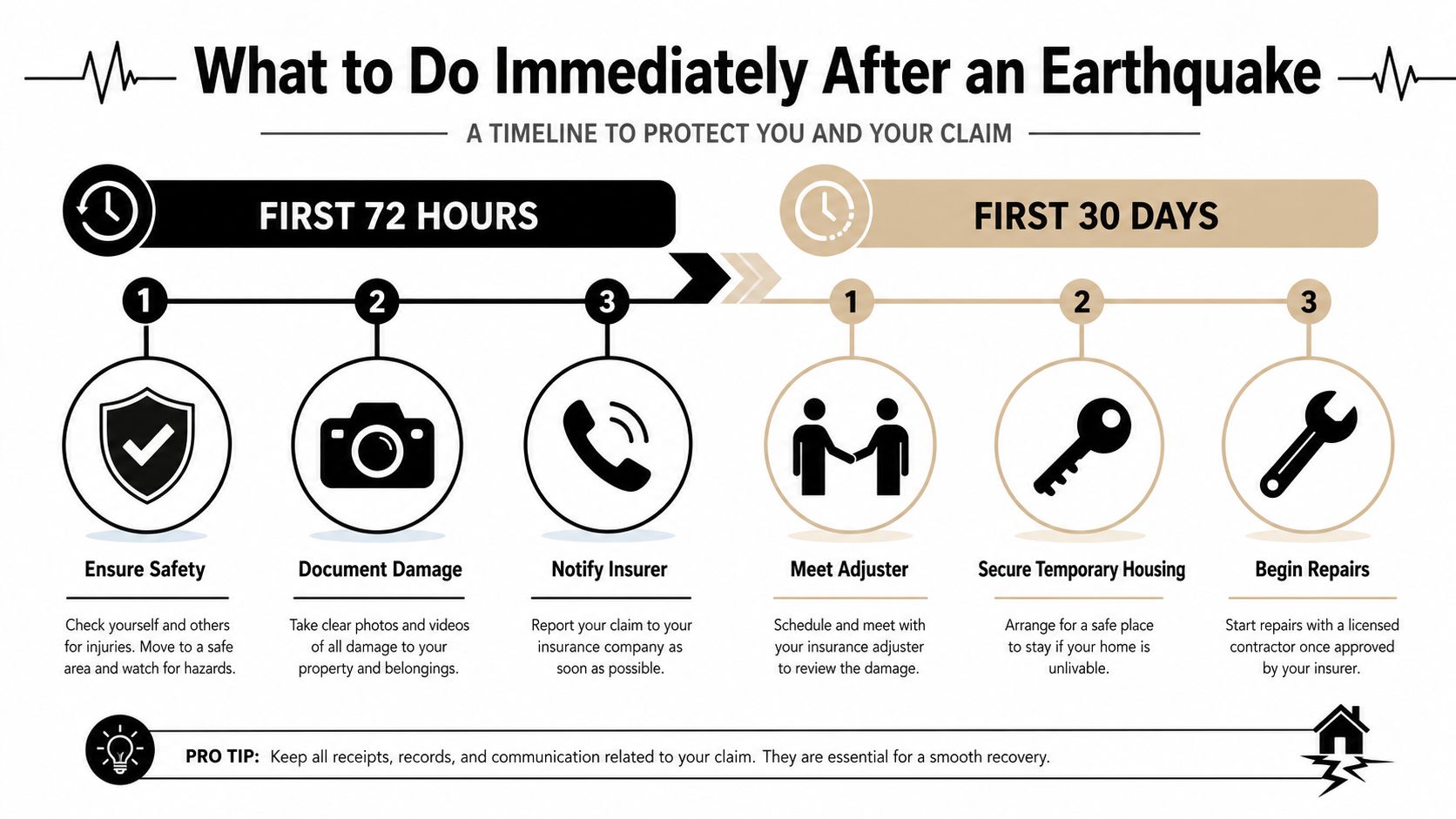
The first priority is people, not paperwork. Leave areas with visible structural movement, falling hazards, gas odors, damaged utilities, or unstable chimneys. Follow emergency instructions, shut off gas only if you can do so safely, and don't reenter a building until authorities or qualified professionals say it's safe.
Once everyone is safe, create a record before cleanup changes the evidence. Photograph and video every room, exterior elevation, foundation, crawl space, chimney, retaining feature, detached structure, and damaged item. Record wide views first, then close-ups that show cracks, displacement, broken connections, water entry, and identifying details.
The first 72 hours
Keep a contemporaneous log. Write down when the shaking occurred, what you observed immediately afterward, who inspected the property, and what temporary measures were taken. Save invoices and receipts for boarding, tarping, emergency plumbing, temporary lodging, engineering inspections, and other reasonable mitigation expenses.
Use this checklist:
- Secure the property: Prevent trespass, protect openings, and follow safety instructions.
- Mitigate further damage: Take reasonable emergency steps, but don't demolish or permanently repair damaged areas before documentation and inspection unless safety requires it.
- Notify the insurer: Report the claim promptly and ask for a claim number, assigned adjuster, and instructions for preserving evidence.
- Preserve communications: Save emails, letters, text messages, voicemails, estimates, and inspection notes in one claim folder.
- Record temporary living costs: Keep lodging, food, transportation, storage, and other expense records if the home is uninhabitable and the policy provides additional living expense coverage.
For a broader practical reference on managing claims after a home disaster, focus on preserving records and controlling communications rather than relying on memory.
The first 30 days
Prepare a room-by-room inventory with purchase dates, descriptions, photographs, receipts, and current replacement costs where available. Don't throw away damaged contents until the insurer has had a reasonable opportunity to inspect them, unless they create a health or safety hazard.
Meet the insurer's adjuster, but don't treat the first inspection as the final scope. Ask for the written estimate, the causation findings, the depreciation schedule, and the policy provisions used to limit or deny each item. A structured emergency response protocol helps keep those requests and deadlines organized.
Your early decisions affect both the speed and size of the eventual settlement. Document first, mitigate carefully, and challenge unexplained omissions before contractors begin irreversible work.
Insurer Tactics That Reduce Earthquake Payouts
The first adjuster's estimate is an opening position, not a verdict. Earthquake claims give insurers several ways to narrow payment, especially when damage involves older construction, prior repairs, soil movement, water, or incomplete records.
Causation becomes the main battleground
An insurer may characterize a foundation crack as settlement, age, poor maintenance, or a pre-existing condition rather than shaking. If the earthquake worsened an existing defect, the adjuster may argue that only the incremental damage is covered, or that the entire repair falls within an exclusion.
Mixed-peril claims make that argument more complicated. A quake may damage a pipe, the pipe may release water, and the water may affect flooring or contents. A slope may move after shaking, while the carrier attributes the resulting damage to excluded landslide activity. The policy language and expert evidence must connect each claimed item to the covered event.
Watch for these phrases in correspondence and reports:
- “Pre-existing condition” without a documented baseline inspection.
- “Wear and tear” used to describe sudden displacement or new cracking.
- “No evidence of direct physical loss” when the inspection was limited or concealed areas weren't opened.
- “Below deductible” without a complete building and contents calculation.
- “Unrelated damage” without an explanation of how the adjuster separated earthquake effects from other causes.
- “Depreciated value” when the policy may provide replacement-cost recovery.
Low estimates and narrow categories
Carriers may rely on a limited contractor scope that omits engineering, code upgrades, access, debris handling, temporary protection, or the full extent of hidden damage. They may apply contents depreciation aggressively or enforce sublimits for masonry, chimneys, detached structures, landscaping, and other categories.
| Tactic | How It Works | Typical Dollar Impact |
|---|---|---|
| Causation reallocation | Assigns damage to settlement, wear, water, or landslide instead of shaking | Can remove disputed work from the covered scope |
| Early limited inspection | Prices visible damage before concealed conditions are investigated | Leaves hidden structural and system damage unscoped |
| Depreciation | Values older building components or contents below replacement cost | Reduces the initial payment |
| Sublimit application | Caps a category even when the total loss is larger | Restricts recovery for items such as masonry or detached structures |
| Deductible framing | Applies the percentage retention to the full insured limit | Can make a substantial repair appear payable only after a large retention |
| Incomplete expert review | Relies on a narrow inspection or unsupported conclusion | Weakens proof of direct earthquake causation |
Don't argue from frustration. Respond with a line-by-line comparison, photographs, engineer findings, contractor estimates, receipts, and the exact policy language supporting each disputed item. A qualified representative can also request a supplemental inspection before repairs erase the evidence.
How a Public Adjuster Maximizes Your Recovery
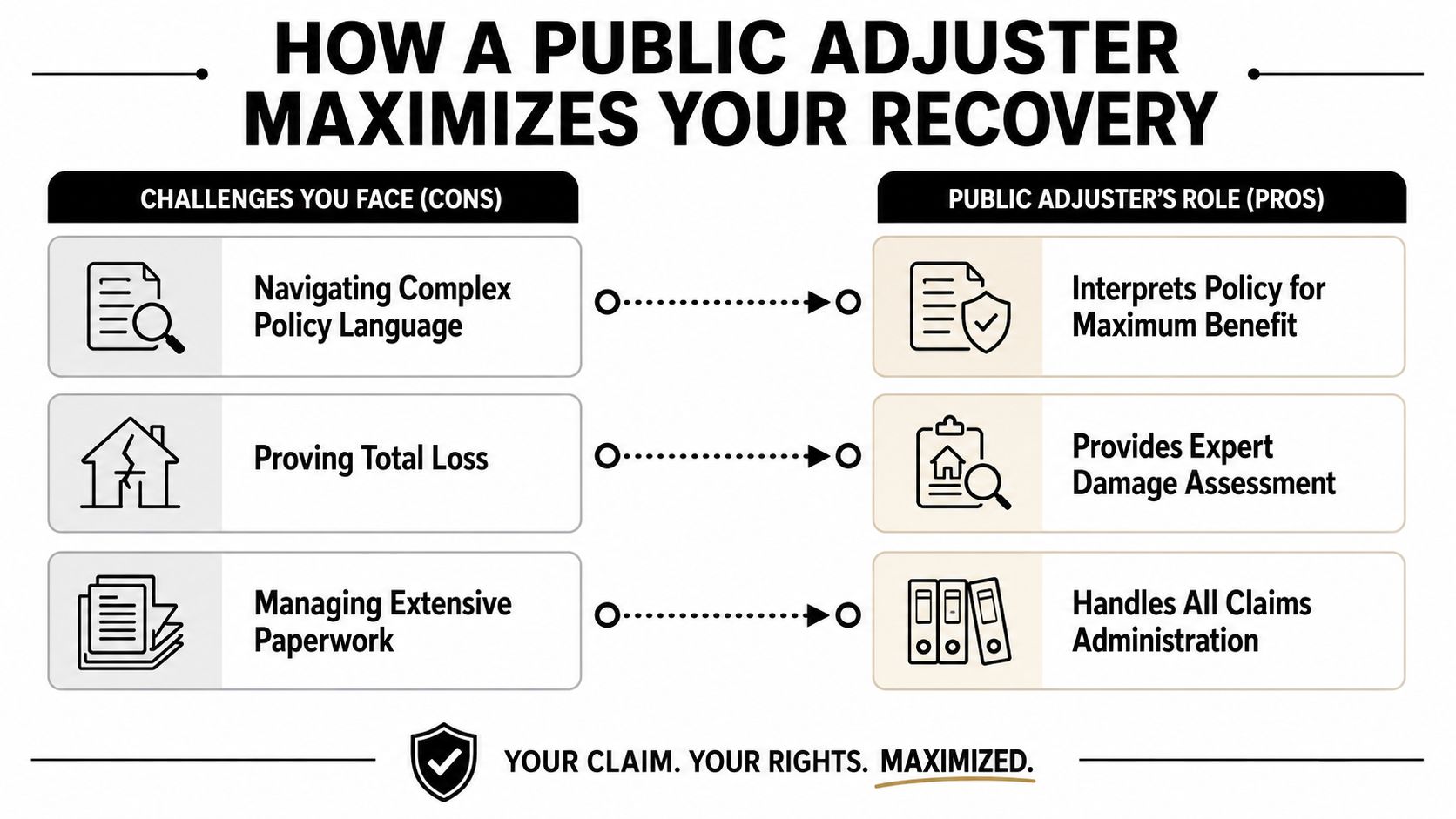
A public adjuster works for the policyholder, not the insurance company. That distinction matters when the claim requires a complete scope, a causation analysis, and persistent negotiation across several coverage parts.
The adjuster begins with the policy. They identify the earthquake trigger, percentage deductible, valuation method, sublimits, additional living expense terms, code provisions, and exclusions. They then document the loss independently, which can expose omissions in the carrier's initial estimate.
For a structural claim, that work may include coordinating with structural engineers or geotechnical professionals when the insurer attributes damage to settlement or pre-existing conditions. For contents, it means building a detailed inventory and testing depreciation, condition, and replacement-cost assumptions. For commercial property, it can include reviewing building damage, tenant improvements, equipment, interruption exposure, and repair requirements.
When representation makes sense
Hire help early when the claim involves:
- Large structural damage: Foundation, framing, chimney, retaining, or multi-building losses need more than a quick visual estimate.
- Disputed causation: A carrier blames settlement, water, landslide, or age for damage that appeared or worsened after shaking.
- Commercial operations: Business income, code compliance, equipment, and tenant issues can complicate the adjustment.
- Multiple structures or locations: Separate deductibles, limits, and scopes require coordinated accounting.
- A rushed or incomplete estimate: Missing rooms, systems, engineering, or contents should be corrected before settlement discussions harden.
Public adjusters commonly charge a percentage of the recovered amount, so review the engagement agreement, fee calculation, services, and termination terms carefully. A licensed public adjuster can explain whether professional representation fits the size and complexity of your claim.
The value isn't a promise of a particular result. It's disciplined claim preparation. A defensible scope, credible expert evidence, organized records, and direct policy analysis give you a stronger position than accepting the carrier's first number without testing it.
Your Earthquake Coverage Action Plan
Today, find the declarations page, policy form, and every earthquake endorsement or standalone policy. Confirm the insured replacement-cost limit, deductible percentage, valuation method, building-specific limits, contents coverage, additional living expense coverage, and exclusions for earth movement, water, masonry, detached structures, and code upgrades.
This week, calculate your real retention by applying the deductible to the current insured replacement-cost limit, not the property's market value. Photograph the property's current condition, especially the foundation, chimney, roof, crawl space, retaining features, and detached structures. Build an inventory of valuable contents and store copies of photographs, receipts, policies, and inspection records in secure cloud storage or another location away from the property.
This month, schedule a policy review with a licensed public adjuster or another qualified insurance professional before a loss occurs. Ask for written answers about mixed-peril damage and whether the policy can support the cost of rebuilding and temporary living or operating expenses.
After a significant seismic event, make three calls within 24 hours: the insurer, a public adjuster, and a structural engineer. Secure the property, preserve evidence, save every mitigation receipt, and don't sign a final release until the full scope and policy calculation have been reviewed.
NW Claims Management reviews earthquake-related policy language, documents structural and contents losses, and helps Oregon and Washington property owners manage complex claim administration. Visit NW Claims Management for a claim evaluation and practical guidance before you accept an insurer's estimate.