You're standing in a home that doesn't feel like yours anymore. The drywall might still be there, but the couch smells like smoke, the cabinets are damp, and the box of family photos on the floor could be either salvageable or a total loss. That's the moment many realize the true damage isn't just structural. It's everything inside the structure, the belongings, the proof, the memories, and the items an insurer is going to ask you to account for.
Contents restoration services exist for that exact problem. In plain English, they're the work of inventorying, packing out, cleaning, deodorizing, restoring, and storing personal property and business contents after fire, smoke, water, mold, vandalism, or similar losses. The broader disaster restoration market is already large and still expanding, estimated at USD 46.55 billion in 2026 and projected to reach USD 60.43 billion by 2031 with a 5.36% CAGR (Mordor Intelligence). That matters because contents work isn't a side hustle inside the restoration industry. It's a major line of recovery.
A lot of homeowners still think restoration means construction. That's only half the job. The structure gets dried and rebuilt, but the belongings inside require a different process, one that protects both the item and the claim file. If you want a plain-language reference for building your own inventory before a pack-out, the personal property inventory template is a useful starting point.
What Contents Restoration Services Cover
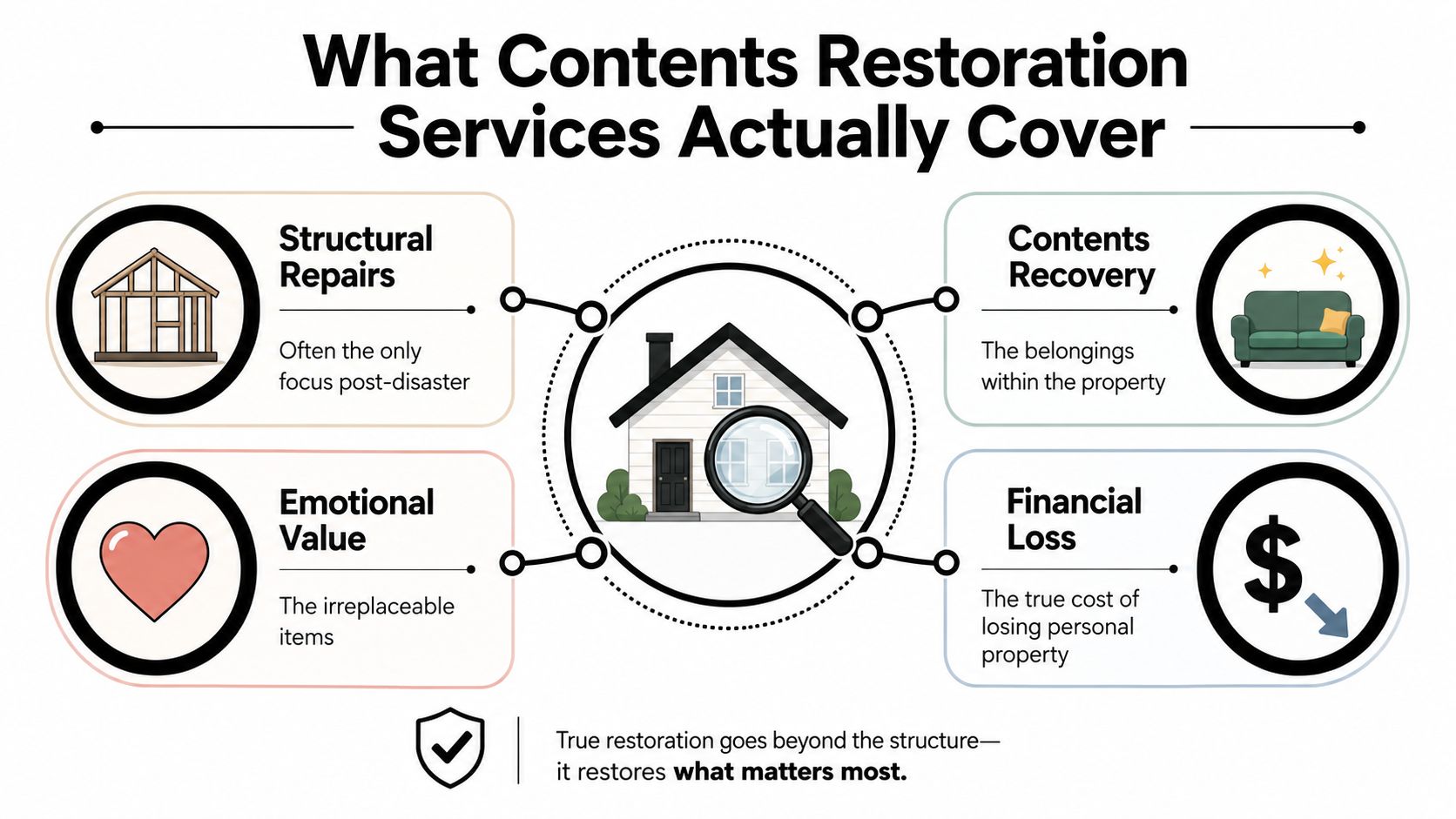
A homeowner usually learns the hard part in real time. One room smells like smoke, another has soaked furniture, and the adjuster is focused on the building shell while the family is staring at the bookshelf full of albums, tax folders, clothes, and the old dining set that has been in the house for years. Contents restoration handles the items people live with, work with, and often cannot replace cleanly, even when the structure itself can be repaired.
The work is broader than cleaning
The industry defines contents restoration as a mix of inventorying, photographing, packing out, cleaning, deodorizing, and restoring salvageable property after a loss. That includes furniture, documents, electronics, clothing, art, and collectibles, along with business contents that need to be tracked, treated, and returned. For a plain-language starting point before any pack-out, use the personal property inventory template to build a usable item list while the scene is still intact.
This work also connects to other cleanup needs after a fire. If smoke has worked into HVAC runs, drywall cavities, or ductwork, contents crews often coordinate with duct cleaning after a fire because lingering soot can recontaminate cleaned belongings.
Structural restoration and contents restoration solve different problems. Structural crews stabilize the building, remove damaged materials, and rebuild what is attached to the property. Contents teams handle the movable items that carry the personal and financial loss. A house can look repaired and still function badly if the belongings were thrown away without documentation or treated like an afterthought.
Practical rule: If the item can be inventoried, packed, cleaned, stored, and returned, it belongs in contents work, not just construction work.
Why the distinction matters in a claim
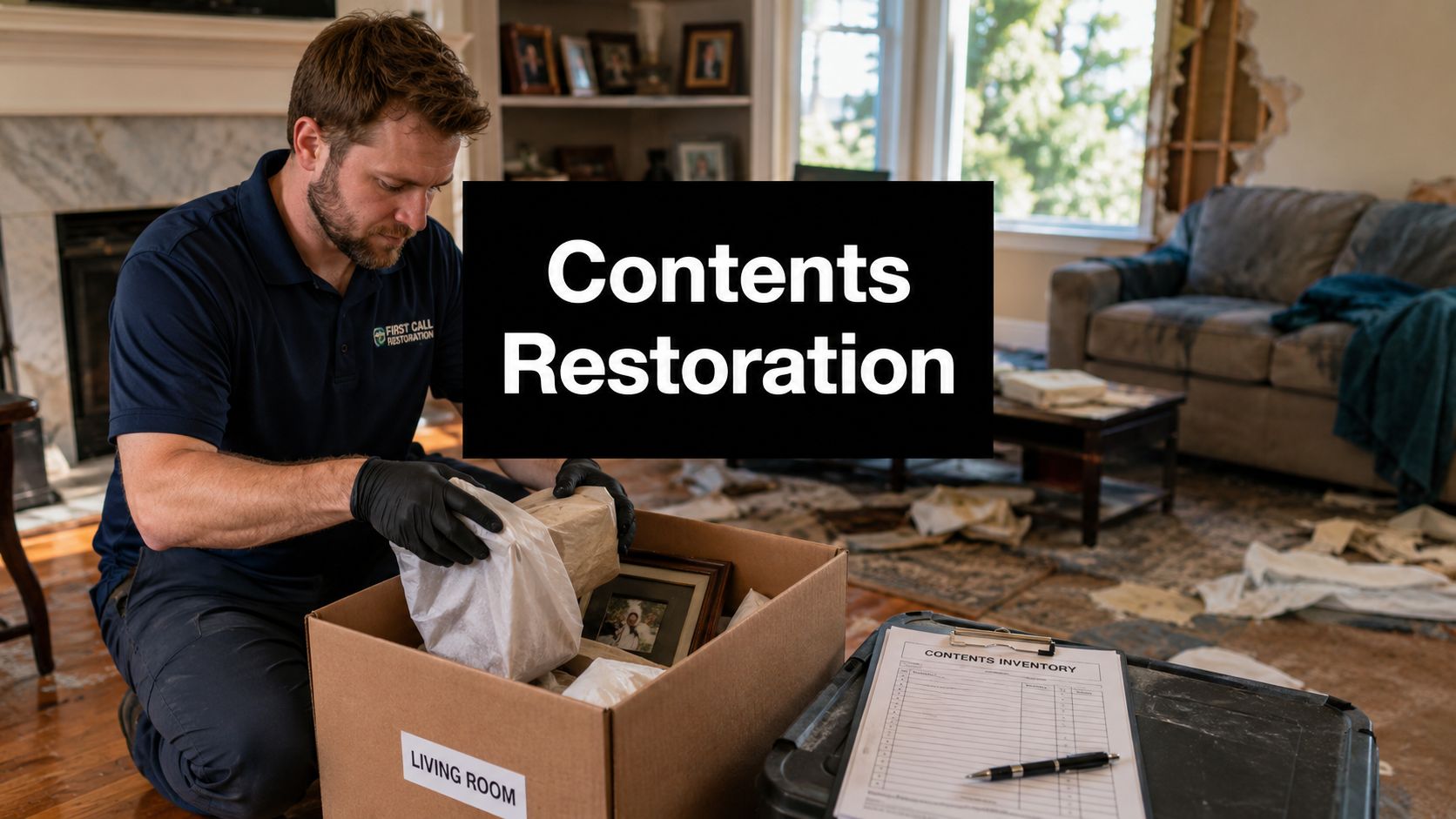
Contents work is not only about salvage. It creates an evidentiary trail. Technicians inventory, label, and photograph each item before movement, then track it through cleaning and storage so the insurer has a defensible record of what existed and what happened to it. In losses involving smoke, water, or vandalism, that documentation can matter as much as the cleaning itself.
It also catches the items with emotional value that never show up well on a remodel estimate. A sofa can be replaced. A family Bible, a child's artwork, or a set of documents usually cannot. That is why contents restoration services are a distinct specialty, not just another form of janitorial work.
The Contents Restoration Workflow from Pack-Out to Return
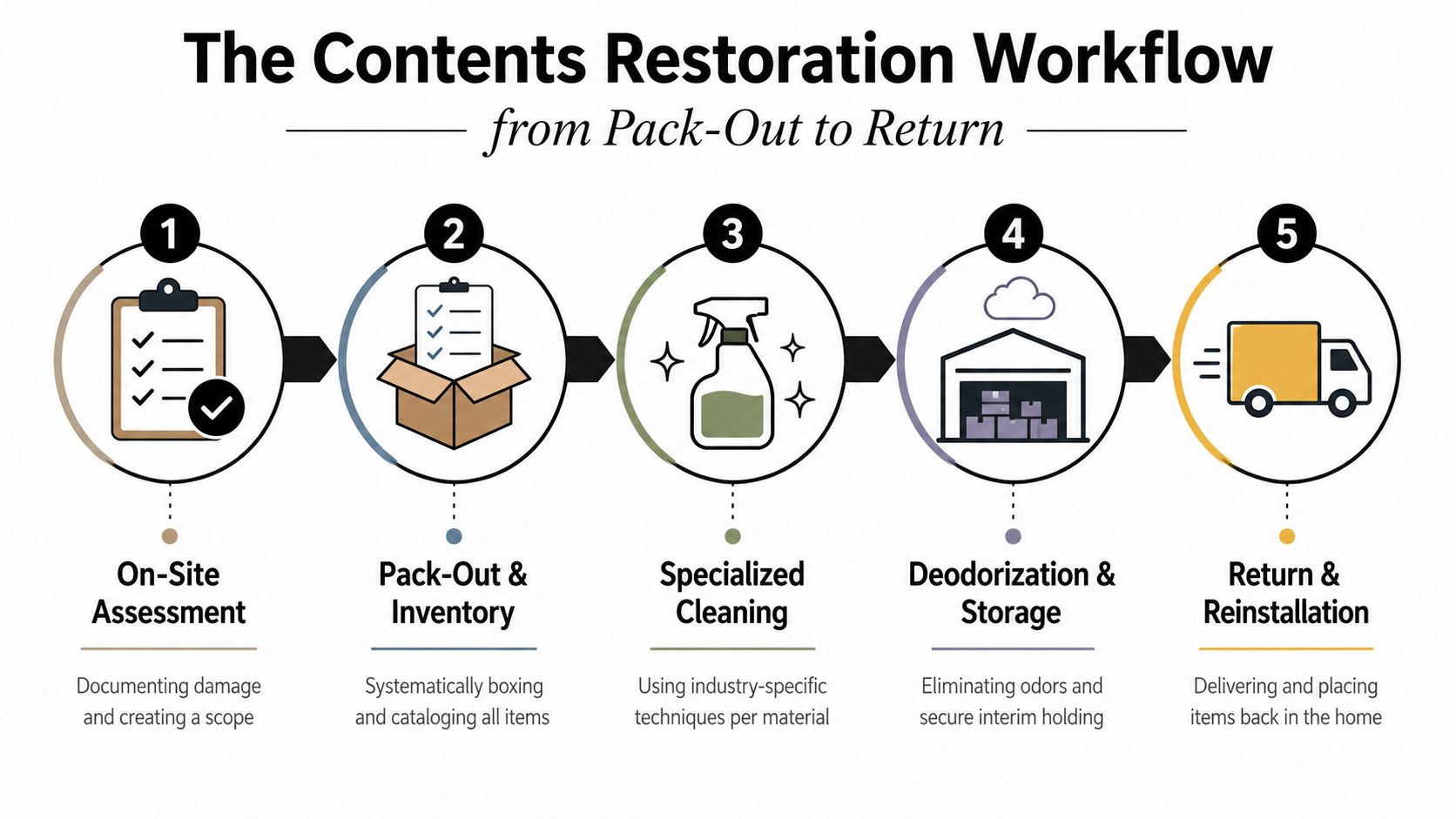
A good contents restoration job starts before anyone touches a box. The crew should walk the property, photograph the damage, and build a room-by-room inventory while the scene is still intact. That first pass protects the chain of custody insurers expect to see when they review valuation, salvage, and disputed items. Once contents start moving, every step needs to be traceable.
Pack-out comes first, not last
Pack-out is controlled removal, not a hauling run. Salvageable contents get wrapped, labeled, barcoded when possible, and moved off-site so the structure can be repaired without exposing them to more damage. If you've ever hired a premium white glove moving company, the handling standard is familiar, but the purpose is different. Here, the crew is protecting the item and the claim record at the same time, and that is why the premium white glove moving company model from TLC Moving & Storage is a useful reference point.
Once the items reach the facility, the cleaning process shifts by material. Hard goods may need specialized washing or ultrasonic treatment, while odor issues can require deodorization systems such as ozone or hydroxyl generators when appropriate. Paper records can need freeze-drying after water exposure, which is why damaged documents should never be tossed into a trash bag and ignored.
Water losses need fast source control before contents work can succeed. The right emergency water extraction services reduce the spread of damage and give the contents crew a better chance to save items that would otherwise keep soaking.
During structural repairs, restored contents are commonly held in climate-controlled storage at about 40 to 60% relative humidity to reduce secondary damage such as mold growth and warping. That matters because items that stay damp in a garage or moving truck often come back worse than they left.
Return is a controlled handoff
The final step is re-delivery and reinstallation. That sounds simple, but the best vendors treat it like a second inventory check. Items should be matched against the original log, then placed back in the home or business in a way that aligns with the claimant's records and the adjuster's scope.
Do not let anyone treat pack-out as a hauling job. It is a controlled evidence move, and that is what protects your settlement.
Contents restoration is also about deciding what deserves to come back. A technician who understands salvage judgment knows when an item should be cleaned, when it should be documented and stored, and when replacement is the smarter claim outcome. That discipline helps preserve the belongings that matter and keeps the record clean for the insurer.
Restore or Replace A Practical Triage Framework
Not everything should be restored. Anyone who tells you otherwise is selling hope, not judgment. The right question is whether an item is worth saving after you weigh replacement value, contamination severity, sentimental value, and insurer rules. That's the decision point homeowners usually need most, and it's the part many guides skip.
Start with the item's economics
If a chair, appliance, or table can be replaced for less than the actual cost of specialty cleaning, storage, and labor, replacement often makes more sense. That's especially true when the item has no meaningful sentimental value and the policy path is straightforward. Contents cleaning and pack-out operations commonly carry gross margins of 40 to 55%, which tells you why vendors may be eager to restore items that a homeowner should replace instead (WebTonic). That margin profile is a business reality, not a reason to save every piece of furniture in the house.
Then look at contamination and material type
Clean water is one thing. Contaminated floodwater, often treated as Category 3 black water in the industry, is another. Smoke residue adds a different problem because it can cling to surfaces and fabrics in ways that are hard to reverse completely. Porous materials are where judgment matters most. Upholstered furniture saturated with contaminated water, warped particleboard, and certain electronics exposed to corrosive smoke often cross the line from “restore” to “replace.”
Hard truth: If the material is porous, swollen, or contaminated deep inside the item, cleaning may improve appearance without making the item safe or economically rational to keep.
Protect what can't be bought again
The other side of the equation is irreplaceability. A wedding album, original business records, family heirlooms, and unusual collectibles don't fit a simple cost comparison. For those, restoration can make sense even when the market value is low. But the insurer's reimbursement rules still matter, especially when depreciation affects the payout. If you need a useful comparison of settlement methods, the actual cash value vs replacement cost explanation is worth keeping nearby.
The cleanest rule is this. Restore when the item has real value, can be safely decontaminated, and the numbers make sense. Replace when the damage is deep, the material is compromised, or the claim math is already pointing that way.
Understanding Costs and Insurance Claim Coordination
A contents restoration invoice is shaped by three things, what was damaged, how heavily it was exposed, and how much hands-on work each item needs. A box of lightly smoked clothing is one kind of job. A whole-house loss with books, electronics, framed art, and family furniture is another. Once different materials enter the mix, the price rises because each category needs its own handling, cleaning, and documentation.
Key cost drivers
Volume drives labor. More items mean more packing, more labeling, more tracking, and more storage space. Item type also changes the job, because electronics, textiles, artwork, and paper records cannot all be treated the same way. Off-site storage adds another layer of cost, since contents may need secure holding while the rest of the claim is handled. Logistics matter as well, especially when crews have to move items down stairs, work through tight access, or deal with hazardous residue.
Insurance coordination changes the outcome just as much. Many homeowners and commercial policies cover contents losses in some form, but the payout method can vary. Actual cash value and replacement cost value are not the same thing, and depreciation can cut the payment if the file is thin. That is why itemized inventories, photos, and proof of ownership carry real weight. They are the evidence that supports a fair settlement.
The claim file is part of the restoration
A good contents vendor should be able to explain how its inventory becomes a claim package. If the company cannot show the documentation trail, the insurer may later question what was packed out, what was cleaned, what was discarded, and what was returned. The claim process matters because contents work lives or dies on the paper trail, and a clear overview of the claim processing steps helps you see where each handoff belongs.
| Common Contents Restoration Cost Drivers | Impact on Price | Typical Considerations |
|---|---|---|
| Item volume | Higher labor and packing time | More boxes, more labeling, more tracking |
| Item type | Different cleaning methods | Textiles, electronics, paper, art, furniture |
| Contamination level | More intensive treatment | Smoke, odor, water, mold, residue |
| Storage duration | Longer interim holding | Climate control, access, chain-of-custody |
| Access and logistics | More labor complexity | Stairs, narrow entries, large pack-outs |
A public adjuster helps by making sure the inventory is complete, the damage is described accurately, and the claim value reflects what happened to the contents. Without that, homeowners often get pushed into a vague settlement where the building gets attention and the contents get shortchanged. This is primarily a financial issue, not a paperwork one.
Your Action Plan After Property Damage
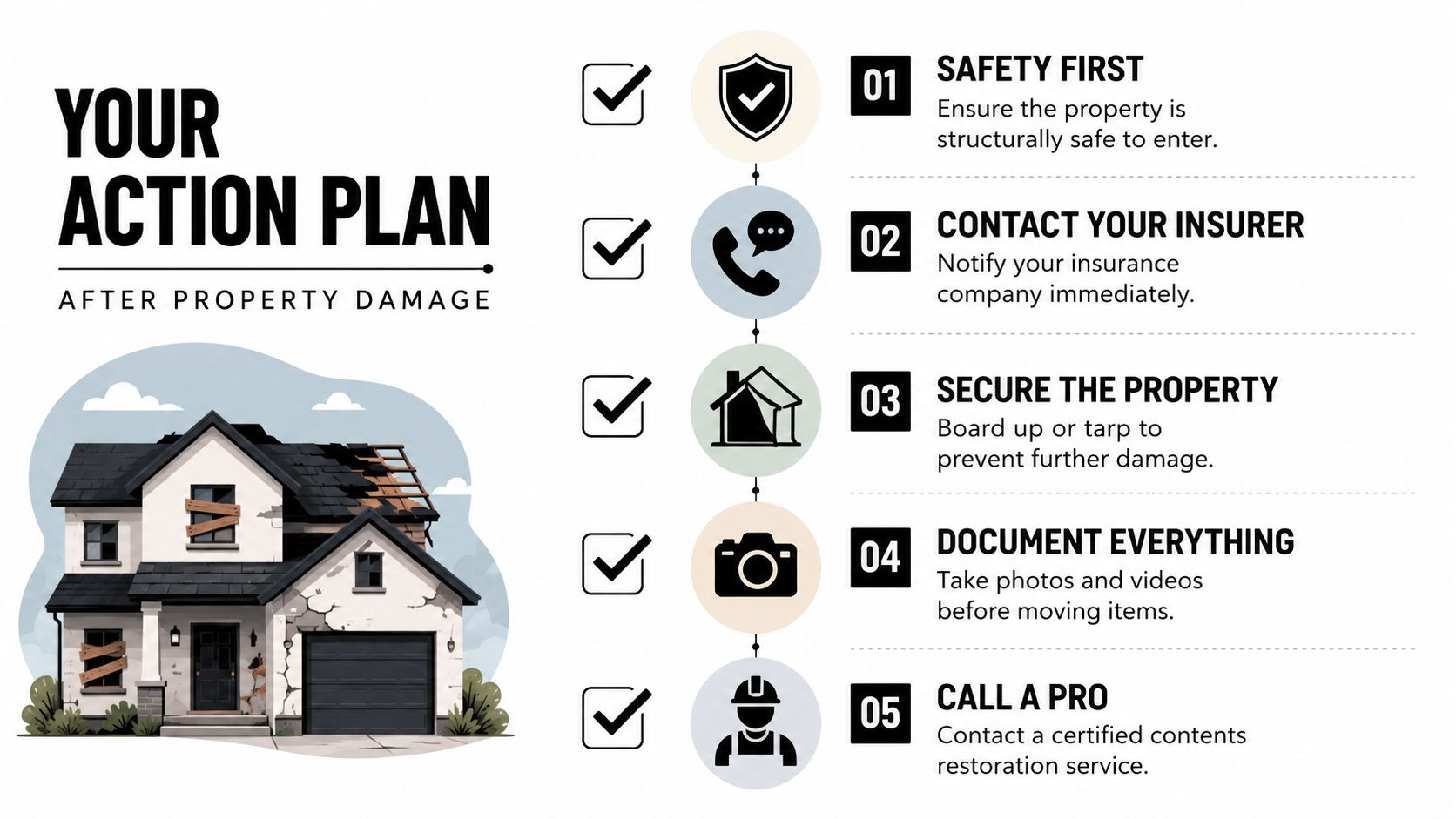
The first hours after a loss set the tone for the entire claim. Don't start with cleaning. Start with safety, documentation, and control. If the property is unsafe, stay out until utilities are shut off and the structure is cleared for entry. If it's safe, move methodically.
Do these five things in order
- Safety first. Confirm the building is safe before you go back inside.
- Contact your insurer. Open the claim quickly and ask how they want contents documented.
- Secure the property. Prevent more damage with boarding, tarping, or temporary repairs.
- Document everything. Photograph and video every room, closet, drawer, and damaged item before anything moves.
- Call a pro. Bring in a qualified contents restoration team that can inventory and protect the items properly.
If water is part of the loss, the mold clock starts fast. The guide to post-leak mold control is useful reading because it reinforces a simple point, wet contents left sitting become a bigger problem by the hour, not the week.
Oregon and Washington homeowners need to be especially careful
In the Pacific Northwest, wildfire smoke, flooding, and wind-driven water intrusion are not rare edge cases. They're common enough that homeowners should assume contents will need triage, not blind rescue. Smoke-affected fabrics, damp documents, and swollen particleboard often need immediate attention, while sentimental items should be separated and logged before the rest of the pack-out begins.
Practical rule: If you're overwhelmed, document first and sort second. The claim file can survive a delay in cleaning. It won't survive lost proof.
For a clearer paper trail, use the evidence preservation approach from the start. That mindset keeps your belongings tied to your claim instead of disappearing into a pile of “miscellaneous damage.”
Red Flags and How to Choose the Right Restoration Vendor
Not every cleaning company is qualified to handle insurance-grade contents work. A pressure washer crew, a general contractor, or a carpet cleaner can't automatically manage chain-of-custody, itemized inventories, and claim documentation. You need a vendor that treats your belongings like evidence as well as property.
What to look for
Start with IICRC certification, then ask how the company documents each item from pack-out to return. Ask whether they use climate-controlled storage, whether they provide itemized inventories, and whether they can coordinate with your adjuster on disputed contents. If they hesitate on any of that, keep looking.
Good vendors can also explain how they decide what gets restored and what gets written off. That judgment matters because a company that “saves everything” without assessment is usually avoiding hard conversations, not protecting you. You want a team that can separate salvageable items from losses that should be documented and replaced.
Red flags that should end the conversation
- Promises before inspection: If they say they can save everything sight unseen, that's a sales pitch, not a diagnosis.
- Weak documentation: If they can't explain their inventory process, your claim file will suffer.
- Broad authorizations too early: Don't sign forms you haven't read and understood.
- No storage clarity: You need to know where items go, how they're held, and who controls access.
- Poor insurance or bonding status: If something goes wrong, you don't want to discover the gap later.
A vendor should be able to work with your public adjuster, your insurer, and your contractor without creating confusion. That collaboration matters because contents restoration is part logistics, part conservation, and part claims support. The wrong company will treat it like hauling. The right company will treat it like recovery.
Protecting Your Claim and Your Belongings
Contents restoration is not just a cleaning service. It's a claim-critical process that protects the items you still own, the evidence you need, and the value your policy is supposed to replace. The homeowners who do best are the ones who document early, separate salvageable from unsalvageable items carefully, and choose vendors who understand insurance paperwork instead of just equipment.
The first 48 hours matter because they shape the inventory, the scope, and the settlement narrative. If the contents are poorly documented, the insurer has less to pay against. If the items are properly photographed, listed, and tracked, the claim has a better shot at being fair. That's why public adjusting and contents restoration work so well together. One protects the paper side, the other protects the physical side.
A licensed public adjuster can help you interpret policy language, challenge low valuations, and keep the contents record tight enough to withstand scrutiny. If you're dealing with fire, smoke, water, or vandalism in Oregon or Washington, request a free claim evaluation from NW Claims Management and get the inventory, documentation, and settlement strategy handled by someone who works for you.
If you're staring at damaged belongings right now, don't guess your way through it. Visit NW Claims Management to get help with your contents claim, protect the items that still can be saved, and make sure the loss is documented the right way before the insurer closes the door on recovery.