Most business owners get bad advice about commercial claims. They're told to treat the loss like a bigger version of a house fire, hand the file to the insurer, and wait for a fair check. That mindset gets files under-scoped, slows payments, and leaves business interruption and extra expense losses half-documented.
Commercial claims are a different game. They involve policy language, operational shutdowns, contractor pricing, inventory, equipment, and sometimes accounting records the owner never expected to pull together. The right commercial insurance adjusters do more than look at damage. They force the claim into a structure the carrier has to take seriously.
Why Commercial Claims Are Not Just Bigger Residential Claims
A commercial loss is a claim with more moving parts, and the insurer knows it. The file is not just about broken property, it also tests coverage language, operational disruption, and whether the owner can prove what the shutdown cost the business. That is why commercial claims get under-scoped so often, especially when the carrier is trying to close the file before the business has a full loss picture. For a fuller breakdown of the process, see our guide on commercial insurance claims.

Commercial losses often turn on provisions that residential guides barely touch, including business interruption, extra expense, ordinance or law, and equipment breakdown. Those coverages live or die on records, not just photos. If you cannot connect the loss to revenue interruption, fixed expenses, restart costs, and the policy wording that applies, the carrier will cut the claim down to physical repairs and ignore the financial damage.
The policy is only part of the fight
Commercial adjusting pulls in construction, financial loss, and operations at the same time. Industry sources on commercial adjusters note that they commonly work across construction, civil engineering, machinery, stock, BI and CBI losses, and liability claims, while using estimating platforms and digital inspection tools to support settlements. That is a different job from writing a simple repair estimate, because the adjuster has to tie visible damage to the business's actual financial harm. You can see that tension in practical service examples from commercial plumbing services in Sydney, where repair work, downtime, and keeping the operation open all affect the claim outcome.
Practical rule: If the claim affects payroll, customer commitments, or reopening dates, treat it like a financial claim from day one.
The scope of this work is large. A survey report estimated 125,000+ active claims professionals in the United States, with large insurers employing roughly 70% of the overall adjuster population, compared with 23% at third-party administrators and 7% at regional adjusting firms, and third-party claims adjusters handling about 3,551,617 new claims each year; the total dollar value of claims adjusted industry-wide was roughly $450 billion to $500 billion annually when extrapolated from survey results. That is not niche work. It is a specialized claims system, and the current capacity shortage leaves a lot of commercial policyholders under-scoped from the start.
The Three Types of Commercial Insurance Adjusters
Business owners hear the word “adjuster” and assume it means one thing. It doesn't. The person assigned to your loss may work for the carrier, work for a carrier through a contract, or work for you. That difference matters because the claim file will usually reflect the incentives of the person controlling the scope.
| Factor | Company Adjuster | Independent Adjuster | Public Adjuster |
|---|---|---|---|
| Who they represent | The insurance company | The insurance company they're assigned by | The policyholder |
| How they're paid | Carrier salary or compensation | Contracted by the insurer, often per assignment | Contingency-based, tied to the claim outcome |
| Primary goal | Control carrier exposure | Handle insurer assignments efficiently | Pursue the insured's claim position |
| Typical use case | Routine carrier claim handling | Overflow, catastrophe, or specialty assignments | Disputed, complex, or under-scoped commercial claims |
| Business owner risk | Scope may be conservative | Capacity can be stretched thin | Fee is tied to recovery, so alignment is direct |
A company adjuster is inside the insurer's machine. Their job is to process claims while protecting the carrier's bottom line. That doesn't make them dishonest, it makes them aligned with the insurer.
An independent adjuster is hired by the carrier but not employed by it. These adjusters are often handling multiple assignments, and in commercial property they may be moving between inspections, estimating platforms, and reports for different carriers. The practical risk is simple, the file can be efficient, but it can also be thin if the assignment volume is heavy.
A public adjuster is hired by the policyholder and represents the insured's interests. For a stressed business owner, that's the only adjuster type with a direct duty to advocate for the claim position instead of the carrier's cost control. If you're comparing who should be involved, the differences matter more than the label on the email signature. The public adjuster vs insurance adjuster distinction is the one every owner should understand before the first inspection.
The biggest mistake is assuming the first adjuster who visits the site is neutral. They're not neutral by role. They're neutral only if the facts happen to match the carrier's initial view.
The BLS reported 293,780 claims adjusters, examiners, and investigators employed in May 2023, with a mean annual wage of $75,770 and a median annual wage of $76,790 in May 2024, and an industry average annual wage of $79,010 in the insurance-carriers sector in June 2026, while projecting the occupation to decline 5% from 2024 to 2034 and still create about 21,600 openings per year on average over the decade (BLS occupation profile). That combination tells you the profession is mature, well paid, and still under turnover pressure. In plain English, experienced commercial claim talent is valuable and limited.
Services Commercial Adjusters Provide for Property Claims
A serious commercial claim file starts with policy interpretation, not damage photos. The adjuster has to read the declarations, exclusions, endorsements, and special provisions, then decide what the loss triggers. If that coverage analysis is sloppy, the rest of the file will drift.
They build the claim around evidence
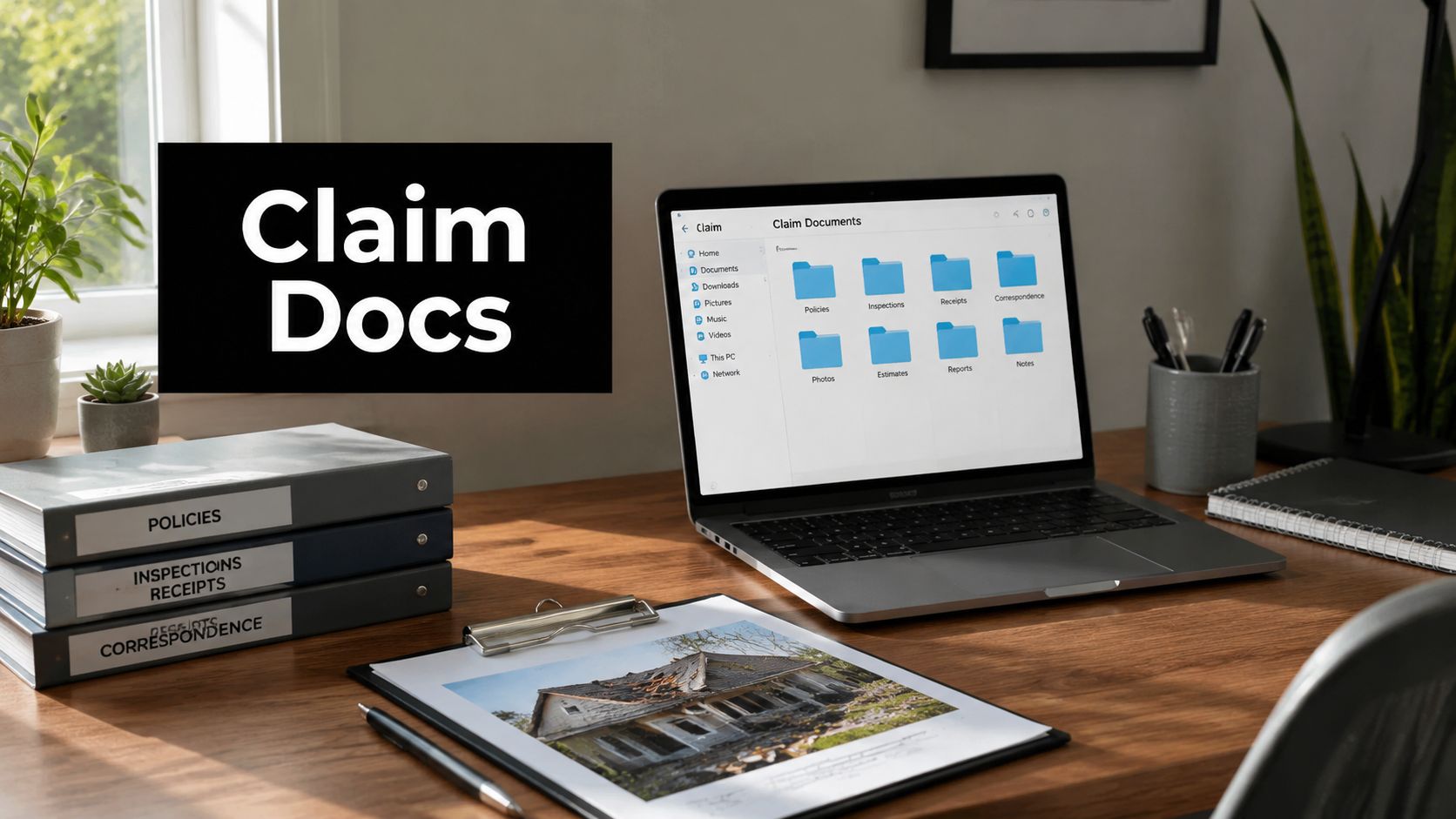
Commercial adjusters gather inspection notes, photographs, repair scopes, inventory records, invoices, and witness statements. For larger or more technical losses, they also coordinate engineers, contractors, and forensic accountants. That mix matters because the carrier will push back on anything that looks unverified.
They also assess physical damage in a way that supports negotiation. That means using estimating platforms, digital inspection tools, and clear documentation that can survive review by a carrier-side adjuster. If the site loss includes roof damage, water intrusion, machinery impact, or tenant improvement issues, the file needs to reflect each category separately.
Business interruption is where owners lose money
The hardest part is usually business interruption and extra expense. Owners often understand the repair side, but they miss the need to prove lost income, fixed costs, and restart expenses in a way the policy can support. Industry guidance on commercial property claims says these losses reach beyond structure damage into business income, extra expense, and policy-specific provisions such as ordinance or law and equipment breakdown, while many owners mistakenly treat the claim like a residential loss.
That gap is why the documentation has to be accounting-grade. The file should show pre-loss revenue patterns, ongoing obligations, what work was interrupted, and what extra costs were required to keep the business moving. If you can't show the carrier how the interruption changed the financial picture, the insurer will default to the narrowest reading of the loss.
Documentation wins this category. The owner who saves contracts, payroll records, vendor invoices, and restart costs gives the adjuster leverage the carrier has to answer.
Commercial adjusters also handle liability files, stock loss, and machinery valuation when those issues are part of the same event. The common thread is not estimating. It's defensible claim presentation. If the loss touches a system, a machine, or a revenue stream, the adjuster's job is to prove how that system failed and what it cost to recover.
The Commercial Claim Workflow From Loss to Settlement
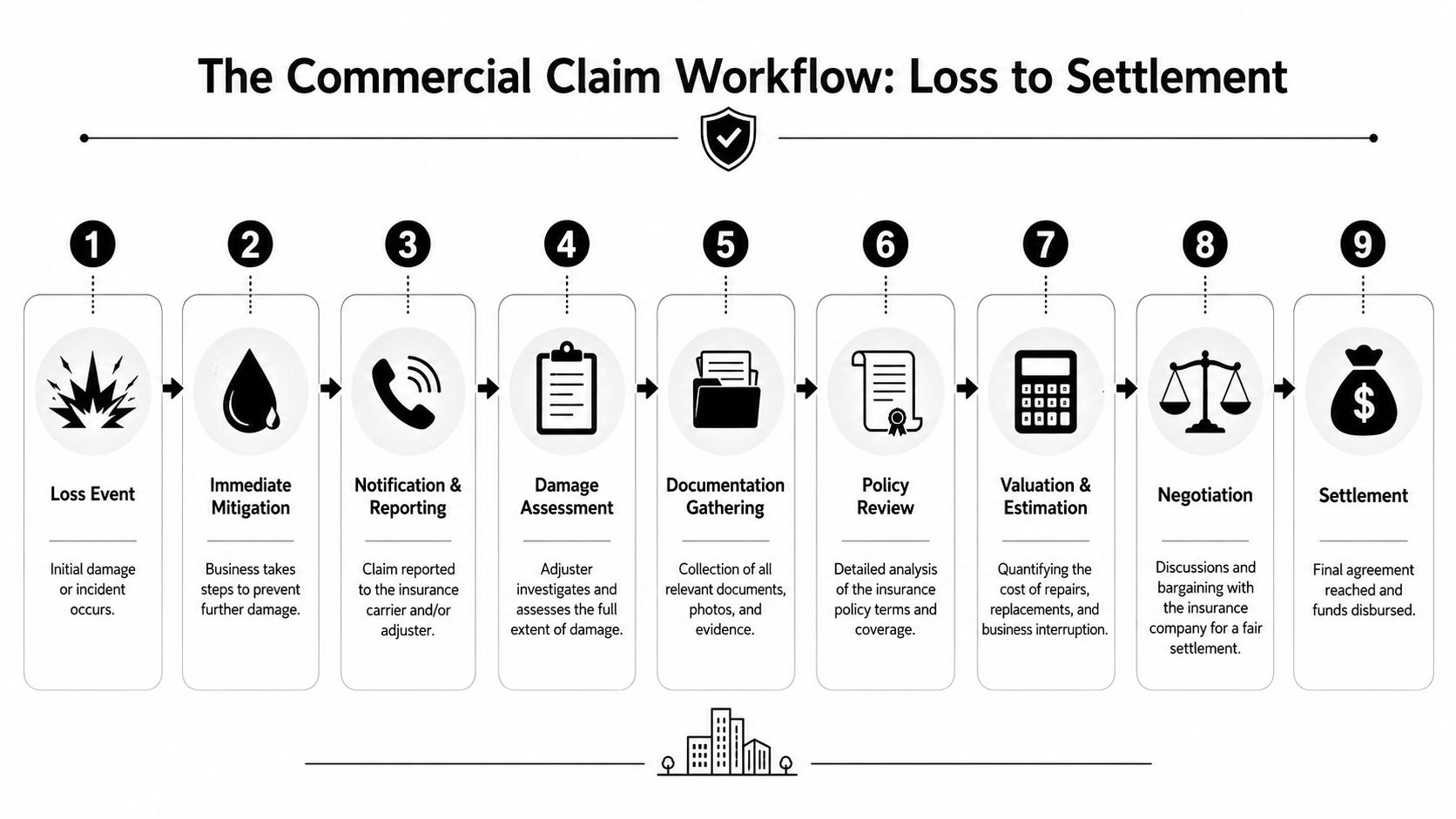
The claim moves fastest when the owner treats the first 48 hours like evidence collection, not cleanup. Take photos before anything is moved, keep damaged materials, and record every temporary fix. If you wait until the building is “organized,” you've already lost your advantage.
The file has to be built in the right order
First comes notice of loss. Then the carrier assigns an adjuster, inspects the site, and starts forming a scope. That's where business owners usually make their first mistake, they speak too casually, assume the adjuster sees the full damage, and fail to correct omissions early.
After the inspection, the policyholder should review the scope line by line and challenge missing items quickly. Supplemental claims are normal in commercial losses because initial inspections miss hidden damage, tenant impacts, and trade-specific details. If the owner waits until repairs are underway, the carrier may argue the missed items weren't part of the covered loss.
The interruption file needs its own discipline
Business interruption documents usually move separately from the physical damage estimate. That's a mistake, but it's common. The insurer wants proof, and the proof needs to connect lost income and extra expense directly to the covered event, not just to a general downturn.
Keep the workflow simple and brutal:
- Mitigate immediately. Stop further damage and document every step.
- Report fast. Delay gives the carrier room to question causation.
- Preserve records. Photos, logs, invoices, contracts, and payroll data matter.
- Inspect with a checklist. Don't let the carrier decide what is “minor.”
- Separate categories. Repair, stock, equipment, and BI are not the same claim.
- Push back on the first scope. It's rarely complete on a commercial loss.
- File supplements early. Waiting weakens the claim.
- Negotiate from documents. Opinion without records gets ignored.
- Close only when the file is complete. A rushed settlement is often a discounted one.
A solid public adjuster keeps the file moving through each of those stages and prevents the carrier from treating the claim like a simple repair ticket. That's the point of representation, not just speed, but accuracy.
When Hiring a Public Adjuster Makes Financial Sense
The fee question is fair. A public adjuster usually works on contingency, so the owner pays only if the claim produces a recovery. That structure makes sense when the claim is complex enough that a better-supported file can change the outcome materially. It doesn't make sense to overhire on a simple, clean loss.
The strongest case for hiring one is a commercial file with disputed coverage, a shaky initial scope, or business interruption exposure. Those are the claims where carrier assumptions can subtly erase value. If the building damage is straightforward and the insurer is already writing the full repair, the need is lower.
The capacity issue also matters. Deloitte says insurers are facing a claims-management shortage and that soft skills are increasingly needed to handle claim volume and complexity, while Verisk says adjusters are dealing with rising complexity, shrinking capacity, and the need for AI assistance (Deloitte analysis). That doesn't prove bad faith. It does explain why commercial claims can come in under-scoped even when nobody is trying to cheat the file.
Use this decision rule
Hire help when one or more of these are true:
- The loss affected revenue. Business interruption or extra expense is in play.
- The scope is contested. The carrier missed items or underestimated damage.
- The property is specialized. Equipment, stock, tenant improvements, or multi-location operations are involved.
- The claim is already dragging. Delays usually mean more omissions, not fewer.
- The owner lacks in-house finance support. BI and extra expense files need disciplined recordkeeping.
Don't hire just because the loss feels stressful. Hire because the claim has enough moving parts that a tighter presentation can change the settlement. The benefits of hiring a public adjuster are clearest when the file needs strategy, not just follow-up.
If you want one practical benchmark, use this. If the claim can be documented fully by a contractor and paid without argument, you may not need outside representation. If it depends on policy language, lost income, or a fight over the scope, you probably do.
Licensing Requirements in Oregon and Washington
Licensing is not a nice-to-have. It's the baseline. A public adjuster should be licensed in the state where the loss is being handled, because unlicensed representation creates compliance risk and can undermine the claim process.
For businesses in Oregon and Washington, the issue gets sharper because operations often cross state lines. A firm licensed in both states can handle multi-site issues without forcing the owner to juggle separate representatives. That matters when a company has a Portland facility, a Vancouver location, or shared management across the border.
The fastest way to check a firm is simple. Ask for the license number, confirm it with the state, and verify that the adjuster is authorized to work on commercial claims. The licensed public adjuster standard should be the first filter, not the last one.
Ask for proof, not promises
Use this checklist before you sign anything:
- Ask for the state license number. Don't accept a verbal claim of compliance.
- Confirm both states if needed. Cross-border operations should not rely on one-state coverage.
- Check the exact business name. The name on the agreement should match the licensed entity.
- Request a written scope of services. You want to know what they'll do.
- Look for commercial claim experience. Residential experience alone is not enough.
If a firm can't explain its licensing or keeps dodging the question, walk away. That's not a paperwork issue, it's a professionalism issue.
Questions to Ask Before Hiring a Commercial Adjuster
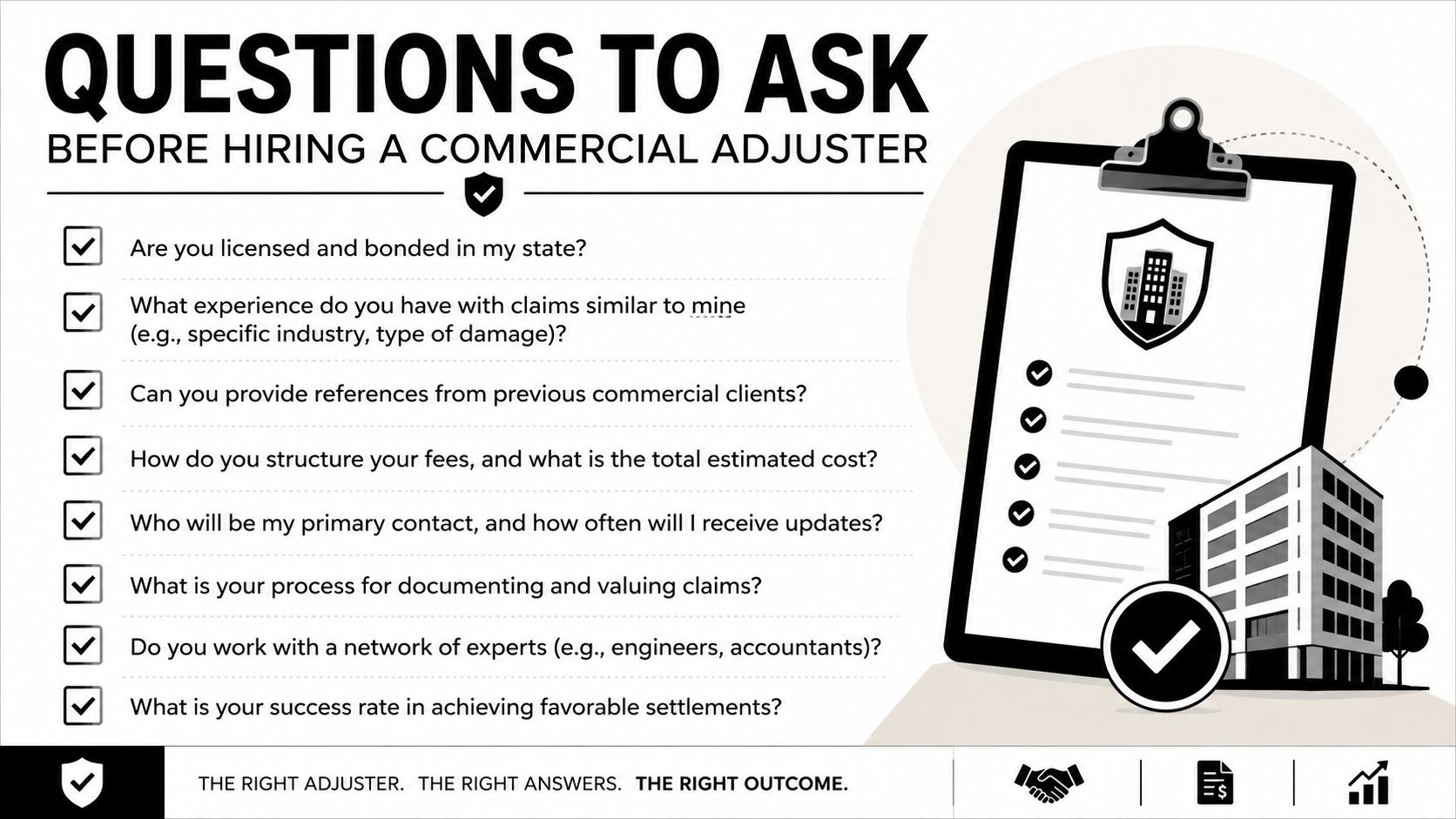
Don't hire based on a polished website. Hire based on how they answer hard questions. A commercial claim can live or die on the details, so you need an adjuster who speaks plainly about scope, documentation, and negotiation.
Ask the questions that expose weak firms
Start with licensing, then move straight into commercial experience. Ask whether they've handled business interruption claims, stock loss, equipment damage, and multi-tenant properties. A strong adjuster can describe the documentation process without stumbling.
Fee structure matters too. If they can't explain how they get paid, what happens if the claim is denied, or whether the fee changes on supplements, that's a warning sign. The how public adjusters get paid answer should be clear before any paperwork is signed.
You also want to know how they communicate. Commercial claims stall when nobody is watching deadlines, chasing records, or responding to carrier requests. Ask who your main contact is and how often you'll get updates.
Red flags to reject immediately
- Guaranteed payout numbers. No ethical adjuster can promise a specific recovery before the file is built.
- Upfront fees. Contingency representation should not require you to fund the claim team before the work starts.
- Vague BI explanations. If they can't describe how lost income and extra expense will be documented, they're not ready for your claim.
- No local knowledge. Oregon and Washington building codes, trade pricing, and contractor realities affect scope and timing.
- No commercial references. A residential track record isn't enough for a business interruption file.
One more practical filter. Ask how they handle documents from accountants, engineers, and contractors. If the answer is vague, expect a vague claim file. If the answer is specific, you're probably talking to someone who knows what commercial adjusting requires.
NW Claims Management handles commercial property claims for businesses in Oregon and Washington, including claims that involve business interruption, extra expense, and complex policy interpretation. If your carrier is under-scoping the loss or dragging its feet on documentation, visit NW Claims Management and ask for a claim review before you accept a low settlement.