Your roof took a hit, the insurer sounded polite on the phone, and now you're staring at a repair estimate that feels too small to fix the problem. That's the moment most homeowners realize insurance roof replacement is not a simple yes or no decision, it's a settlement process with math, evidence, and negotiation.
A partial approval can look official and still leave you with a roof that won't match, won't meet code, or won't stay watertight through the next storm. In Oregon and Washington, that gap matters even more because roof age, storm history, and claim documentation all affect how the carrier positions the loss. The right move is usually not to accept the first number. It's to understand why that number was written, what it leaves out, and how to force a complete review before any work starts.
The First Conversation Most Homeowners Have Wrong
A homeowner calls after a storm, hears a calm voice, and answers the wrong question. The insurer asks what happened, the homeowner says the roof “probably needs work,” and the claim starts with a narrow frame before anyone has looked at the whole slope. By the time the adjuster visits, the carrier often has enough room to approve a patch and call it reasonable, even when the roof is functionally done.
That's where a lot of claims go sideways. The first conversation should be about visible damage, active leaks, and preserving evidence, not about whether the roof “just needs a little repair.” Once a temporary fix is made or a contractor disturbs the damaged area, the photos that would've supported full replacement are gone. That's why roof claims need strategy from the first call, not optimism.
A practical habit helps here. Before anyone climbs anything, compare the roof's condition to nearby debris, gutters, and exterior impacts, then save the photos in a folder that matches the date of loss. If the roof is already shedding granules or the surrounding yard shows impact from wind or hail, that evidence belongs in the claim file before the insurer narrows the scope. For homeowners who want a broader sense of when carriers owe for a new roof, this guide on whether insurance covers a new roof is worth reading before the first adjuster visit.
Practical rule: the insurer's first offer is usually a starting position, not a verdict.
A simple maintenance task can also matter more than people expect. If gutters are packed and debris is sitting on the roof edge, a cleanup service such as Colorado Springs gutter cleaning can improve visibility around the damage without changing the loss itself, which makes later documentation cleaner and easier to defend.
How Insurance Roof Replacement Coverage Actually Works
The policy language is usually where homeowners get blindsided. Two roofs can suffer the same storm damage and end up with very different payout structures depending on whether the policy pays actual cash value or replacement cost value. That difference is the heart of the claim math, and it's where many partial approvals are born.
ACV and RCV change the check size
On an ACV policy, the insurer pays the value of the roof at the time of loss after depreciation. On an RCV policy, the insurer covers the cost to repair or replace the damaged roof, then withholds depreciation until the work is finished. If the same roof loss were priced at $20,000, the ACV claim would start by subtracting depreciation before payment, while the RCV claim would pay the covered cost in stages, with the withheld amount released after completion. That's why the declarations page matters more than the marketing summary.
The clause homeowners miss most often is recoverable depreciation. If the policy has it, the withheld amount can be collected after the contractor finishes the scope and the insurer gets final proof. If it doesn't, the roof may be covered but the payout still lands short of the amount needed to complete the job.
The exclusions that usually decide the fight
The strongest roof claims aren't built on outrage. They're built on policy language, photos, and the reason the damage can't be repaired cleanly.
Four policy issues come up again and again. Wear and tear gets used when the carrier says the roof was already aging out. Age and useful life matter because older roofs often attract reduced settlement terms or tighter underwriting. Code upgrades can be limited unless the policy or local law supports them. And matching becomes a real problem when discontinued shingles can't blend with the undamaged side.
For a plain-English look at roof damage coverage, the overview at roof damage insurance coverage is useful if you're comparing your declarations page with the denial language.
Inspecting and Documenting Damage Before Anyone Touches the Roof
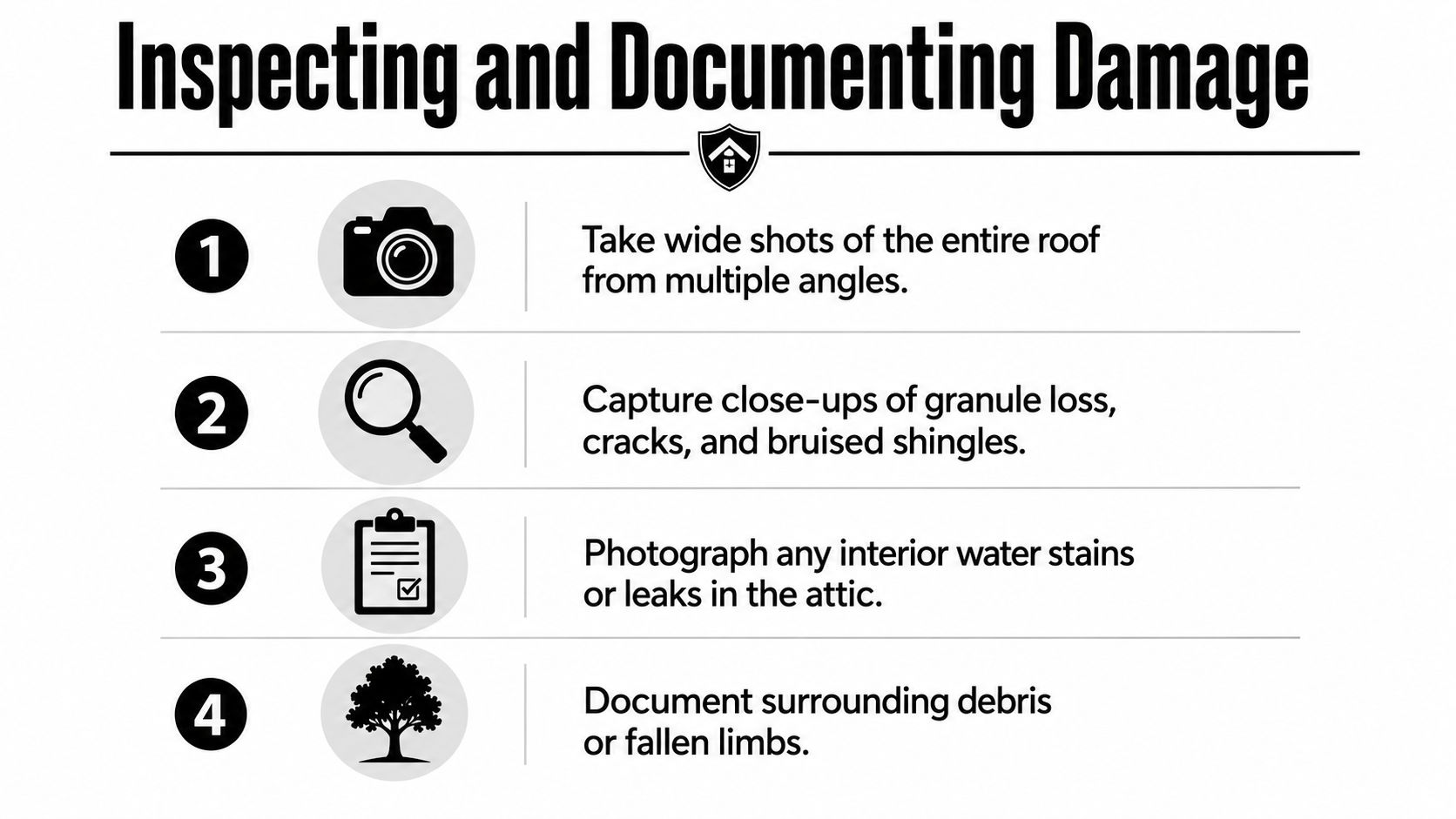
The first inspection should preserve evidence, not disturb it. Start from the ground, use timestamped photos, and capture the whole roof from multiple angles before any temporary repair is made. If there's a drone or professional inspection available, that often gives the clearest slope-by-slope record without putting a homeowner on a damaged surface.
What to capture first
The best documentation sequence is simple. Get wide shots of every elevation, then zoom in on hail bruising, lifted shingles, cracked tabs, granule loss, ridge damage, flashing separation, and torn vents. If water reached the attic or ceiling, photograph interior staining and insulation issues too, because roof loss is rarely just a surface problem.
The same logic applies to the yard and the house perimeter. Fallen limbs, debris patterns, and gutter impact can help tie the roof damage to the storm event instead of a maintenance argument. If a contractor or inspector finds issues at the ridge, valleys, or drip edge, those details belong in the file before any sealant or patch changes the evidence.
What not to do
Homeowners usually make one costly mistake, they climb the roof themselves. That creates a safety problem and can also damage brittle shingles, which gives the carrier an easy way to argue the loss was worsened after the fact. Save the climbing for a qualified inspector who knows how to document the roof without changing it.
Keep receipts for emergency mitigation. The insurer often treats that work separately from the permanent roof scope, and if you can't show what was spent, that money is harder to recover.
A good process also includes temporary protection only after documentation is complete. For homeowners who want a visual reference for what a proper inspection workflow looks like, a drone-based review can help before a claim is filed, and this page on drone roof inspection fits that role well.
If you need a contractor resource for roof cleaning or surface prep in another market, soft washing services in Flagstaff can be helpful for understanding how roof cleaning firms describe roof condition before and after a storm event.
Filing the Claim and Reading the Insurer's Estimate
The claim call should be short, factual, and careful. Say the roof was damaged by a specific event, that you've documented it, and that you're requesting an inspection. Don't speculate about age, previous wear, or whether one slope is “probably okay,” because the carrier will use any casual statement to anchor a partial scope.
What to expect from the adjuster visit
The adjuster is going to inspect for covered damage, check whether the loss looks sudden, and compare the observed damage to the policy language. A homeowner who has already collected photos, mitigation receipts, and interior leak evidence has a much better chance of keeping the discussion focused on the actual loss. If the visit ends with a narrow scope, that doesn't close the file. It just sets the first draft.
When the estimate arrives, read it like a builder, not like a customer. Look line by line for shingles, underlayment, ridge cap, ridge vent, flashing, drip edge, starter strip, valley metal, and any code-required components the carrier skipped or priced too lightly. The weak spots are usually the same ones, ice and water shield, permit fees, and debris removal.
How to compare the scopes
Practical rule: if the contractor's scope and the insurer's scope don't match line by line, the estimate isn't finished.
That's where supplements come in. A supplement is not a complaint, it's a reconciliation document that shows what the insurer missed, what code requires, and what the job needs to be whole. If the carrier refuses to include an item that's clearly tied to the repair, the supplement becomes the record of why the settlement is incomplete.
For a closer look at how estimates are built and challenged, the resource on insurance claim estimates is useful when you're trying to spot underpriced labor or missing materials before the check is issued.
Fighting for Full Replacement Instead of a Patch
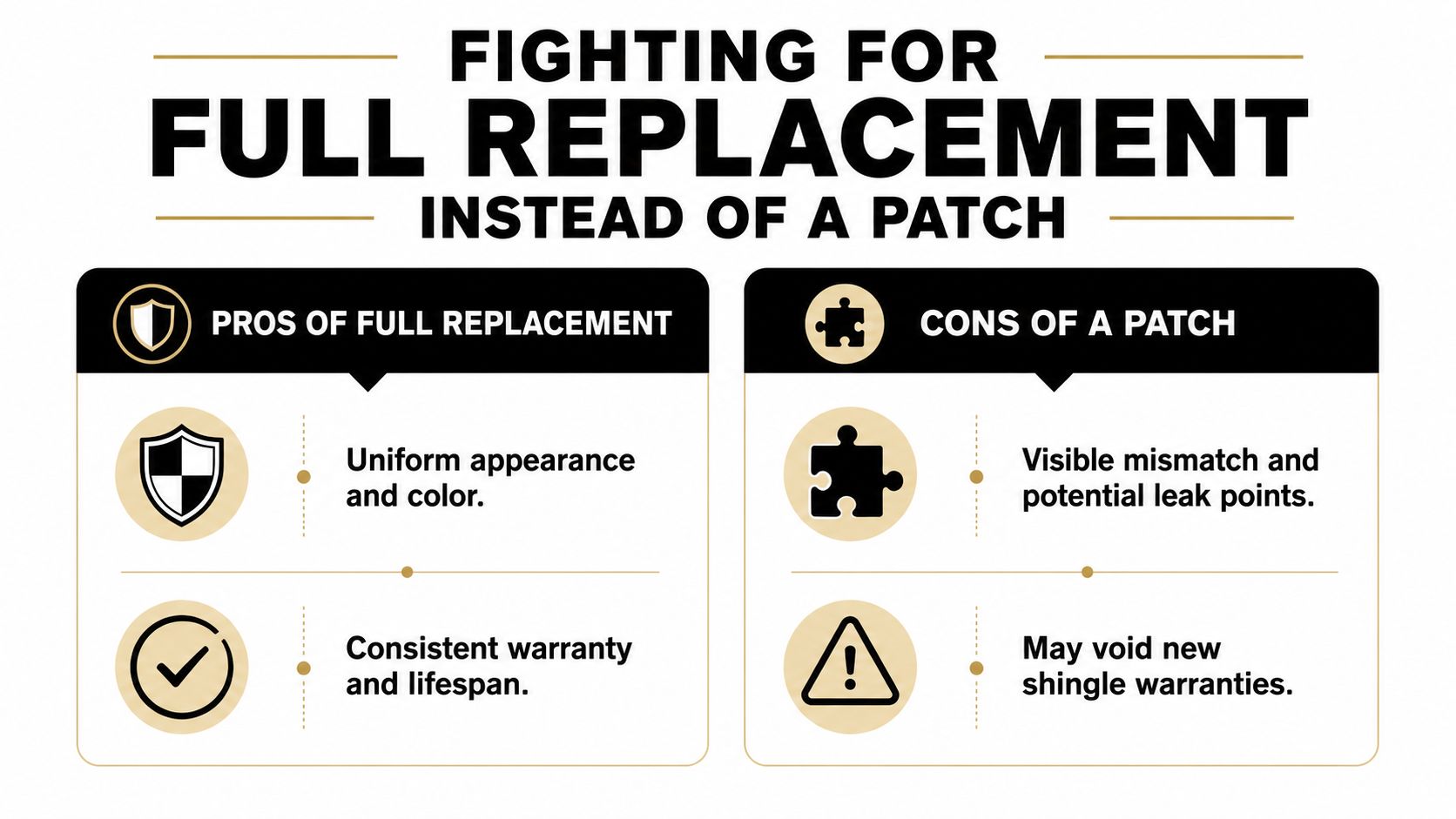
A patch is only acceptable when it restores the roof cleanly, matches reasonably, and meets code. In practice, that's not always possible. When damage is spread across a slope, when the shingles are discontinued, or when local code forces a broader repair package, the insurer's patch strategy can leave you with a roof that's technically repaired and practically unfinished.
The case for full replacement
The strongest full-replacement arguments usually rest on three things. First, the damage is broad enough that spot repair won't restore the roof as a uniform system. Second, the existing shingles can't be matched in color, profile, or weathering. Third, local code or manufacturer requirements force components to be replaced together so the roof functions as intended.
That's why the argument should be framed as compliance, not preference. Words like code-required, manufacturer spec, and matching provision matter because they point the adjuster to something measurable. A statement like “the roof looks bad patched” rarely moves anything. A statement like “the replacement scope is required because the damaged field can't be matched and the listed underlayment upgrade is code-driven” gives the carrier a reason to reconsider.
What wins the supplement
The best supporting package usually includes photo evidence, a contractor scope, and the exact policy or code language that explains why the patch is insufficient. That's especially important when the insurer tries to split the roof into isolated areas to save money. If the undamaged portions no longer blend, or if a partial repair leaves visible mismatch, the settlement still may not restore the home to pre-loss condition.
Full replacement isn't automatic, and it shouldn't be argued like it is. It becomes realistic when the facts show that a repair would leave the homeowner with a mismatched, noncompliant, or short-lived result. That's the point where a cleanly documented supplement can change the settlement outcome.
The Financial Tradeoff of Filing a Roof Claim
Not every roof issue should become a claim. A small covered loss on an aging roof can cost more in the long run if the deductible is high, the premium reacts, or the insurer later decides the roof was already at the edge of insurability. That's why the decision should be treated like a balance sheet question, not an emotional one.
Verisk-based reporting says U.S. roof repair and replacement costs totaled nearly $31 billion in 2024, about a 30% increase since 2022, and that roof-related losses made up more than one-quarter of all residential claim value while wind and hail drove more than half of residential claims. The same data shows average U.S. residential roof replacement cost reached $17,631 in 2025, which was 33% above the 2021–2024 average, while average roof repair costs hit $4,699, up 25% over that same baseline. Those numbers matter because they show why insurers are scrutinizing roof claims more aggressively and why a borderline loss deserves a real cost comparison, not a quick filing reflex. See the broader cost context in this 2026 roof replacement cost guide.
The decision to file or pay out of pocket
If the roof is near the end of its useful life, a claim can become a bad bargain even when it's technically covered. A denial for wear, age, or matching can leave the homeowner worse off than if the work had been handled privately. On the other hand, a clearly storm-driven loss with widespread damage often justifies filing even if the premium changes later, because delaying can create more damage and more insurer scrutiny.
A covered claim isn't free money. It's a trade between today's payout, tomorrow's pricing, and the roof's remaining life.
The best timing is usually before the next event, not after the roof has already been pushed beyond reasonable repair. If the roof is old, the documentation is weak, or the damage is small, the breakeven point may favor out-of-pocket replacement. If the damage is broad and sudden, the settlement case is usually stronger than waiting.
When a Public Adjuster Makes the Difference
A public adjuster matters most when the claim stops being routine. Simple losses can move through the system without much friction, but once a carrier denies coverage, underpays a large scope, or refuses to reconcile code and matching issues, the homeowner is no longer just reporting damage. They're negotiating with a company that writes estimates for a living.
Public adjusters work for the policyholder, not the insurer. They inspect the loss, build the scope, document the roof, and push the estimate toward the amount needed to restore the property. In Oregon and Washington, the usual contingency fee sits in the 5% to 15% range of the settlement, which means the fee is tied to the recovery rather than billed like a fixed hourly invoice. That structure makes sense most when the claim value is high, the denial is messy, or the gap between the insurer's number and the contractor's scope is material.
When hiring usually makes sense
- Denied claims: When the carrier says the damage is maintenance, wear, or not storm-related, representation can help rebuild the record.
- Underpaid losses over $25,000: Larger losses have more room for missing line items, code upgrades, and supplement disputes.
- Complex properties: Commercial buildings, nonprofits, and mixed-use roofs usually need a tighter paper trail.
- Matching and code fights: If the roof can't be patched cleanly or the scope needs code citations, the file benefits from a specialist.
Oregon and Washington also give homeowners a regulatory path to check who they're hiring. A licensed public adjuster can be verified through the state Division of Financial Regulation or the Office of the Insurance Commissioner, and that's worth doing before anyone signs a representation agreement. For a quick reference on what a licensed public adjuster does in practice, this page on licensed public adjuster is a useful starting point.
A quick settlement comparison
| Scenario | ACV Policy | RCV Policy |
|---|---|---|
| Same roof loss with depreciation | Pays the damaged roof's depreciated value first, then stops there unless the policy allows more | Pays repair or replacement cost, then releases recoverable depreciation after work is completed |
| Roof near the end of its life | Often leaves a bigger out-of-pocket gap | Still gives the homeowner a path to complete restoration if the policy terms support it |
| Contractor scope exceeds first estimate | Usually needs a supplement and strong documentation | Also needs a supplement, but the withheld depreciation can help close the gap after completion |
A good public adjuster doesn't replace the homeowner's judgment. They give the claim structure, the line-item math, and the regulatory pressure that make a full settlement more likely. NW Claims Management is one option in this space, and it offers public adjusting services for property owners who need help documenting roof damage, comparing scopes, and negotiating with the carrier.
What to ask before you sign
- How will you document the roof? Ask whether they use photo sets, contractor scopes, and code support.
- Who handles the supplement? The answer should be specific, not vague.
- How do you get paid? The fee should be explained in plain language before the file opens.
If your roof claim is stalled, disputed, or underpaid, get the documentation organized, request the itemized estimate, and compare it against the repair scope line by line. Then have a licensed public adjuster review the file before you accept a patch that won't restore the roof correctly.
If you want a claim reviewed before you sign off on a low estimate, contact NW Claims Management for a free evaluation. They handle roof damage claims across Oregon and Washington, and they can help you compare the insurer's scope against what your roof needs to be restored.