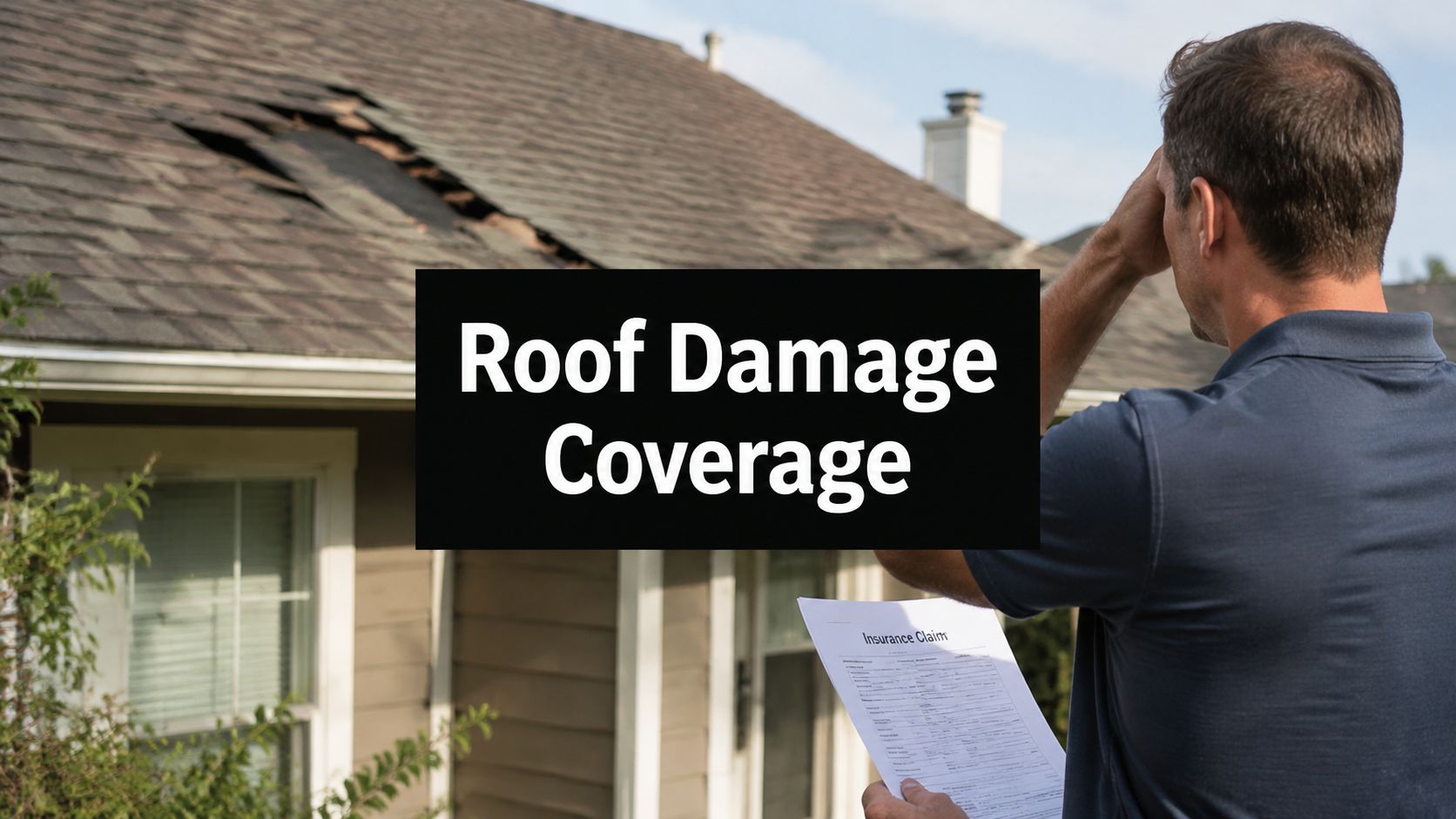
You walk outside after a windy night in Portland, look up, and spot shingles in the yard. A gutter is hanging loose. There's a damp ring on the ceiling near the hallway light. Your first thought is simple: will insurance pay for this?
That question gets harder fast. Roof damage insurance coverage sounds straightforward until you hit terms like covered peril, actual cash value, replacement cost, and the quiet rules carriers use to decide between a patch and a full replacement. Many homeowners in Oregon and Washington don't realize how much hinges on documentation, roof age, and policy wording.
The stakes are real. In 2024, roof-related claims accounted for more than 25% of all residential insurance claim value in the United States, driven largely by non-catastrophic wind and hail events, according to this roof claim analysis. That means roof claims aren't rare edge cases. They're a core part of homeowners insurance today.
Grasping the Essentials of Roof Damage Insurance Coverage
Roof damage insurance coverage usually comes down to one basic question: what caused the damage? If a storm tears off shingles, a tree limb punctures the decking, or hail bruises the roof surface, you may have a covered claim. If the roof failed because it was worn out, neglected, or already at the end of its life, the insurer may treat that as maintenance instead of sudden loss.
That difference frustrates people because roofs don't always fail in a neat, obvious way. A windstorm may expose a weak spot that's been aging for years. A carrier may agree there was wind, but argue the roof was already deteriorated. The homeowner sees storm damage. The insurer may see mixed causes.
What insurance is actually designed to cover
A standard homeowners policy is meant for sudden and accidental damage. Consider car insurance as an analogy. If a branch crashes onto your parked car, that's a clear event. If the paint faded over time, that isn't a claim. Roof policies work similarly. A storm event is the crash. Aging shingles are the fading paint.
Roof claims often turn on cause, not just condition. A damaged old roof can still have a valid storm claim, but the homeowner has to show that the storm caused covered damage.
Why Oregon and Washington homeowners need to read closely
State rules matter, but they don't replace your policy. Oregon and Washington insurers still rely on the contract language first. That means your declarations page, endorsements, deductible structure, and loss settlement terms matter more than broad assumptions like “storm damage is always covered.”
A careful claim starts with the policy, not the roofer's first opinion and not the insurer's first estimate.
How Roof Damage Coverage Works
Most homeowners carry an HO-3 policy, which is the common form for owner-occupied homes. In plain language, it usually covers the house itself against many direct physical losses unless the policy excludes them. For roofs, that often means wind, hail, fire, and falling objects may be covered, while wear, rot, and deferred maintenance usually are not.
The tricky part is that coverage and payment are separate decisions. Your insurer might accept that part of the damage is covered, but still pay only for a repair instead of a full roof.
Covered peril versus maintenance problem
A useful comparison is a car after a storm. If hail dents one door, the insurer pays to fix the damaged part. If the frame is bent and the car can't be safely restored, the loss becomes much bigger. Roofs work the same way. Missing shingles in one area may lead to a spot repair. Widespread lifted shingles, broken seals, water intrusion, or structural compromise may support replacement.
Insurers also look at whether the roof was serviceable before the loss. If a carrier can show cracking, patching, brittle shingles, or long-term neglect, it may reduce or deny the claim.
The hidden rule many homeowners never hear about
A major reason claims stall is the damage threshold used to decide repair versus replacement. Insurers predominantly use the 30% damage threshold tied to ISO 2312, with regional adjustments often falling between 15% and 25%, according to this explanation of full versus partial roof payment rules. That means a roof can have legitimate storm damage and still be treated as a repair claim if the carrier says the damage doesn't cross its threshold.
This catches homeowners off guard. They hear “covered” and assume “new roof.” The insurer may hear “covered” and think “patch that slope.”
What Oregon and Washington homeowners should check
Insurers in Oregon and Washington still have to follow state insurance rules, but they have room to apply policy language, inspection findings, and repairability standards. Read your policy for these items:
- Loss settlement method. Is your roof paid on ACV or RCV?
- Wind or hail deductible. Some policies separate these from the main deductible.
- Matching language. If one slope is damaged, does the policy address visual or material mismatch?
- Roof surface endorsements. These can change how payment works.
If you're preparing to file, this step-by-step guide to how to file a homeowners insurance claim helps organize the process before the adjuster visit.
Comparing Actual Cash Value and Replacement Cost Value
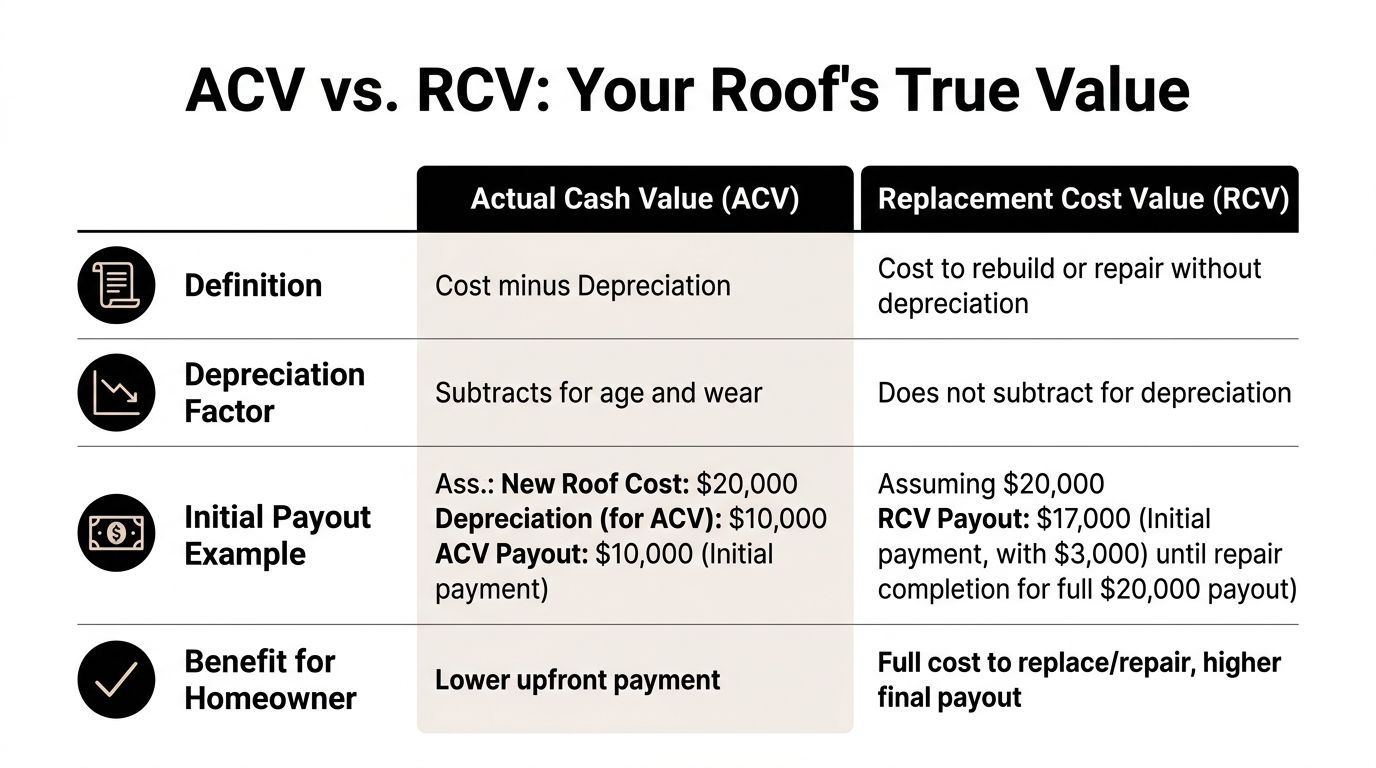
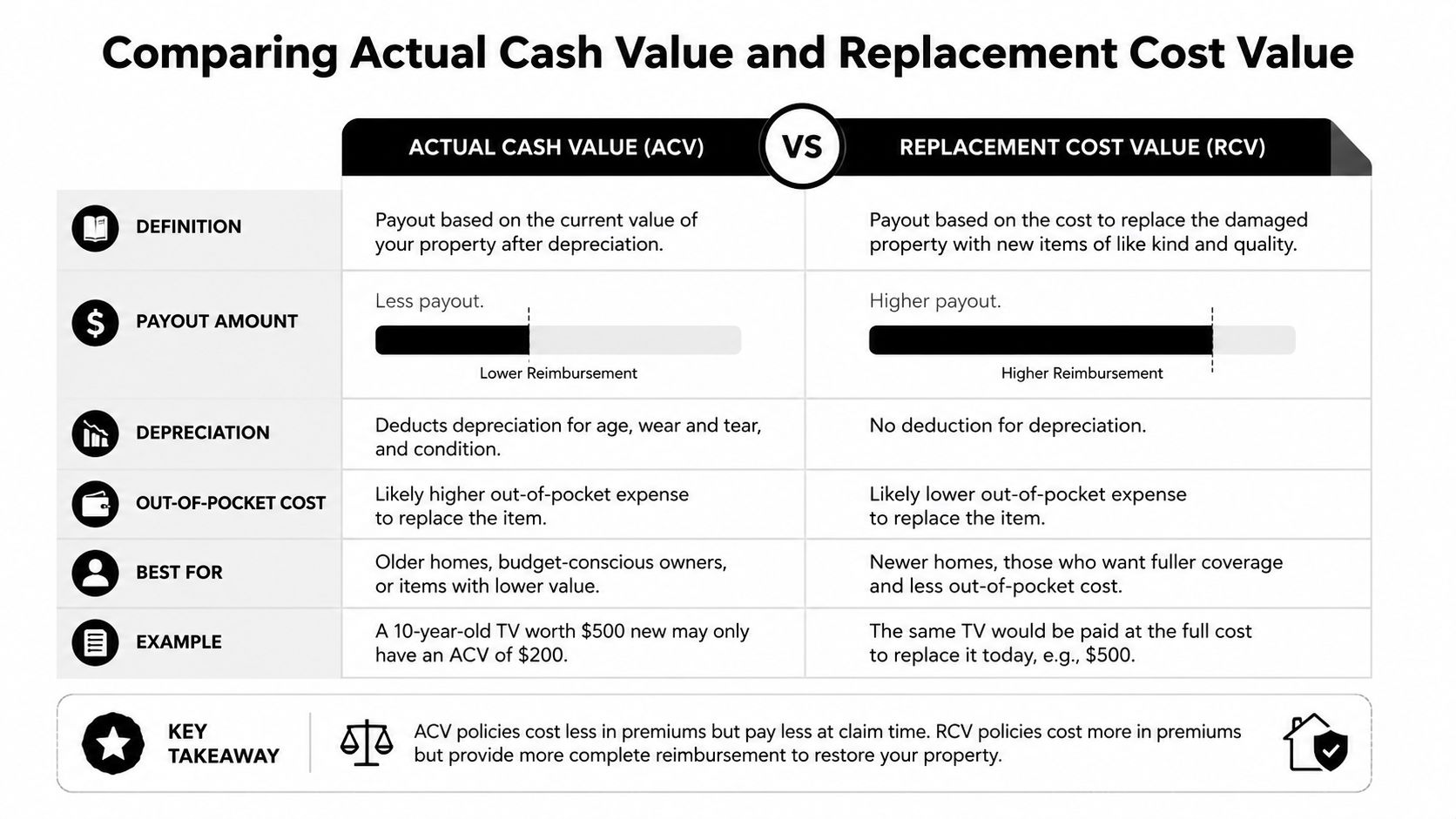
The biggest money question in roof damage insurance coverage is often not “am I covered?” It's “how will the insurer value the loss?” That's where Actual Cash Value (ACV) and Replacement Cost Value (RCV) matter.
The side by side difference
ACV means the insurer subtracts depreciation for age and wear. RCV means the insurer pays based on the cost to repair or replace with similar materials, without that depreciation reducing the final covered amount, assuming the policy conditions are met.
Here's the practical difference.
| Settlement method | How it feels in real life | Common issue |
|---|---|---|
| ACV | You get paid based on what the old roof was worth right before the loss | The check may not be enough to complete the work |
| RCV | You may receive an initial payment, then collect the remaining amount after repairs are completed | You usually have to follow deadlines and provide proof of completion |
Why this creates confusion
Many homeowners don't know which valuation method they carry until after the adjuster writes the estimate. That's a problem because the financial gap can be large on an older roof. Recent data indicates that failure to distinguish between ACV and RCV leads to underpayment in up to 40% of roof claims in states with frequent severe weather, according to this discussion of ACV versus RCV underpayment risk.
Practical rule: If your estimate mentions depreciation, ask whether it is recoverable or non-recoverable. That single question often reveals whether you have ACV or RCV treatment.
What to look for in your paperwork
Check your declarations page and any roof endorsements. Then review the estimate line by line for depreciation, withheld amounts, and payment conditions. If your policy is RCV, the insurer often holds back part of the payment until repairs are finished and documented.
If you want a plain-English breakdown of these payment methods, this overview of loss valuation methods is a useful reference.
Avoiding Common Coverage Exclusions and Pitfalls
A denied roof claim often starts with a sentence that sounds harmless: “We observed damage, but the policy does not cover this condition.” The wording changes, but the pressure points are predictable.
The exclusions that come up most often
- Wear and tear. Insurers often argue the roof failed from age, not from a sudden event. Old shingles, granule loss, curling, and brittle tabs can all support that position.
- Deferred maintenance. If flashing was loose, debris sat in valleys, or prior leaks went unaddressed, the carrier may say the homeowner allowed the condition to worsen.
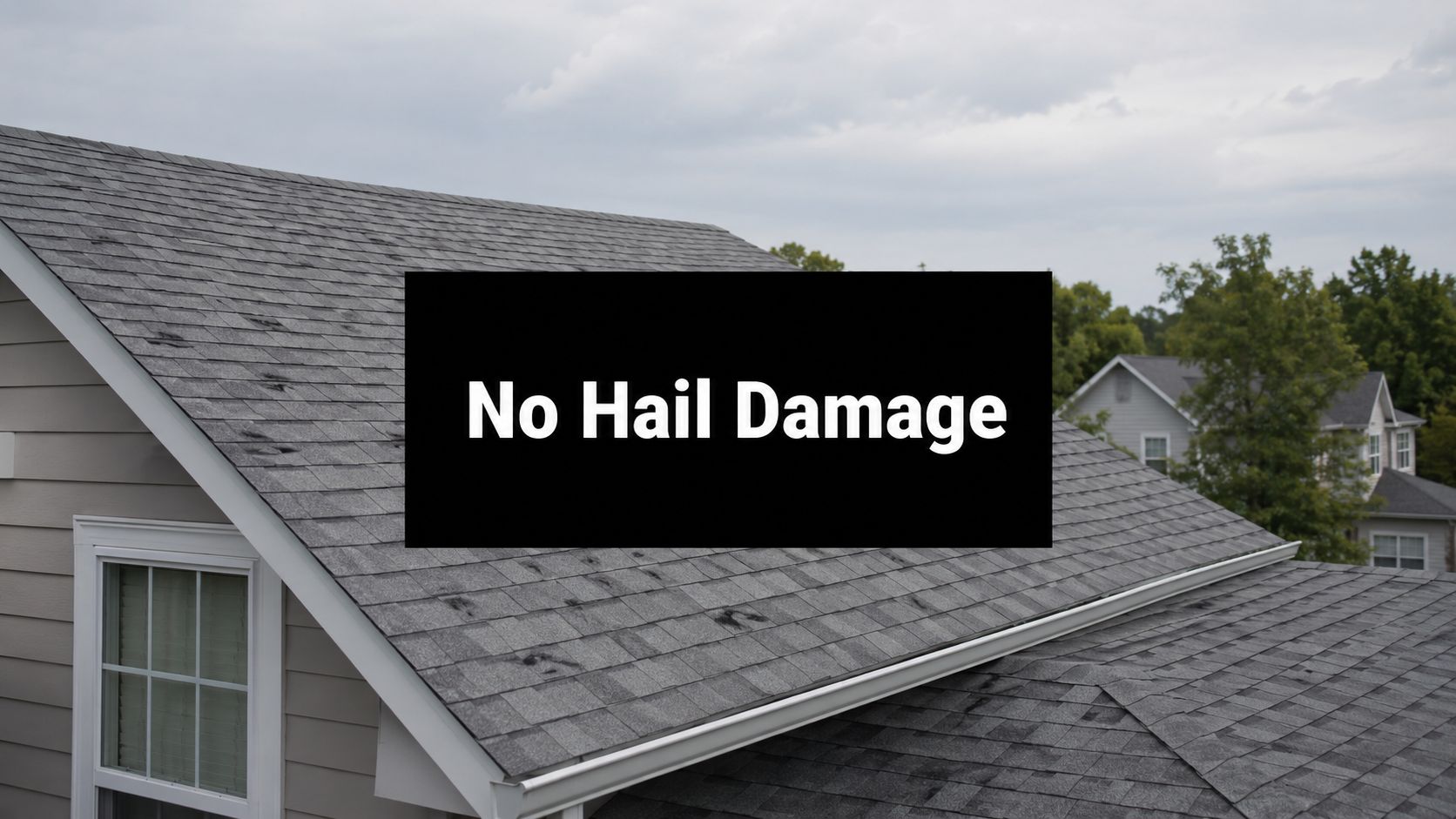
- Cosmetic damage. Hail marks or scuffs may be described as cosmetic if the insurer believes the roof still sheds water and performs its function.
- Partial repair logic. Even with accepted storm damage, the carrier may approve only a section repair.
The threshold issue behind many disputes
Most homeowner guides leave out the rule that often drives those partial approvals. Insurers use a 30% wind damage threshold to deny full replacements in many cases, leading to partial repair offers when a full tear-off may be justified, as noted in this discussion of the 30% wind damage rule.
That matters because homeowners often focus on whether damage exists. The insurer may focus on whether enough of the roof was damaged to justify replacing the whole system.
Questions worth asking before you argue the estimate
Instead of telling the adjuster “this roof is ruined,” ask more precise questions:
- What exclusion are you applying? Ask for the exact policy language.
- How did you decide repair versus replacement? Request the repairability basis.
- Did you inspect for functional damage or only visible surface marks?
- Did you consider water intrusion, underlayment, vents, flashing, and decking?
A detailed overview of whether insurance will cover a new roof can help you compare what your carrier said against common claim outcomes.
If the denial letter sounds broad, narrow it down. The real dispute is usually one of four things: cause, scope, valuation, or exclusion.
Documenting Damage Timing and Deductibles
Documentation is where many good claims either strengthen or collapse. Homeowners usually take a few photos and assume that's enough. It often isn't. Independent forensic assessments have found that solo adjuster inspections under-count damage by 30–40% compared to contractor evaluations, according to this roof scope and documentation guidance.
Build a clean record from day one
Use a simple evidence stack:
- Take time-stamped photos from the ground, then closer photos if it's safe.
- Photograph related signs such as downed branches, displaced gutters, attic moisture, ceiling stains, and interior leaks.
- Write down the event date and what you observed first.
- Get a weather report for the storm window if wind or hail is involved.
- Request a roofing inspection with marked damage locations, not just a verbal opinion.
If the damage includes moisture intrusion in walls or ceilings, tools used in leak tracing can matter too. Homeowners dealing with hidden moisture problems may find help for Las Vegas home water leaks useful as an example of how specialized leak detection can identify damage paths that casual inspection misses.
Deductibles and timing issues that surprise people
A deductible is your share of the loss before insurance pays. Some policies use one standard deductible. Others apply a separate wind or hail deductible. That means a claim can be valid but still feel disappointing if the approved repairs sit close to the deductible.
Oregon and Washington homeowners should report loss promptly and review their policy for notice requirements, proof-of-loss obligations, and repair deadlines tied to recoverable depreciation. State rules affect claim handling, but your policy deadlines still matter.
Smart tools for better proof
Roof photos from the lawn are rarely enough for a disputed claim. A documented aerial review, slope-specific images, and moisture evidence are much stronger. For homeowners who need a more complete visual record, a drone roof inspection can help capture steep, high, or unsafe areas without creating more damage during inspection.
Practical Claim Scenarios and When to Hire a Public Adjuster
Not every roof claim needs outside help. Some do.
A simpler claim you may handle yourself
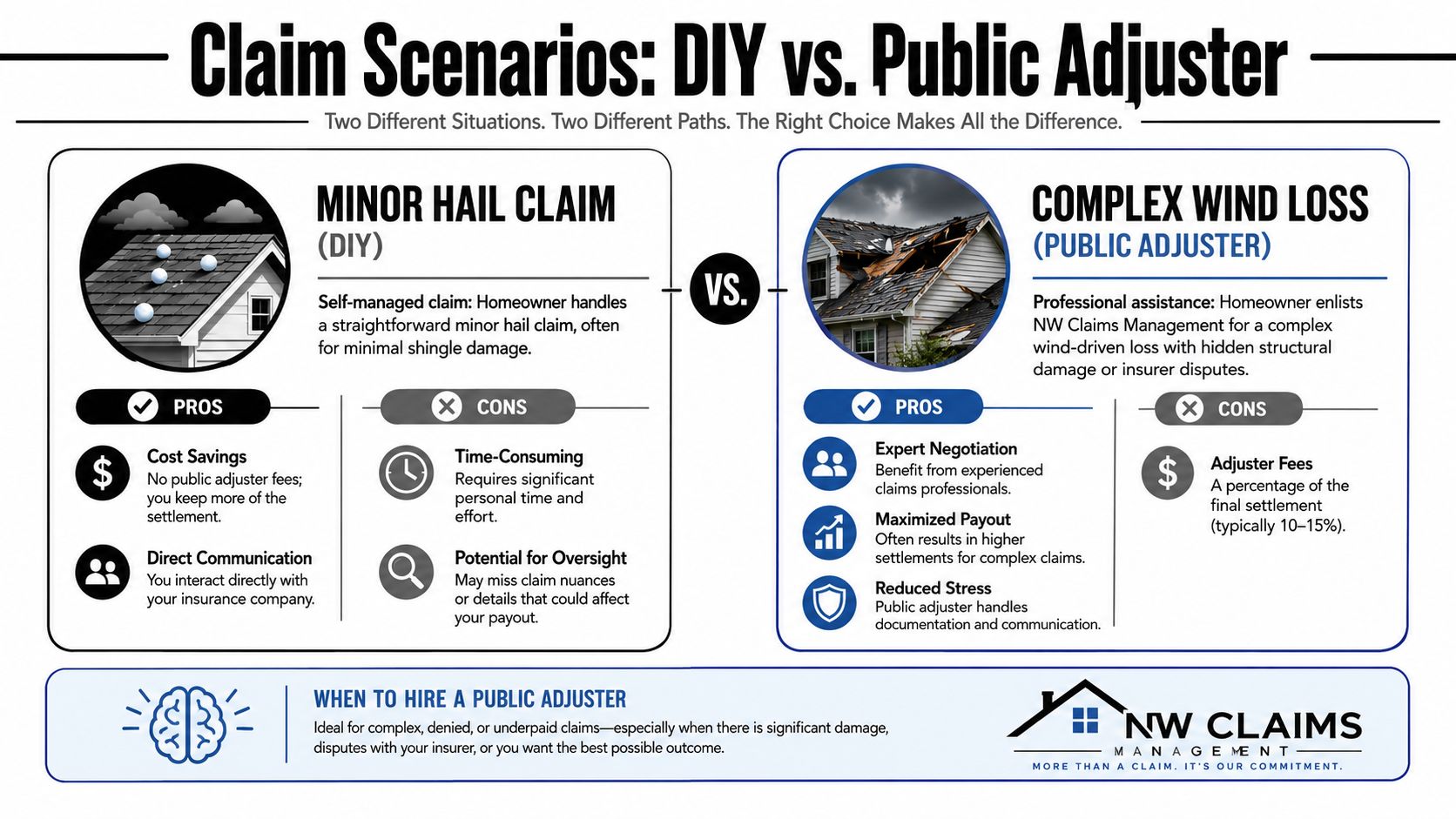
A homeowner notices a small area of hail impact after a recent storm. The interior is dry. The insurer inspects quickly, accepts the claim, and the scope is limited to a modest repair. In a situation like that, the homeowner may be able to manage the paperwork, contractor coordination, and final invoice without much friction.
That works best when the cause is obvious, the damage is localized, and the insurer's estimate tracks what the roofer sees.
A more complex claim that often needs advocacy
A different homeowner has wind damage across multiple slopes, lifted shingles, possible underlayment issues, and staining in the attic. The carrier agrees there was a storm but approves only a patch. The homeowner then has to argue scope, repairability, matching, and valuation at the same time.
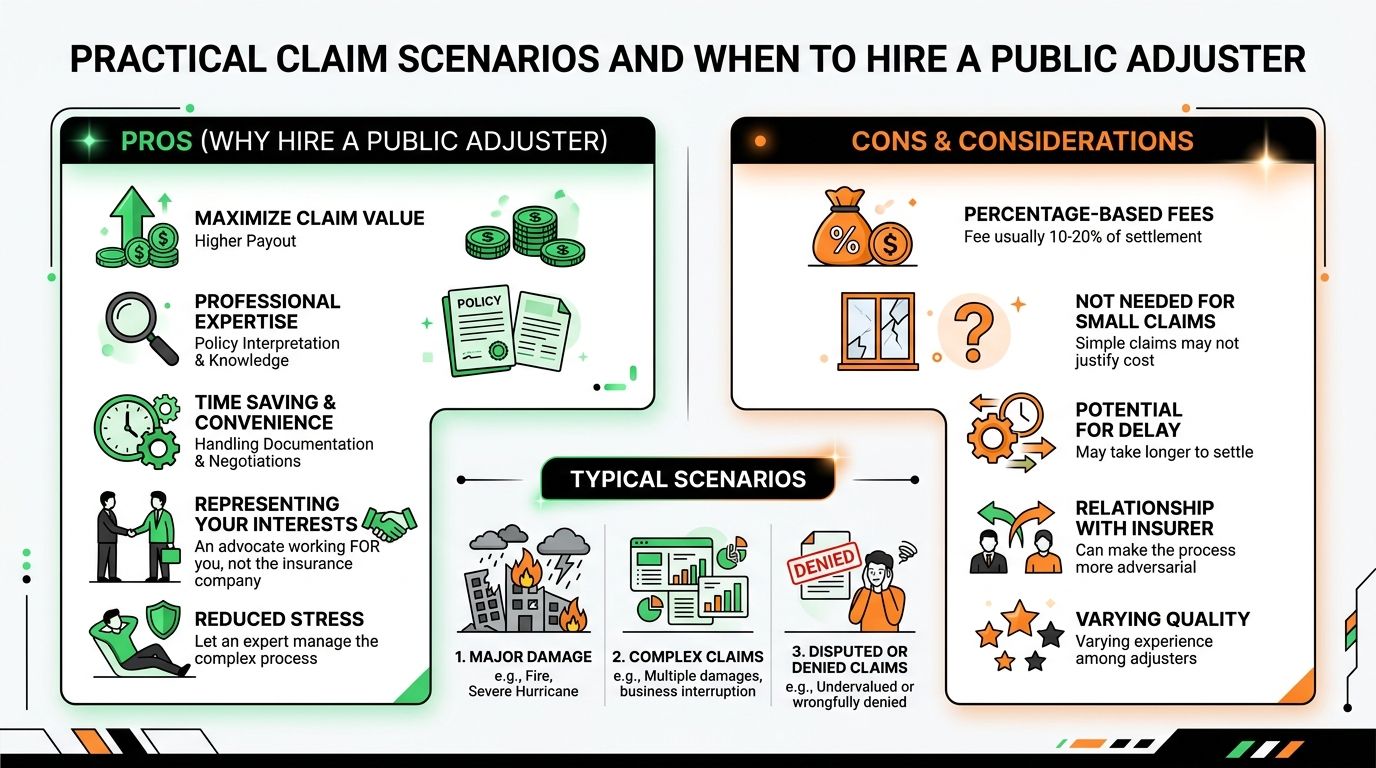
That's the point where many people consider a licensed public adjuster. The value isn't magic. It's process. A public adjuster can organize evidence, interpret policy language, challenge scope limitations, and negotiate with the insurer on the policyholder's behalf. For example, homeowners dealing with storm-related shingle damage can review what goes into a hail-damage roof insurance claim before deciding whether they need representation.
When hiring help makes sense
Consider outside help when:
- The claim was denied and the letter relies on wear, cosmetic damage, or vague language.
- The insurer accepted coverage but cut scope to a repair you believe won't restore the roof properly.
- Your roof is older and ACV, depreciation, or matching issues are driving a large out-of-pocket gap.
- You don't have the time or comfort level to document, argue, and follow up on a technical property claim.
In Oregon and Washington, homeowners should also verify that any public adjuster they consider is properly licensed in the state where the claim is being handled.
Next Steps to Maximize Your Roof Damage Claim
The best roof claims are calm, documented, and specific. Panic leads people to miss deadlines, skip photos, or accept the first explanation without checking the policy.
Start with a short checklist:
- Pull your declarations page and find out whether your roof is settled on ACV or RCV.
- Document the damage immediately with photos, notes, and any signs of interior moisture.
- Ask the insurer what caused the loss decision, what scope they approved, and what policy language controls that decision.
- Review whether the carrier is treating the roof as a repair claim because of a threshold or repairability analysis.
- Check your deductible and any separate wind or hail deductible.
- Keep every estimate, email, invoice, and inspection note in one folder.
A strong claim file answers three questions clearly: what happened, when it happened, and what it damaged.
If your claim becomes a dispute over scope, depreciation, or exclusion language, don't assume the first estimate is the final word. Roof damage insurance coverage often turns on details that aren't obvious from a quick adjuster visit. The more organized your evidence is, the better your position will be.
If your roof claim in Oregon or Washington feels underpaid, delayed, or harder than it should be, NW Claims Management is one option for policyholders who want professional help reviewing the policy, documenting the loss, and negotiating the claim.