A hard rain hits Portland overnight. By morning, there's a yellow-brown stain climbing the drywall near your window, the baseboard feels damp, and the paint has started to bubble. In Seattle, the version of this story might be a widening crack near a basement corner after a cold stretch and another week of wet weather. At first, many owners treat these as ordinary repair issues. Then the contractor says it's “normal settling,” the insurer asks whether the damage came from faulty work, and the paperwork starts to pile up.
That's where a construction defect claim enters the picture. It's the process owners use to identify what failed, connect the failure to design, materials, workmanship, or site conditions, and seek recovery through the channels that apply. Sometimes that means a claim under an insurance policy for resulting damage. Sometimes it means invoking legal rights against the builder, subcontractor, or design professional. Often, in Oregon and Washington, it means dealing with both at the same time.
Pacific Northwest properties create a special kind of confusion because water exposes hidden mistakes slowly. A roof edge that was flashed incorrectly may not show itself until repeated rain drives moisture behind siding. A foundation issue may begin as a hairline crack, then turn into sticking doors, sloped floors, and moisture intrusion months later. Owners understandably ask one simple question: “Is this covered?” The answer often depends on whether you're claiming the defective work itself or the damage that defect caused elsewhere.
Introduction to Construction Defect Claims
A construction defect claim usually starts long before anyone uses that phrase. It starts with something that feels off. A warped floor near a patio door. A musty smell in an upstairs bedroom. Window trim that keeps swelling after each storm. In Oregon and Washington, owners often discover hidden problems during the wet season because rain exposes weak detailing, poor sealing, and rushed installation.
The legal side can feel bigger than the damage itself. You're not just trying to dry out a wall or patch a crack. You're trying to answer several questions at once. Who caused this. When did it start. Is it defective work, resulting damage, or both. Which notice rules apply. What can be fixed now without harming your rights later.
Why these claims matter in the Pacific Northwest
The region's climate turns minor installation errors into major disputes. A small gap around a window flashing detail might not matter on day one. After repeated weather exposure, it can become hidden moisture in framing, insulation, sheathing, and interior finishes. By the time a stain appears indoors, the original mistake may be buried behind walls.
That's why a construction defect claim isn't just about blame. It's about preserving evidence before repairs erase the trail.
Practical rule: If moisture, movement, or cracking appears repeatedly in the same area, treat it as a possible defect issue before treating it as a simple maintenance problem.
Owners also get trapped between systems. Contractors may offer to “take a look,” insurers may reserve rights, and everyone may ask for records you haven't gathered yet. The earlier you understand the claim path, the easier it is to avoid casual mistakes that weaken your position.
Defining Construction Defect Claims
A construction defect claim often starts with a familiar Pacific Northwest problem. A homeowner in Portland notices a faint stain near a window after weeks of rain. A condo board in Seattle sees paint bubbling along an an exterior wall. The visible mark is only the clue. The key question is whether faulty design, materials, or installation allowed water, movement, or other damage to develop behind the surface.
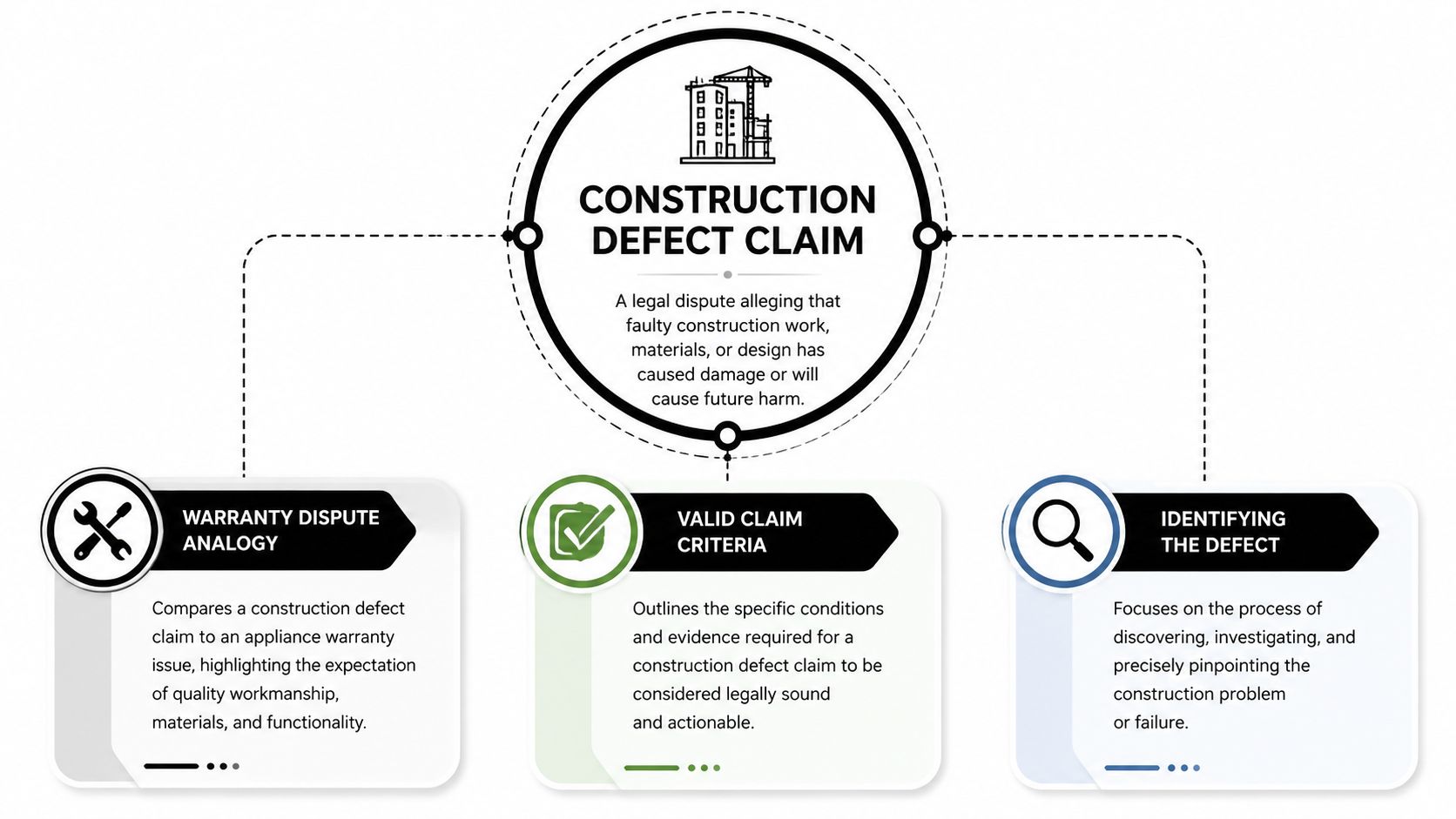
A construction defect claim is a demand for repair costs, damages, or other relief based on building work that failed to meet the required standard and caused loss. The key point is performance. A cosmetic blemish may be frustrating, but a defect claim usually involves a part of the building that does not work as it should. In the Northwest, that often means wall assemblies, roofs, decks, windows, or foundations that cannot handle the moisture and movement they were supposed to resist.
An appliance warranty offers a useful comparison. If a new refrigerator looks fine but cannot keep food cold because of a bad part or poor assembly, the problem is not ordinary aging. A building works in much the same way, except more people may share responsibility, and the failure may stay hidden for months or years.
What turns a building problem into a claim
Three parts usually need to line up.
- There must be a real defect. Something in the design, materials, workmanship, or site preparation fell short of code, contract requirements, manufacturer instructions, or accepted building practice.
- A responsible party must be tied to it. Depending on the facts, that could be a general contractor, subcontractor, architect, engineer, developer, or supplier.
- The defect must lead to damage, repair expense, or loss of use. That distinction matters because some disputes are still punch-list or warranty issues, while others become full defect claims with larger financial stakes.
A simple way to frame it is to compare three versions of the same building. What the plans required. What was built. What happened after weather, time, and normal use tested the difference.
Why the definition gets blurry in Oregon and Washington
Owners often mix together three separate questions. Is there defective work. Is there resulting property damage. Is there insurance coverage for some part of the loss.
Those questions overlap, but they are not identical. A contractor may be responsible for defective installation. An insurer may argue that the faulty work itself is excluded but that certain resulting water damage is covered. Oregon and Washington claims can become even more confusing because notice and right-to-repair rules may affect timing before a lawsuit is filed. That means a rushed repair, a poorly worded notice, or an incomplete inspection can create problems later.
Cracks create similar confusion. Some are cosmetic. Others point to movement, load issues, or moisture intrusion. For a plain-language explanation of how surveyors distinguish ordinary cracking from structural concern, Corinthian Surveyors London offers a useful reference.
Cause matters more than appearance.
A stain on drywall, a soft deck board, or a stair-step crack in masonry is usually the symptom, not the defect itself. Sorting out cause and origin takes methodical inspection, moisture mapping, document review, and sometimes destructive testing. A practical explanation of that process appears in this overview of a forensic investigation process.
Practical takeaway: A construction defect claim is not just a complaint that something looks wrong. It is a fact-based claim that a building component failed to perform as required, and that failure caused measurable harm.
Common Construction Defect Types
A construction defect usually shows up in one place and starts somewhere else. A stain on a ceiling may begin with roof flashing. A cracked tile floor may trace back to framing movement. In the Pacific Northwest, that gap between symptom and cause creates trouble because rain exposure, wet framing, and delayed moisture damage can make one problem look like another.
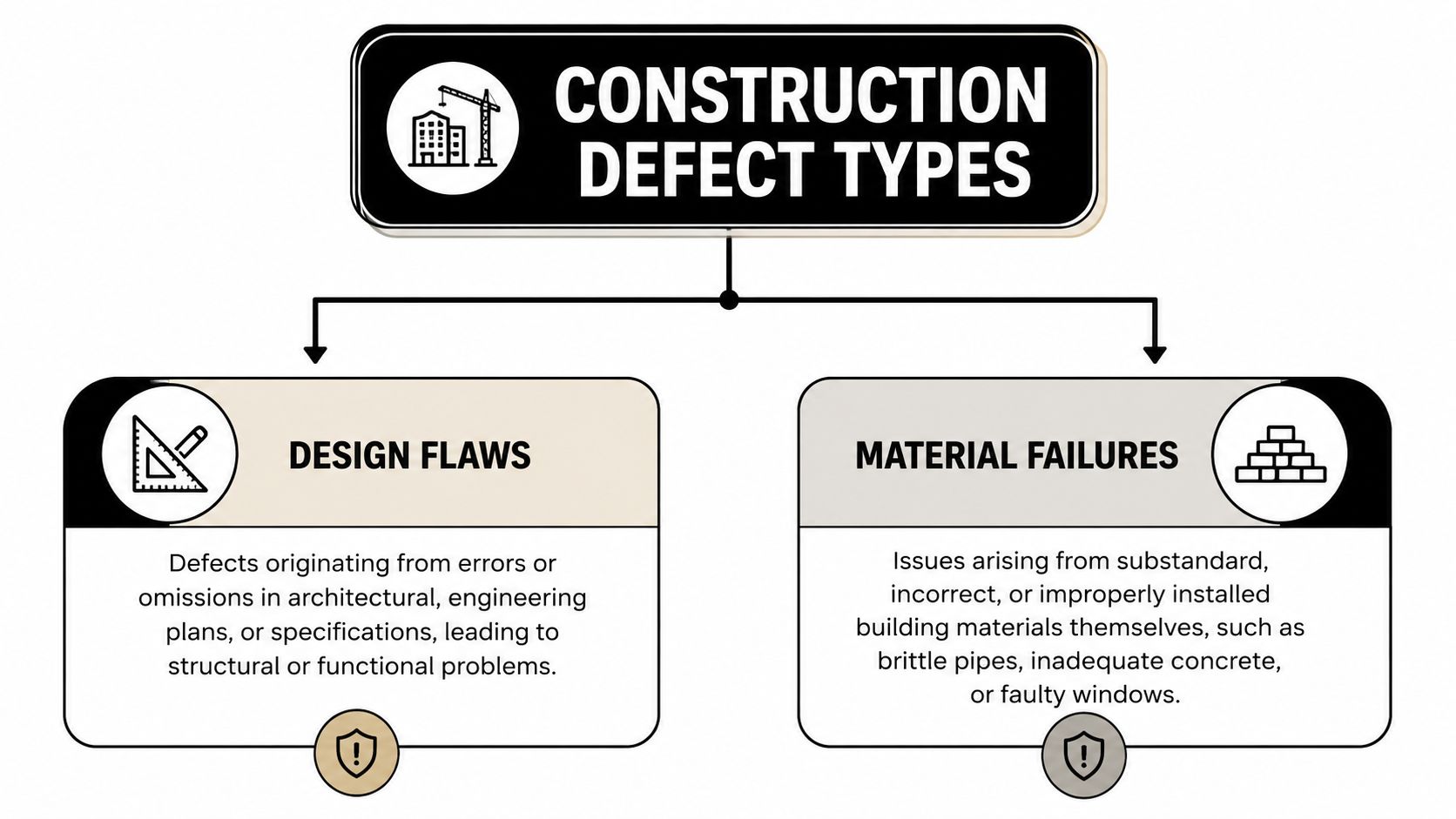
A useful way to sort the problem is by origin. Four categories cover most defect claims: design, materials, workmanship, and subsurface conditions. Those labels are practical, not academic. They help you identify who should inspect the loss, which records matter, and whether the repair needs a product swap, a rebuild, or a correction to the original plans.
Design defects
Design defects begin before construction starts. The plans, specifications, or engineering assumptions are wrong for the building's actual conditions.
That issue shows up often in western Oregon and Washington, where assemblies must handle persistent wind-driven rain. A wall detail might look fine on paper yet leave little room for drainage or drying. The contractor may follow the drawings closely and still end up with a wall that traps moisture.
A simple comparison helps. The design is the recipe. If the recipe leaves out a step that keeps water out, careful cooking will not fix the missing instruction.
Owners often notice repeated failure at the same location. Water may collect at roof-to-wall transitions, deck-to-door thresholds, or window heads. If each repair addresses only the visible stain or rot, the same location tends to fail again because the underlying detail never changed.
Material defects
Material defects involve the product itself. The window unit, membrane, fastener, siding panel, or sealant may fail too early or perform below what normal use and local weather should allow.
PNW conditions make this category harder to evaluate than many general guides suggest. A product can fail on its own, or it can fail faster because moisture stayed trapped around it. That distinction matters. A cracked cladding panel may point to manufacturing trouble, installation stress, or movement in the structure behind it.
This is one reason owners get confused about latent damage. The visible product failure might be small, while hidden moisture damage inside the assembly is much larger. By the time bubbling paint or swelling trim appears, water may have been traveling behind the exterior for months.
Workmanship defects
Workmanship defects happen during installation. Flashing is omitted. Fasteners are placed wrong. Waterproofing laps run the wrong direction. Concrete cures poorly because site conditions were not controlled.
In the Pacific Northwest, these claims often involve transitions rather than large obvious failures. One missing kick-out flashing at a roof edge can direct water into siding every time it rains. One poorly sealed penetration for a vent or hose bib can wet sheathing and framing slowly enough that the owner does not notice until soft spots, mold odor, or interior staining appear.
Cracks create similar confusion. Some are surface-level shrinkage or seasonal movement. Others reflect settlement, framing deflection, or foundation trouble. Corinthian Surveyors London gives a useful plain-language reference for distinguishing ordinary cracking from warning signs that deserve closer review.
Subsurface defects
Subsurface defects start below the building. Poor compaction, unstable soils, drainage failures, or incorrect foundation preparation can all lead to movement above.
These claims can be easy to misread at first. A homeowner in Tacoma or Olympia may notice doors sticking after a wet season and assume humidity is the whole story. Then the drywall corners crack, windows go out of square, and gaps open along baseboards. Those clues can point back to settlement, soil movement, or water affecting the ground around the foundation.
Finding the root cause usually requires more than a visual walk-through. Moisture readings, elevation checks, document review, and targeted opening of assemblies may all be needed. For a practical look at that process, see this explanation of what a forensic construction investigation involves.
One PNW-specific caution belongs here. These categories often overlap. A drainage design may be weak, the installer may miss a flashing step, and water may stay hidden long enough to trigger disputes about when damage began. That overlap is one reason cure statutes and insurance questions become so messy later. The defect type is not just a label. It shapes the entire claim.
| Defect type | Typical source | PNW-style symptom |
|---|---|---|
| Design | Plans or engineering | Drainage detail that repeatedly leaves water at vulnerable transitions |
| Material | Product failure | Exterior component breaks down early under normal wet-weather exposure |
| Workmanship | Installation error | Water enters behind siding, roofing, windows, or deck connections |
| Subsurface | Soil or foundation issue | Settlement, slab cracking, misaligned doors, and trim separation |
Navigating Insurance and Legal Timelines
A common Pacific Northwest claim starts like this. After the first long stretch of winter rain, a homeowner notices staining at a window corner in Portland or swelling trim below a deck door in Tacoma. The visible damage feels new, but the water path may have started months earlier behind cladding or flashing. That gap between when damage began and when it was discovered creates two separate timing problems at once. Insurance may ask when the resulting damage occurred. State law may ask whether the builder received proper notice and a chance to repair.
Those are different clocks.
Insurance timing is not the same as legal timing
Owners often assume one date controls everything. It rarely does. A construction defect claim usually involves at least three dates that matter: when the work was done, when damage began, and when the owner reasonably discovered the problem. In the Pacific Northwest, that distinction gets messy because hidden moisture can sit inside wall cavities through one rainy season, then show up during the next.
Insurance carriers also separate defective work from damage caused by that work. Amerisure's discussion of construction defects explains that liability policies often exclude the cost to redo the faulty construction itself while treating resulting property damage as a different coverage question. In plain terms, a bad roof install and the soaked insulation below it may sit in different buckets.
A roof leak is a useful example because owners can see both buckets at once. Reinstalling shingles or flashing that were put on incorrectly may fall outside coverage. Water damage to ceilings, framing, flooring, or personal property may trigger a separate analysis. Imbrex Roofing details roof issues in a homeowner-friendly way, and the same warning signs often appear in defect cases before anyone realizes the problem may involve both insurance and contractor liability.
That distinction affects how you describe the loss. If every problem is reported only as "bad construction," you may blur the part of the claim tied to resulting damage. If every problem is reported only as "water damage," you may leave out facts that matter to notice and repair rights.
The PNW trap: hidden water and latent-damage confusion
This region creates a special kind of confusion. Long wet seasons, layered wall assemblies, and intermittent leaks can hide damage so well that everyone argues about timing later. The insurer may focus on whether there was an occurrence during the policy period. The contractor may focus on whether notice came late. The owner is left trying to prove when a hidden condition became reasonably discoverable.
Latent damage works a lot like rot in a deck ledger hidden behind finished siding. By the time the stain appears indoors, the underlying issue may be older and deeper than the first visible symptom. That is why vague timelines hurt claims. "We noticed it sometime last winter" is much weaker than "yellow staining appeared below the second-floor west window after the January rainstorm, and trim swelling was first photographed two days later."
Cure statutes in Oregon and Washington need early attention
Oregon and Washington both use pre-suit notice and repair frameworks in many construction defect disputes. The exact rule, deadline, and consequence depend on the state, the type of property, the contract, and the parties involved. What matters at the owner level is simpler. Written notice is not just courtesy. It can shape whether the dispute proceeds cleanly or turns into an argument about procedure before anyone reaches the defect itself.
In practice, cure statutes work like a checkpoint before a lawsuit. The owner gives notice. The contractor may inspect. A repair offer may follow. Deadlines can run quickly, and casual texts or hallway conversations do not create the same record as a dated written notice that identifies the location, symptoms, and known damage.
Pacific Northwest weather makes things harder. During active rain intrusion, owners feel pressure to fix the issue immediately. That instinct makes sense. Yet a rushed repair can erase evidence, while a delayed notice can complicate legal rights. The goal is controlled mitigation and careful documentation, not silence and not demolition by panic.
A practical way to track the claim
A defect claim usually moves on five parallel tracks:
Discovery track
Record the first date you observed each symptom, not just the date you became convinced it was a defect.Insurance track
Give prompt notice to the carrier when property damage may exist, even if the cause is still being investigated.Contractor notice track
Notify the builder or trade in writing with enough detail to identify the issue and location.Cure-process track
Calendar inspection windows, response deadlines, and any repair-offer deadlines.Litigation track
Confirm the applicable limitation and repose periods under the governing law and contract.
These tracks overlap, but they are not interchangeable. Missing one can weaken the others.
Deadlines vary more than owners expect
Online summaries often make construction deadlines sound universal. They are not. The applicable deadline can change based on contract claims, negligence claims, warranty theories, whether the defect was hidden, and whether a statute of repose applies. Oregon and Washington also differ in procedure and terminology, so a rule you read for one state may not fit the other.
That is why broad internet advice causes trouble in this area. A homeowner may be within an insurance reporting window but close to a legal deadline. Or the homeowner may be focused on a lawsuit deadline while missing a cure-notice step that changes the sequence of the dispute.
Comparison of Oregon and Washington deadlines
Because owners often want one chart, the table below works best as a planning aid. It shows where questions usually arise, not a substitute for state-specific legal advice.
| Jurisdiction | Timing issue to confirm early | Notice concern owners often miss |
|---|---|---|
| Oregon | The applicable limitation period depends on the claim theory, the contract, and whether the defect was hidden or discovered later. | A builder repair opportunity or other pre-suit step may need formal written notice rather than informal back-and-forth. |
| Washington | The deadline can shift based on the legal theory, project type, and any applicable repose rules. | Written notice and careful handling of repair offers matter because procedural missteps can complicate the claim before suit begins. |
One document request often surprises owners
If an insurer asks for a formal statement of the loss, do not treat it like routine paperwork. This plain-language guide to a proof of loss form and what insurers are asking for explains why dates, damaged areas, and claimed amounts need to line up with the rest of your file. In hidden-water cases, small inconsistencies can become larger credibility disputes later.
A good rule is simple. Build your timeline like a weather log, not a memory test. In the Pacific Northwest, the claims that hold together best are the ones that tie each symptom to a date, each date to a document, and each document to the right notice track.
Step-by-Step Actions After Defect Discovery
A common Pacific Northwest scenario starts like this. After three days of steady winter rain in Portland or Seattle, a homeowner notices a faint stain at the top corner of a window, then damp baseboard trim the next morning. At that moment, the claim can still be orderly. A week later, after a handyman opens the wall, the contractor offers a quick patch, and the insurer asks new questions, the same claim can turn into a dispute about what failed first, what damage was hidden, and whether anyone got the written notice process wrong.
The first month matters because construction defect claims often split into two tracks at once. One track concerns the builder, subcontractor, or developer. The other concerns insurance. In Oregon and Washington, owners often assume those tracks move together. They do not. A builder may have a chance to inspect and propose a cure before a lawsuit. An insurer may ask for prompt notice, mitigation, and a clear description of what was damaged. Treat those as two separate lanes on the same highway.
Days one through seven
Start by freezing the scene as it exists.
Take photos before cleanup changes the evidence. Use wide shots to show the room, medium shots to show the affected area, and close-ups to show details like swollen trim, cracked sealant, staining, or rusted fasteners. If the issue appeared after rain, include exterior walls, roof edges, downspouts, windows, and door thresholds. In the Northwest, wind-driven rain can enter high and show up low, so the visible stain may be the end of the path, not the start.
Write a simple field log the same day. A good note reads like a weather-and-symptom journal: date, time, recent weather, exact location, what you saw, what you smelled, and whether the condition changed after heat, rain, or drying. That detail helps later when people disagree about whether the problem was sudden water entry, long-term seepage, or a hidden defect that only surfaced recently.
Use reasonable mitigation. Dry wet areas, protect belongings, place a tarp if active water is entering, and shut off utilities if safety requires it. Avoid opening walls, pulling flooring, or replacing materials unless active damage makes that necessary. Once materials are removed, it becomes harder to show whether the problem came from faulty flashing, missing weather barrier, poor installation, or something else.
Send written notice early. Notify the contractor and the insurer in separate messages. Keep both factual. In the Pacific Northwest, cure statutes and pre-suit notice rules can create procedural problems if an owner relies on phone calls or casual text threads. Latent damage adds another layer of confusion because the defect may have existed for years even though the visible damage appeared last week.
Days eight through fifteen
This period is about control.
If the issue involves roofing, skylights, vent penetrations, or flashing, visible clues can help you describe the problem without guessing at the cause. A consumer reference like Imbrex Roofing details roof issues can help you spot conditions worth documenting, such as lifted materials, damaged flashing, or worn seal points.
Create one central file for the claim. Put emails, text screenshots, inspection appointments, invoices, mitigation receipts, weather notes, and photo sequences in one folder. A scattered record causes trouble fast. For example, if your insurer sees photos taken on Monday, a contractor proposal from Wednesday, and demolition invoices from Friday, but no written explanation of what changed in between, the carrier may question whether the damage was mitigated, altered, or misidentified.
This is also the stage where owners often get tripped up by coverage language. Insurance may cover resulting water damage in some situations while excluding the cost to repair the defective workmanship itself. That distinction confuses many owners because the leak source and the interior damage feel like one problem. On paper, they may be treated as two different categories.
Days sixteen through thirty
By now, you should shift from observation to decision-making.
Set up the right inspection path
If the defect involves repeated leaks, structural movement, concealed moisture, or mold concerns, arrange a qualified inspection instead of relying only on a repair bid. A repair estimate tells you what someone wants to do. It does not always explain why the failure happened.Confirm every important conversation in writing
After a phone call with a contractor, builder representative, or adjuster, send a short follow-up email summarizing what was discussed. This works like staking survey flags before a boundary dispute. It marks the timeline before memories drift.Evaluate cure offers carefully
A proposed patch may stop visible symptoms without fixing the assembly that failed. In Northwest water-intrusion cases, that can matter a great deal. If a contractor offers to recaulk one window but the underlying issue is missing flashing integration across several openings, accepting a narrow repair may leave the underlying defect in place.Handle the insurance claim in a deliberate sequence
If you need a plain-language roadmap for first-party claim handling, this guide on how to file a homeowners insurance claim can help you organize notice, mitigation, and communication with the carrier.
One final caution. Do not assume a quick repair offer closes the legal side, and do not assume insurance acceptance answers the defect question. In Oregon and Washington, the most expensive mistakes often come from treating hidden damage, repair rights, and coverage questions as if they were the same issue.
Gathering Evidence and Documentation Checklist
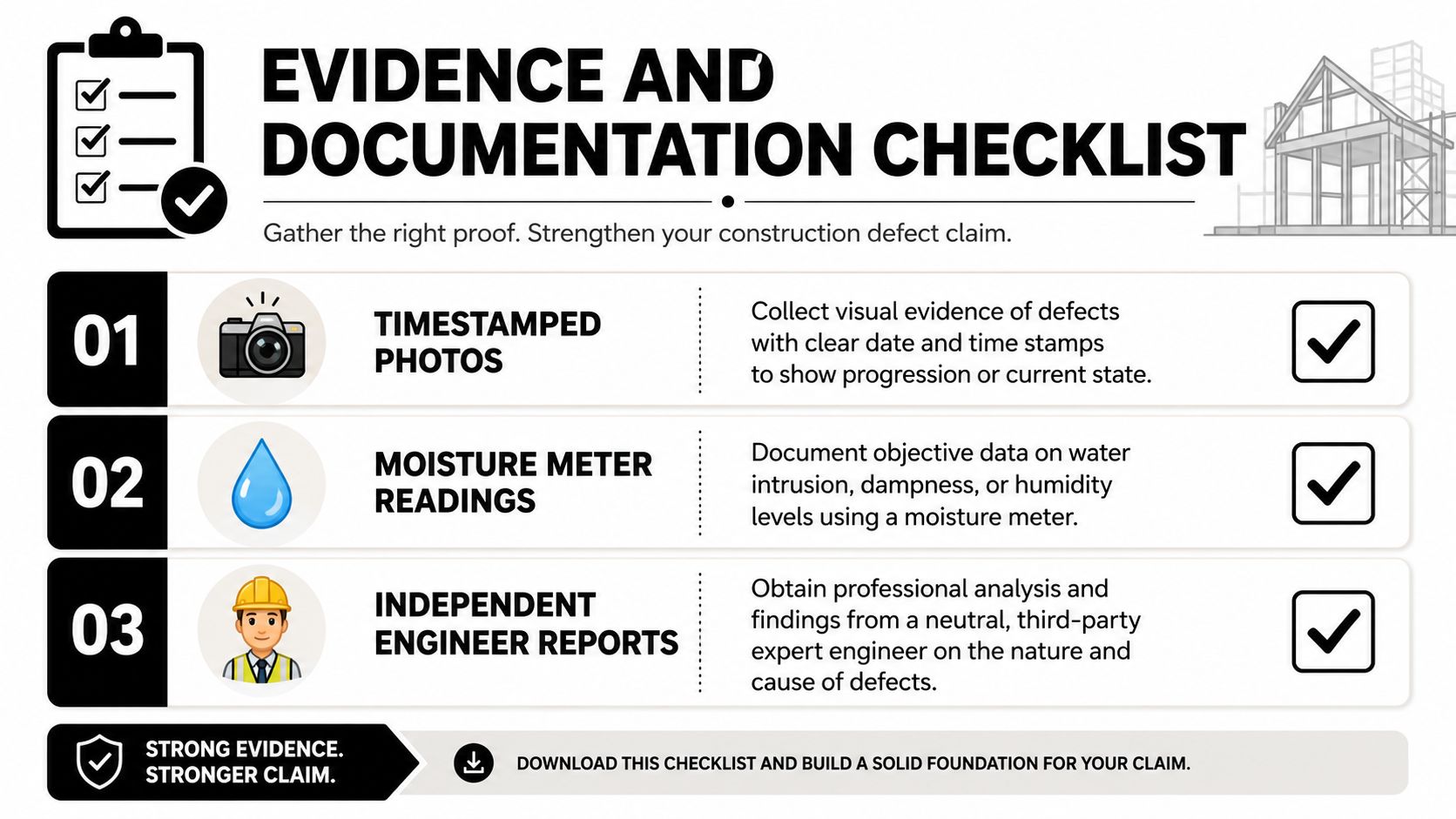
A strong construction defect claim rests on proof, not suspicion. The goal is to establish a clean causal chain. The verified data states that proving a claim requires a three-part causal chain: a component failed to meet the standard of design, materials, or workmanship; the deficiency came from construction practices rather than owner modification or maintenance failure; and the defect caused actual damages. It also notes that forensic engineers may use methods such as thermal imaging and moisture readings in that process, as described by Bay Legal's explanation of documenting and proving a construction defect.
What to collect first
Use a checklist mindset, not a memory mindset.
Timestamped photos
Capture progression, location, and surrounding materials. Include exteriors and interiors.Moisture meter readings
If available, document wet areas objectively rather than relying only on appearance.Thermal imaging results
These can help show hidden moisture patterns inside wall or ceiling cavities.Independent engineer or inspector report
This is often the document that connects symptoms to root cause.Repair estimates and mitigation invoices
Separate emergency mitigation from final repair proposals.
What makes documentation persuasive
Good documentation does three jobs at once. It shows what failed. It shows when and where it failed. It helps rule out alternative explanations such as owner neglect or later alterations.
For larger or more technical losses, organization matters almost as much as content. A property-specific checklist like this property inspection checklist can help structure what you collect before records go missing.
Simple file structure to use
| Folder | What goes inside |
|---|---|
| Photos and video | Dated visuals by room and exterior elevation |
| Communications | Emails, letters, text screenshots, call summaries |
| Expert findings | Reports, test results, diagrams, measurements |
| Costs | Mitigation bills, estimates, invoices, receipts |
The strongest file usually reads like a timeline. Someone unfamiliar with the property should be able to follow the story from discovery to damage to cause.
When to Engage a Public Adjuster or Attorney
Owners often ask which professional should come first. The answer depends on the dispute you have, not the title you think you need. If the immediate problem is policy interpretation, scope of damage, valuation, and insurer response, a public adjuster may help early. If the core problem is a legal conflict over notice, cure rights, liability, or anticipated litigation, an attorney often becomes essential.
When a public adjuster makes sense
A public adjuster is often helpful when the insurance piece is active and technical. That includes situations where the carrier is questioning scope, separating excluded defective work from potentially covered resulting damage, or requesting detailed documentation and valuation support.
Courts in some major states have held that CGL coverage applies only to damage to third-party property and excludes repair of the defective work itself, according to the Reinsurance Association of America's archived construction defects entry. Even if Oregon or Washington facts differ, that broader legal environment explains why owners often need specialized help sorting coverage theory from repair reality.
When an attorney should step in
If you're dealing with a contested cure offer, multiple potentially liable parties, or a likely lawsuit, get legal advice early. The issue may no longer be just claim preparation. It may be rights preservation.
If your broader concern involves construction-site injury rather than property defect, a separate resource such as expert legal help for construction accidents shows how legal representation shifts when the dispute centers on bodily injury rather than building failure.
For owners weighing whether it's time to bring in claim representation on the insurance side, this guide on when to hire a public adjuster can help clarify the decision.
Frequently Asked Questions
Do several small problems add up to one construction defect claim
They can. A single stain, one cracked tile, or one sticky door may look minor by itself. But if those issues point to one underlying cause, such as hidden water intrusion or settlement, they may belong in the same claim narrative. The key is whether the symptoms connect to a common defect, not whether each symptom looks dramatic alone.
What should I do if the contractor offers to fix the problem under a cure statute
Take the offer seriously, but don't treat it as automatically fair or automatically dangerous. Review exactly what the contractor proposes to repair, whether the proposal addresses root cause, how the work will be documented, and what rights you may affect by accepting or rejecting it. In Oregon and Washington, owners get into trouble when they respond informally and skip the required written process.
Are nonprofit and municipal property owners treated differently
The building issues may look similar, but claim handling often becomes more document-heavy for nonprofits, schools, and municipalities. Internal approval chains, procurement rules, maintenance logs, and public accountability standards can all affect how the file should be built. These owners usually benefit from a tighter chronology and more formal recordkeeping from the start.
Does latent damage coverage include foundation settling
Sometimes the answer turns on wording and cause. A policy may treat poor construction itself differently from damage that develops later because of that condition. Foundation issues also raise complicated questions about subsurface conditions, engineering, exclusions, and whether the policy responds to resulting interior damage. Don't assume “foundation” means automatically covered or automatically excluded. It usually needs careful policy reading and expert causation analysis.
If you're in Oregon or Washington and you're trying to sort out whether you have faulty workmanship, resulting damage, a cure-statute issue, or all three, NW Claims Management can help you understand the claim path, organize evidence, and approach the insurance side with a clearer strategy.