The call usually comes after a hard rain, a windstorm, or the kind of fire season headline that makes every property owner look up from the kitchen table and wonder whether their building would hold up. In Oregon and Washington, that question isn't abstract. It shows up in soaked crawlspaces, lifted roofing, smoke intrusion, downed trees, and claim files that get more complicated the longer you wait.
A risk management assessment gives you a practical way to get ahead of that chaos. For a homeowner, it helps you spot the weak points that turn a manageable event into a major loss. For a commercial owner, school, or nonprofit, it does something equally important. It creates a record of what the property was worth, where it was vulnerable, and what should've been protected before the damage happened.
That matters twice. First, it helps prevent avoidable damage. Second, if you do end up in an insurance claim, good assessment work often becomes the backbone of your proof.
Why Your Property Needs a Risk Management Assessment
A property owner usually doesn't think in risk categories. You think in practical terms. Is the roof still tight? Is water moving away from the foundation? Are those trees too close to the structure? Will the insurer call that damage sudden, or say it was already there?
That's why a risk management assessment works best when you treat it like a property health check, not a corporate formality. It forces you to look at the building the way a loss adjuster, contractor, engineer, and insurer will look at it later. You identify conditions now, while you still have options.
A static approach isn't enough. A Forrester finding cited by Canada Safety Training's risk management overview reports that 41% of organizations experienced three or more critical risk events within a single year, and companies with tested incident response plans saved an average of $2.66 million per incident compared with those that didn't. Those figures come from organizational risk, but the lesson applies directly to property ownership. Reactive plans cost more.
What property owners gain
A sound assessment helps you do four things well:
- Catch weak points early: Drainage failures, deferred roof issues, poor defensible space, and aging electrical components rarely improve on their own.
- Prioritize spending: You don't need to fix everything at once. You need to know what creates the biggest exposure first.
- Document pre-loss condition: This is one of the most overlooked advantages. A dated record can become critical when an insurer questions whether damage was new.
- Strengthen claim position: If a storm hits, your file is stronger when you can show inspection notes, photos, repair history, and maintenance decisions.
Practical rule: If a condition would matter to a contractor pricing repairs, it will probably matter to an insurer evaluating your claim.
For owners who want a clearer view of structural condition before a loss becomes a dispute, a third-party review like this Firm Foundations structural review can help frame what deserves closer attention. If you want to align that kind of building-level thinking with a broader process, this guide on five risk management steps for property owners is a useful starting point.
The Five Core Components of a Risk Assessment
The cleanest way to run a risk management assessment is to follow a simple five-part sequence. The ISO/IEC 31010:2016 framework uses that structure, as outlined in Optro's overview of the risk assessment matrix. In plain language, it comes down to identifying risks, deciding how you'll judge them, scoring them through Likelihood × Impact, prioritizing them, and reviewing them on a recurring basis.
Here's the visual version of that process.
Risk identification
Start with the blunt question. What can go wrong here?
For a house in the Pacific Northwest, that might include roof failure, wind-driven rain intrusion, wildfire ember exposure, frozen pipe breaks, tree strike, slope movement, sewer backup, or chronic drainage. For a commercial building, add tenant-caused damage, access control failures, equipment interruption, and areas where one small failure can shut down operations.
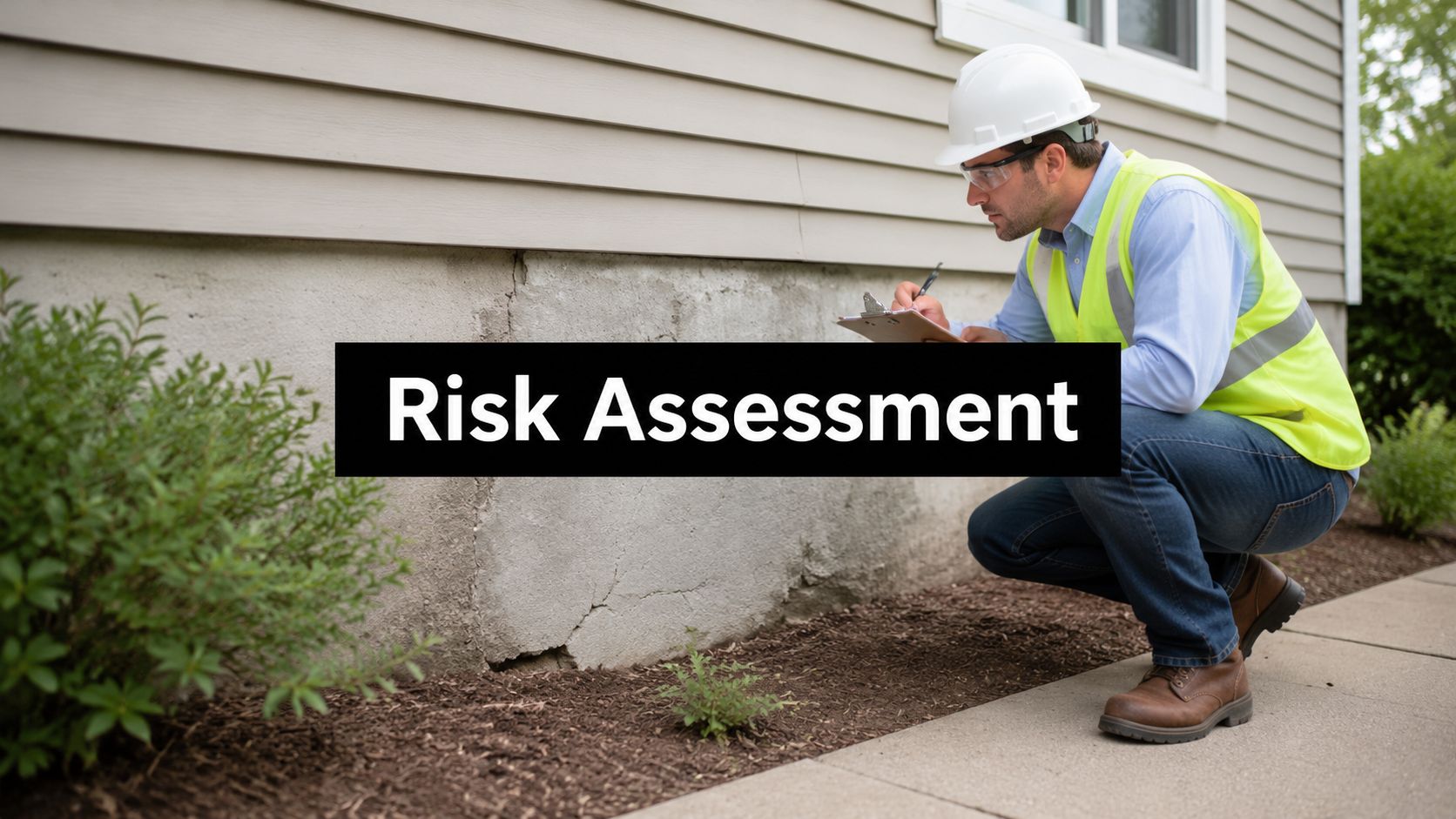
This step works best when you walk the property, not when you rely on memory.
- Look up: Roof coverings, flashing, chimneys, gutters, overhanging limbs.
- Look out: Siding joints, windows, retaining walls, site grading, runoff paths.
- Look in: Electrical panels, plumbing shutoffs, attic staining, crawlspace moisture, storage practices.
Risk analysis
Once you've named the threats, judge two things. How likely is each one, and how bad is the result if it happens?
A loose ridge cap and a buried foundation drain aren't equal. One may be easier to fix. The other may be more expensive if ignored. Owners, therefore, often make the wrong trade-off by focusing on visible issues instead of costly ones.
If you're unsure about building-envelope exposure, roof condition deserves special attention because so many claims start there. A detailed inspection informed by Penn Ohio Roofing expertise shows the level of detail owners should expect when evaluating shingles, flashing, drainage paths, and signs of hidden failure.
Risk evaluation
Not every risk needs immediate money. Every risk does need a rank.
A practical way to evaluate is to sort findings into three buckets:
- Act now: Conditions likely to cause active damage or complicate a claim.
- Schedule next: Issues that aren't urgent today but can escalate with one bad season.
- Monitor: Items worth photographing and rechecking on a routine basis.
A property owner gets into trouble when minor repairs keep displacing major vulnerabilities.
A written framework matters here because it keeps decisions consistent. If you're formalizing the process for a business, nonprofit, or multi-property portfolio, a written risk management policy for property operations helps tie inspections, maintenance, and claim readiness together.
Risk treatment and monitoring
Treatment means choosing your response. You might repair, reinforce, transfer the risk through insurance, or accept it if the exposure is limited and documented.
Monitoring is where most plans fail. Owners inspect after a problem, not before a season change. In the Northwest, reassessment should happen after major storms, after wildfire smoke or heat events, after contractor work on the envelope, and whenever water has entered the structure for any reason.
A Practical Assessment Framework for Your Property
Most owners don't need a glossy binder. They need a working checklist they can use on a rainy Saturday or during an annual facility walk-through. A useful risk management assessment should separate the property into categories, then force a decision about what deserves attention first.
One reliable quantitative model comes from FEMA's property risk guidance. In FEMA's risk assessment reference, the formula is Risk = Asset Value × Threat Rating × Vulnerability Rating. That matters because it stops you from treating every issue as equal. A small cosmetic defect on a low-value component isn't the same as a known weakness in a high-value system exposed to a recurring threat.
How to use the formula in real property decisions
You don't need to turn your house into a spreadsheet to benefit from this. Think about the formula in plain terms:
- Asset value asks what's at stake if this part fails.
- Threat rating asks how exposed that part is to a real hazard.
- Vulnerability rating asks how likely it is to fail under that hazard.
A basement storage room with poor drainage might carry modest importance for one owner and major importance for another, depending on what's inside. A flat commercial roof over mission-critical space will rank much higher because the interruption cost can spread far beyond the repair.
Property risk assessment checklist
| Risk Category | Residential Example | Commercial/Institutional Example |
|---|---|---|
| Structural | Roof wear, window seal failure, settling cracks, deck attachment concerns | Roof membrane failure, parapet issues, loading dock damage, deferred facade repairs |
| Environmental | Poor grading, flood-prone crawlspace, tree overhang, wildfire fuel near structure | Stormwater backup, flood exposure, hazardous material concerns, smoke infiltration risk |
| Security | Weak locks, garage access gaps, inadequate exterior lighting | Unsecured entries, camera blind spots, key control problems, vandalism exposure |
| Operational | No water shutoff plan, poor maintenance records, lack of inventory documentation | No continuity plan, weak vendor response process, missing maintenance logs, tenant coordination gaps |
That checklist gets better when you support it with specialist inspections. For below-grade and drainage concerns, especially before purchase or after recurring backups, resources like what drain surveys reveal to buyers show why hidden line conditions can't be judged from surface symptoms alone.
A workable field method
When I look at a property from a claims perspective, the most useful owner records are usually the simplest.
- Photo sets: Take broad shots first, then close-ups. Date them and store them somewhere easy to retrieve.
- Repair records: Keep invoices, contractor notes, and product details. That includes roofing materials, mitigation work, and emergency repairs.
- Asset notes: List major systems, finish quality, upgrades, and anything custom or difficult to replace.
- Change log: Note what changed after storms, freezes, smoke events, or contractor work.
For owners who want a more structured walk-through, a property inspection checklist for claim readiness can help turn scattered observations into a record that supports later valuation.
Navigating Regulations in Oregon and Washington
In the Pacific Northwest, the hardest part of property risk isn't merely identifying today's hazard. It's recognizing that local exposure is shifting, and insurers know it. A risk management assessment that only looks backward can miss the conditions that matter most in Oregon and Washington.
FEMA addresses this directly. In its guidance on mitigation planning, FEMA states that future probability based on climate change should be described as a distinct part of risk assessment. That's especially relevant in this region, where flood, storm, and related site conditions may not match the assumptions owners formed from older weather patterns.
Why historical loss history isn't enough
A lot of owners still assess risk by memory. Has this ditch overflowed before? Did that slope ever move? Has wind ever pulled at this roof edge?
Those questions matter, but they aren't enough. Carriers increasingly examine current site conditions, defensible space, drainage management, maintenance history, and whether the property shows signs of foreseeable exposure. If your assessment only says, “it hasn't happened yet,” that isn't much protection.
The properties that create the worst claim fights are often the ones with visible vulnerabilities that nobody documented before the loss.
Local compliance and claim readiness
The practical issue in Oregon and Washington is that regulation, underwriting, and claims handling often overlap. Wildfire-adjacent properties may need clearer vegetation and access planning. Flood-exposed sites need stronger drainage documentation and clearer records of prior conditions. Commercial and institutional owners also need internal reporting discipline, because a poorly documented timeline can damage a valid claim.
Three habits help:
- Track site changes: New runoff paths, vegetation growth, retaining wall movement, and drainage modifications all belong in your file.
- Match records to policy duties: Your inspection notes should support what you may later need to prove after a loss.
- Preserve formal claim documents carefully: When the loss happens, accuracy matters. A completed proof of loss form guide for property owners is only as strong as the documentation behind it.
Beyond the Assessment From Risk to Resolution
A risk management assessment earns its full value after a loss. Before the event, it helps you reduce exposure. After the event, it becomes evidence.
That shift is where many property owners get blindsided. They assume the insurer will compare visible damage with the policy and pay what's necessary. In practice, the file often turns on documentation. Was the damage sudden? Was the condition pre-existing? Was the scope of repair limited, or did the event affect connected materials and systems?

What your pre-loss record can prove
A good assessment file can support several points at once:
- Condition before the event: Prior photos and inspection notes can help separate old wear from new damage.
- Known vulnerabilities: If you identified a weakness and addressed it, that helps rebut arguments that neglect caused the loss.
- Scope logic: When damage spreads through assemblies, finishes, or operations, earlier records make that story easier to prove.
- Value: The better your property records, the harder it is for anyone to minimize what was affected.
Why this matters in settlement disputes
Insurers often focus on narrow damage descriptions. Property owners live with the broader reality. Water entering through one opening may affect insulation, framing, flooring, trim, contents, and the time required to make the property functional again.
Claim insight: The better your assessment records, the less room there is for a debate built on assumptions.
That's why valuation work matters so much after a loss. If you're trying to understand how repair scope, depreciation, and replacement logic fit together, these loss valuation methods for insurance claims provide a useful framework for reading your claim more critically.
When to Hire a Public Adjuster for Your Claim
Some claims are straightforward. Many aren't. The right time to hire a public adjuster is usually the moment the claim stops feeling like a simple reimbursement process and starts looking like a technical dispute.
That doesn't always mean hostility. Sometimes it means the property is too complex for a quick inspection. Sometimes it means the insurer's estimate leaves out obvious components. Sometimes it means you're spending your evenings trying to decode policy language while contractors, tenants, or family members need answers.
Clear signs you need help
The strongest signals are usually practical, not dramatic.
- Large structural or water losses: If multiple building systems are involved, the scope often gets undercounted early.
- A settlement offer that won't cover the work: If contractor pricing and the carrier estimate aren't even close, that gap needs to be analyzed, not guessed at.
- Repeated delay or poor communication: A slow file often becomes a weak file unless someone pushes for inspections, documents, and decisions.
- Policy language feels hard to apply: Coverage may exist, but many owners don't know how to present the loss in policy terms.
- The insurer points to wear, maintenance, or prior damage: That's where documentation and technical argument become critical.
What a public adjuster actually changes
A good public adjuster doesn't just “handle paperwork.” The primary value is in building the claim correctly. That means inspecting thoroughly, expanding scope where justified, organizing proof, interpreting policy language, and negotiating from documented facts instead of frustration.
For homeowners, that can mean recovering the full repair picture rather than only the most visible damage. For businesses, schools, and nonprofits, it can also mean protecting operations, budgets, and timelines while the claim is still unfolding.
If the financial stakes are high, expert representation isn't a luxury. It's part of protecting the asset.
How NW Claims Management Champions Your Recovery
In property claims, experience shows up in the details. It shows up in how the damage is documented on day one, how policy language is read against the facts, and how the file is built so the insurer has less room to narrow scope or discount value.
That's where NW Claims Management's approach stands out for Oregon and Washington policyholders. The firm works only for property owners, not insurers, and that difference matters. Their adjusters aren't trying to close the file at the lowest supportable number. They're focused on documenting the full loss, tying it to the policy, and pressing for a settlement that reflects the actual cost of recovery.
The broader industry is moving in this direction. The global risk management software and services market reached $15.4 billion in 2024 and is projected to reach $51.97 billion by 2033, reflecting a 14.6% compound annual growth rate from 2025 to 2033, according to Empyrean Solutions' risk management statistics roundup. The practical takeaway is simple. Property risk work is becoming more data-driven because vague judgment doesn't hold up when money is on the line.
How that looks in practice
NW Claims Management applies the same logic used in strong risk work.
- Identify the full exposure: They inspect beyond the obvious damage and look at how the event affected the structure, finishes, systems, and use of the property.
- Document with purpose: Photos, measurements, contractor input, repair logic, and policy obligations are organized to support the claim, not just describe the event.
- Value the loss carefully: The goal is a complete claim package that reflects the full effort needed to restore the property.
- Negotiate from evidence: When insurers question scope, causation, or pricing, the response is built on documentation and analysis.
Why policyholders call when the process gets heavy
A residential owner may be dealing with smoke, water, or storm damage while trying to keep the household functioning. A commercial or nonprofit client may be juggling tenants, staff, board pressure, and interrupted operations. In both cases, the claim can become its own full-time job.
That's the gap NW Claims Management fills. They step into the technical side of the process so the owner isn't left trying to argue building damage, valuation, and policy language alone.
If you're facing property damage in Oregon or Washington and need an advocate who works for you, contact NW Claims Management for a clear review of your loss, your policy, and the next steps toward a fair settlement.