The first insurance check often brings a few minutes of relief. Then the contractor walks the property, opens a wall, pulls base cabinets, or tears off damaged roofing, and the numbers stop making sense. The estimate from the carrier says one thing. The actual repair scope says another.
That gap is where most homeowners freeze. They assume the insurer's first number is final, or they worry that asking for more money will look dishonest. It won't, if the additional work ties back to the original loss and you document it correctly. That's what insurance claim supplements are for.
Your Insurance Check Is Here But Is It Enough
A common example goes like this. A homeowner has a water loss in the kitchen. The insurer inspects quickly, writes for visible drywall damage, some paint, and limited cabinetry work, then issues payment. At first, that feels like progress.
Then demolition starts.
Behind the wall, the contractor finds soaked insulation, damaged backing, and material that can't be reset the way the original estimate assumed. The flooring tie-in is wider than expected. Dry-out left visible warping in adjacent finishes. None of that was on the first scope.
Why the first estimate often feels short
Initial insurance estimates are built from what the adjuster could see at the time. That sounds reasonable, but property damage rarely stays confined to what's visible on day one. Water travels. Fire residues penetrate concealed spaces. Wind losses expose installation issues only after removal begins.
That's why homeowners should compare the insurer's document against a more complete repair review. If you haven't looked closely at how carriers build those numbers, this breakdown of insurance claim estimates helps explain where scope gaps usually start.
A first payment is often a starting point for valuation, not the finish line for repair reality.
The tool that closes the gap
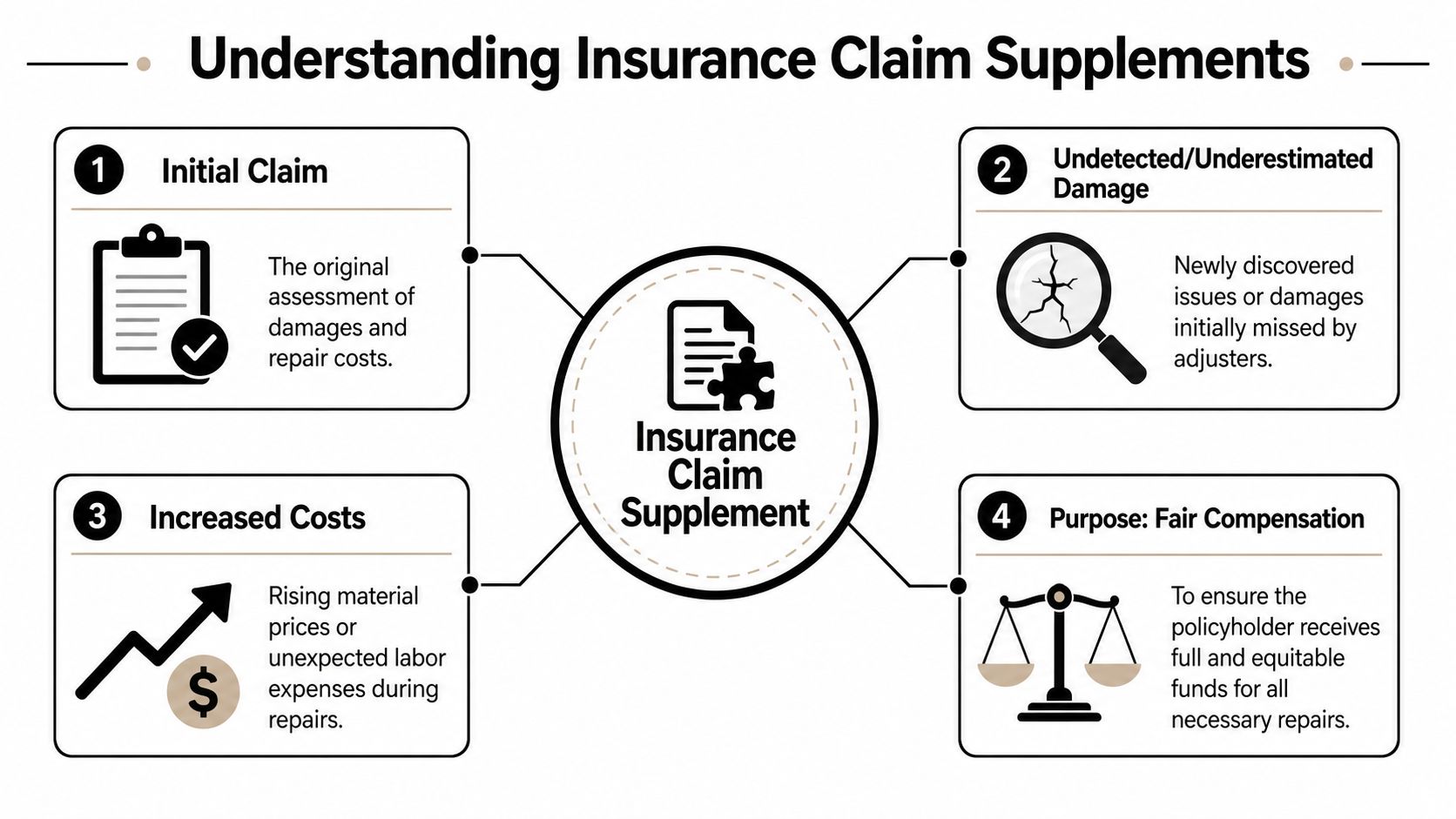
An insurance claim supplement is the formal process for requesting additional payment for work the original scope missed, understated, or couldn't reasonably identify yet. It isn't a favor request. It's the mechanism used to bring the claim back in line with the actual covered damage.
For homeowners, that distinction matters. You're not asking the insurer to be generous. You're asking the insurer to evaluate documented repair needs tied to the original loss.
If your repair team is already telling you, “We found more,” you're probably in supplement territory.
What Exactly Is an Insurance Claim Supplement
Think of a supplement like a change order on a construction job. The original plan was based on what was known at the start. Once hidden conditions appear or code-required work becomes clear, the scope has to be revised. Insurance works the same way, except the revised scope has to be proven back to the covered event.
What a supplement is and what it isn't
A supplement is an extension of the existing claim. It is not a brand-new loss.
Under Florida's statutory definition discussed in this industry analysis, a supplemental claim is additional loss or damage from the same peril the insurer already adjusted, or costs incurred while completing repairs under an open claim with timely notice. That mattered because it created a clear legal definition where the term had long been used without consistent formal meaning.
For a homeowner, the practical takeaway is simple:
- Same event: The added damage must come from the original covered loss.
- New information: The issue was missed, concealed, or not fully measurable at first.
- Formal request: The insurer needs revised documentation, not just a phone call saying the job costs more.
Why the distinction matters
Insurers deny plenty of weak submissions because they read like new work, elective upgrades, or contractor preference. A proper supplement reads differently. It shows why the original valuation changed.
That's why supplement disputes often come down to loss valuation methods. If you want a clearer sense of how insurers separate replacement needs, depreciation, and scope logic, this guide to loss valuation methods is worth reviewing before you submit anything.
| Issue | Supplement | New claim |
|---|---|---|
| Cause of damage | Same original peril | Separate event |
| Timing | Discovered during repair or review | Occurs later |
| Purpose | Add funds to existing claim | Open a different claim file |
| Key proof | Link back to initial loss | Show a distinct new loss |
Practical rule: If you can't tie the added work directly to the original loss, don't call it a supplement yet. Prove causation first.
Common Triggers for Filing a Supplement
Most valid supplements begin when the repair process exposes something the first inspection didn't capture. Sometimes that's hidden damage. Sometimes it's a measurement problem. In Oregon and Washington, code compliance is often where the biggest fight starts.
Hidden damage after tear-out
This is the classic supplement trigger. Until a contractor opens a wall, removes roofing, pulls siding, or detaches finishes, some damage isn't visible. Rot behind siding, damaged sheathing, compromised framing, or fire impact behind drywall often show up only after work begins.
The key point is not that the damage is expensive. The key point is that it wasn't reasonably knowable during the first scope.
Code-required work left off the original estimate
A repair can be fully related to the original loss and still get underpaid because the adjuster wrote only for basic replacement, not code-compliant replacement. That difference matters in practice. If local requirements force added electrical protection, energy upgrades, or structural details, those items need to be separated and documented, not buried inside a contractor total.
A lot of owners feel pressure to absorb that difference. They shouldn't.
Quantity and scope errors
Adjusters miss measurements. They omit detach-and-reset steps. They undercount affected materials. They assume partial repair where continuity requires a broader fix. Those are supplement issues, not minor annoyances.
In the restoration industry, supplementing is described as the single most important revenue recovery activity, and one analysis notes that on a standard $30,000 initial scope, a supplement can request an additional $10,000, which is a 33.3% increase over the original payout when missed damage, underestimated quantities, or code-required work were excluded, as explained in this supplementing overview.
Cost pressure during repair
Some claims also change because the actual repair path becomes more complex once the work starts. A carrier may have written for a simplified method that doesn't match site conditions. The supplement then isn't about inflation in the abstract. It's about the actual labor, materials, and sequence required to complete the covered repair correctly.
If you're seeing cost differences tied to current repair pricing, local labor conditions, or scope creep created by the original estimate, it helps to understand how construction cost inflation affects rebuild math.
The most common real-world patterns
- Water losses: Wet insulation, subfloor damage, cabinet backing, and concealed microbial impact found after removal.
- Wind and roof losses: Decking, flashing, ventilation details, and underlayment needs discovered during tear-off.
- Fire losses: Framing, insulation, wiring impact, and smoke-damaged cavities that weren't visible during first inspection.
- Storm exterior claims: Siding removal reveals substrate damage or code-required installation details absent from the initial scope.
The important part is this. A supplement works best when it fixes a specific scope failure, not when it tries to reopen every part of the claim without evidence.
How to Document and Submit Your Supplement
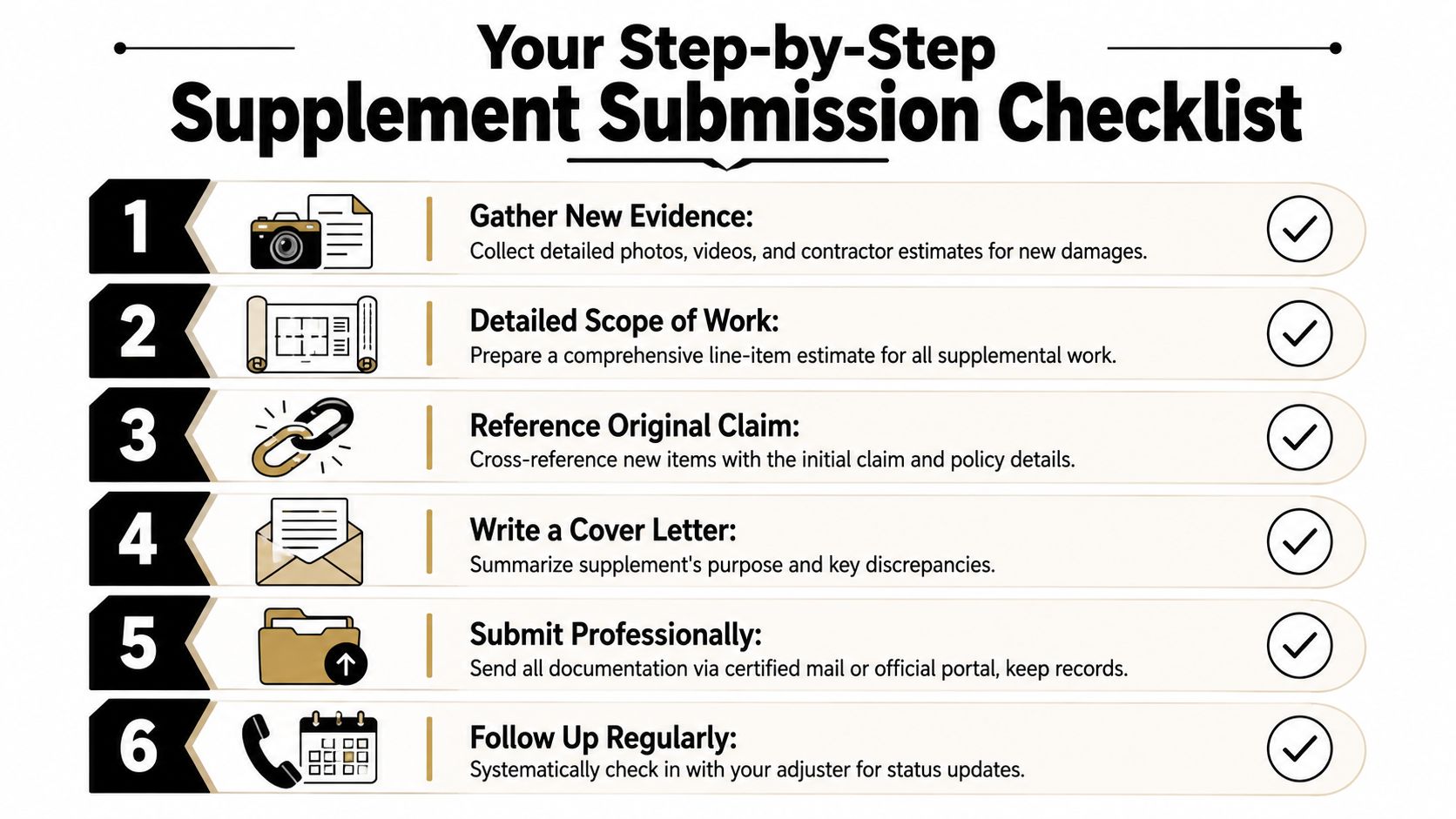
Most supplements fail for one reason. The file doesn't prove enough. A good supplement is an evidence package, not a complaint letter.
Start with the carrier estimate, not your contractor invoice
Before you write a single argument, get the insurer's original estimate in full. That usually means the Xactimate ESX or PDF version, not just the payment summary. Then compare it line by line against what the contractor found after tear-out or deeper inspection.
According to this detailed discussion of supplemental insurance claims, a valid supplement depends on the discovery of hidden damage or code-mandated work that wasn't reasonably knowable during the initial scope, and it requires a forensic comparison between the carrier's original Xactimate estimate and post-tear-out findings. That same source stresses an evidentiary chain: map the new items to the original loss date, include annotated photos of newly exposed damage, and cite the specific code sections that require added work.
That means your submission should answer three questions clearly:
- What line item was missing or inadequate?
- What new evidence justifies the added work?
- How does that added work tie back to the original covered event?
Build the file like an adjuster will read it
A weak supplement says, “We need more money.”
A strong supplement says, “Line item X was omitted. Photo set B shows the concealed damage after demolition. Code section Y requires the added repair method. Revised estimate reflects those facts.”
Use a structure like this:
- Original estimate excerpt: Highlight the affected area or omitted line.
- New finding: State what was discovered and when.
- Photo proof: Add annotated images with arrows, captions, and room or elevation labels.
- Revised line item: Show exactly what should be added or changed.
- Code support if applicable: Quote the section number and describe why it applies.
If your carrier asks for formal sworn documentation at any stage, understand the difference between a supplement package and a policyholder statement of loss. This guide on what a proof of loss is helps homeowners avoid mixing those up.
Submit the supplement as if the reader has never seen your house and has five minutes to decide whether your evidence is complete.
The photo standard that matters now
Homeowners and contractors often get blindsided. Generic photo galleries don't work as well as they used to.
A current analysis of insurer review practices notes that many carriers are using AI-driven virtual claim reviews that reject supplements missing line-item-specific photo linkage, meaning each image should be captioned with the exact line item and placed next to it in the PDF. The same source reports that only 12% of publicly available supplement guides explain this level of detail, and pilot data from virtual review platforms showed a 47% higher approval rate for captioned, line-item-linked photos versus generic galleries, according to this review of roof claim supplement documentation standards.
What line-item-linked photos look like
| Photo caption | What it proves |
|---|---|
| Line 12, west wall insulation removal | Wet insulation discovered after drywall removal |
| Line 18, roof decking replacement at rear slope | Damaged decking exposed during tear-off |
| Line 24, AFCI device upgrade in bedroom circuit | Code-triggered electrical work tied to loss-area repair |
That format does two things. It helps the human adjuster review faster, and it reduces the chance that an automated workflow treats your file as unsupported.
What to send and how to send it
Keep the package organized. A clean submission usually includes:
- Cover summary: Claim number, property address, date of loss, and a short explanation of why the supplement is being filed.
- Revised estimate: Itemized by trade and grouped logically.
- Photo package: Captioned and linked to line items.
- Contractor findings: Tear-out notes, measurements, and scope comments.
- Code references: Only where required. Cite the section, don't just say “per code.”
- Invoices or supporting records: If the work has progressed far enough to generate them.
Send it through the insurer's official portal or claim email if that's the required channel. Save the sent confirmation, file names, and the exact version you submitted. Small recordkeeping mistakes turn into unnecessary delays later.
Navigating Insurer Responses and Negotiations
Once the supplement is in, the insurer will usually do one of four things. Approve it, partially approve it, ask for more support, or deny it. None of those responses should surprise you.

The most common pushback
Insurers often come back with one of these positions:
- Unrelated damage: They argue the newly claimed item doesn't stem from the original peril.
- Insufficient documentation: They say the file doesn't show the damage clearly enough.
- Excessive pricing: They challenge quantities, labor, or material selections.
- Non-covered upgrade: They characterize code-driven work as optional or outside policy terms.
Your advantage comes from precision. If your supplement package maps the item to the original loss, includes line-item-specific photos, and shows why the repair method changed, you've already done most of the negotiation work.
How to respond without getting pushed off course
Keep your replies short and technical. Don't argue in broad terms. Respond item by item.
A useful pattern is:
- Identify the denied or reduced line.
- State the basis for inclusion.
- Point to the exact supporting document.
- Ask for written clarification if they still decline.
For owners who want a finance-oriented view of how claims records and support documents should be handled, Lighthouse Consultants' claims guide is a helpful companion read.
If the insurer says the damage is unrelated, ask them to identify exactly what evidence they relied on and what evidence in your file they rejected.
Stay professional and keep the file moving
Negotiation doesn't mean escalating every disagreement into a fight. It means controlling the record. Every email should make the file clearer.
Ask for written explanations. Confirm verbal conversations by email. If they request another inspection, attend it with your contractor or representative and keep the discussion focused on the disputed line items, not a general rehash of the whole claim.
Homeowners lose momentum when they treat denials as final. Many are often requests for a cleaner file or a tighter causal argument.
Oregon and Washington Specific Claim Notes
Oregon and Washington owners run into a problem that many national guides barely mention. The original scope may be written to pre-loss replacement basics, while the actual repair has to satisfy current local requirements. When that happens, insurers often frame the added work as new, elective, or outside the estimate.
Why Pacific Northwest supplements get stuck
This issue shows up frequently in code-related disputes. One analysis focused on this region reports that 38% of supplemental claims in Pacific Northwest markets are rejected solely because of misalignment with current ordinance or law coverage limits, particularly where newer code requirements supersede the original scope, as outlined in this discussion of supplemental claim essentials in recent Pacific Northwest contexts.
That same source points to recent 2024 to 2025 code updates, including examples involving Oregon energy efficiency and Washington seismic amendments, and explains that many guides fail to show how to separate depreciation and replacement-cost differences tied specifically to code-driven line items.
What that means in practice
If you live in Oregon or Washington, don't let code items blur into the rest of the supplement. Separate them.
A cleaner way to present code-driven work
- Base repair scope: The work required to restore direct physical damage from the covered loss.
- Code-triggered additions: Items required because current code applies once repair crosses a threshold.
- Policy support: The part of the policy that may respond, often through ordinance or law coverage.
- Valuation split: If needed, distinguish depreciated components from recoverable replacement-cost components.
That separation matters because it keeps the insurer from dismissing the entire supplement as padded or unsupported.
Two local pressure points to watch
| State focus | Typical supplement issue |
|---|---|
| Oregon | Energy-related repair requirements omitted from the initial estimate |
| Washington | Seismic or structural amendment issues treated as optional extras |
Code compliance isn't “betterment” when the jurisdiction requires it for the covered repair. It has to be documented and presented that way.
Owners also need to understand timing. Once repairs begin, the opportunity to photograph pre-repair conditions, capture tear-out discoveries, and tie code triggers to the scope can disappear quickly. In Oregon and Washington claims, that delay costs more than is commonly realized.
When a Public Adjuster Is Your Best Advocate
Some homeowners can manage a small supplement on their own. Many can't, especially when the dispute involves hidden damage, code compliance, depreciation issues, or repeated insurer pushback.
At that point, the value of a public adjuster isn't just writing a better estimate. It's controlling the claim narrative from inspection through negotiation. That includes reviewing the policy, comparing the insurer's scope against actual damage, documenting losses correctly, organizing the supplement file, and pressing the carrier to address the evidence rather than sidestep it.
When professional help makes the most sense
You should strongly consider representation if:
- Repairs already revealed more damage: The file has changed and nobody is packaging it correctly.
- The carrier keeps asking for more support: That usually means the submission lacks structure or technical detail.
- Code items are being denied: These disputes often require a tighter presentation than a homeowner or contractor can reasonably provide.
- You're exhausted by the process: That matters. Claims drag on when the policyholder runs out of time or energy.
If you're trying to decide whether outside representation fits your situation, this guide on when to hire a public adjuster lays out the decision points clearly.
Most public adjusters work on contingency, which means their fee is tied to the claim outcome. For many owners, that aligns incentives in a way the claims process otherwise doesn't. More important, it shifts the burden of documentation, communication, and negotiation off your shoulders while the property still needs to be repaired.
If your insurance payment doesn't match the actual cost of putting your property back together, NW Claims Management can review the claim, identify missed scope, and help pursue the additional funds your policy may owe. For Oregon and Washington property owners dealing with supplement disputes, code-compliance issues, or underpaid repair estimates, that kind of experienced representation can make the process far more manageable.