When your home or business suffers damage, your insurance company will send out an adjuster. It’s an expected part of the process. What most people don’t realize, however, is that this adjuster works for the insurance company, not for you. Their job is to protect the insurer's bottom line.
A public claims adjuster is different. We work exclusively for you, the policyholder. Our only goal is to document the full scope of your loss and negotiate with the insurance company to get you the maximum settlement you're entitled to. This one distinction can make all the difference in your financial recovery.
Public Adjuster vs Insurance Company Adjuster At a Glance
Understand who each adjuster truly works for and their primary goals during your claim.
| Attribute | Public Adjuster (Your Advocate) | Insurance Company Adjuster (Their Employee) |
|---|---|---|
| Who They Work For | You, the policyholder. | The insurance company. |
| Primary Goal | Maximize your claim settlement fairly and accurately. | Minimize the insurance company's payout. |
| Allegiance | Your financial interests and recovery. | The insurer's profitability and policies. |
| Role in Claim | Investigates, documents, and negotiates on your behalf. | Investigates and values the claim for the insurer. |
This table really cuts to the chase. The adjuster sent by your carrier is a company employee, plain and simple. Having a public adjuster on your side is about leveling the playing field.
Why You Need an Expert Advocate After Property Damage
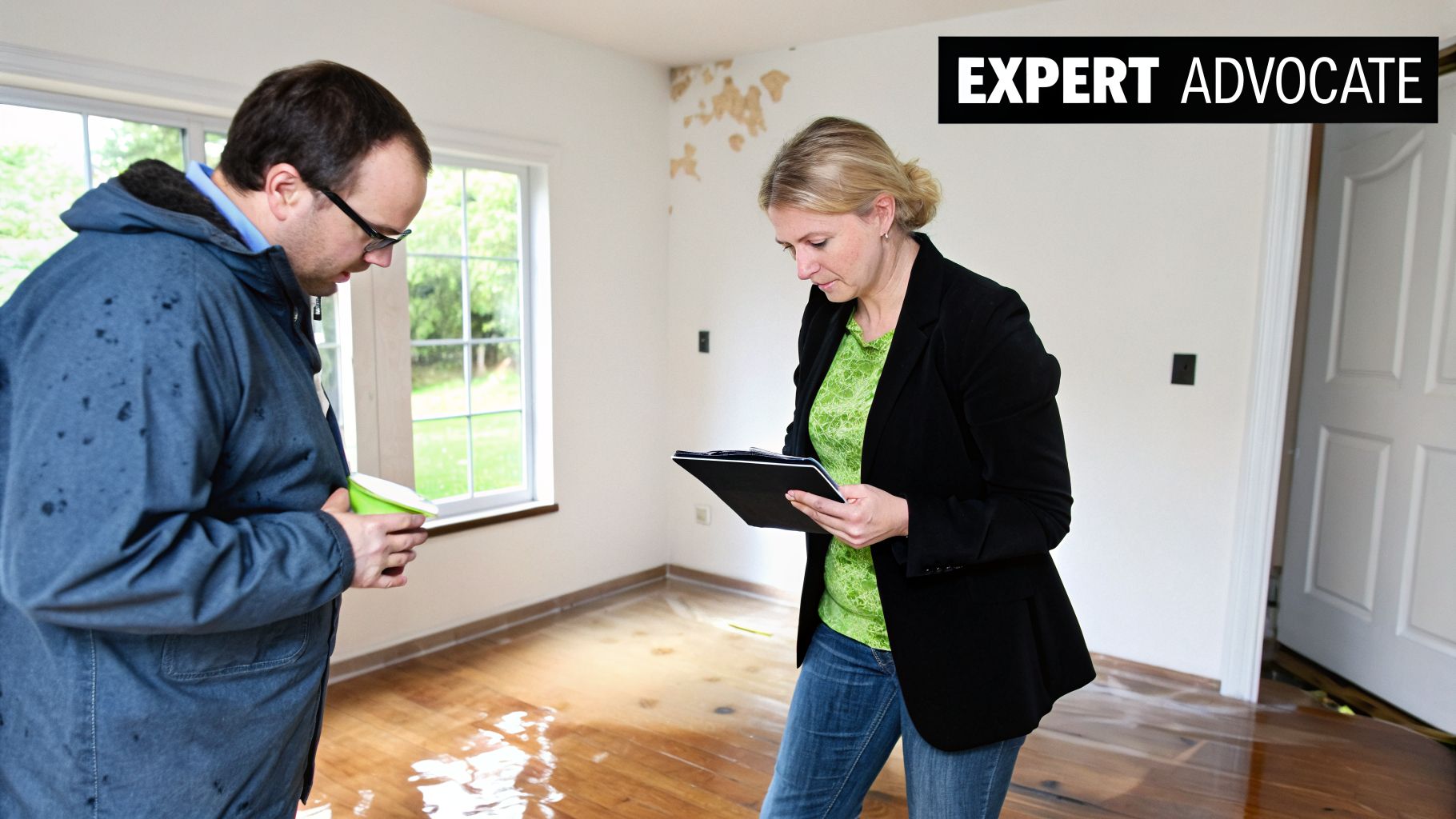
After a fire, flood, or major storm hits your property, the aftermath is chaotic and stressful. The adjuster from your insurance provider might seem helpful, but there’s an inherent conflict of interest. They are trained to protect their employer’s financial interests, which often means settling your claim as quickly and for as little money as possible.
This can lead to overlooked damages, undervalued repair costs, and a final settlement that leaves you paying out-of-pocket to truly restore your property.
A Real-World Portland Scenario
Let’s look at a situation we see all the time here in the Portland area: a supply line to a dishwasher fails overnight, flooding the kitchen and seeping into the living room. The insurance company’s adjuster comes out, measures for new flooring and drywall, and writes up an estimate. It seems straightforward.
But a professional public adjuster knows to look deeper. We would bring in specialized equipment like moisture meters and thermal imaging cameras to find what the naked eye misses.
- Trapped Moisture: We almost always find moisture wicked up behind baseboards and insulation. If this isn't properly dried out, it’s a breeding ground for toxic mold.
- Hidden Structural Damage: That water could have saturated the subfloor, causing it to swell or delaminate. Simply putting new flooring over a damaged subfloor is a recipe for disaster.
- Code Compliance: Was your home built 20 years ago? Building codes have changed. We make sure the estimate includes the cost to bring any affected plumbing or electrical systems up to current Oregon code, which is often covered by your policy but frequently missed by the carrier’s adjuster.
While learning how to identify water damage is useful, a public adjuster’s real value is in proving the full extent of that damage to the insurer.
It all comes down to this: The insurance company's adjuster works for them. A public adjuster works for you. Our job is to get you the fairest and most complete settlement possible under your policy—period.
The claims adjusting industry is a massive field, projected to hit $10.8 billion by 2026. With that much money at stake, you can bet insurance companies are focused on controlling costs. For property owners in Oregon and Washington, having your own expert advocate is no longer a luxury; it’s a necessity.
Hiring a public adjuster isn’t about being adversarial; it’s about ensuring fairness. It changes you from being a passive victim in the claims process to an empowered, informed participant. To learn more, check out our article on the key benefits of hiring a public adjuster and see how we put our expertise to work for you.
Key Signs It's Time to Hire a Public Adjuster
Most people in Oregon and Washington assume their insurance claim will be a straightforward, honest process. After a fire or major leak, you just want to get things fixed. But the reality of a large insurance claim can be a shock. It's often a complex, adversarial battle you're not prepared for.
Knowing when to tag in a professional is the most important decision you can make. If you’re feeling overwhelmed, confused, or just have a gut feeling that something’s not right, that's your cue. It’s time to find an expert who works for you, not the insurance company.
Here are the major red flags we see every day that tell you it's time to call for backup.
Your Claim Is Large or Complex
A broken window is one thing. A fire that guts your kitchen and sends smoke throughout your entire home is something else entirely. When the damage is significant, the claim becomes exponentially more complicated.
Think about these real-world scenarios:
- A fire damages the structural frame of your Portland home.
- A burst pipe floods several floors of your commercial building in Seattle.
- A major hailstorm shreds the roof on a multi-family apartment complex you own.
These aren't simple repair jobs. The sheer volume of documentation, the technical know-how for estimating costs, and the intricate policy details are overwhelming. A public adjuster has managed hundreds of these claims. We know how to account for everything—from hidden smoke damage in your walls to mandatory building code upgrades you're entitled to.
One of the biggest mistakes we see is a property owner underestimating the true scope of their loss. What looks like simple water damage on the surface can mean rot, mold, and electrical problems hiding underneath. An experienced adjuster knows exactly where to look for these expensive, hidden issues.
The Settlement Offer Seems Too Low
This is the classic story. You get the insurance company's settlement check, look at the numbers, and it just doesn't add up. It feels impossibly low, and your instincts are probably right.
Remember, insurance carriers are for-profit businesses. Their first offer is almost always a starting point, calculated to be the lowest number they think you’ll accept.
Here’s a perfect example: A Bellevue, Washington, business gets hit with major storm damage. The insurer’s adjuster writes a quick estimate to replace the flooring and some drywall. But the offer completely ignores the cost of lost income while the business is closed, the value of ruined inventory, and the industrial-grade drying equipment needed to prevent a future mold infestation. An offer like that is a massive red flag.
A public adjuster’s first job is to conduct our own, far more thorough investigation. We document every single detail of your loss and build an undeniable case, forcing the insurer back to the negotiating table to pay what you're actually owed.
The Insurance Company Is Delaying Your Claim
Are your emails going into a black hole? Does the company adjuster keep asking for documents you’ve already sent? These aren't just annoying administrative issues; they are often deliberate delay tactics.
Insurers know that the longer they drag out the process, the more likely you are to get frustrated and accept a lowball offer just to make it all go away.
If you feel like you're getting the runaround, you are. Hiring a public adjuster puts an immediate stop to these games. We take over all communications, apply firm and professional pressure, and hold the carrier accountable to the timelines defined in your policy and by state law. We know their playbook, and we won't let them wear you down. For a deeper look into this, our guide on when to hire a public adjuster offers additional insights.
You Don't Understand Your Policy
Let's be honest—insurance policies are dense, confusing legal contracts. They are packed with jargon, special conditions, and pages of exclusions. It’s nearly impossible for a layperson to grasp what terms like "actual cash value," "replacement cost," "ordinance or law," or a "co-insurance penalty" really mean for their settlement.
If you’re struggling to figure out what you’re covered for, you’re negotiating from a position of weakness. The insurance company's adjuster knows your policy inside and out, and they can use that complexity against you.
A public adjuster’s job is to be your policy expert. We translate that confusing legal document into a roadmap for getting you the maximum possible settlement, ensuring you claim every single benefit you've been paying for.
Finding a Licensed Public Adjuster in Oregon and Washington
When you’re looking for a "claims adjuster near me," your very first filter should be a simple one: are they licensed? A public adjuster's state license isn't just a piece of paper; it's your assurance that they've met strict professional standards and are held accountable. Hiring an unlicensed adjuster is not only risky, it’s illegal.
Luckily, both Oregon and Washington provide easy-to-use online portals to verify an adjuster’s credentials. I always tell potential clients to run this check before even making a phone call. It only takes a minute.
- For Oregon: Check the Oregon Division of Financial Regulation License Search. You can look up a person or business to see if their license is active and in good standing.
- For Washington: Use the Washington State Office of the Insurance Commissioner License Search. This tool confirms if an adjuster is legally allowed to work on behalf of policyholders in the state.
If someone can’t provide a current license number, or if their status is "inactive" or "expired," walk away. It's a non-negotiable red flag.
Prioritize True Local Expertise
A license is the bare minimum. The real difference-maker is deep, on-the-ground knowledge of the Pacific Northwest. After a major storm, you'll see out-of-state firms swoop in, but they just don't have the nuanced understanding to get you the best possible outcome.
There's no substitute for a local firm with a real office in Oregon or Washington. We know the specific challenges of this region, from the brutal windstorms on the coast to the unique fire behavior in Central Oregon's high desert.
We once handled a claim for a homeowner in the Columbia River Gorge whose roof was torn up by extreme winds. The insurance company's adjuster, who was from California, based his estimate on standard asphalt shingles. We stepped in and proved that local building codes and the area's severe weather patterns required a much tougher, more expensive roofing material. That insight significantly boosted the settlement—a detail only a local would even think to fight for.
This kind of local insight is what turns a good claim into a great one. Your adjuster should be fluent in regional labor rates, material costs, and the specific building codes for your town. This prevents your insurer from lowballing you with national average pricing that simply doesn't reflect the cost of rebuilding in places like Portland or Seattle. And while it helps to know the key differences between the adjuster who works for you and the one who works for the insurance company (we cover this in our guide on the public adjuster vs. insurance adjuster), it’s that local expertise that truly puts money back in your pocket.
Look Beyond General Experience
Property claims aren't one-size-fits-all, and neither are public adjusters. When you’re vetting potential firms, you need to dig deeper than just "years of experience." You need to know if they have experience with your kind of disaster.
Don't be shy about asking for case studies or references from past clients who had a similar loss. A firm that excels at commercial fire claims will understand business interruption and inventory loss, but those skills don't translate if you're dealing with a residential water damage claim.
Ask them about their background in specific areas:
- Residential Claims: Experience with single-family homes, condos, and multi-unit properties.
- Commercial Claims: A deep understanding of business properties, from retail and restaurants to warehouses.
- High-Value Claims: A proven ability to manage complex losses that exceed $500,000 or $1 million.
- Specific Perils: Some of the best adjusters have a niche, like deep expertise in wildfire, flood, or earthquake claims.
Hiring an adjuster with a track record matching your situation means they won't be learning on your dime. They’ll already know the right documentation to gather, the best experts to bring in, and exactly how to dismantle the insurance company's arguments. That specialized experience is a massive advantage that ensures every last detail is covered.
You’ve done your homework, checked licenses, and now have a shortlist of public adjusters. This is where the rubber meets the road—the interview. You’re not just hiring a vendor; you’re choosing a professional partner to manage what is likely a major financial recovery. Don't be shy about asking the tough questions.
A great adjuster will welcome this scrutiny. They'll be confident in their skills and transparent in their process. The goal here is to find the right advocate for your specific claim, and that all comes down to asking the right questions.
The Initial Gut Check
Before you dive deep into the specifics of your fire or water damage, you need to cover a few non-negotiables. These questions are designed to quickly weed out anyone who isn’t a legitimate, professional fit.
- "What is your Oregon or Washington public adjuster license number?" Even if you looked it up online, ask them directly. Any hesitation is a huge red flag. A pro will have this on hand and be happy to provide it.
- "Can I speak with a few past clients whose claims were similar to mine?" General references are one thing, but specific ones are what count. If you have a complex commercial fire claim, hearing from someone who had a simple water leak isn't as helpful.
- "Who, specifically, will I be working with?" This is a big one. You need to know if the experienced professional you’re interviewing is the person who will actually handle your claim, or if it will be passed off to a junior associate.
If you get vague answers or pushback on any of these, it’s a clear sign to move on.
Digging into Their Strategy and Experience
Once the basics are covered, it’s time to see how they think. You're hiring their expertise and strategic mind, not just a paperwork filer. Their answers here will tell you everything you need to know about the depth of their experience.
Get a feel for their hands-on knowledge with questions like these:
- "What’s your experience with claims like mine—[e.g., commercial fire, residential water]—right here in the [e.g., Portland, Seattle] area?" Local knowledge is a massive advantage. They should know the regional challenges and even the tendencies of specific insurance company offices.
- "From what you know so far, what’s the biggest potential hurdle you see with my claim?" A seasoned adjuster can spot trouble from a mile away. They might mention potential co-insurance penalties, difficulties proving lost business income, or fighting depreciation. Their answer shows they're already thinking strategically.
- "How do you handle documenting and valuing everything that was damaged?" Listen for their process. Do they use specialized software? Do they have a team of contents specialists they bring in? The details matter.
The claims industry is under a lot of pressure. The median salary for claims adjusters is over $76,000, but paradoxically, it's also a profession at risk from AI automation, as detailed in this 2026 claims profession report. This makes it more important than ever to hire someone whose value comes from irreplaceable human expertise and strategic negotiation, not just data entry.
Talking Fees, Contracts, and Communication
No one likes surprises, especially when it comes to money. A clear, upfront conversation about fees and communication is non-negotiable before you sign anything.
Most public adjusters work on a contingency fee. This means they earn a percentage of the settlement they secure for you. Their incentive is directly aligned with yours: the more money they recover for you, the more they earn. We cover this in detail in our guide to the cost of hiring a public adjuster.
Be sure to get crystal-clear answers on the business side of the relationship:
- "Is your fee calculated on the entire settlement amount, or only on the 'new money' you recover above what the insurance company has already offered?"
- "Are there any other out-of-pocket expenses not included in your fee, like fees for engineers or appraisers?"
- "How often can I expect to get updates, and what's the best way to communicate—phone calls, emails?"
A reputable public adjuster will never, ever pressure you to sign a contract on the spot. They should encourage you to take it home, review it carefully, and ask any follow-up questions you have. High-pressure sales tactics are a sure sign you should walk away.
What to Expect After You’ve Hired Your Public Adjuster
Okay, you’ve signed the contract and brought an expert onto your team. You can finally take a breath. This is the moment the heavy burden shifts from your shoulders to ours. Your job is now to focus on getting your life or business back on track; our job is to fight for the settlement you deserve.
From here on out, we become the single point of contact for your insurance company. No more confusing calls, endless emails, or frustrating documentation requests for you to handle. We take all of that on, building the strongest possible case while you regain your peace of mind.
Our First Move: The Deep-Dive Inspection and Policy Review
Right out of the gate, our first job is a two-pronged attack: we dissect the property damage and your insurance policy. We’ll schedule a visit to your property for a comprehensive inspection that goes far beyond what the insurance company’s adjuster did. We aren’t just looking at the obvious damage; we’re hunting for the hidden issues they almost always miss. We’ll be there with thermal cameras, moisture meters, and a trained eye, meticulously documenting every single detail.
At the same time, we'll be poring over your insurance policy. This isn't a quick skim—it's a forensic analysis to uncover every ounce of coverage you’ve been paying for. We’re looking for things like additional living expenses (ALE), code upgrade requirements, business interruption losses, and other benefits that are often buried in the fine print. This analysis forms the very foundation of our claim strategy.
Building Your Case: The Art of Documentation
This is where a great public adjuster truly proves their worth. We compile a mountain of evidence to prove the full extent of your loss, leaving absolutely nothing to chance.
- Structural Damage: We create a detailed, line-by-line estimate to rebuild or repair your property. Crucially, this is based on real-world labor and material costs right here in Oregon and Washington, not some national average that doesn't reflect our local market.
- Personal or Business Property: We inventory every single item that was damaged—from furniture and electronics to business inventory and specialized equipment—and research its correct, current replacement cost.
- Additional Expenses: We meticulously track and document all the extra costs you're forced to pay because your property is unusable. This ensures you're made whole for hotel stays, lost revenue, and other related expenses.
A critical mistake is simply accepting the insurer’s first number. We saw this firsthand on a multi-family property claim in Seattle after a serious fire. The insurance company's initial offer was $450,000, based on a quick, surface-level inspection. Our team spent two full weeks documenting hidden structural damage, smoke contamination in units the fire didn't directly touch, and city-mandated code upgrades. We presented a comprehensive claim for $1.1 million—and it was approved.
As you can see, getting to this point requires a deliberate process of finding and hiring the right expert for the job.
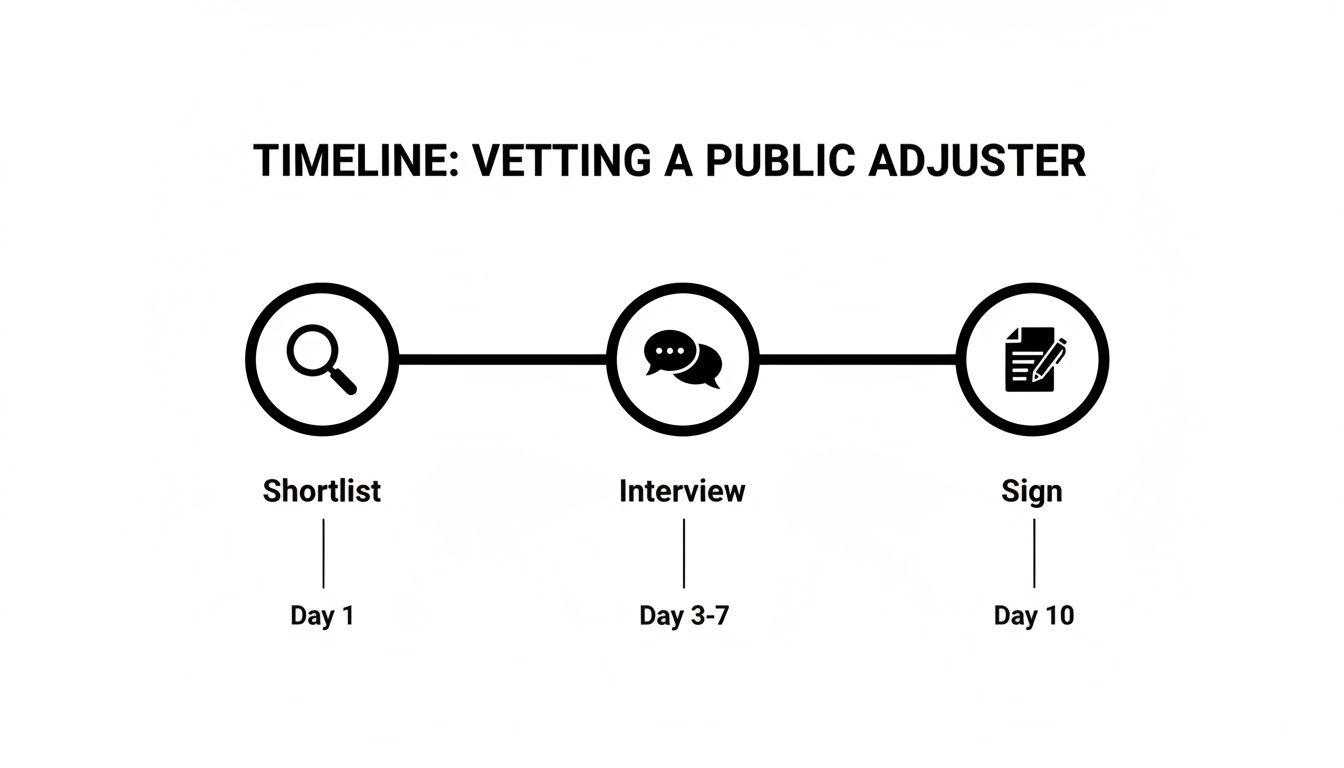
This simple timeline—shortlisting, interviewing, and signing—is your path to securing a professional advocate who can achieve these kinds of results.
The Negotiation: Pushing for a Fair Settlement
Once we’ve built this ironclad claim package, we formally submit it to your insurance company. This kicks off the negotiation phase. Their adjuster will almost certainly try to chip away at the total, but now they’re dealing with a seasoned professional who speaks their language, understands the tactics, and won’t be pushed around.
It's a stark reality of the industry: insurance adjusters are often juggling 150 to 200 claims at once. As highlighted in industry reports, this crushing workload inevitably leads to mistakes, oversights, and undervalued claims. You can discover more about these insurance claim trends to see why having a dedicated advocate is no longer a luxury—it’s a necessity.
We handle all the back-and-forth, counter-offers, and requests for clarification. We methodically defend every line item in our estimate until we secure a fair settlement agreement. Only when we’re confident the offer is correct will we review it with you for your final approval, bringing your claim to a successful close.
You can get a broader view of this entire journey by exploring our guide on the home insurance claim process.
Your Top Questions About Hiring a Public Adjuster, Answered
If you're thinking about hiring a public adjuster, you're bound to have questions. That's a good thing. It means you’re taking your property damage claim seriously, and you should be.
Over the years, we've had thousands of these conversations with homeowners and business owners across Oregon and Washington. Here are the honest answers to the questions we hear the most.
What Does a Public Adjuster Cost?
This is usually the first thing people ask, and it's simple: We work on a contingency fee basis.
That means you pay nothing upfront. No hourly billing, no surprise invoices. Our fee is a small, agreed-upon percentage of the final settlement we recover for you.
Our goals are your goals. If we don’t get you paid by your insurance company, we don’t get paid either. Simple as that.
This model lets you have an expert on your side without any financial risk. You get professional representation right when you're most vulnerable, and we're completely motivated to maximize your claim.
My Insurance Company Already Denied My Claim. Is It Too Late?
Absolutely not. A denial is often just the insurance company's opening bid, not the final word. They count on you giving up right there. Don't.
Bringing in a public adjuster after a denial is one of the most effective ways to fight back. We see it all the time. Our first step is to formally re-open the claim and put the insurer on notice.
From there, we get to work:
- We conduct our own deep-dive investigation, looking for the crucial evidence their adjuster conveniently missed.
- We scrutinize your policy, find the exact language that supports your claim, and build an airtight case.
- We challenge the carrier’s flimsy excuses for the denial with hard facts and expert reports.
A wrongful denial can almost always be overturned with the right expertise and pressure. Never take "no" for an answer without getting a second opinion.
Will Hiring an Adjuster Make My Claim Take Longer?
It’s a common concern, but the answer is usually no. In fact, having a professional running the show can often speed things up. We know how to cut through the insurance company's classic delay tactics—the endless requests for information, the unreturned phone calls, the lowball offers.
The timeline really depends on the situation. A straightforward pipe burst might be wrapped up in a few months. A catastrophic fire that guts a commercial building could take a year or more. It all hinges on the scale of the damage and how cooperative the insurance carrier decides to be.
Our role is to drive the process forward aggressively but without cutting corners. We keep the pressure on so you get a fair settlement as quickly as possible, not on the insurance company’s lazy timeline.
Is It Worth It for a "Small" Claim?
This is where you have to weigh the value. There isn’t a magic number, but a good rule of thumb is to seriously consider an adjuster for any claim that looks to be in the $10,000 to $20,000 range or more.
For something truly minor—like a single cracked window pane—the fee might not make sense. But be careful. Many claims that look small on the surface are hiding much bigger problems.
That "minor" roof leak? It could be quietly saturating your insulation and framing, setting the stage for a massive mold problem down the road. The real value of a public adjuster is our ability to spot these hidden and long-term damages, ensuring your settlement covers the entire cost of the repair, not just the cheap, cosmetic fix. A quick, free claim evaluation can tell you if it’s worth a closer look.
Feeling overwhelmed by your insurance claim is a sign that you need an advocate. At NW Claims Management, we bring clarity and expertise to property owners in Oregon and Washington. If you're ready to level the playing field, let our licensed public adjusters provide a free, no-obligation evaluation of your claim. Visit us at https://nwclaimsmanagement.com to get started.