You can have a clean commercial insurance package, pay your premiums on time, and still get the worst kind of surprise, a controller finds odd transfers, a bookkeeper vanishes, and the numbers keep climbing backward while everyone asks the same question, “Are we covered?” That's the moment most business owners discover the gap between having insurance coverage for employee theft and collecting on it. The policy language is where the fight starts, and the timing, the proof, and the form you bought decide whether the carrier pays or walks away.
Why Standard Property Insurance Will Not Cover Employee Theft
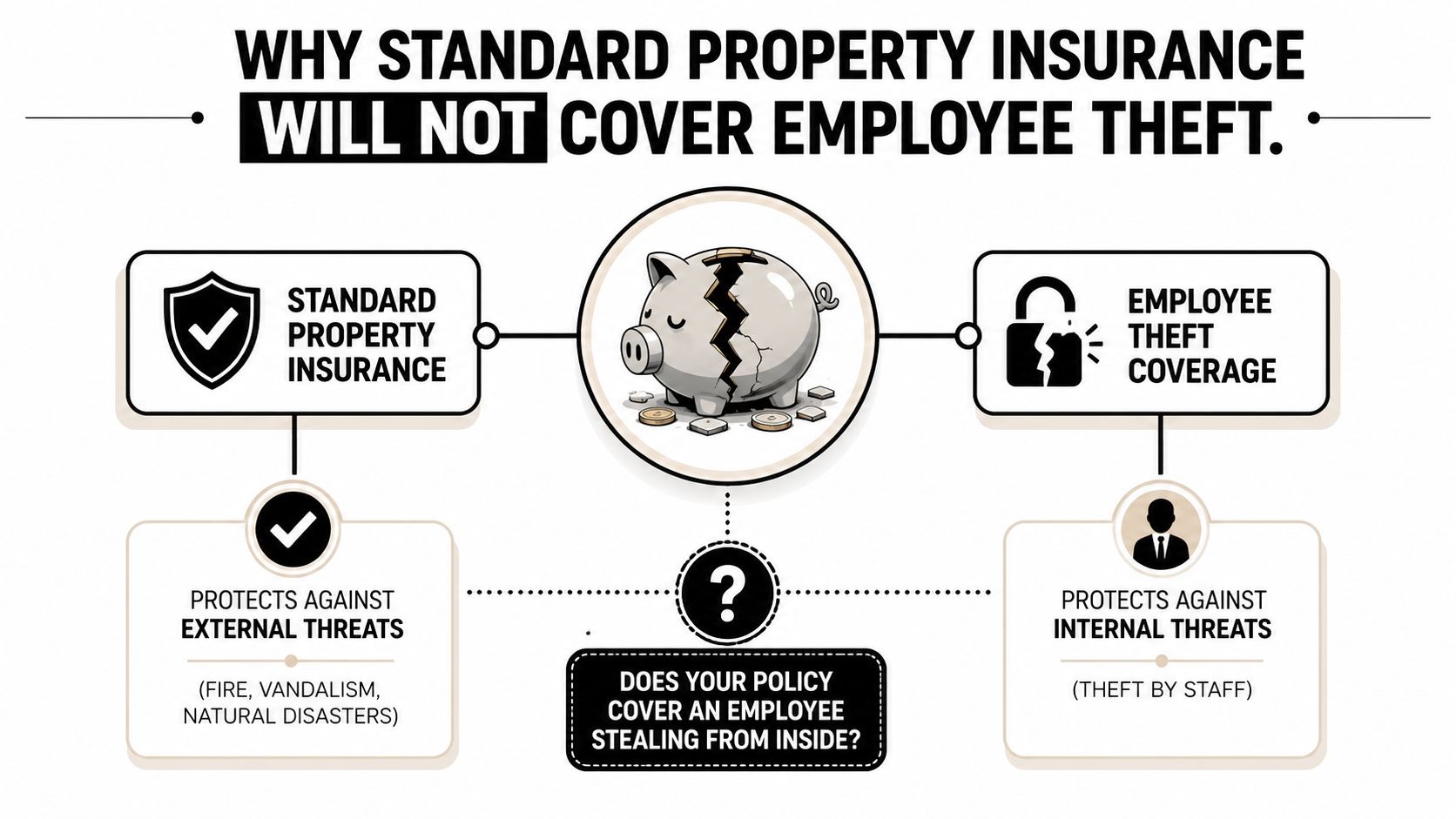
A business owner often starts with the property carrier because that is the policy already in hand. The adjuster usually asks a simple question first, whether the loss came from fire, vandalism, burglary, or a dishonest employee. Once the answer is employee theft, the claim usually falls outside standard property coverage, because standard commercial property insurance generally excludes losses caused by employees. That gap is why businesses need a separate crime or fidelity form for internal dishonesty, fraud, and embezzlement. For a direct look at the gap between what a policy seems to cover and what it pays, see this claims-focused overview.
A common loss that gets denied
A retailer notices cash shortages for months, then a controller finds manipulated deposits and missing inventory. The owner assumes the commercial property policy should treat it like any other theft loss. It does not, because property insurance is built for outside perils, not a trusted employee's dishonest acts.
That misunderstanding is expensive. Property insurance protects the building, stock, and equipment from fire, vandalism, and outside theft, while employee dishonesty coverage pays for money, securities, or tangible property taken by staff. A commercial crime form is the tool that responds to the direct financial loss caused by an employee acting alone or with others. One insurer source says employee theft coverage limits can range from $100,000 to $2.5 million with deductibles from $100 to $500,000. A separate detailed employee dishonesty guide gives a useful overview of how fidelity coverage is typically structured.
Practical rule: if the loss came from inside the business, do not start with property insurance and hope the carrier stretches the wording. Check whether you actually have a crime or fidelity form, then read the trigger language before you file.
What Employee Theft Coverage Actually Is
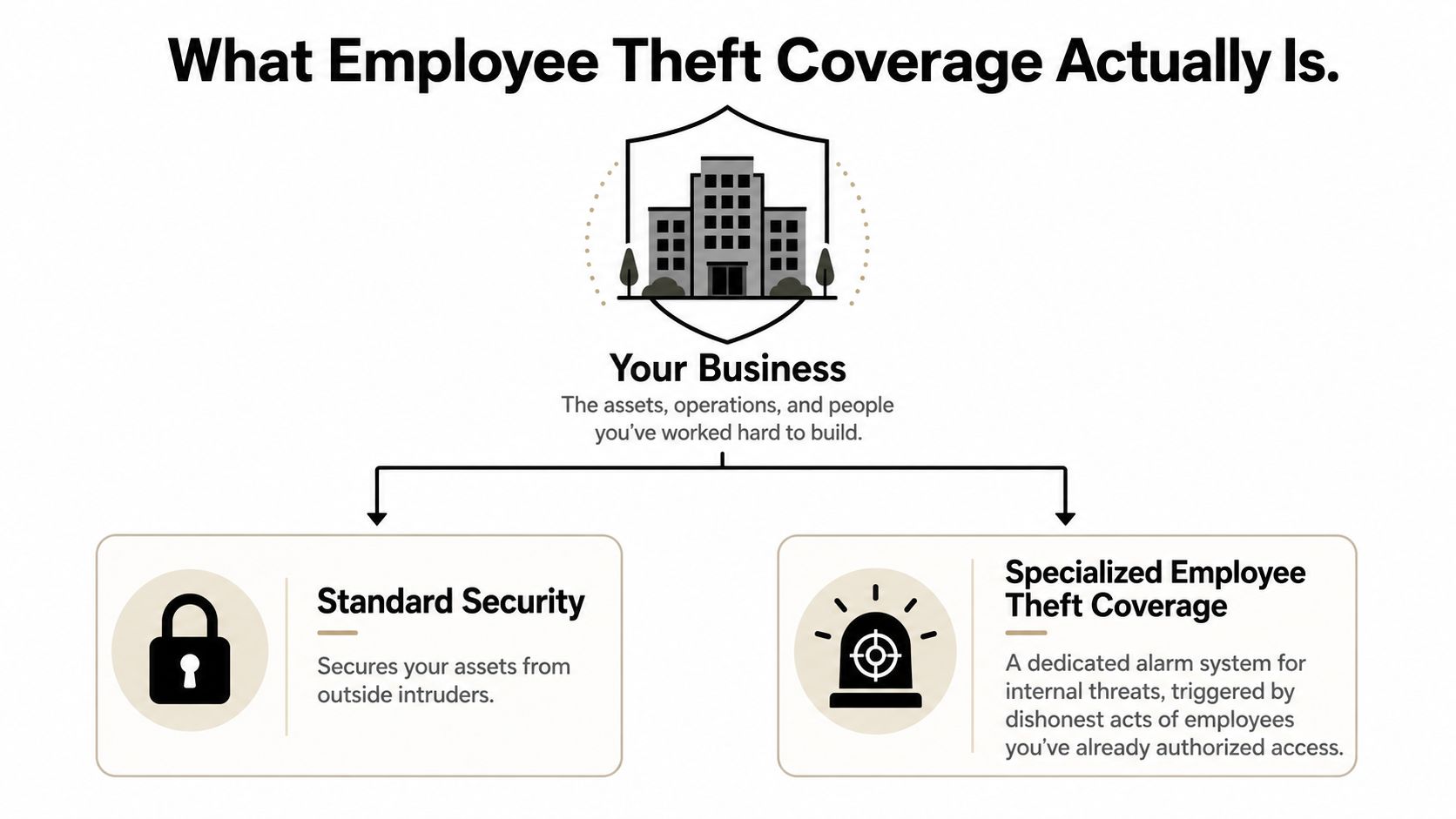
A company finds missing deposits, altered entries, and inventory that never left the stockroom. The loss did not come from a break-in or a storm. It came from someone inside the business using access, trust, and opportunity to steal.
What the policy is built to pay
Employee theft coverage pays for intentional, fraudulent, and dishonest acts by an employee that cause a direct financial loss to the business. That is the core promise. If the conduct was careless, sloppy, or merely a bad business decision, the claim usually falls outside the form.
The coverage is aimed at theft of money, securities, or tangible property, and many forms also address forged checks, altered records, or unauthorized transfers when those perils are included. It is first-party insurance, so the business is claiming for its own loss, not waiting on a third party to make it whole. That matters because employee theft rarely stays neatly inside one ledger, and crime forms are built to respond to the financial harm the business absorbs commercial crime policy guidance.
A claim succeeds or fails on the wording. The insurer wants proof of dishonesty and a covered form of loss, not a general story about poor controls or a manager who behaved badly. If the policy does not include the act that caused the loss, or if the loss is only indirect, payment gets cut down or denied.
Where business owners get tripped up
Owners often assume any theft by an employee is automatically covered. That is the wrong assumption. The policy does not pay for bad morale, customer anger, or damage to reputation, and it does not replace future profits that disappear after the theft is discovered employee dishonesty guide.
It also does not turn every internal accounting problem into an insurance claim. A bad reconciliation, a bookkeeping mistake, or weak supervision is not the same thing as a dishonest taking. The claim has to match the policy trigger, and the business has to prove what was stolen, how it was taken, and why the loss falls inside the coverage language.
Bottom line: employee theft coverage pays for dishonest taking and the direct loss tied to it. It does not fix every consequence that follows.
Commercial Crime Policies, Fidelity Bonds, and BOP Endorsements Compared
The right choice comes down to how much employee access really exists. If staff can touch cash, accounts payable, inventory adjustments, or bank transfers, the policy has to match that exposure. A small retail counter with one cashier needs a different setup from a company with payroll staff, AP clerks, and a controller. The market usually gives businesses three ways to buy this protection, a standalone commercial crime policy, a fidelity bond, or an employee dishonesty endorsement attached to a BOP.
Comparing the three ways to buy employee theft coverage
| Structure | Typical buyer | Common limit range | Best for | Key tradeoff |
|---|---|---|---|---|
| Standalone commercial crime policy | Businesses with meaningful internal exposure | Often much broader than basic endorsements, with limits that can reach $100,000 to $2.5 million in the market source | Companies that need stronger protection for embezzlement, forgery, and funds transfer fraud | Better protection usually means more underwriting detail |
| Fidelity bond | Smaller operations and some organizations that want a surety-style promise | Market varies by form, but it is usually built around a specific promised amount rather than broad coverage fidelity coverage overview | Owners who want a narrower, simpler structure for a defined employee risk | Can be narrower than a true crime policy |
| BOP endorsement | Small businesses buying convenience inside a package policy | Many BOP-style limits are only about $10,000 to $50,000 source | Basic internal theft protection with a simple insurance program | The limit is often too low for a real embezzlement loss |
Which one actually fits
A standalone commercial crime policy is the strongest option when several employees can move money, write checks, or change inventory records. It is built for businesses that need real internal theft protection, not a token limit buried inside a package form. A fidelity bond can work for a narrow risk, but it usually gives you a tighter promise and less flexibility than a true crime form. A BOP endorsement is acceptable only when the exposure is small, and too many owners mistake “included” for “enough.”
The limit issue is where claims get exposed. If an employee steals over time and hides the trail through book entries, payroll manipulation, or inventory shrinkage, a small sublimit disappears fast. A cheap endorsement looks fine at renewal and useless at claim time. That is why the lowest-cost option often becomes the most expensive one after a theft.
The underwriting differences matter just as much as the price. Standalone crime carriers usually ask for more detail because they are pricing real loss exposure, not just attaching a convenience endorsement. A fidelity bond may be easier to buy, but easier is not the same as better. A BOP endorsement is the quickest way to add a small layer of protection, and that is exactly where many owners stop too early.
If you want a claim to pay, the policy has to match the way money moves inside the business. It also has to be documented well enough to survive the proof-of-loss stage, which is where many theft claims stall. A good policy is only half the job. The other half is the paperwork, and that is where businesses often lose ground, as explained in this proof of loss guide.
Loss Discovered vs Loss Sustained and Other Trigger Rules
Claims get won or lost here. Two businesses can suffer the same embezzlement scheme and get completely different results because one policy is written on a loss discovered basis and the other on a loss sustained basis. One form cares about when the loss was found, the other cares about when it happened, and that difference is everything.
The timeline that decides payment
If an employee skims cash for 18 months before the controller catches it, the policy trigger may decide whether the entire scheme is covered or only part of it is. Industry guidance says a preferred crime policy often gives about a 1-year grace period to discover losses, while proof of loss may need to be filed within 120 days of discovery unless the insurer extends that deadline employee dishonest coverage timing. Separate guidance also notes that prior known losses are not covered, and the theft has to fall within the policy's trigger structure loss trigger guide.
The same theft can be paid under one form and excluded under another. Policy form drives the outcome more than the owner's sense of fairness.
The intent test the insurer will use
The carrier isn't just asking whether money left the business. It wants proof that the employee acted intentionally, fraudulently, and dishonestly, and that the employee intended to obtain a financial benefit other than normal wages or bonuses. That's why sloppy files, half-finished reconciliations, and delayed reporting hurt a claim. The insurer will use those gaps to argue the loss is unproven, outside the trigger, or discovered too late.
For the proof-of-loss deadline and related timing obligations, review this proof-of-loss guide.
The practical reading test
Look at your declarations page and the crime form wording. If it says loss discovered, the discovery date controls a lot of the analysis. If it says loss sustained, the policy period matters more, and late discovery can still miss coverage if the wrong period was in force.
Exclusions, Sublimits, and Endorsements That Quietly Shrink Your Coverage
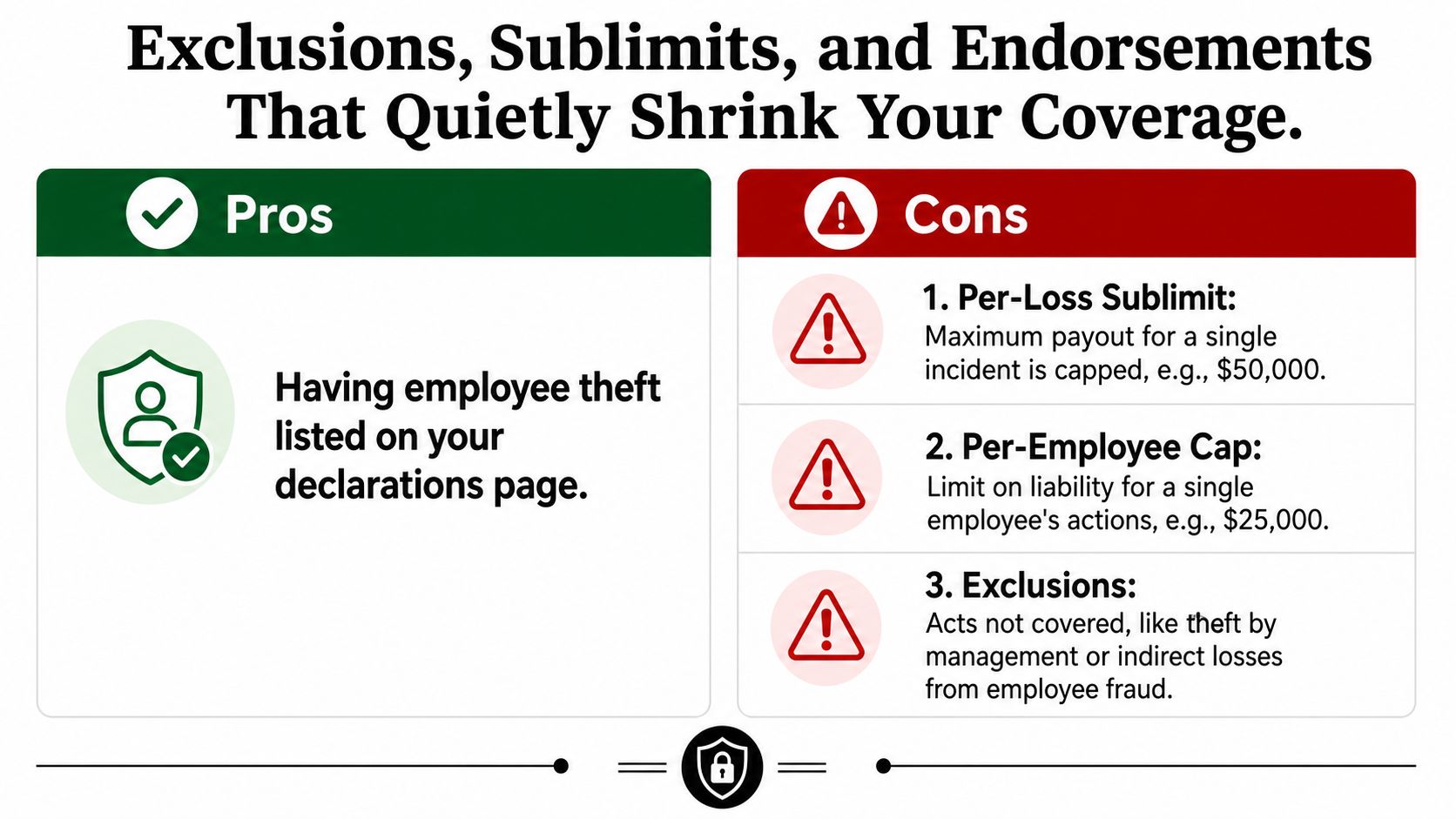
A declarations page that lists employee theft can still leave you underpaid. I see this mistake all the time. The policy looks like it responds to fraud, then the insurer points to a sublimit, a narrow definition, or an exclusion that knocks out the biggest part of the loss.
The clauses that shrink a claim
The most common trap is a per-loss sublimit. The form promises employee dishonesty coverage, then caps one incident at an amount far below the actual theft. Another common trap is a per-employee cap, which limits what the carrier pays for one person's conduct even when the scheme ran through several accounting periods. Exclusions for indirect loss, reputational harm, and lost future profit can also leave the business with only the stolen cash covered, while the operational fallout stays on the owner's balance sheet coverage limitations discussion.
BOP-style endorsements are where many owners get burned. One broker-facing comparison shows that many BOP policies carry only modest employee dishonesty limits limit comparison. That is coverage on paper, but for a long-running fraud it can amount to a partial payment that barely moves the needle.
The size of the limit matters as much as the grant of coverage itself. For a plain-English explanation of why that ceiling controls the recovery, use this limits guide.
Endorsements that actually matter
Some businesses need computer fraud, funds-transfer fraud, or ERISA-related protection for benefit-plan theft. Those endorsements do not fix every problem, but they close gaps the base theft wording often leaves open. Any company that moves money electronically should read those forms closely, because internal fraud rarely stays limited to paper checks anymore commercial crime policy guidance.
The claim file should show three things
- What was taken: money, property, securities, or another covered item.
- How it was taken: the dishonest act, not just the missing balance.
- When it was discovered: because discovery timing controls notice and proof deadlines.
Documenting and Proving a Theft Loss That Meets the Policy Trigger
Employee theft claims are documentation fights. If you can't prove the loss, the insurer will treat the claim as incomplete. The best-adjusted files I've seen had one thing in common, they were organized before the carrier ever asked for them.
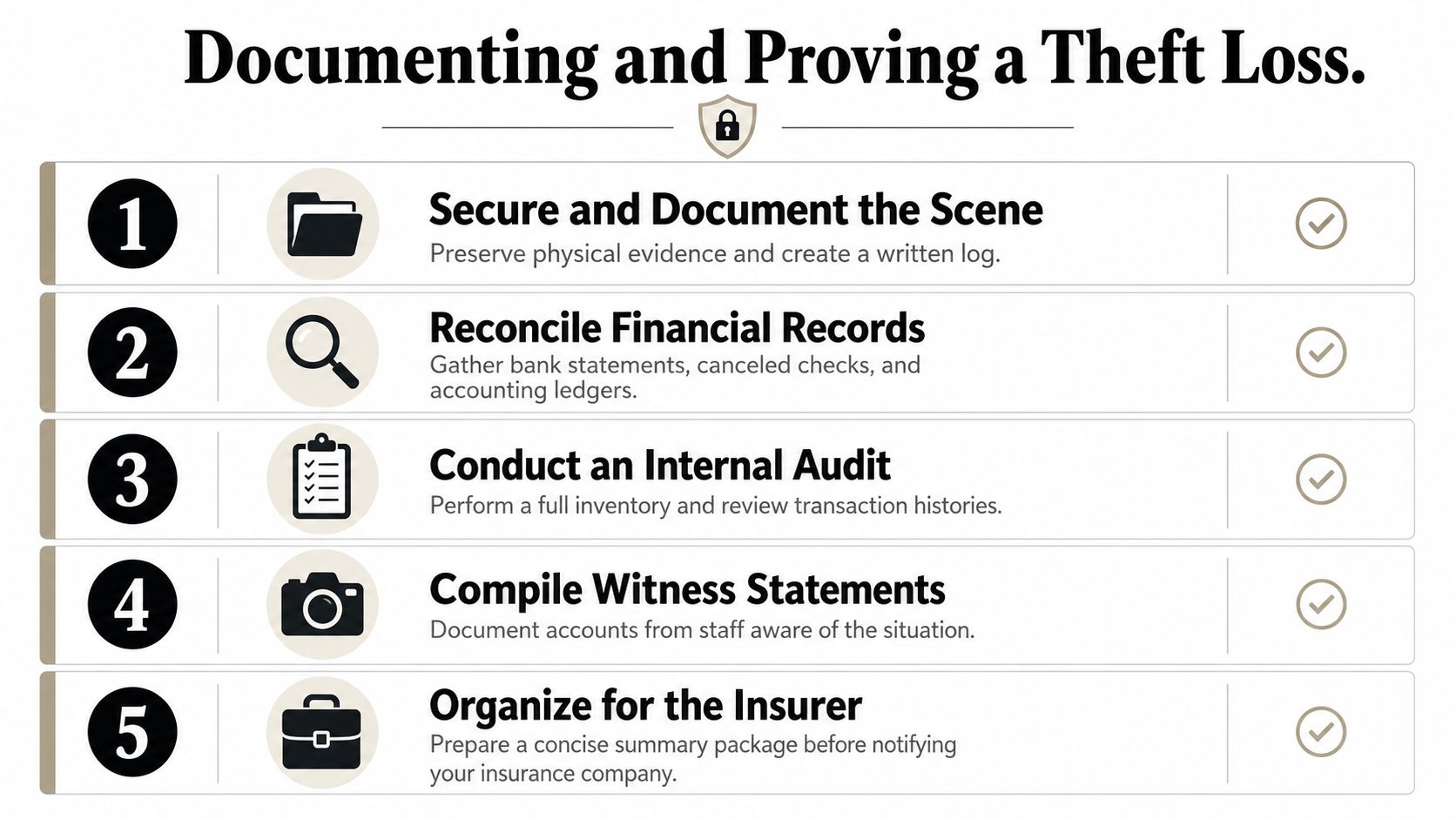
Build the loss package before you notify the insurer
Start with the financial trail. Pull reconciled bank statements, canceled checks, inventory records, payroll reports, and any forensic accounting work you already have. A clean timeline matters because the insurer will compare the suspected conduct against the policy's discovery or sustained trigger and look for any gap that lets it deny part of the loss.
Then preserve the evidence. Don't give the employee a chance to delete records, alter files, or backfill explanations. The more quickly you lock down the books, the easier it is to show the act was intentional, fraudulent, and dishonest, which is the standard the policy is built around forensic accounting resource.
Use outside records that strengthen the file
A police report can help, but it's not the whole claim. So can termination paperwork, a civil demand letter, and statements from staff who noticed unusual transfers, missing deposits, or altered ledgers. Those records support the chronology and make it harder for the insurer to argue the loss is just a bookkeeping problem.
Practical rule: if you're still debating whether to notify the carrier, the paper trail is already more valuable than the conversation with the suspect.
What a strong proof package looks like
- A short summary: who was involved, what happened, and when it was found.
- Supporting records: bank, inventory, ledger, and HR documents.
- A timeline: every key transaction tied to the suspected scheme.
- A clean demand: the amount claimed and how it was calculated.
Filing the Claim and Working the Settlement
Once the file is organized, the claim has to be submitted like a claim, not a complaint. Notify the carrier in writing, cooperate with the investigation, and file the sworn proof of loss on time. Miss the deadline, and you hand the insurer an easy defense.
The carrier will test your numbers
Expect requests for ledgers, bank records, emails, termination documents, and anything that supports the valuation. If the insurer challenges a transfer, a payroll entry, or the start date of the scheme, don't just accept its first number. Push back with transaction-level proof, because lowball valuations usually rest on a narrow reading of the loss period or an incomplete view of the records.
Negotiation matters here, and so does stamina. The claim may be assigned to a specialist or SIU-style investigator if the amount is material, which means every inconsistency gets examined. Keep answers tight, consistent, and supported by documents, not memory.
For a deeper look at claim negotiation strategy, see this negotiating guide.
When a public adjuster earns the fee
A public adjuster becomes useful when the carrier starts disputing coverage position, valuation, or timing. That's especially true when the claim involves multiple employees, layered transactions, or a long-running scheme that has to be reconstructed from partial records. At that point, the settlement isn't just about proving theft, it's about proving the amount the policy owes.
A weak claim file invites a weak settlement. A disciplined file forces the carrier to address the evidence instead of the narrative it prefers.
Prevention, Recovery, and Oregon and Washington Specific Considerations
The businesses that recover cleanly usually had controls in place before the loss. Separate duties so the same person can't create, approve, and reconcile the payment. Require dual approval on disbursements, run background checks on finance staff, and force mandatory vacations so someone else has to touch the books. Surprise audits also help because they shorten the life of a scheme and give the insurer less room to argue the loss was avoidable.
Recovery starts with control, not panic
If you suspect a theft, bring in outside eyes fast. That can mean a forensic accountant, outside counsel, or a private investigator who knows how to preserve records without contaminating the evidence. For that part of the response, business investigations can be useful as a reference point for what a structured fact-finding process looks like.
Oregon and Washington policyholders also need to pay attention to licensing and representation. If you're crossing state lines with operations, vendors, or locations, make sure the public adjuster is properly licensed where the claim is being handled. That detail matters more than most owners realize, because a technical licensing problem can create friction exactly when the file needs momentum.
When to escalate and when to stay hands-on
Handle a small, obvious loss internally if the records are clean and the carrier is cooperative. Escalate when the scheme is long-running, the policy language is restrictive, or the insurer starts leaning on the timing rules from the earlier section. That's when a licensed public adjuster can change the negotiation posture and keep the claim from being underpaid.
If you're dealing with suspected employee theft right now, stop guessing and get the records organized before the insurer does its own version of the story. Contact NW Claims Management for a claim review, especially if the loss is tied to a discovery-date dispute, a low sublimit, or a carrier that's already narrowing the payout.