You may be reading this while your home still smells like smoke, while fans are drying a soaked floor, or while a contractor is telling you one thing and your insurance company is telling you another. At that moment, most property owners in Oregon and Washington discover a hard truth. Filing a claim isn't just paperwork. It's a technical process with deadlines, policy language, damage documentation, pricing disputes, and people with titles that sound similar but mean very different things.
That confusion matters. A staff adjuster works for the insurance company. An independent adjuster is usually hired by the insurance company. A public adjuster works for you, the policyholder. If you're deciding whether to bring in help, a practical starting point is learning when to hire a public adjuster so you know whether your loss has reached the point where professional representation makes sense.
Once you start comparing adjusters, you'll see licenses, acronyms, course names, and promises of expertise. Some of those credentials matter a great deal. Some are just marketing language. If you're dealing with water damage, fire, storm damage, or a major commercial loss, understanding claim adjuster certifications can help you ask better questions and avoid handing a complicated claim to someone with only basic qualifications. If you want a homeowner-friendly overview of claim strategy, this guide on how to maximize your water damage settlement is also useful because it shows how documentation and timing shape the outcome long before the final payment is offered.
Navigating Your Claim with an Expert Guide
After a major property loss, most clients don't ask about certifications first. They ask, “Who can help me?” That's the right instinct, but the better second question is, “How do I know this person is qualified to help me with my kind of claim?”
A burst pipe in Portland, a wind-driven rain loss on the Washington coast, or a fire in a mixed-use building all create different claim problems. One loss may revolve around moisture mapping and drying records. Another may turn on code upgrades, structural valuation, and business interruption support. The adjuster you hire needs more than confidence. They need training that matches the work.
The titles sound similar, but the loyalties differ
The insurance world uses overlapping job titles, and that confuses property owners at the worst possible time.
- Staff adjuster: Works for the insurer and represents the insurer's interests.
- Independent adjuster: Often handles claims on behalf of insurers as an outside contractor.
- Public adjuster: Represents the policyholder and advocates for the policyholder's side of the claim.
That doesn't mean every insurance adjuster is unfair. It does mean their role isn't the same as yours.
When your claim involves policy interpretation, repair scope disputes, or underdocumented damage, representation matters as much as paperwork.
Why credentials become so important
When you've just suffered a loss, it's easy to judge by personality. If someone sounds experienced, many clients assume they are. But this field has a wide range of entry points, and credentials help separate legal permission to act from proven depth of knowledge.
That difference is where many claim mistakes begin. A licensed adjuster may be legally allowed to work. A certified adjuster has usually gone further by completing formal coursework and passing exams in claims handling, insurance law, or specialized subject matter. For a property owner, that can translate into better documentation, sharper policy analysis, and a cleaner negotiation record.
Licensing vs Certification The Fundamental Difference
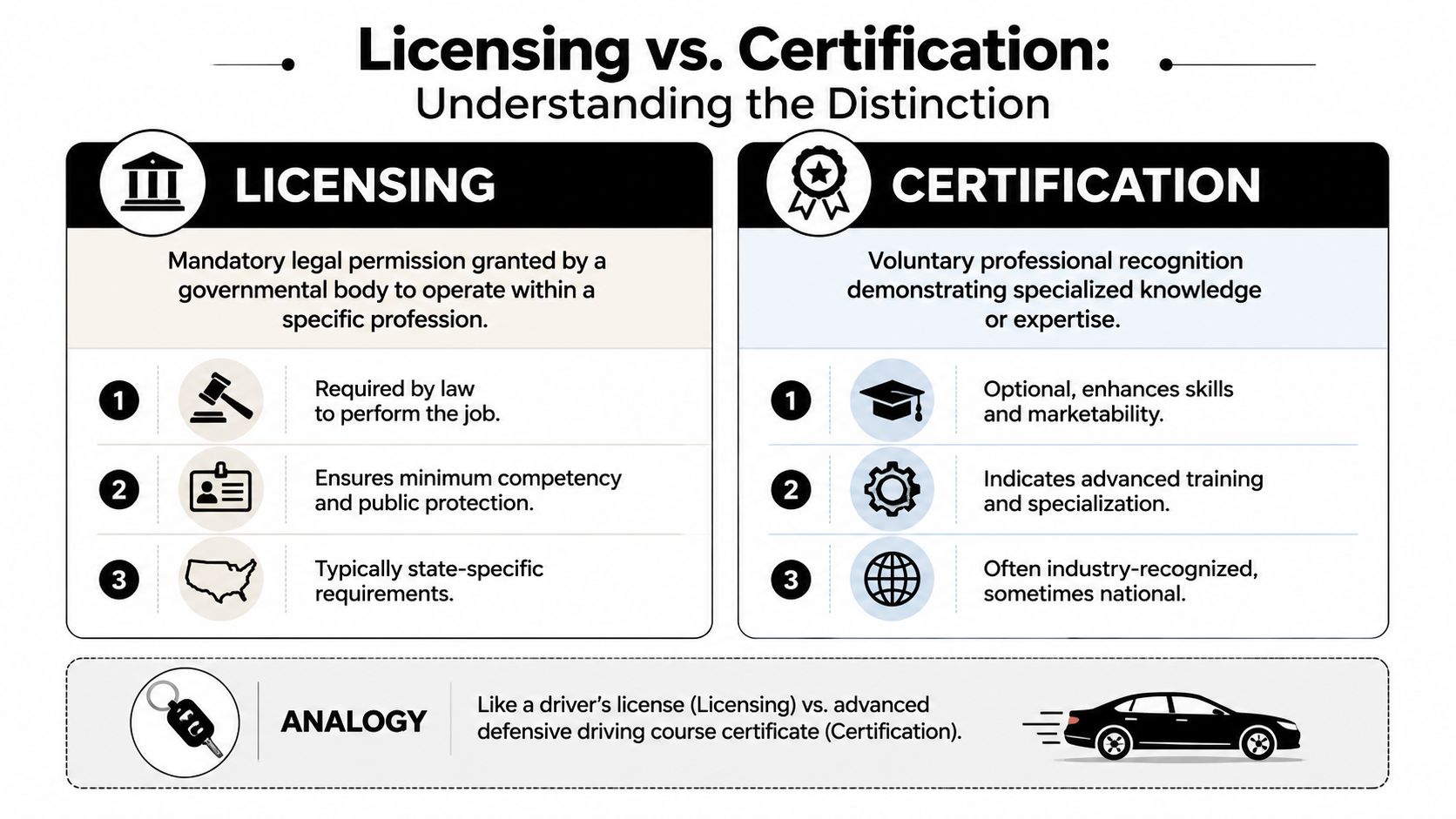
If you remember one idea from this article, remember this one. A license lets an adjuster legally do the job. A certification helps show how well they've studied the job.
Consider the driving analogy: A driver's license means the state says you can operate a vehicle. An advanced defensive driving certificate doesn't replace that license, but it tells you the driver has gone beyond the minimum. In property claims, both matter, but they do different jobs.
What a license tells you
A public adjuster's license is the baseline. It answers the first question a client should ask: “Is this person legally allowed to represent policyholders in my state?”
According to Kaplan, licensing and certification are operationally distinct, and in many jurisdictions adjusters must first satisfy state licensing rules before they can legally work claims. Kaplan also notes that some states require a license, may require a home-state exam, often impose continuing-education renewal requirements, and may use reciprocity or designated-home-state mechanisms that help adjusters work across multiple states without repeating every exam. That matters if your loss involves out-of-state issues, catastrophe deployment, or regional claim handling across state lines. You can review that framework in Kaplan's guide on how to become an insurance claims adjuster.
For a client, the practical takeaway is simple:
- License first: If an adjuster isn't properly licensed for the work they're doing, stop there.
- State compliance matters: Oregon and Washington work isn't something an adjuster should treat casually.
- Renewal matters too: An expired or inactive license can create problems you shouldn't inherit.
If you want to understand how adjusters typically enter the field before they build advanced expertise, NW Claims Management has a plain-language overview of insurance trainee positions.
What a certification tells you
Certification is different. It's usually voluntary and built around coursework plus examination. It doesn't grant legal authority by itself. It signals that the adjuster chose to invest in a structured body of knowledge.
That matters because property claims aren't just about measuring visible damage. A strong adjuster has to read coverage terms carefully, identify missing line items in an estimate, recognize when code-related costs may be in play, and organize claim support in a way that holds up under review.
Why clients should care about both
Some property owners hear “voluntary” and assume certification must be optional in the unimportant sense. It isn't. It's optional in the legal sense, but often meaningful in the professional sense.
Here's the cleanest way to think about it:
| Question you should ask | What answers it |
|---|---|
| Can this person legally represent me? | Licensing |
| Has this person pursued deeper professional training? | Certification |
| Can this person handle my type of property claim well? | Experience plus relevant certification |
| Can this person work compliantly in my jurisdiction? | Licensing status and state-specific knowledge |
Practical rule: Never hire based on certification alone. Never hire without confirming licensing first.
A Guide to Reputable Claim Adjuster Certifications
Once you know the difference between a license and a certification, the next challenge is the alphabet soup. Clients often see acronyms and have no idea what they mean for a real-world claim. The useful question isn't, “Which acronym sounds impressive?” It's, “What did this person study, and how could that help with my loss?”
Indeed reports that the Associate in Claims (AIC) is designed to teach how to handle various forms of insurance claims, while the Senior Claims Law Associate (SCLA) focuses on legal aspects of insurance claims. Indeed also notes that the Chartered Property Casualty Underwriter (CPCU) requires eight courses and eight exams in subjects such as risk management and business law, and that these programs are tied to exam-based standards and professional recognition. You can see those program descriptions in Indeed's overview of adjuster certifications.
Top claim adjuster certifications at a glance
| Credential | Governing Body | Primary Focus | Best For Your Claim If… |
|---|---|---|---|
| AIC | The Institutes | Claims handling across different claim types | You want someone trained in the nuts and bolts of investigating, documenting, evaluating, and moving a claim properly |
| SCLA | The Institutes | Legal issues in insurance claims | Your dispute involves policy interpretation, liability questions, or arguments over legal obligations |
| CPCU | The Institutes | Broad property-casualty insurance knowledge, risk management, and business law | Your loss is large, layered, commercial, or complicated enough that broad insurance knowledge really matters |
| CACP | WebCE program | Claims education tied to exam-based completion and, in some cases, licensing pathways | You want evidence of formal training tied closely to practical adjuster entry and compliance considerations |
AIC and why many property owners should pay attention to it
The AIC is one of the clearest claim-focused credentials because it's centered on claims handling itself. For a homeowner, that matters more than a vague “expert” label.
An AIC-holder should understand the claim process as a system. That includes documentation, investigation, communication, and evaluation. If your home has water damage behind walls, smoke contamination in multiple rooms, or partial roof damage that affects interior finishes, a process-oriented adjuster is less likely to miss how one damage category affects another.
SCLA and when legal knowledge matters more than people expect
Clients often assume legal complexity only shows up in lawsuits. In reality, legal concepts appear much earlier. They show up in policy interpretation, reservation of rights letters, time limits, causation arguments, and disputes over what part of a loss is covered.
That's where the SCLA can be valuable. An adjuster with deeper claims-law training may be better prepared to spot where the disagreement is really happening. Is the insurer denying the whole loss? Or agreeing there was damage, but disputing which cause triggered coverage? Those are very different problems.
CPCU and the value of broad insurance knowledge
The CPCU is often respected because it covers a wide body of insurance knowledge. Since Indeed notes that it requires eight courses and eight exams, it signals serious study rather than a casual weekend credential.
For clients, CPCU knowledge tends to matter most when the claim is bigger or more layered:
- Commercial property claims: Leases, operations, and multiple decision-makers can complicate the file.
- Nonprofit or institutional claims: Mission-critical buildings often involve unusual usage and recovery pressures.
- Losses with overlapping issues: Structural damage, ordinance concerns, contents, and interruption of operations may all need to be organized together.
Certification tied to estimating and documentation
Not every useful credential is a classic designation. Some training is software-specific and directly affects estimate quality. If your adjuster uses Xactimate to scope and price repairs, competence in that tool matters because line-item structure, category selection, and supporting detail can shape how the insurer responds. If you want to understand how software training fits into claim preparation, NW Claims Management has a practical page on Verisk Xactimate training.
A polished estimate isn't just about a final total. It's about whether every damaged component, repair step, and supporting note is organized in a way the claim file can withstand scrutiny.
How to read credentials without getting dazzled
A credential is useful when you can connect it to a claim need.
Ask questions like these:
- “What did this certification train you to do better?”
- “How does that help on a fire claim versus a water claim?”
- “Is this broad insurance training or claim-specific training?”
- “Do you use that training in estimating, policy review, or negotiation?”
Those questions usually lead to clearer answers than “What certifications do you have?”
The Path to Earning Professional Adjuster Credentials
A serious credential usually represents months of disciplined work, not just a registration form. That's worth understanding because it changes how you read a business card. When you see a respected designation, you're not just seeing letters after a name. You're seeing evidence that the adjuster sat down, studied difficult material, and passed exams designed to test whether they learned it.
The Institutes' AIC program is a good example. The Institutes states that the AIC is delivered as 100% online learning and includes videos, practice quizzes, flash cards, a simulated credentialing exam, and specialty tracks in property, liability, workers compensation, and auto. The same source explains why specialization matters. Property damage work involves skills like structural valuation and code-upgrade analysis that differ from liability work. You can review that structure on The Institutes' page for claims education programs.
What the learning path usually looks like
An adjuster pursuing respected credentials typically moves through a sequence like this:
Core study
They learn policy language, claim investigation, documentation standards, and the logic behind coverage analysis.Specialization
They focus on a domain such as property claims, where damage assessment and repair scoping are central.Examination
They complete formal testing. That's the checkpoint that separates “attended material” from “mastered material.”Ongoing maintenance
They keep learning through continuing education and professional development.
Why specialization helps your property claim
If your loss is property-related, broad insurance knowledge helps, but claim-specific property training is often where the daily work gets better. An adjuster handling a major water loss has to understand more than wet drywall. They need to know how flooring assemblies, insulation, cabinetry, trim, and hidden moisture can affect the full scope. If code upgrades or rebuilding standards are in play, the file gets more technical.
That's why specialty tracks matter. They indicate the adjuster didn't stop at generic claims education.
Clients often assume experience alone is enough. Experience matters. But experience plus tested study is usually more reliable than experience that was never formally sharpened.
If you want a closer look at how adjusters build those technical foundations, NW Claims Management provides an overview of claims adjuster training.
Public Adjuster Licensing in Oregon and Washington
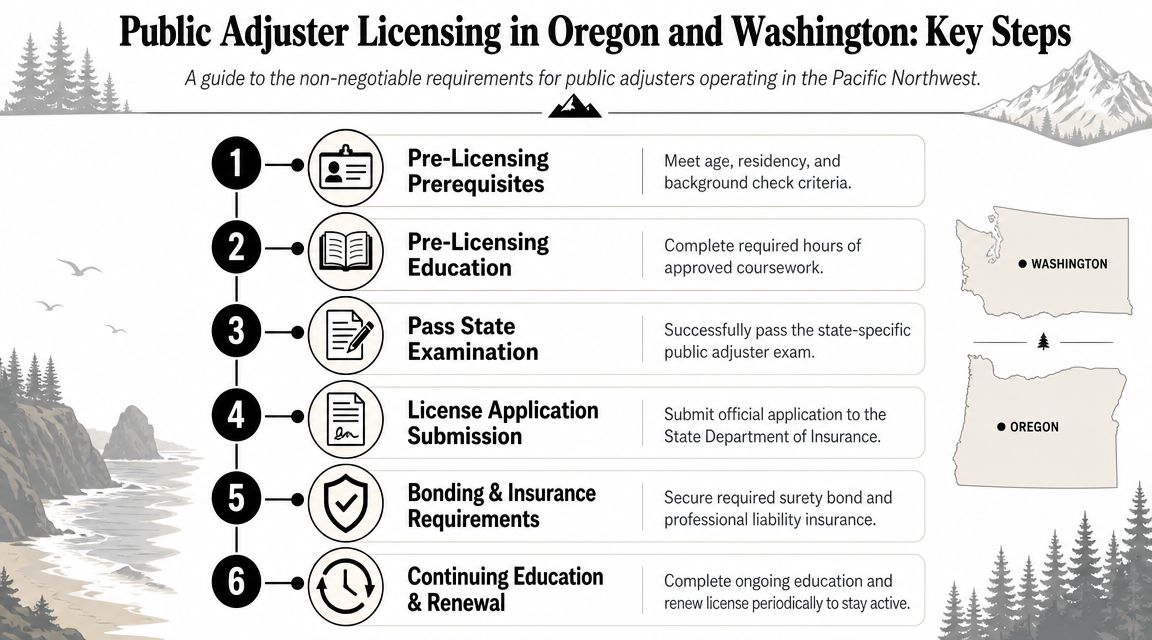
For Oregon and Washington property owners, licensing isn't a nice extra. It's the compliance checkpoint that protects you from hiring someone who shouldn't be handling your claim in the first place.
The broader profession is large. The U.S. Bureau of Labor Statistics reports 365,300 jobs for claims adjusters, examiners, and investigators in the United States as of May 2024, and notes that the field includes roles where some positions require only a high school diploma while others prefer a bachelor's degree or insurance-related experience. In a field that large and varied, state-specific licensing and professional credentials become important ways to distinguish baseline eligibility from deeper expertise. You can review that occupational profile at the Bureau of Labor Statistics page for claims adjusters, appraisers, examiners, and investigators.
What compliance means from a client's side
Most clients don't need to memorize licensing law. They do need to understand what licensing is supposed to accomplish. It creates accountability. It ties the adjuster to state rules, renewal obligations, and professional requirements that aren't optional.
When a public adjuster is properly licensed for Oregon or Washington work, that tells you the person is operating inside a legal framework. That matters when your claim file includes sensitive documents, time-sensitive decisions, and negotiations that may affect a large portion of your recovery.
The practical checkpoints to verify
Even if you never want to think about licensing again after this article, verify these basics before signing anything:
- License status: Confirm the public adjuster is licensed for the jurisdiction where your property claim is being handled.
- Current standing: Make sure the license is active, not lapsed or inactive.
- Identity match: The name on the contract should match the licensed individual or properly authorized firm.
- Role clarity: Know whether the person speaking with you is the licensed adjuster, a trainee, or support staff.
Why Oregon and Washington owners should be especially careful
Pacific Northwest claims often involve weather-driven water intrusion, fire losses, roof issues, and commercial or nonprofit properties with complex restoration needs. Those aren't claims where you want loose compliance. If an adjuster is careless with licensing, clients have reason to worry about how careful that person will be with deadlines, estimate revisions, documentation, and policy terms.
A compliant public adjuster should also understand the operational side of multi-state work. That includes how state rules, renewal cycles, and legal authority affect claim handling continuity.
Questions worth asking before you sign
Use plain questions. You don't need industry jargon.
- “Are you licensed to act as a public adjuster for my Oregon or Washington claim?”
- “Who on my file holds the license?”
- “If my claim develops into a more complex dispute, who handles that work?”
- “How do you stay current on renewal and continuing-education requirements?”
Those questions are not confrontational. They're responsible.
What Certifications Mean for Your Insurance Claim
Credentials only matter if they improve the actual handling of your claim. That's the standard clients should use. Not whether the letters look impressive. Not whether the adjuster sounds polished. The question is whether those certifications help produce a more complete, more defensible, and better organized insurance claim.
Better reading of policy language
Certified adjusters often have stronger formal training in how claims fit inside policy language. That matters because many disputes are not about whether damage exists. They're about how the damage is categorized, what coverage applies, what limits or exclusions are implicated, and what supporting proof the insurer expects.
A well-trained adjuster is more likely to catch issues like:
- Incomplete scope framing: Damage to one area may require work in connected areas.
- Coverage misunderstanding: The insurer's first framing of the loss may not be the only reasonable one.
- Documentation gaps: A valid claim can still struggle if the support is thin or disorganized.
Stronger estimates and cleaner support
On a property claim, numbers don't stand alone. Every estimate depends on scope, measurements, line items, pricing logic, photographs, notes, and supporting records. Certification doesn't guarantee perfection, but it often correlates with a more disciplined process.
That can reduce a lot of friction for the client. Instead of reacting to every insurer question one piece at a time, the adjuster can build a file that anticipates common objections.
A better claim presentation doesn't create coverage that isn't there. It helps ensure covered damage is documented and argued properly.
Better negotiation under pressure
Negotiation in claims isn't just persuasion. It's documentation plus reasoning. The adjuster has to explain why a repair method belongs, why omitted line items should be added, why a valuation should change, or why a denial rationale doesn't fit the facts as cleanly as the insurer suggests.
That's one reason many policyholders seek out claim adjuster certifications when comparing representation. The certifications themselves don't pay the claim. The underlying training can improve how the adjuster builds the case.
If you're trying to understand the homeowner side of negotiation, this guide on how to secure a fair insurance payout offers practical context on where claim discussions often go wrong.
Lower stress through a more orderly process
A certified adjuster may also help in a way clients don't think about until they've lived through it. They can reduce chaos. They know what information is likely to matter, what order to assemble it in, and how to keep the claim from becoming a pile of disconnected documents and half-answered emails.
For property owners comparing help options, one practical resource is this explanation of the benefits of hiring a public adjuster, which focuses on what representation changes in the day-to-day life of a claim.
The NW Claims Management Advantage Our Credentials at Work
For Oregon and Washington clients, credentials become meaningful when they show up in the file itself. That means licensed representation, policy analysis, careful damage documentation, and structured negotiation.
NW Claims Management is a licensed public adjusting firm serving property owners in Oregon and Washington. According to the publisher information provided for this article, the firm operates under Oregon and Washington public adjuster licenses and works on residential, commercial, and nonprofit claims. The same background information states that its certified adjusters draw on more than two decades of industry experience to interpret policy language, assess structural damage, document losses, and negotiate settlements.
For a property owner, the practical value is straightforward.
What those qualifications look like in real claim work
- Licensed compliance: Your representation is tied to the states where your claim is being handled.
- Claim-focused advocacy: The firm represents policyholders rather than insurers.
- Property-claim capability: Structural damage review, loss documentation, and settlement negotiation are central parts of the work.
- Range of claim types: Residential, commercial, and nonprofit property owners often face different documentation and recovery challenges.
That combination is often what clients are looking for when they search for claim adjuster certifications. They don't just want credentials on paper. They want someone whose training and legal status match the complexity of the loss in front of them.
A calm standard for evaluating any firm
Whether you speak with this firm or another one, use the same checklist:
- Confirm licensing in your state
- Ask what certifications are relevant to your claim type
- Ask who will manage your file
- Ask how damages, estimates, and policy issues will be documented
If the answers are clear, specific, and easy to understand, that's usually a good sign. If the answers are vague, rushed, or overly sales-driven, keep looking.
Frequently Asked Questions About Adjuster Credentials
Does a certified adjuster cost more than a non-certified one
Sometimes the better question is whether the adjuster is qualified enough for the claim you have. If your loss is small and straightforward, advanced credentials may matter less. If your loss is large, disputed, technical, or disruptive to your home or business, deeper training can be worth far more than the difference you were focused on.
What's the single most important credential to look for
For a public adjuster, the first requirement is an active license for the work being performed in your state. After that, look for certifications that match property claims rather than generic insurance language. The most useful credential depends on the problem. A claim-handling credential helps if the file is documentation-heavy. A law-focused credential helps if coverage interpretation is becoming the issue.
How can I verify an adjuster's license and certifications in Oregon or Washington
Start by asking for the adjuster's full legal name and license details. Then verify licensing through the appropriate state regulatory channel. For certifications, ask which organization issued the credential and what it covered. A reputable adjuster should be able to explain both in plain language.
Should I choose the person with the most letters after their name
Not automatically. Credentials are helpful, but they aren't the whole picture. You're looking for the right combination of licensing, relevant training, property-claim experience, and clear communication. If an adjuster can't clearly explain your claim issues, the credential list alone won't help much.
If my insurer already assigned an adjuster, why would I need another one
Because that adjuster represents the insurer's side of the process. If you want your own advocate, you're looking for a licensed public adjuster. The need becomes more obvious when the loss is large, the estimate feels incomplete, the insurer's scope seems too narrow, or you lack the time to manage the claim well on your own.
If you're dealing with a property loss in Oregon or Washington and want help understanding your options, NW Claims Management offers public adjusting services for residential, commercial, and nonprofit claims. A careful review of your policy, damage documentation, and claim status can help you decide whether professional representation fits your situation.