So, you're thinking about a career as an auto damage adjuster. It's a role that often gets simplified, but it’s far more than just looking at crumpled fenders. At its core, this job is about combining deep technical vehicle knowledge with real people skills to help policyholders navigate the often-stressful aftermath of an accident. You're not just an evaluator; you're a problem-solver.
What the Role of an Auto Damage Adjuster Is Really Like
Forget what you've seen on TV. The day-to-day reality of an auto damage adjuster is a dynamic mix of fieldwork, sharp analysis, and genuine human connection. You’re part detective, part mechanic, and part counselor, all rolled into one.
One morning, you might be crouched in a sun-baked parking lot, assessing hail damage across a dozen cars. The next afternoon, you could be in an auto body shop, deep in a technical conversation with a mechanic about repair methods, making sure everything aligns with industry standards. Your main job is to figure out the full extent of the loss and put an accurate dollar value on the claim.
A Blend of Technical and People Skills
To really succeed as an auto damage adjuster, you have to master the art of balancing technical know-how with genuine empathy. Policyholders are usually stressed and uncertain after an accident. Your calm, professional guidance can completely change their experience for the better. You become the face of the claims process for them.
This means you'll be juggling several key duties:
- Investigating the incident: This involves piecing together the story by gathering statements, poring over police reports, and examining the accident scene.
- Assessing vehicle damage: You’ll use your training and specialized software to write up a detailed and precise repair estimate.
- Making critical decisions: You'll be the one to determine if a vehicle is repairable or if it needs to be declared a total loss—a decision that has huge financial weight.
- Negotiating with repair facilities: It's your job to ensure repair costs are fair and that the work is done right.
- Documenting everything: You’ll build a rock-solid claim file that clearly justifies your decisions and the final settlement amount.
Industry Growth and Job Stability
The demand for skilled adjusters is on the rise. In fact, the Claims Adjusting industry is projected to hit $14.6 billion in revenue in 2025, fueled by an impressive 9.6% annual growth rate. This isn't surprising when you consider the increase in major weather events and the ever-growing complexity of modern cars.
The U.S. Bureau of Labor Statistics data paints a clear picture of a stable career with steady demand.

This points to a reliable profession, whether you're just starting out or looking for a long-term path. While many adjusters work directly for insurance companies, others become public adjusters, who advocate for the policyholder. To get a better feel for these paths, it's worth reading about the differences between a public adjuster vs an insurance adjuster.
The heart of the job is this: You bring order to chaos. By meticulously documenting damage and communicating clearly, you help people move forward after a stressful event. It's a challenging but deeply rewarding career.
The Skills That Set Successful Adjusters Apart
A love for cars is a great starting point, but to truly excel as an auto damage adjuster, you need a specific blend of technical expertise and people skills. In my experience, the best adjusters aren't just a walking encyclopedia of vehicle parts—they're master communicators and problem-solvers.
It's one thing to know what a quarter panel is. It's another to spot subtle frame damage that an initial walk-around might miss, especially with today's vehicles. Cars are packed with complex sensors and advanced driver-assistance systems (ADAS), and a seemingly minor fender-bender can easily disrupt these delicate electronics. A top adjuster sees beyond the cosmetic damage.
Core Technical Abilities
Your credibility starts with your technical know-how. This is the foundation you'll build every claim on, so it has to be rock-solid.
Sharp Damage Analysis: You need to develop an eye for how impact energy travels through a vehicle's structure. It's about looking at a crumpled bumper and knowing to check for hidden damage to the unibody frame or radiator support.
Estimating Software Fluency: You have to be completely comfortable in software like CCC ONE or Mitchell. These platforms are the language of the auto repair industry, and your ability to write a detailed, accurate estimate is non-negotiable.
Modern Vehicle Construction Knowledge: Do you know the difference between repairing high-strength steel versus aluminum or composites? You must, because approving the correct repair procedures is crucial for both safety and cost.
The Soft Skills That Win Claims
While your technical skills get you in the door, your people skills are what will define your career. You're stepping into people's lives during a moment of high stress, and how you handle that interaction can make or break the entire experience. The best adjusters I've worked with are a unique combination of empathetic listener and firm negotiator.
A great adjuster is a master of communication. They can explain a complex total loss valuation to a distressed policyholder with genuine empathy, then pivot to a firm, fact-based negotiation with a seasoned body shop manager moments later.
This ability to wear two hats is what separates the good from the great. The key is blending strong analytical thinking with genuine empathy and sharp negotiation tactics.
If you really want to get a leg up, focus on honing your ability to negotiate. Understanding the key strategies for negotiating with an insurance company is an absolute game-changer. That mix of compassion and resolve is what allows a top-tier adjuster to close claims fairly and efficiently for everyone involved.
Getting Licensed as an Adjuster in Oregon and Washington
Before you can land a professional auto damage adjuster job, you need a license. Think of it as your official credential—the state’s way of verifying you have the foundational knowledge to handle claims professionally and ethically. It’s your ticket to play.
The process for getting licensed isn't the same everywhere. While the core skills of a great adjuster are universal, the specific hoops you need to jump through differ between Oregon and Washington. We’ll break down exactly what you need to do for each.
At the end of the day, licensing and training are all about building three essential skills: technical know-how, genuine empathy for the policyholder, and sharp negotiation tactics.
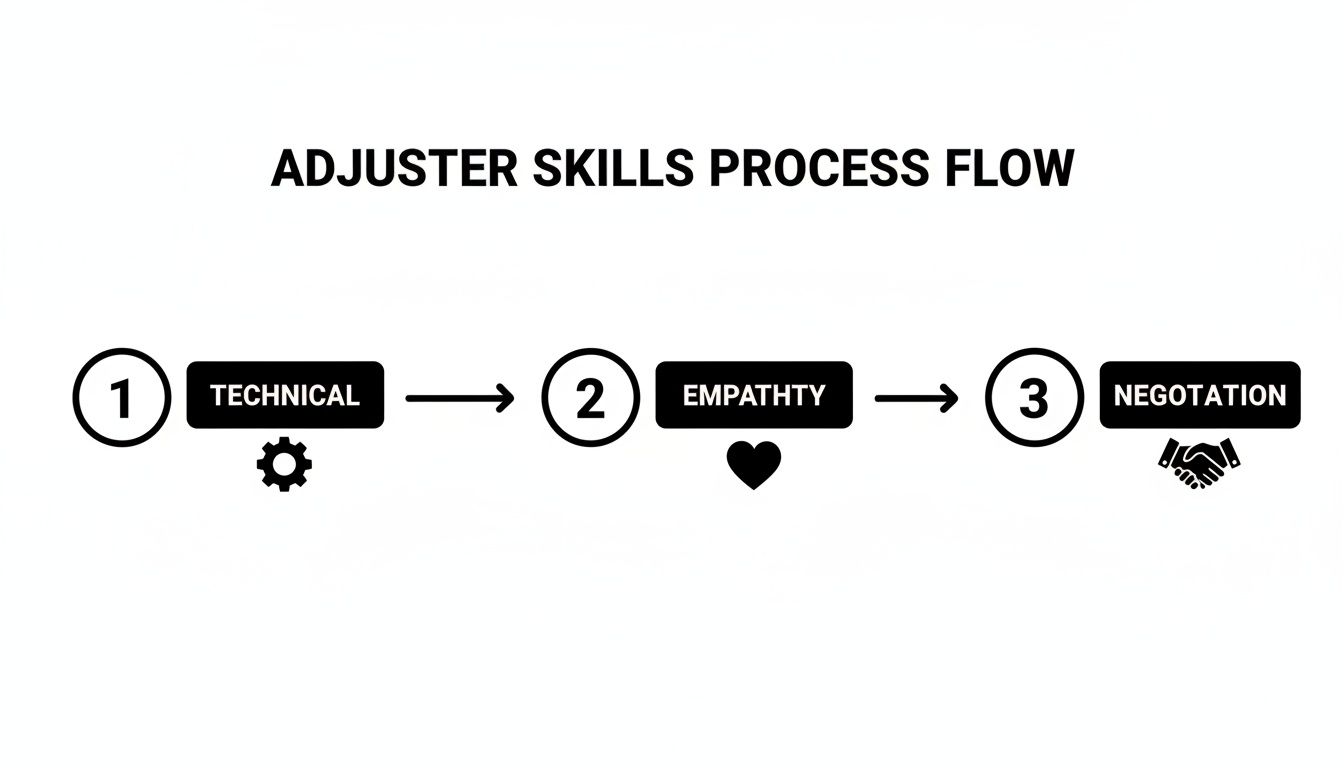
As you can see, the job is a constant balancing act. You need to understand the mechanics of a vehicle's damage just as well as you understand the person who owns it.
Oregon vs Washington Adjuster Licensing at a Glance
Navigating state requirements can feel a little overwhelming at first. To make it easier, here’s a side-by-side look at what it takes to get your independent adjuster license in Oregon versus Washington. It helps to see the key differences in one place.
| Requirement | Oregon (Independent Adjuster) | Washington (Independent Adjuster) |
|---|---|---|
| Pre-Licensing Education | Mandatory. Must complete a 20-hour Oregon-approved course. | Not mandatory, but highly recommended. You can go straight to the exam if you feel prepared. |
| State Exam | Required. Must pass the state exam after completing the pre-licensing course. | Required. Must pass the Washington state exam. |
| Application Process | Submit your application and background check through the National Insurance Producer Registry (NIPR). | Submit your application and fingerprints for a background check through the state's portal. |
| Continuing Education (CE) | 24 hours every two years, including 3 hours of ethics. | 24 hours every two years, including 3 hours of ethics. |
As you can see, both states take ongoing education seriously, but Oregon has a stricter upfront requirement with its mandatory pre-licensing course. Washington gives you a bit more flexibility, but most people find an exam prep course is essential for passing on the first try.
Your Path to an Oregon Adjuster License
In Oregon, the path is very structured. The state wants to ensure you have a solid foundation before you even sit for the exam.
First, you’ll need to enroll in and complete an approved 20-hour General Lines Adjuster pre-licensing course. This isn't just a formality; it covers the fine print of insurance policies, state laws, and ethical conduct you'll need on the job.
Once your course is done, you can schedule and take the Oregon Adjuster exam. After you pass, the final step is submitting your official application through the NIPR website, which also initiates your background check.
Don’t forget about upkeep. In Oregon, your license must be renewed every two years, which requires completing 24 hours of continuing education, with at least three of those hours focused on ethics.
Washington State Licensing Requirements
Washington offers a more direct route. There’s no state-mandated pre-licensing course, so you could technically just sign up for the exam.
However, that’s a risky move. Most successful candidates invest in a good exam prep course. These programs are designed to teach you exactly what’s on the test, which is the fastest way to a passing score.
After you pass the Washington Adjuster exam, you'll need to get your fingerprints taken for a background check. From there, you just submit your application through the state's online licensing portal, and you’re on your way.
Beyond the License: Certifications That Boost Your Career
Your state license gets your foot in the door, but professional certifications are what help you climb the ladder. They signal to employers like us that you’re serious about your craft and have gone the extra mile.
Pursuing advanced credentials can directly impact your earning potential and open up opportunities for more complex, senior-level roles.
Here are a couple of the most respected ones in the industry:
- Associate in Claims (AIC): This designation proves you have a deep, well-rounded understanding of the entire claims lifecycle.
- Chartered Property Casualty Underwriter (CPCU): Often considered the gold standard in the insurance world, the CPCU shows comprehensive expertise across property and casualty insurance.
Earning these shows a commitment that makes you stand out, especially when applying for competitive auto damage adjuster jobs at firms that prize deep industry knowledge.
What to Expect for Salary and Job Prospects
Let's talk about what really matters: how much can you make as an auto damage adjuster, and what does the job market actually look like? It's one thing to get licensed, but you need to know if the career path is financially sound.
Your paycheck isn't just a number pulled from a hat. It's a direct reflection of your expertise, your location, and how you're employed.
Right out of the gate, newly licensed adjusters can typically expect to start in the $45,000 to $55,000 range. But that’s just the starting line. Once you get a few years of real-world experience, that number can jump significantly. I've seen many seasoned adjusters who are sharp negotiators and can spot complex, hidden damage easily clear $75,000 or more, especially in higher cost-of-living areas like Oregon and Washington.
What Pushes Your Salary Higher?
Where you work is one of the biggest levers on your paycheck. An adjuster based in a major metro area like Portland or Seattle will almost always command a higher salary than someone in a more rural part of the Pacific Northwest. It’s a simple matter of claim volume and higher repair costs in the city.
Beyond geography, a few other key things will really move the needle on your earnings:
- Experience Level: New adjusters are paid to learn the ropes. Veterans who can efficiently manage a high volume of complex claims are the ones who command top dollar.
- Certifications: Earning advanced credentials, like the Associate in Claims (AIC) or the highly respected Chartered Property Casualty Underwriter (CPCU), makes you a more valuable expert. This specialized knowledge often translates directly into a bigger paycheck.
- Employment Type: Staff adjusters have the stability of a consistent salary and benefits package from an insurance company. Independent adjusters, on the other hand, often have higher earning potential per claim but have to manage the ebb and flow of their workload.
As a public adjuster, your income is often a percentage of the settlement you secure for a client. It's a performance-based model, so it’s critical to understand how public adjuster costs are structured. Your success directly impacts your bottom line.
A Look at the Current Job Market
So, is there still demand for auto damage adjusters? Absolutely.
While the U.S. Bureau of Labor Statistics projects a slight dip in the total number of roles over the next decade, that doesn't tell the whole story. The industry still needs to fill around 21,600 job openings every year as experienced adjusters retire or move into other roles. With a national median pay of $66,540 per year, it’s a career with solid financial footing. You can dig into the complete outlook on the BLS website for more details.
What’s really interesting is why the demand remains steady. First, an increase in severe weather events means more widespread vehicle damage from things like hailstorms and flooding, requiring a surge of adjusters.
Second—and this is a bit counterintuitive—the rise of technology is actually making skilled human adjusters more valuable. Automated estimating tools are becoming common, but they frequently miss subtle frame damage or underlying issues. This creates a huge need for experienced professionals who can perform thorough re-inspections and fight for a fair and accurate settlement. An expert eye is still the most important tool in this business.
Crafting Your Resume and Acing the Interview

Getting hired as an auto damage adjuster comes down to two things: your resume and your interview. A generic, one-size-fits-all resume just won’t get you noticed. Your real task is to show a hiring manager you possess that unique blend of technical know-how and genuine people skills, even if you’ve never worked in insurance before.
Put yourself in their shoes. They aren't just looking for a car enthusiast; they need a sharp investigator, a tactful negotiator, and a crystal-clear communicator all rolled into one. It’s all about how you frame your experience to prove you’re that person.
Building a Standout Adjuster Resume
Your resume needs to speak the language of claims. This means translating your past job duties into quantifiable results that directly align with an adjuster’s responsibilities.
For example, maybe you worked in customer service. Instead of a vague line like "handled customer inquiries," make it count. Try something like this: "De-escalated and resolved over 30+ sensitive customer complaints per week, maintaining a 95% satisfaction rating." Now, you're not just a service rep; you're someone who can navigate the tough conversations adjusters have every day.
Think about how your background translates. Here are a few real-world examples:
- Auto Mechanic: Don't just list the cars you worked on. Emphasize your diagnostic expertise and your ability to write up detailed, accurate repair orders. That’s the foundation of creating a solid damage estimate.
- Retail Manager: Talk about managing inventory and negotiating with vendors. This shows you have the organizational skills to manage a claims caseload and the confidence to negotiate with body shops.
- Construction Worker: Focus on your project management skills and your keen eye for structural problems. This demonstrates the attention to detail required to assess damage thoroughly.
If you feel like you need a refresher on the basics, there are some great resources that explain how to write a resume from the ground up.
Nailing the Auto Adjuster Interview
Once that polished resume gets your foot in the door, it's time to prove you can think on your feet. When you’re interviewing for auto damage adjuster jobs, expect the hiring manager to throw situational questions at you to gauge your problem-solving style.
They'll ask things like, "Tell me about a time you had to give a customer some bad news," or "What would you do if a repair shop's estimate came in 30% higher than yours?" The key is to have specific stories ready. Structure your answers using the STAR method: describe the Situation, your Task, the Action you took, and the Result.
It also helps to show you understand the current market. For instance, total loss frequency recently shot up to nearly 23% because repair costs have skyrocketed by 20-40%. Mentioning trends like this signals that you've done your homework and are serious about the industry.
Finally, come prepared with your own thoughtful questions. Ask about their training programs, what performance metrics they value, or their process for handling complicated total loss claims. This shows you're not just looking for any job—you're looking for the right career. Thinking through these scenarios can also be helpful if you ever find yourself on the other side and need to know https://nwclaimsmanagement.com/how-to-get-more-from-insurance-claim/.
Common Questions About Auto Adjuster Careers
Thinking about becoming an auto damage adjuster? It’s a rewarding field, but you probably have a lot of questions. Before you jump into getting licensed, let’s clear up some of the things I hear most often from people trying to break into the industry.
What Is the Biggest Challenge for New Auto Damage Adjusters
Honestly, the steepest learning curve isn't the technical side—it's learning how to juggle. New adjusters are almost always surprised by the sheer volume of claims and the constant pressure of deadlines.
One minute you’re trying to close out three different claims, and one involves complex battery damage on an EV you've never seen before. The next, two new assignments hit your inbox just as an angry policyholder calls, demanding to know why their repairs are taking so long.
The real challenge is balancing that urgent, empathetic customer service with the slow, methodical, and highly technical work of writing an accurate estimate. The key is to develop rock-solid organizational skills from day one and accept that you’ll always be learning.
Can I Become an Auto Adjuster with No Experience
Absolutely. Some of the best adjusters I know came from completely different fields. In fact, hiring managers are often more interested in your core skills than in direct insurance experience.
Take a look at your background. Do you have experience in any of these areas?
- Customer Service: You're skilled at handling difficult conversations and managing people's expectations during stressful times.
- Auto Repair: You already have a great foundation in vehicle mechanics and what it takes to fix them.
- Project Management: You’re a natural at tracking deadlines, managing paperwork, and keeping multiple projects on track.
The first step is always getting your state adjuster license. After that, it’s all about showing a potential employer how your past experience translates. Learning how to tailor your resume for each specific role is a critical skill that makes your transferable abilities shine.
What Is the Difference Between an Independent and a Public Adjuster
This is a crucial distinction that trips a lot of people up. At its core, it comes down to who you work for.
An independent adjuster (IA) is hired by the insurance company as a contractor. Their job is to investigate the claim and represent the insurance carrier’s interests.
On the other hand, a public adjuster works only for the policyholder—the home or business owner who suffered the loss. Our job is to be their advocate. We dig deep to find and document all the damage, interpret the dense policy language, and negotiate with the insurance company to make sure our client gets a fair, full settlement.
That advocacy becomes vital when a claim gets complex or the initial offer is low. For any policyholder, knowing when to hire a public adjuster can be the single most important decision they make.
How Is Technology Changing the Auto Adjuster Role
Technology is definitely changing the game, but maybe not how you’d expect. Photo-estimating apps and AI can spit out an initial estimate in minutes, which sounds great. The problem is, these tools are notorious for missing hidden structural damage—things you just can’t see in a few photos.
This actually makes a skilled human adjuster more valuable, not less.
The industry needs experts who can go out and perform thorough re-inspections, find what the algorithm missed, and build a powerful, fact-based case to correct an inaccurate automated estimate. The best adjusters provide that essential human oversight, ensuring the final repair is safe, complete, and fair.
Whether you're exploring a new career or dealing with a property loss yourself, the world of insurance claims can feel overwhelming. If you're a policyholder in Oregon or Washington, the team at NW Claims Management is here to fight for you. Our licensed public adjusters work on your behalf to secure the fair settlement you’re entitled to. Visit us at https://nwclaimsmanagement.com to get a free claim evaluation.