The denial letter arrives after weeks of waiting. It may cite excluded damage, insufficient proof, late notice, wear and tear, or a policy condition you didn't know would control the claim. You're left with a damaged home or business, a stack of records, and the understandable hope that an online appeal letter template will solve the problem.
A template can give your appeal order and professional form. It can't prove coverage by itself. The strongest appeals connect the insurer's exact denial reason to the policy language, address the evidence standard behind that reason, add relevant documentation, and satisfy every procedural requirement. That distinction matters in Oregon and Washington, where property claims often involve overlapping causes, valuation disputes, and strict communication with the carrier.
Why Your Appeal Letter Template Needs More Than Format
A generic form usually begins with a polite request to reconsider, followed by a description of what happened and a list of attachments. That's better than sending an emotional complaint, but it leaves the central question unanswered: what specific fact or policy provision requires the insurer to change its decision?
A reviewer isn't grading the letter's appearance. The reviewer is testing whether the appeal responds to the denial, supports the requested coverage, and gives the carrier a documented basis to reopen the file. Institutional appeal guidance consistently emphasizes a chronological explanation, supporting evidence, and a clear request for reconsideration, which is why the format works best for documentation-heavy disputes rather than casual correspondence. The University of Waterloo's appeal letter guidance reflects that evidence-centered structure.

Consider a storm claim denied because the insurer says the roof damage resulted from deterioration. A weak appeal says the roof was in good condition and asks the company to reconsider. A useful appeal identifies the denial language, points to the policy's covered wind or storm provision, supplies pre-loss photographs and inspection records, and explains why the observed damage is consistent with the reported event rather than ordinary aging.
The evidence standard controls the argument
The same principle applies to a commercial water loss. If the carrier says the building owner failed to prevent damage, the response should address maintenance records, prior inspections, emergency mitigation invoices, photographs, and the policy duties after loss. If the dispute involves business interruption, the appeal must also explain how the physical damage affected operations and identify the financial records supporting the claimed period of interruption.
For health-insurance appeals, Washington's insurance regulator makes the missing step especially clear. The appeal should map the request to the policy's stated medical criteria and include written support from the treating doctor, rather than stopping at a general explanation of what happened. That is a useful model for property claims too. Match each disputed coverage element to evidence that proves it.
Practical rule: Use the template for organization, then rebuild every paragraph around the insurer's stated reason for denial.
Before drafting, create a simple three-column worksheet:
- Denial reason: Copy the carrier's wording accurately.
- Policy or evidence requirement: Identify the provision, condition, exclusion, or documentation standard involved.
- Response and proof: State your position and name the document that supports it.
If you want to understand the mechanics of responding to a denial, the claim denial letter guidance from NW Claims Management provides a related starting point. The letter's format matters, but the evidence map is what gives the format force.
The Five-Part Structure That Appeals Reviewers Expect
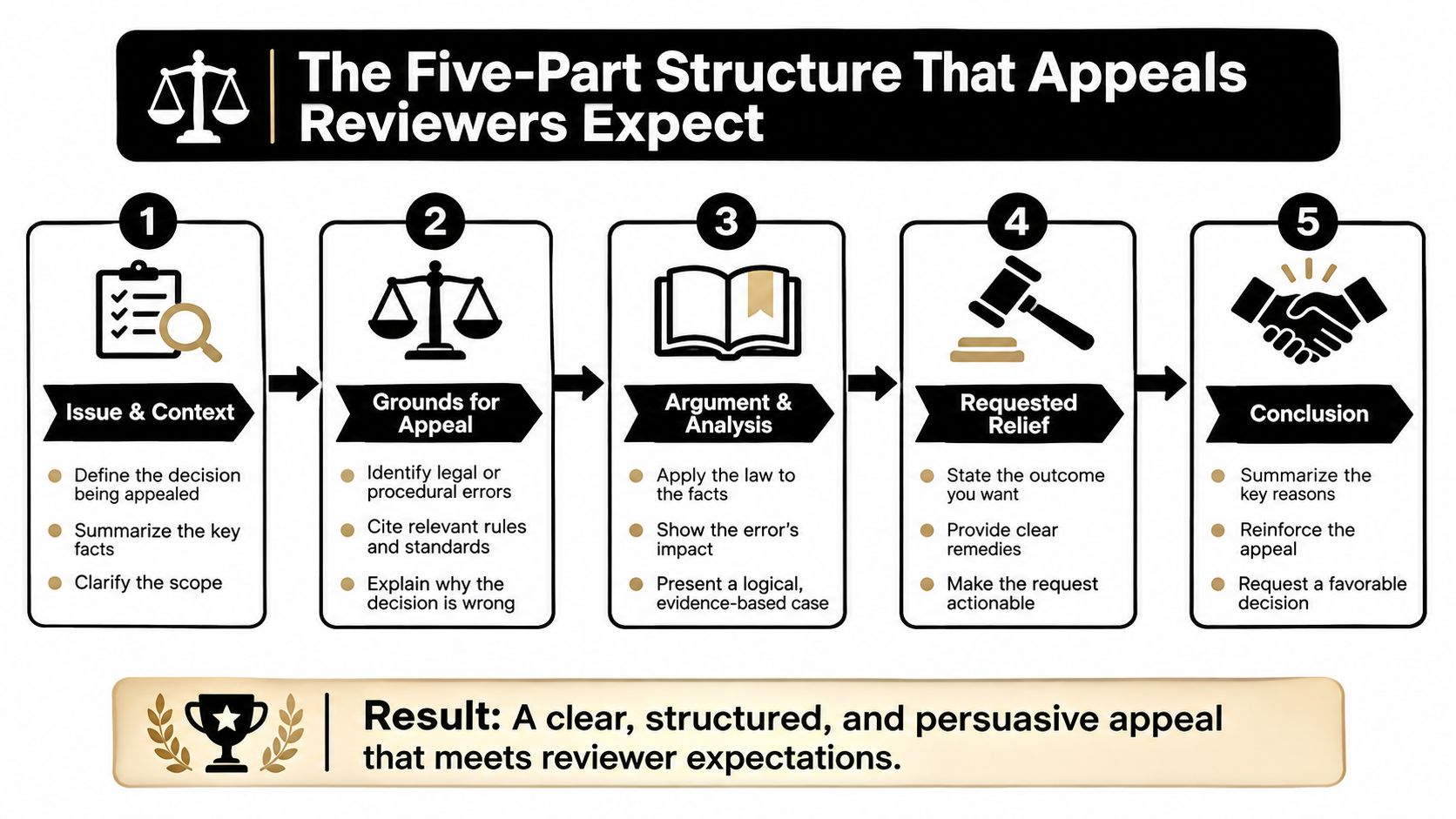
A dependable appeal letter follows a recognizable business-letter sequence. That continuity isn't accidental. University and employment guidance documents preserve the same core components, including sender information, date, recipient details, subject line, salutation, factual body, closing, signature, and attachments. Columbia's guide organizes the advocacy itself around story, facts, ask, and reinforcement, a sequence that keeps the writer focused on substantiated persuasion. The Columbia University appeal letter template illustrates that logic.
Start with identification, not argument
Header and recipient details. Put your name, mailing address, phone number, email, policy number, claim number, and date of loss at the top. Address the carrier's claims or appeals department using the contact information in the denial notice.
Subject line. Make the file immediately identifiable. A practical example is:
Re: Formal Appeal of Claim Denial, Claim No. [number], Policy No. [number], Date of Loss [date]Salutation. Use the assigned adjuster's name if you have it. Otherwise, address the claims review team or appeals department.
These details reduce the risk that the submission is separated from the claim file. They also tell the reviewer exactly which decision you're challenging.
Build the body around facts and a specific request
- Opening and chronology. State that you're appealing the denial, identify the notice date, and summarize the loss in chronological order. For example: “A wind event damaged the roof on [date]. Temporary protection was installed on [date]. The claim was reported on [date]. The inspection occurred on [date]. The denial dated [date] states [exact reason].”
Then separate facts from conclusions. Describe visible damage, emergency actions, inspections, repairs, and communications. Avoid calling the adjuster dishonest or accusing the company of bad faith unless a qualified professional has advised you on that issue.
- Rebuttal, requested action, and closing reinforcement. Address each denial reason under its own subheading. Quote the relevant denial language, identify the policy section or evidence standard, explain your response, and refer to the attached proof. Finish with a direct request, such as: “Please withdraw the denial, reopen the investigation, and issue a revised coverage determination after reviewing the enclosed documentation.”
Sign and date the letter. List every enclosure in the order it appears, and keep a complete copy of the submission. If you're preparing another formal request and need a separate example of structured business correspondence, FaxZen's resource on drafting a court excuse letter shows how a clear subject, concise explanation, and supporting documentation can work together.
Customizable Appeal Letter Templates for Different Claim Types
A homeowner's appeal shouldn't sound like a corporation's financial submission, and a nonprofit's letter shouldn't treat a mission-critical facility like an ordinary residence. The basic format stays stable, but the evidence and requested relief change with the claim.
Use the following variations as working drafts. Replace every bracketed field, quote the denial accurately, and remove any paragraph that doesn't apply.
| Element | Homeowner | Commercial | Nonprofit |
|---|---|---|---|
| Primary focus | Covered residential damage and personal property | Restoration, income interruption, and commercial coverage | Mission operations, public assets, and budget impact |
| Useful evidence | Photos, inventory, repair estimates, receipts | Building records, contracts, financial statements, mitigation invoices | Ownership records, funding documents, board or facility records |
| Requested action | Reopen and reevaluate the property claim | Confirm coverage, revise valuation, and address interruption loss | Protect the asset, recognize covered costs, and reassess the decision |
Homeowner appeal template
[Your name]
[Address]
[Phone and email]
[Date]
[Insurer name]
Claims Appeals Department
[Address from denial notice]
Re: Appeal of Claim Denial, Claim No. [number], Policy No. [number]
Dear [adjuster or review team]:
I'm writing to formally appeal the denial dated [date] concerning damage to my property at [address] arising from [fire, flood, storm, vandalism, or other event] on [date of loss]. The denial states: “[insert the insurer's exact reason].”
The loss occurred as follows: [provide a chronological explanation]. I promptly took reasonable steps to protect the property, including [emergency repairs, water extraction, board-up, temporary covering, or other action].
The denial should be reconsidered because [explain the coverage position]. The attached [photographs, inspection report, estimate, inventory, receipts, and policy pages] support the conclusion that [state the specific disputed fact]. Please also consider [pre-loss photographs, maintenance records, witness statements, or contractor findings] that address the carrier's position regarding [cause, scope, valuation, or policy condition].
I request that [insurer] withdraw the denial, reopen the claim investigation, and issue a revised written determination after reviewing the enclosed evidence.
Sincerely,
[Signature and printed name]
Enclosures: [numbered list]
Commercial property appeal template
Use a more operational tone when the building supports revenue-producing activity.
“[Company] appeals the denial of Claim No. [number] for physical damage at [location] following [event]. The denial states [exact language]. The attached building records, mitigation documentation, and contractor evaluation address the carrier's stated concern regarding [cause, scope, or valuation].”
Add a separate paragraph for business interruption: “The covered physical damage affected operations by [describe closure, restricted access, equipment loss, or interruption]. We enclose [financial records, payroll records, invoices, schedules, and operational documentation] supporting the claimed loss.”
Request a revised coverage determination, a complete explanation of any remaining disagreement, and payment of covered amounts supported by the enclosed valuation.
Nonprofit or public-serving organization template
Focus on stewardship and continuity without relying on emotional pressure.
“[Organization] appeals the denial concerning damage to [facility or asset] at [location]. This property supports [program, service, or public function]. The denial states [exact language]. The enclosed ownership documents, damage records, repair proposals, and operational materials show [specific response to the denial].”
Explain the practical consequences of delayed restoration, identify temporary measures already taken, and distinguish covered repair costs from unrelated improvements. Ask the insurer to reconsider the decision, confirm the information still required, and provide a written response tied to the policy provisions at issue.
For a related fill-in-the-blank approach, the rebuttal letter template from NW Claims Management can help organize claim identifiers and the formal dispute language.
Documentation Checklist and Submission Timing
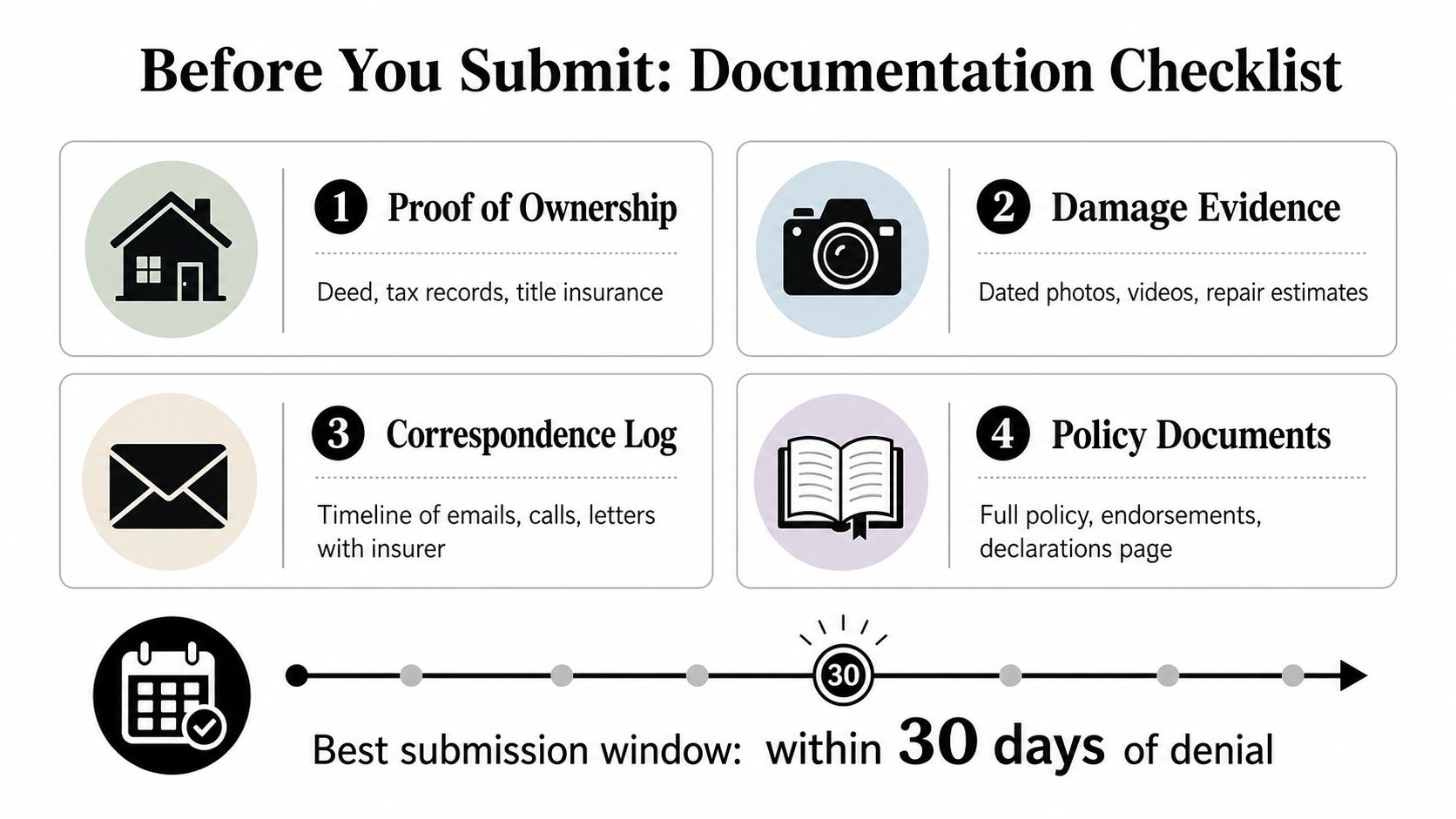
A polished letter can still fail if the file doesn't prove the facts it asserts. Before sending an appeal, build an evidence packet that lets a reviewer verify ownership, cause, scope, value, and compliance with post-loss duties without searching through scattered emails.
Assemble the file by proof category
- Proof of ownership: Include the deed, purchase records, title materials, leases, or other documents establishing your interest in the property and damaged items.
- Damage evidence: Use dated photographs, videos, inspection reports, mitigation records, repair estimates, and contractor opinions. Photograph broad room or building views as well as close details.
- Inventory and valuation: Prepare a room-by-room contents list for residential losses. Commercial and nonprofit files may also need equipment schedules, replacement proposals, invoices, and records showing the function of damaged assets.
- Policy documents: Keep the declarations page, full policy, endorsements, exclusions, and amendments together. The declarations page alone rarely answers a complex coverage question.
- Correspondence record: Create a dated log of calls, emails, letters, inspections, requests for information, and responses. Save delivery confirmations and portal messages.
- New evidence: Clearly identify material that wasn't previously submitted. New evidence should be directly relevant to the stated denial, not a large volume of unrelated paperwork.
The evidence preservation guidance from NW Claims Management is useful when damage may be altered by emergency repairs, demolition, drying, or continued exposure.
Control the submission process
Read the denial notice for the appeal deadline, required form, delivery address, and permitted submission methods. Deadlines vary by insurer and state, so never assume that a general online template contains the correct filing period. If the carrier requires a specific form or portal, submit it in addition to the letter rather than substituting your own format.
Create a deadline tracker with the denial date, calculated due date, contact person, submission method, and confirmation number. Send the package through a method that produces proof, such as certified mail, a carrier fax confirmation, or an online submission receipt. Keep the original documents and a complete copy of everything transmitted.
A documented appeal workflow for specialty medication appeals found that templating didn't change the approval rate, which remained 93% before and after implementation, but it changed submission speed: 89% were submitted within three days after implementation, compared with 29% before. The workflow analysis supports a practical lesson for property claims: a template is valuable when it helps you submit a complete, timely package, not when it replaces claim analysis.
A late, well-written appeal is still a procedural problem. Put the deadline on your calendar before you begin polishing the prose.
When to Escalate to a Public Adjuster in Oregon and Washington
Self-filing makes sense when the denial is narrow, the policy language is clear, the damage is well documented, and you can meet the carrier's process without disrupting your work or recovery. It becomes less practical when the claim involves competing causes, extensive structural damage, disputed estimates, business interruption, ordinance or law issues, or a carrier position that changes during the investigation.
A public adjuster can add value before the appeal is written. The work may include interpreting coverage, inspecting the loss, separating repairable damage from unrelated conditions, preparing a scope and valuation, organizing evidence, and communicating with the insurer. The point isn't to make the letter more aggressive. It's to make the underlying file more defensible.
Use complexity as the decision test
Escalation deserves serious consideration when:
- The cause is disputed: The insurer attributes damage to wear, faulty maintenance, earth movement, flood, or another excluded cause, while the evidence suggests a covered event or concurrent damage.
- The scope is incomplete: The estimate omits hidden damage, code-required work, contents, debris handling, or necessary mitigation.
- The valuation is contested: The carrier's estimate doesn't match contractor pricing, material requirements, replacement needs, or the policy's valuation provisions.
- Operations are affected: A commercial property, school, municipality, or nonprofit faces restricted use and must document interruption, extra expense, or temporary relocation.
- The file is becoming adversarial: The carrier requests repeated materials, relies on a new reason for denial, or treats reasonable emergency action as a coverage violation.
Oregon and Washington regulate public adjusters through state licensing systems and consumer protections. That matters because a licensed professional must operate within applicable state requirements, and familiarity with local procedures can help identify available complaint channels, required disclosures, and claim-handling issues. State-specific knowledge doesn't guarantee coverage, but it can prevent a policyholder from treating an Oregon or Washington dispute like an informal negotiation.

Know what representation changes
A public adjuster represents the policyholder's claim interests, not the insurer's. That role differs from the company adjuster, whose assignment is to investigate and evaluate the claim for the carrier. It also differs from an attorney's role in litigation or legal advice. Choose the professional based on the problem in front of you.
If you're considering representation, ask for the adjuster's Oregon or Washington license information, written fee terms, scope of services, communication expectations, and explanation of what happens if the claim proceeds to appraisal, mediation, regulatory complaint, or litigation. Don't sign an agreement you haven't read, and don't let urgency replace due diligence.
NW Claims Management describes its work for Oregon and Washington policyholders through its licensed public adjuster services. The firm handles residential, commercial, and nonprofit property claims, including policy review, damage documentation, valuation, and insurer negotiations. Those services are most relevant when the appeal requires rebuilding the claim file rather than merely correcting a missing attachment.
Moving Forward with Your Appeal Strategy
A useful decision framework starts with three questions. Can you identify the denial reason precisely? Can you prove the disputed facts with documents? Can you complete the required process before the deadline? If the answer to all three is yes, self-filing may be reasonable, particularly for a contained dispute with a clear repair scope.
Self-filing becomes risky when you're relying on assumptions about coverage, estimating damage from visible surfaces alone, or sending documents without explaining their significance. A long narrative won't cure a missing causation analysis, and a contractor estimate won't automatically establish that the policy covers every line item. The appeal should make the reviewer's task straightforward: here is the decision, here is the policy issue, here are the facts, and here is the requested correction.
Choose the next action deliberately
Use the appeal letter template to create the formal shell, then customize the substance:
- Copy the insurer's denial reason into your working notes.
- Locate the relevant policy language and identify the evidence standard.
- Build a chronology supported by dated records.
- Add only new, directly relevant documentation.
- Confirm the deadline, delivery method, and receipt process.
- Decide whether the remaining dispute requires professional claim preparation.
If the carrier has made a low offer rather than issued a full denial, the strategy changes from pure reconsideration to documented valuation and negotiation. The guide to negotiating with an insurance company can help frame that next phase without confusing a settlement discussion with an appeal.
A denial is stressful, but it isn't the same as the end of the claim. A structured appeal gives you a clear record, and a properly supported appeal gives the insurer a reason to revisit its decision. When the claim is too complex to manage alone, professional representation can reduce administrative pressure while keeping the focus on coverage, scope, evidence, and recovery.
NW Claims Management helps Oregon and Washington policyholders prepare evidence-based appeals, document property damage, evaluate disputed valuations, and negotiate with insurers. Visit NW Claims Management to request a free claim evaluation and discuss whether self-filing or licensed public-adjuster representation fits your situation.