
You're standing in a wet kitchen, looking at buckled flooring, or walking through a fire-damaged room that still smells like smoke. The contractor says the place needs emergency mitigation now. The insurer says to open a claim and wait for the adjuster. In that moment, a rush to act, skipping documentation, and handing over too little information too early is a common response.
That's the mistake that costs money later. Claim processing steps are not a single phone call or a single inspection, they're a controlled pipeline, and each stage gates the next. The basic sequence runs from First Notice of Loss, or FNOL, through investigation, valuation, settlement, and closure, which is why a sloppy start can poison the whole file from the beginning. That structure matters even more in Oregon and Washington, where policy language, complaint rights, and repair realities can turn a simple loss into a paperwork fight.
The shortest path to a fair outcome is usually the most methodical one. Don't try to “keep it simple” by giving the insurer the bare minimum. Give them enough to start the claim cleanly, then keep building the record as the loss unfolds.
What Happens After Property Damage Strikes
The first hours after a loss are chaos, and insurers know it. A roof leak turns into ceiling collapse, a kitchen fire pushes smoke through every room, or a windstorm strips shingles and leaves the attic exposed to more damage by the hour. In that scramble, property owners focus on stopping the damage and forget that every photo, receipt, and repair note becomes part of the claim file.
The claim is a pipeline, not a single event
Insurance claims do not move in one straight line. They move through intake, validation, investigation, valuation, settlement, and closure, with FNOL at the front and payment at the end. That sequence exists because insurers need a clean audit trail and a file that can survive internal review, and it is the same basic logic described in current workflow guidance that runs from intake to closure, along with the practical end-to-end flow used by claims teams from FNOL/intake to settlement/payment and analytics capture (industry workflow reference, end-to-end claims processing).
That is where claims go sideways. Policyholders treat the loss like a quick report, while insurers treat it like a file that has to pass multiple gates. If the first report is thin, the inspection scope usually comes back thin too.
Practical rule: Stop thinking in terms of “filing a claim.” Build a record that can survive inspection, valuation, and negotiation.
A real disaster scenario makes that clear fast. If wildfire is the cause, the questions come at you immediately, and what happens if wildfire burns your home is a useful way to understand the sequence of hard decisions people face after severe loss. The same pressure shows up in Oregon and Washington whether the loss comes from smoke, water, storm, or vandalism.
Use a property inspection checklist right away, not after the adjuster schedules the visit. It keeps the loss organized while cleanup is starting, which matters because the condition of the property changes fast once emergency work begins.
Initial Reporting and Evidence Collection
The first report shapes the whole file. If you give the insurer a vague loss date, an incomplete property list, or a sloppy description of what happened, you give them room to narrow the claim later. First-touch completeness matters because missing or inaccurate data often triggers rework and denials, especially when member numbers, policy numbers, dates, or codes are wrong in the first submission (first-touch guidance).
What to do before cleanup starts
Photograph everything before you move it if it is safe to do so. Take wide shots for context, then closer shots for detail, and include ceilings, baseboards, flooring transitions, appliances, contents, and any visible source of damage. If a tree hit the house, document the strike point, the roofline, gutters, downspouts, attic intrusion, and any water that came in afterward.
Don't let a cleanup crew erase the evidence. Temporary mitigation is fine, but the claim file needs proof of what was there first.
Save receipts for tarps, drying equipment, board-up work, hotel stays, meals if covered, and emergency materials. Make an inventory of damaged personal property, and separate structural damage from contents damage so the full loss picture does not get compressed into one vague bucket. That distinction matters on property claims because delayed damage often shows up later, after the initial emergency is handled.
What insurers want in the first notice of loss
The insurer will ask for the policyholder name, policy number, loss date, loss location, a brief description of what happened, and the extent of damage you can identify right now. Give facts, not guesses. If you do not know whether water came from a roof leak or a failed pipe, say that you are still determining the source.
A lot of delays start because people describe the damage too narrowly. A homeowner says “a little smoke damage” when the home has soot in the HVAC system, contaminated contents, and hidden heat damage in the attic. A business owner says “some water in the warehouse” when inventory, equipment, and electrical systems are all at risk. The insurer will often treat your first description as the claim boundary unless you expand it with proof.
If you are renting and your belongings are damaged, the same rule applies. Good documentation protects your personal property claim, and a straightforward resource like protect your belongings with helps reinforce why contents documentation matters even when the structure belongs to someone else.
Use the proof of loss concept early, even before the insurer formally asks for it. Treat every receipt, photo, estimate, and email as evidence that may later support the final sworn statement, and keep the standard in mind by reviewing what a proof of loss is. A file that starts organized is much easier to defend later, especially when damage keeps unfolding after the first inspection.
Insurer Investigation and Damage Valuation
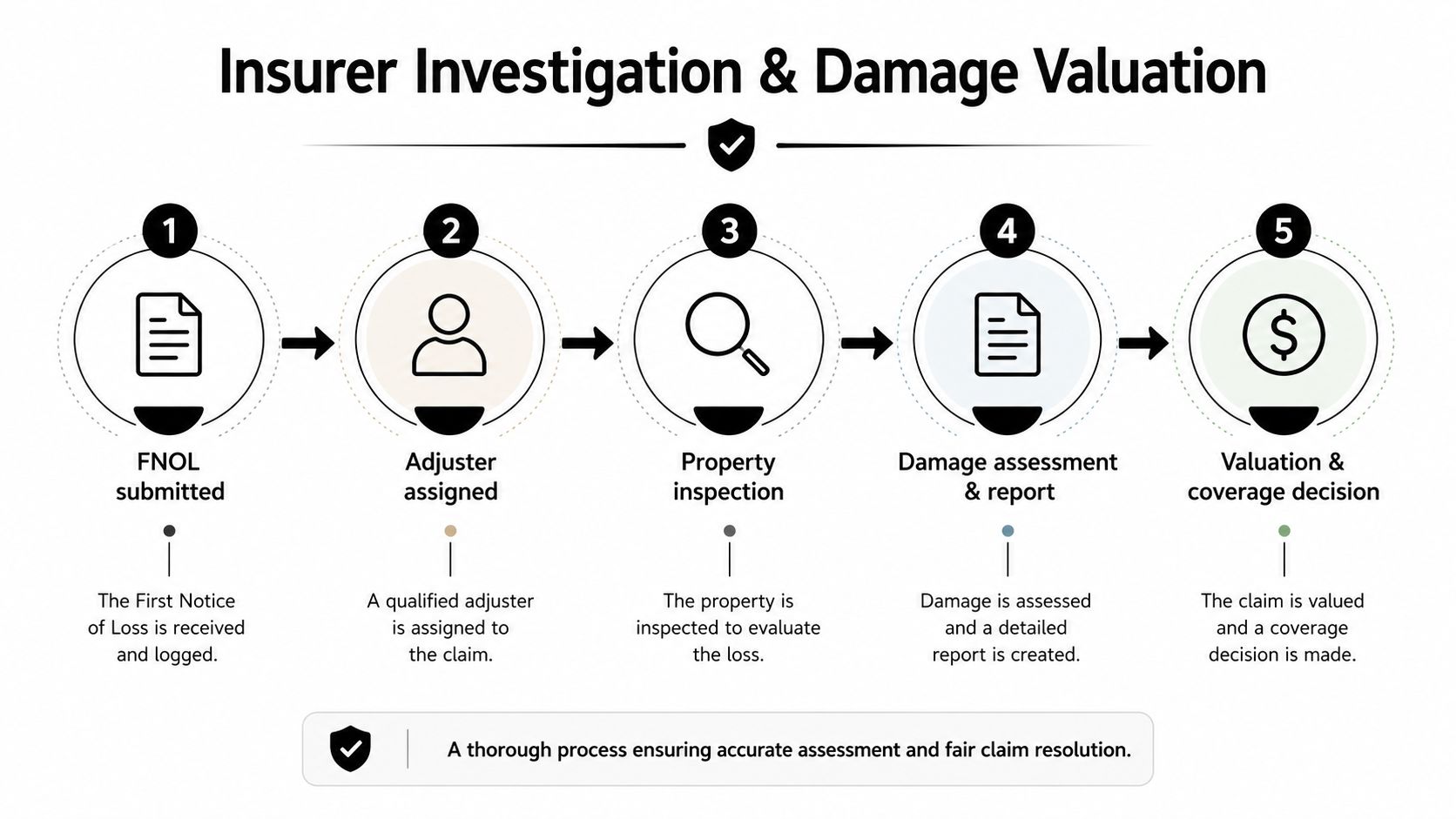
Once the insurer opens the file, the substantive work starts behind the scenes. An adjuster gets assigned, the coverage is reviewed, and the company begins deciding what it believes happened, what it thinks the policy covers, and how much it wants to reserve for the loss. In benchmark reporting, the average cycle time for claims is often cited as 3 to 5 business days from intake to resolution, though the actual duration depends on the loss type and complexity, and some lines settle in around 12 days or less while commercial claims can take up to 90 days because of heavier documentation and investigation burdens (claims benchmarks).
What the adjuster is really looking for
The adjuster is not just checking damage. They're testing causation, policy fit, scope, and documentation quality. That means they'll look at where the damage started, whether the source is sudden or ongoing, whether anything was pre-existing, and whether the items you claimed can be tied to the covered event.
A property inspection should capture the full condition of the loss site, but the insurer's first pass is often narrower than the actual damage. If they miss attic smoke, hidden moisture, subfloor damage, or structural compromise behind finished surfaces, that's where supplements come in. The file doesn't stop because the first estimate was thin.
Why valuation disputes happen
The biggest fights usually come from scope and valuation, not from the fact that damage exists. Line items get depreciated, omitted, or priced at the wrong quality level. Depreciation alone can change the settlement direction, and that's why you should read every line, not just the total.
Practical rule: If the estimate doesn't match the field conditions, challenge the scope first, not just the price.
The useful distinction is between actual cash value and replacement cost. Actual cash value reflects depreciation, while replacement cost is tied to the cost of new materials or equivalent repair, subject to policy terms. If the insurer uses one method when your policy supports the other, your recovery can be materially different even when the damage is the same.
A reserve gets set early too, which is the insurer's internal estimate of what it expects to pay. That number often changes as new damage appears. Don't assume the first reserve reflects the final value of the claim. It usually doesn't.
For a deeper breakdown of how valuation methods affect the file, the practical overview of loss valuation methods is worth keeping in mind while you compare the insurer's estimate with your own records. If structural damage shows up later, file the supplement fast and keep the old estimate attached to the new evidence so the gap is obvious.
Negotiating Your Settlement
A settlement offer is not a verdict. It is the insurer's opening position, and in many property claims it is built on incomplete scope, conservative pricing, or a rushed reading of the policy. If you accept the first number because the file feels draining, you usually leave repair costs uncovered.
Read the scope like a contractor, not a consumer
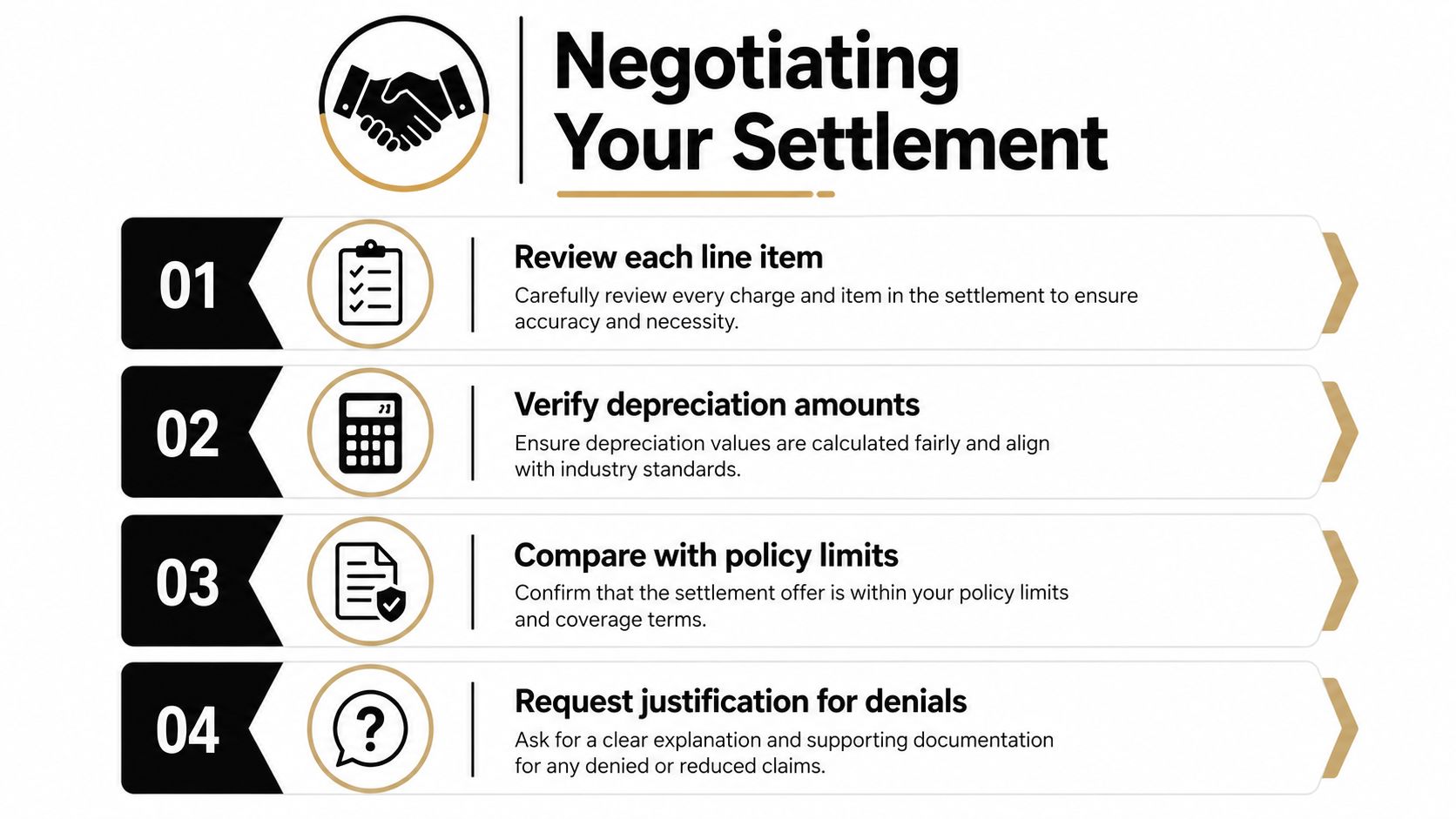
Start with the line items. Match each one against your photos, invoices, contractor notes, and any field observations from the loss. If the insurer left out drywall replacement, insulation, paint blending, finish carpentry, code upgrades, or contents work, flag each miss with proof instead of broad complaints.
Specific counteroffers get attention. “This is too low” gets brushed aside. “Your estimate misses the damaged subfloor in the northeast bedroom, the trim replacement in the hallway, and the smoke cleaning of the HVAC system” forces a real response. When you can, support that with an independent estimate and a short explanation of why your scope is wider.
Push back without turning the claim into a fight
Negotiation is not a shouting match. It is a paper trail. Ask for the written basis of denials, depreciation, and exclusions, and compare that explanation against your policy language and the actual damage. If the adjuster will not explain a number, the file is weak.
Use practical guidance on negotiating with an insurance company to keep the conversation focused on scope, valuation, and policy language instead of emotion. That approach works when the insurer is trimming repair items or trying to close the file before the loss is fully documented.
The same pressure shows up in water losses. Carriers often push for a quick close before wet materials are dry or before mold has time to show up. Do not let the claim get shut down early because the adjuster wants it off the desk. Delayed damage is common, and a premature closure can hide a larger repair problem. Business interruption claims fail in the same way. The insurer focuses on what is visible now instead of what the interruption cost the business over time.
If the dispute centers on a roof claim, the discussion usually turns on scope, matching, and policy terms. For a plain-English example of that fight, see when insurance covers roof replacement. The point is simple, document first, then negotiate from the evidence.
Why Claims Stall and How to Prevent Delays
A claim can look active on paper and still go nowhere. The usual culprits are simple, and they are operational, not mysterious. Someone misses a document, a note gets buried in a file system, the adjuster changes, or the policyholder is left waiting for an update that never comes.
The real bottlenecks are operational
The biggest slowdowns usually happen between handoffs. Independent industry guidance points to repeated manual entry, delayed transfers, missing documentation, duplicate work, and policyholders calling because no one has told them what changed, then insurers respond with automation and more proactive updates to close those gaps (workflow breakdowns and automation response). That is where most “slow claim” complaints come from. The steps themselves are usually fine. The workflow around them is what breaks.
Keep your own claim file from the first day. Put every email, estimate, receipt, diary note, photo, and text message in one place. Keep a communication log too, with the date, the person you spoke with, their role, and exactly what they said they would do. If the file gets reassigned, that record stops the next adjuster from acting like earlier conversations never happened.
When to push and when to wait
Some delay is normal. Fire, water, and storm claims often need real investigation before anyone can price the loss correctly, especially when hidden damage is involved. The problem starts when the insurer keeps asking for items you already sent, gives you no clear status, or lets weeks pass without a straight answer. That is a process failure, and it deserves escalation.
Roof claims often slow down for a different reason. Water intrusion, decking damage, and matching issues get split across multiple reviews, and the file drifts while each reviewer waits on the other. A plain-English look at when insurance covers roof replacement helps show why roof files so often bog down at valuation instead of intake.
In Oregon and Washington, use the state insurance department complaint process when the carrier stops responding or keeps ignoring the file. Do not reach for a complaint while the claim is still moving and evidence is still being exchanged. Use it when communication has failed, not as a substitute for a clean paper trail and solid documentation. If the file is large, disputed, or getting stuck in repeated back-and-forth, knowing when to hire a public adjuster can save time and keep the insurer from controlling the pace.
When to Hire a Public Adjuster
Some claims are manageable on your own. Others are built to wear down a homeowner or business owner who has a full schedule, a flooded basement, and no patience for policy jargon. The right call depends on complexity, time, and how hard the insurer is likely to push back.
A small, well-documented loss with a responsive carrier is usually worth handling yourself. Once the file turns into major structural damage, coverage fights, business interruption, repeated estimate revisions, or supplement battles, the workload changes fast. That is when claim handling stops being paperwork and starts becoming a second job.
| Claim Characteristic | Handle Independently | Consider Public Adjuster |
|---|---|---|
| Small, clearly documented loss | Yes, if the scope is obvious and the insurer is responsive | Usually not necessary |
| Major structural damage | Rarely, unless you already know the policy and repair scope well | Strong candidate |
| Coverage dispute or policy interpretation issue | Only if the issue is narrow and supported | Strong candidate |
| Business interruption or extra expense | Only with strong bookkeeping and time to manage the file | Strong candidate |
| Repeated estimate revisions or supplement fights | Possible, but time-intensive | Strong candidate |
For a closer look at the hiring decision, use this public adjuster hiring guide alongside the claim facts in front of you.
What a public adjuster changes
A public adjuster works for the policyholder, not the insurer. That matters because the carrier's adjuster is building a file for the company's interests, while a public adjuster is building the loss presentation for yours. In a complex claim, that difference shows up in the quality of documentation, the accuracy of the scope, and the pressure applied during negotiation.
A public adjuster makes the most sense when the loss involves multiple rooms, hidden damage, business interruption, contents loss, code issues, or a carrier that is dragging its feet. It also makes sense when you already know the loss is larger than the insurer's first estimate and you do not have the time to fight every line item yourself. A kitchen fire in Portland with smoke infiltration into adjacent rooms, or a wind-driven roof loss in Seattle that turns into interior staining and insulation damage, can turn messy quickly because the first inspection rarely captures the full picture.
If you are already exhausted by the paperwork and still have not reached a fair scope, that is usually the signal to bring in help.
The fit matters too. Check Oregon or Washington licensing, ask for experience with your type of damage, and read the fee terms before you sign anything. If the file is simple and the insurer is being reasonable, you may not need representation. If the file is complex or the communication has gone sideways, hire help before the claim hardens into a bad number.
Your Action Plan for Claim Success
Start with the facts, then keep building the file. In the first 24 to 48 hours, protect the property, photograph everything, save receipts, and report the loss with enough detail to create a complete FNOL. During the first week, organize damage by structure, contents, and temporary living or operating costs so nothing gets lost in the shuffle.
By weeks 2 to 4, focus on the insurer's inspection, the estimate, and the gaps between what they wrote and what needs repair. If the company misses damage, changes adjusters, or keeps asking for the same documents, write it down. That record matters later if you need to escalate.
When the offer arrives, don't let fatigue make the decision for you. Compare the scope, line by line, against your evidence and contractor input. If the claim is large, disputed, or still unfolding, get professional help before you sign a release.
A denied or underpaid claim can move through internal appeal, mediation, and litigation, but the smartest move is to avoid getting shoved into those stages by submitting a stronger file upfront. Rushing to close a claim is usually more expensive than taking the time to do it right.
If you're dealing with a fire, flood, storm, or vandalism claim in Oregon or Washington and the insurer is already narrowing the scope, talk to NW Claims Management. They handle property claims from the policyholder side, and they can help you turn a messy file into a claim that's documented, defended, and negotiated the right way.