The letter lands in your inbox or mailbox after days of waiting. You open it expecting next steps, maybe a payment update, maybe a request for one more document. Instead, you see words like “not covered,” “below deductible,” “wear and tear,” or a payment amount that won't come close to putting your home back together.
If you own property in Oregon or Washington, that moment can feel like the floor drops out twice. First from the damage itself, then from the claim decision. Many find themselves unprepared for how technical the language gets once an insurer pushes back. You're suddenly expected to read policy wording, compare repair scopes, and argue about causation while your house, rental, church, shop, or nonprofit building still needs attention.
That's where coverage dispute insurance becomes more than a phrase. It's the process of challenging a denial, delay, or underpayment. And if you understand one thing early, make it this: not every dispute is the same. Some fights are about how much the insurer should pay. Others are about whether the policy applies at all. That difference changes everything.
Your Claim Was Denied or Underpaid Now What
A Salem homeowner opens a claim decision after a windstorm and sees a payment that barely covers a patch, even though the contractor says the whole slope is compromised. In Spokane, a rental owner gets a denial after a plumbing leak because the carrier says some of the damage happened over time. Different losses, same problem. The insurer and the property owner are no longer reading the claim the same way.
That moment feels personal, but the first step is practical. A denial, delay, or low payment often marks the beginning of a dispute process, not the end of the file. For Oregon and Washington property owners, the key is to slow the claim down enough to identify what the insurer decided, and why.
A coverage dispute means you and the carrier disagree about what the policy requires for this loss. Sometimes the disagreement is obvious from the letter. Sometimes it is hidden inside phrases like “excluded cause,” “limited damage observed,” “not sudden and accidental,” or “payment issued based on our estimate.”
Read the letter like a road map, not a verdict.
If you have one in hand and the wording is hard to pin down, this guide to a claim denial letter can help you spot the insurer's stated reason, the policy language they rely on, and what may be missing from the explanation.
For property owners in Oregon and Washington, that distinction matters early because the next move depends on the kind of disagreement you are dealing with. If the carrier accepts the loss but prices it too low, you are usually dealing with a value fight. If the carrier says the policy does not apply, even in part, you are dealing with a coverage fight. Those are different problems, and they call for different proof.
A roof claim is a good example. An insurer may agree hail hit the property but pay for a few shingles instead of full replacement. That is usually a dispute about amount. By contrast, if the insurer says the marks are old wear, blistering, or mechanical damage rather than storm damage, the dispute is about whether coverage exists for the claimed loss at all. The same basic issue shows up in roof disputes across the country, including cases involving Columbus Ohio hail roof damage, but Oregon and Washington owners still have to ground the response in their own policy language, timeline, and local claim facts.
What to do in the first 48 hours
- Save every claim document. Keep the denial or payment letter, estimates, photos, emails, text messages, proof of loss, and any adjuster notes you have.
- Build a simple timeline. List the date of loss, mitigation steps, inspections, calls, document requests, and payments.
- Take current photos and video. Water spreads, materials dry out, and temporary repairs can change what the damage looks like.
- Request the basis of the decision in writing if it is unclear. You want the policy provisions, exclusions, and facts the insurer says support the outcome.
- Hold off on arguing from instinct. The better first move is to match the insurer's reason to the policy and the physical evidence.
That last step saves a lot of wasted effort. If you answer a coverage denial with only a higher repair estimate, you may leave the insurer's real argument untouched. If you answer an underpayment with only policy language, you may miss the need for a better scope, pricing, or expert support.
Treat the first decision as the insurer's opening position. Then start building your response with the file, the facts, and the policy in front of you.
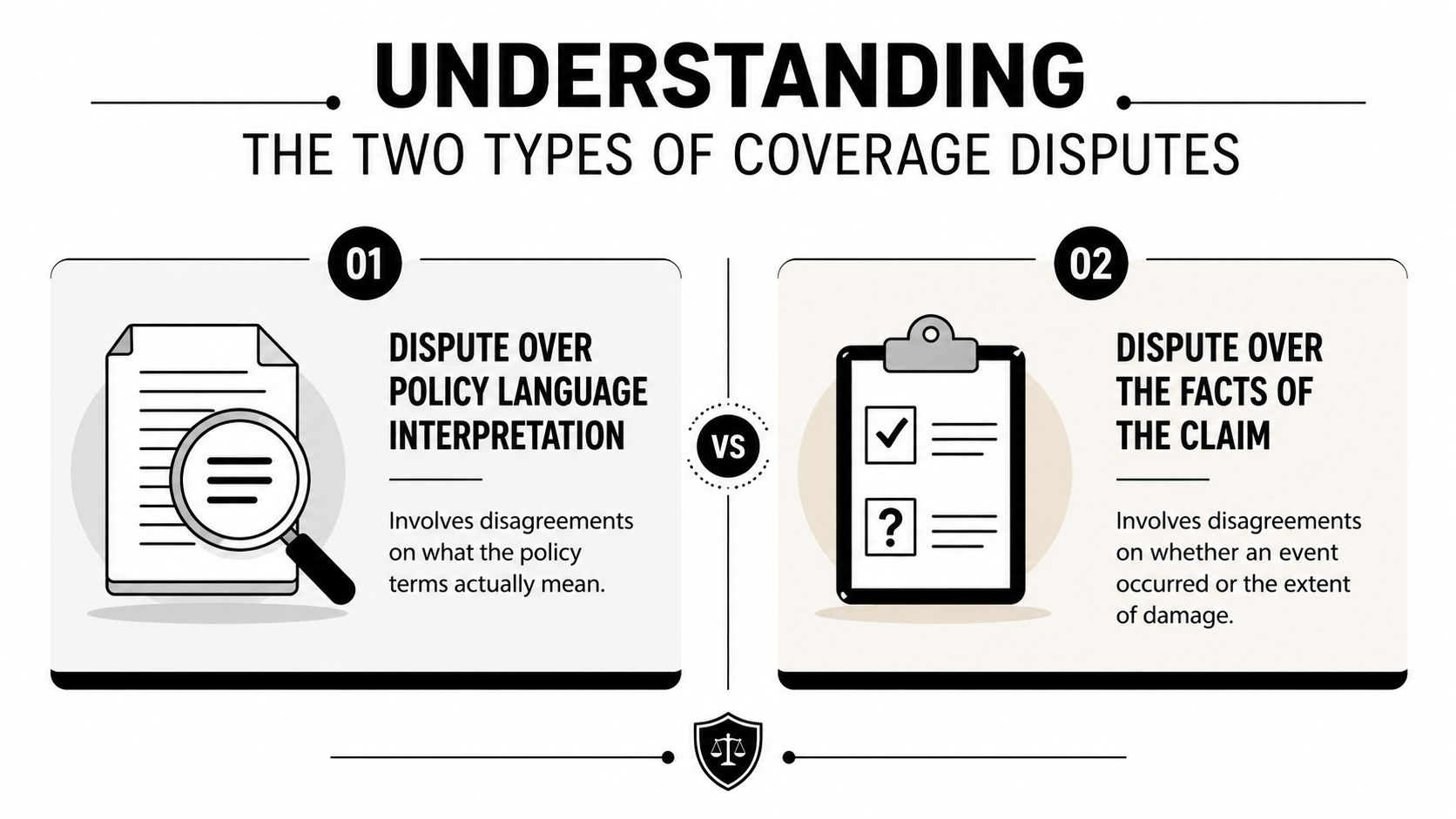
Understanding the Two Types of Coverage Disputes
The term “insurance dispute” is often used as if it's one thing. It isn't. In property claims, there are two very different fights, and they need different strategies.
Applicability disputes
An applicability dispute asks whether coverage exists at all for the loss being claimed.
A simple analogy helps. Think of a car warranty. If the dealer says engine failure isn't covered because the problem falls under an exclusion, that's an applicability dispute. You are arguing over whether the contract applies.
Property insurance versions sound like this:
- “The damage was caused by wear and tear.”
- “This was long-term seepage, not a sudden event.”
- “The policy excludes neglect, rot, or faulty workmanship.”
- “You gave late notice, so coverage is barred.”
In these disputes, getting “another estimate” usually won't solve the core problem. The insurer isn't just debating cost. They're saying the policy doesn't respond.
Valuation disputes
A valuation dispute is different. Here, the insurer agrees the loss is covered in principle, but the two sides disagree on the amount owed.
That can include:
- scope of repairs
- replacement versus repair
- depreciation
- matching issues
- labor and material pricing
- code-related items
If the same roof is covered but the carrier pays for patching while your contractor says replacement is necessary, that's usually a value fight. A strong grasp of loss valuation methods becomes central in that situation.
Practical rule: Ask one question before you do anything else. Is the insurer saying “we owe less,” or “we don't owe for this at all”?
Why the distinction matters
A lot of consumer advice blurs these categories. That's a problem. Guidance from Merlin Law Group notes a major gap between coverage amount disputes and coverage applicability disputes, and explains that appraisal is widely promoted for value disagreements but is legally ineffective when the insurer denies coverage based on exclusions such as wear and tear or neglect. It also notes that 80% of consumer guides miss that nuance in discussing appraisal and applicability disputes in this coverage dispute analysis.
Here's the practical takeaway:
| Type of dispute | Core question | Best early move |
|---|---|---|
| Applicability | Does the policy cover this event or cause of loss? | Analyze policy wording, denial language, and causation evidence |
| Valuation | What is the covered damage worth? | Compare scopes, estimates, measurements, and pricing |
If you get this distinction right, you stop guessing. You start building the right file.
Common Reasons Insurers Deny or Underpay Claims
A homeowner in Oregon gets a denial letter after a winter storm. The roof leaked during heavy rain, but the carrier points to wear, age, and deferred maintenance. A property owner in Washington gets payment for only part of a water loss because the insurer says some of the damage was old, not sudden. Those outcomes feel different on the surface, but they usually come back to the same few pressure points in a claim file.
Understanding those pressure points helps you respond with something stronger than frustration.
Exclusions and causation fights
Many denials start with an exclusion. The insurer cites wear and tear, deterioration, rot, repeated seepage, faulty workmanship, neglect, or another excluded cause. Then it argues your loss fits that category.
This happens often in roof, water, and structural claims because property damage rarely arrives in a neat package. A windstorm can damage an aging roof. A plumbing leak can expose a long-hidden weakness inside a wall. In those cases, the fight is often about causation. What caused the damage that matters under the policy, and what was already there?
That question matters even more in Oregon and Washington, where wind-driven rain, moss, freeze events, and long periods of moisture can blur the line between sudden damage and long-term deterioration. If your insurer is framing the loss as a maintenance problem, review how property insurance coverage gaps can affect claim outcomes before accepting that conclusion at face value.
If you want a visual example of how adjusters and contractors separate storm impact from age-related wear, this overview of Columbus Ohio hail roof damage shows the kind of physical indicators that often become central in a roof dispute.
Policy wording that can be read more than one way
Some disputes are not about what happened to the building. They are about what the policy language means.
Words such as “direct physical loss,” “sudden,” “hidden,” “collapse,” and “neglect” may sound plain in everyday conversation. In a claim, they can carry technical meaning. Endorsements can also change the result. One form may cover a type of water damage that another form limits or excludes. A denial letter can sound final even when the actual wording leaves room for a different reading.
Owners often get tripped up, assuming a confident letter means the carrier's interpretation is the only reasonable one. It may not be.
Weak proof of the loss, the cause, or the amount
The policyholder has the burden to show the loss, the cause, and the amount.
If the file is thin, the insurer has more room to deny parts of the claim or reduce payment. That can mean missing photos from the first day, no moisture readings, no repair timeline, an estimate that does not tie each line item to storm-related damage, or an inventory that leaves out age, quantity, and replacement details.
This problem shows up in both kinds of disputes discussed earlier, but in different ways. In a coverage dispute, proof usually means evidence of cause. Did wind create the opening? Did the leak begin suddenly? In a value dispute, proof usually means evidence of amount. How much material was damaged? What scope is reasonably necessary? Which pricing is supported?
The distinction matters because the cure is different. Better causation evidence will not solve a pricing disagreement by itself. A bigger estimate will not fix a denial based on an exclusion.
A quick way to sort your own denial
Read the letter once for the overall message. Then read it again with a marker and sort each reason into a category.
- Exclusion issue: The insurer says a policy exclusion bars some or all of the claim.
- Interpretation issue: The insurer relies on wording that may support more than one reading.
- Proof issue: The insurer says the claim lacks enough evidence of cause, scope, or amount.
Many letters contain more than one of these. That is common.
Once you label the reason correctly, the next step gets clearer. A coverage fight needs policy analysis and causation support. An underpayment fight needs a stronger scope, pricing support, and documentation of the full amount owed.
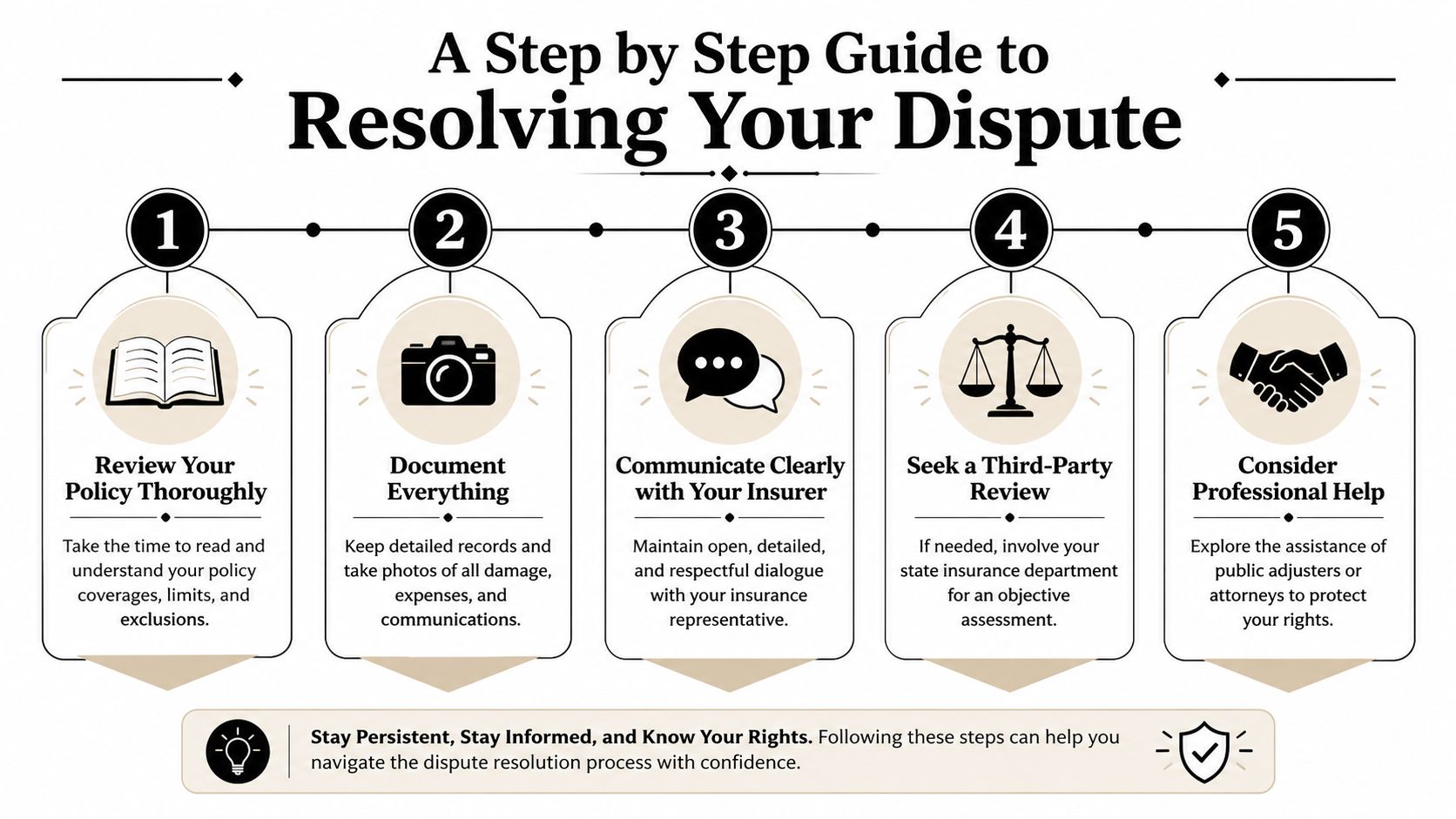
A Step by Step Guide to Resolving Your Dispute
At 4:45 on a Friday, you open a letter that says your roof claim is denied, or your water loss payment is thousands short of the contractor bid. Your first instinct is often to argue the whole claim at once. That usually creates more heat than progress.
A better approach is to handle the dispute in sequence. Read the decision. Match it to the policy. Gather proof that fits the insurer's stated reason. Then choose the resolution path that matches the type of dispute you have.
Step one review the denial against the policy
Set the denial or underpayment letter beside the full policy, including endorsements and amendments. Read both slowly. In many Oregon and Washington claims, the problem is not hidden in one dramatic sentence. It sits in the details. A limitation tucked into an endorsement. An exception to an exclusion. A factual statement from the adjuster that does not match what was observed at the property.
Go line by line and compare:
- what the insurer says caused the damage
- what coverage section may apply
- what exclusion or limitation the letter relies on
- what facts, dates, or inspection findings appear incomplete or wrong
This step matters because it tells you what kind of dispute you have. If the insurer agrees damage is covered but paid too little, you are likely dealing with a value dispute. If the insurer says the policy does not apply at all, or only applies in part because of an exclusion, you are in a coverage dispute. Those are different problems, and they require different responses.
Step two build an evidence package that matches the dispute
Your file should answer the insurer's stated objection. A coverage dispute usually needs proof of cause and policy fit. A value dispute usually needs proof of scope, quantity, and pricing. A hammer does not fix a wiring problem. In the same way, a larger estimate alone will not overcome a denial based on wear and tear, late reporting, or a claimed exclusion.
Build a file a new reviewer could understand without guessing:
- Time-stamped photos and video: Show damaged areas, nearby undamaged areas, and any temporary repairs.
- Itemized estimates: Use line-by-line bids or estimates, not a one-line total.
- Cause opinions: If the insurer disputes how the loss happened, get a report from a qualified contractor, engineer, or other appropriate expert.
- Claim timeline: List inspections, conversations, document submissions, and response dates.
- Mitigation records: Save receipts and invoices for drying, tarping, board-up, debris removal, and emergency work.
If you need help putting your response in order, this rebuttal letter template for insurance claim disputes gives you a practical structure for policy language, factual corrections, and supporting exhibits.
Step three submit a focused written appeal or reconsideration request
Once your documents are organized, send a written response that is calm, specific, and easy to follow. Treat it like building a file for a reviewer who knows nothing about your property. The goal is not to vent. The goal is to make it hard to ignore the strongest parts of your position.
Include these points:
- Claim number and property address
- The exact decision you are challenging
- The policy language that supports your position
- A clear correction of factual errors or omissions
- The documents attached, such as estimates, reports, photos, and receipts
- A direct request for reconsideration or supplemental payment
If deadlines are mentioned in the denial letter, calendar them immediately. If no deadline is stated, send your response promptly anyway and keep proof of delivery.
Step four choose the right resolution path
Many property owners find themselves losing time. They pursue the wrong tool for the wrong dispute.
If it is a value dispute
Appraisal may help if the policy includes an appraisal provision and both sides agree there is coverage for the loss. Appraisal is often used when the main issue is over repair scope, unit pricing, or replacement methodology. In plain terms, both sides agree the pie is covered, but disagree on how large the pie is.
If it is a coverage dispute
Appraisal usually does not solve the core problem. If the insurer says the loss is excluded, was caused by something not covered, or falls outside the policy terms, you generally need a direct challenge to that position. That may involve a stronger written coverage argument, better causation evidence, mediation, a regulatory complaint, or legal counsel.
For Oregon and Washington owners, this distinction is especially important. A storm claim underpaid on scope is handled very differently from a denied water claim where the insurer says no covered peril caused the damage in the first place.
Step five escalate if the carrier does not respond reasonably
If the insurer repeats the same position without addressing your evidence, raise the level of the dispute in a deliberate way.
Your next options may include:
- Mediation: Useful when both sides may settle with a neutral third party guiding the discussion.
- Arbitration: Sometimes required by contract terms, though not common in many homeowner property claims.
- Regulatory complaint: A complaint to the state insurance department can prompt a more complete written explanation.
- Professional representation: A public adjuster can develop scope, documentation, and negotiation strategy. An attorney may be appropriate when the dispute turns on policy interpretation, denial of coverage, or bad faith concerns.
One option in Oregon and Washington is NW Claims Management, a licensed public adjusting firm that documents losses, analyzes policy language, and negotiates property claims on behalf of policyholders.
The key is to break the dispute into parts you can solve. Policy wording. Facts. Cause. Amount. Deadlines. Once each part is clear, the path to a fairer outcome usually becomes clearer too.
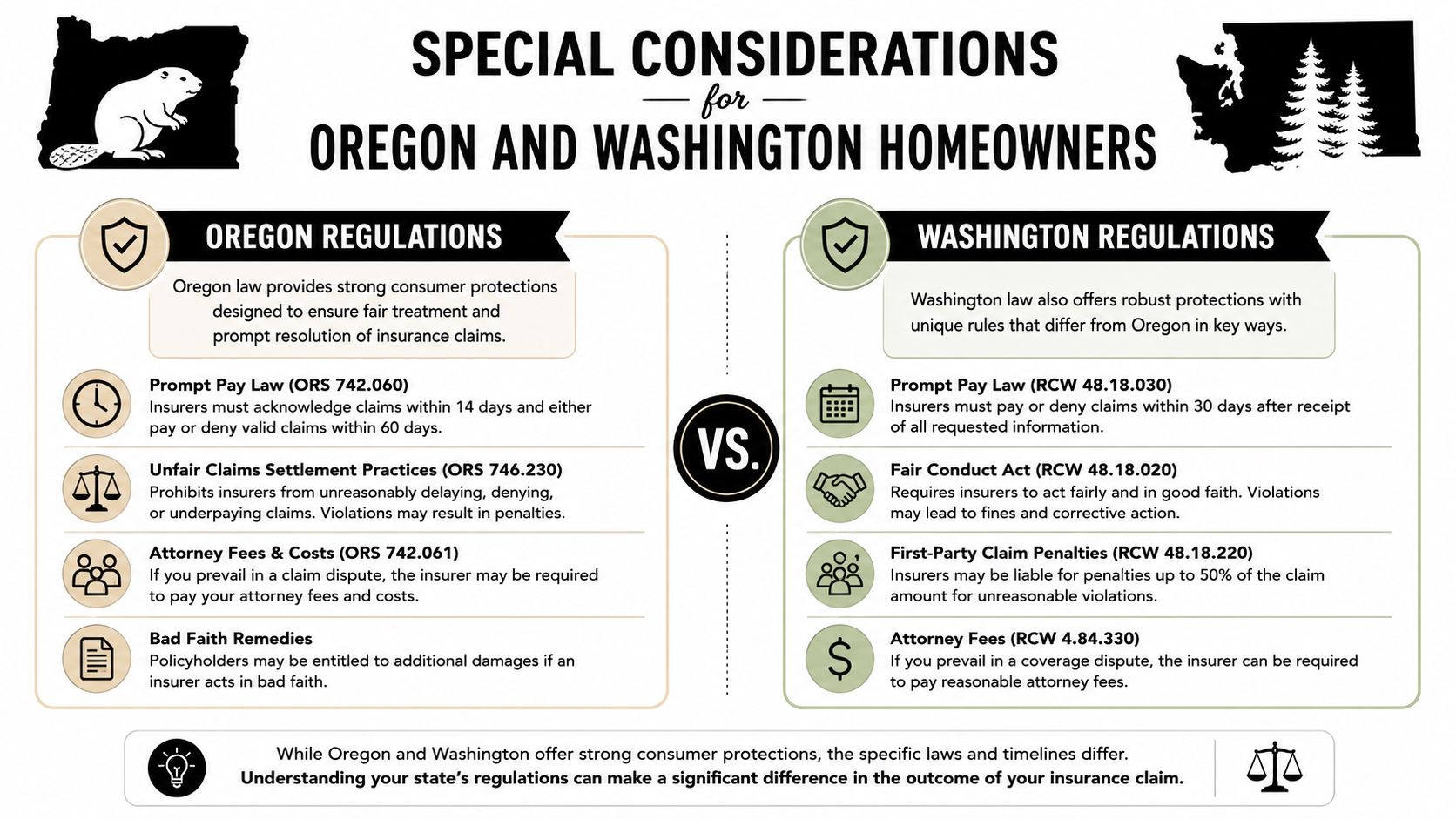
Special Considerations for Oregon and Washington Homeowners
National insurance advice often gets too abstract to be useful. Oregon and Washington property owners benefit from looking local. The same claim problem can feel very different depending on which state regulator oversees the complaint process and how your insurer responds to local scrutiny.
Oregon owners should focus on documentation and policy completeness
In Oregon, one of the most common practical problems is discovering too late that the policy language isn't as broad as the owner assumed. Deductibles, exclusions, ordinance and law limitations, vacancy provisions, and water-related limitations can all shape the dispute before it starts.
That's why reviewing potential insurance coverage gaps matters so much for Oregon homeowners, landlords, and commercial owners. In a dispute, the issue may not be whether damage exists. It may be whether the policy form you bought responds to that category of loss the way you thought it would.
Oregon owners should also insist on a clean paper trail. When a claim stalls, your position strengthens if every request, submission, inspection date, and disputed item is logged in writing.
Washington owners often benefit from strong issue framing
Washington property owners face many of the same claim patterns, but the most important practical move is often how the disagreement is framed. If you present a pure value issue as a coverage fight, the process slows down. If you present a coverage denial as if it's only about price, the insurer can stay in a narrow lane and avoid the actual issue.
That means Washington owners should sort the dispute early:
| Oregon and Washington question | Why it matters |
|---|---|
| Is the insurer disputing cause, scope, or both? | It affects what expert support you need |
| Is there an exclusion being applied broadly? | That may require a direct policy response |
| Is the problem underpayment on admitted damage? | Appraisal or estimate comparison may matter more |
| Has every communication been confirmed in writing? | Written records travel better than phone memories |
Local regulators are part of the process
Both states give property owners somewhere to turn when an insurer's communication is unclear or the claim handling feels off. For many people, filing a regulator complaint isn't about punishment. It's about forcing precision.
Ask for the insurer's position in writing, with policy citations and factual support. That single request often changes the tone of the file.
For Oregon and Washington owners, local weather patterns also matter. Wind-driven rain, roof leaks, frozen pipes, wildfire smoke, and moisture-related losses often create mixed-cause disputes. That's another reason regional claim experience helps. The facts on the ground in the Pacific Northwest don't always fit the generic examples found in nationwide claim guides.
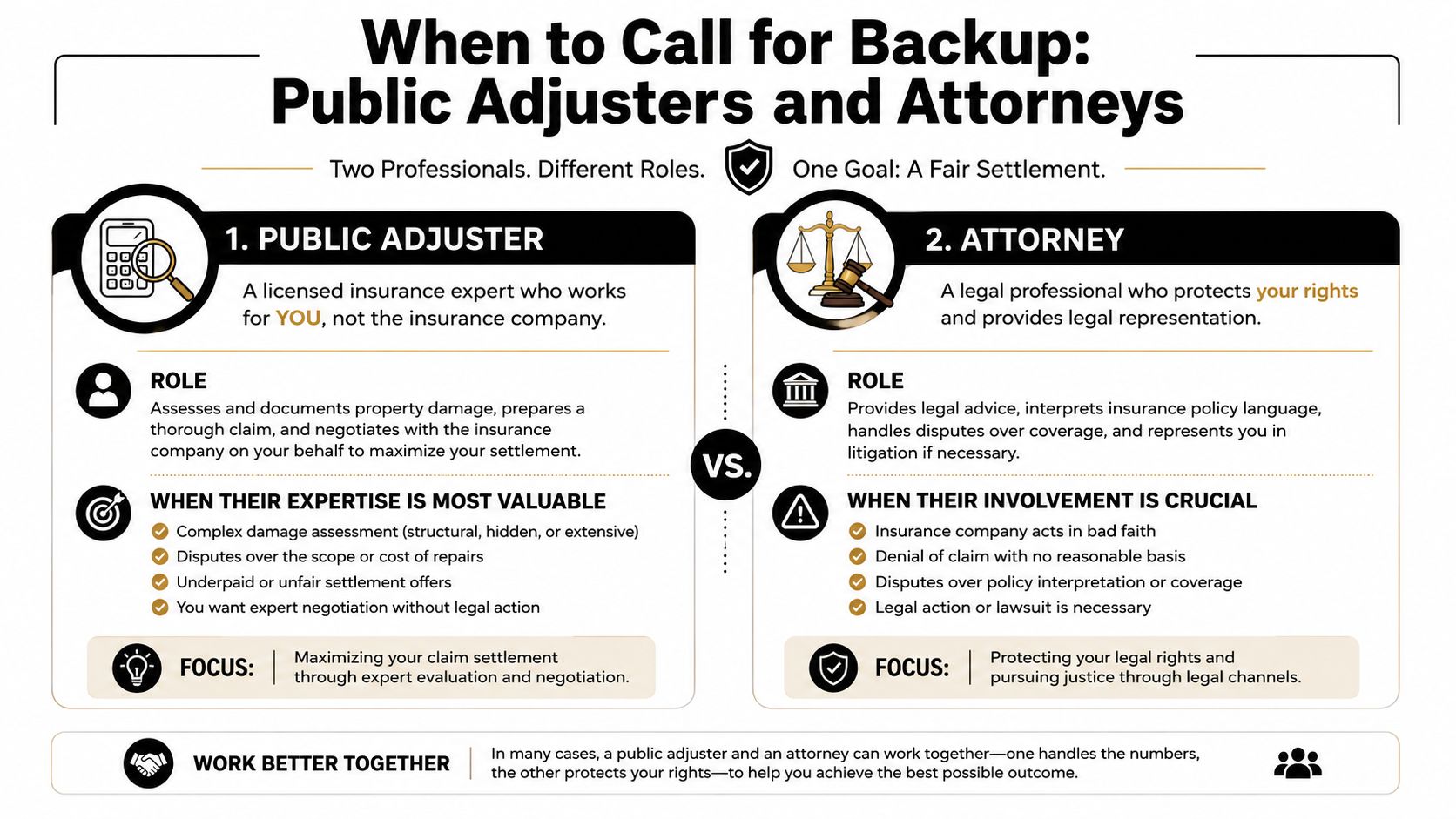
When to Call for Backup Public Adjusters and Attorneys
Some disputes can be handled directly by the policyholder. Others reach a point where going alone costs too much time, influence, or money. The key is hiring the right type of help for the type of problem you have.
When a public adjuster makes sense
A public adjuster is usually the better fit when the dispute centers on claim development, valuation, scope, documentation, causation support, or negotiation with the insurer.
Call a public adjuster if:
- The carrier's estimate misses major items: Scope disputes are often fixable with better documentation and line-item support.
- You're overwhelmed by the process: Claims expand into inspections, estimates, inventories, follow-ups, and rebuttals fast.
- The insurer accepted coverage but underpaid: This is often where public adjusters add the most value.
- You need the file built correctly: Photos, repair scopes, expert reports, and communication logs have to align.
If you're unsure whether your situation fits, this guide on when to hire a public adjuster can help you compare the signs.
When an attorney becomes necessary
An attorney becomes more important when the dispute turns legal. That includes alleged bad faith, a lawsuit, a reservation of rights issue, or a serious conflict over how the contract should be interpreted.
Courts generally apply the plain meaning rule in coverage disputes. If policy language is clear, it controls. Only when language is ambiguous do courts look beyond the policy, and many states construe ambiguity against the insurer that drafted it, as explained in this analysis of insurance dispute interpretation.
That legal framework matters because some disputes can't be solved by better estimates alone. If the fight is over what the contract means, legal analysis becomes central.
A simple comparison
| Professional | Usually best for | Less suited for |
|---|---|---|
| Public adjuster | Damage documentation, valuation, negotiation, claim management | Filing lawsuits or giving legal advice |
| Attorney | Coverage interpretation, litigation, bad-faith allegations, legal strategy | Building repair scopes or managing the day-to-day claim file |
The wrong help can slow a claim down. Match the professional to the actual dispute, not just your frustration level.
In some files, both professionals are useful at different stages. A public adjuster may organize the damages and negotiation record first. An attorney may step in later if the carrier's position becomes a legal breach rather than a claim adjustment disagreement.
Your Path Forward to a Fair Settlement
A denied or underpaid property claim feels personal because it is personal. Your home, rental, business, or nonprofit property isn't an abstract asset to you. It's where life or work happens. That's why a weak claim decision can hit so hard.
Still, a bad first decision doesn't erase your rights. It means you need to identify the kind of dispute you have, gather the right proof, match the facts to the policy, and choose the correct path for resolution. For Oregon and Washington owners, that process works best when it stays organized and local to the realities of Pacific Northwest claims.
The most important takeaway is simple. A value dispute and a coverage applicability dispute are not the same problem. Once you sort those correctly, the next steps become much clearer.
If you're stuck, get another set of eyes on the file before you accept a result that doesn't feel right. Clear policy analysis and complete documentation often change the conversation.
If you want a second opinion on a denial, low offer, or disputed scope of damage, NW Claims Management offers claim reviews for Oregon and Washington property owners. A professional review can help you determine whether you're dealing with a valuation issue, a true coverage dispute, or both, and what evidence you'll need before taking the next step.