You've already had the bad day. Water, fire, smoke, wind, a pipe burst, a fallen tree. Then the insurance company sends a Proof of Loss form, and suddenly the claim stops feeling like customer service and starts feeling like law.
That reaction is normal. Most homeowners read this document once and think the same thing: “Am I about to sign something that can hurt my claim?” The honest answer is yes, you can. A Proof of Loss form is one of the few claim documents that can lock you into numbers, expose gaps in your documentation, and hand the insurer an argument if your submission is sloppy.
That's why you need to slow down and treat it seriously. Not fearfully. Seriously.
If you're still figuring out the broader claim process, this step-by-step claims guide is a useful companion because it places the form inside the full claim timeline. You should also understand the filing sequence from the policyholder side, especially if you haven't yet organized your claim file. This overview on how to file a homeowners insurance claim helps with that groundwork.
Your Insurance Claim Just Got Real
The day a carrier asks for a Proof of Loss form is the day your claim becomes formal.
Up to that point, many homeowners are still operating on conversations, rough estimates, inspection visits, and scattered emails. Once the insurer requests this form, you're no longer just reporting damage. You're being asked to submit a sworn statement of what happened and what you're claiming.
That shift matters because insurance companies often act casual right up until the moment they need something binding from you. Then the tone changes. The form arrives. The instructions get stricter. You're expected to know values, categories, and deadlines while your home may still be torn apart.
Why this moment feels so stressful
You're being asked to do three hard things at once:
- Describe the loss accurately: Not just “the kitchen burned,” but what was damaged, how far the damage spread, and what categories of loss you're claiming.
- Put numbers on damage before the claim is fully settled: That's difficult even for contractors, and homeowners are rarely given enough time or guidance.
- Sign under oath: A mistake can be framed as inconsistency. An omission can be treated as a reason to resist payment.
Practical rule: If the insurer asks for a Proof of Loss form, stop treating the claim like an informal conversation. Start treating every document like it may be reviewed by a supervisor, coverage attorney, or defense expert later.
What you need to do next
Your job is simple in theory and demanding in practice. You need to submit a form that is complete, supportable, and timed correctly.
That means gathering documents first, checking the insurer's instructions carefully, and refusing to sign anything you don't fully understand. It also means knowing the state-specific rules that apply in Oregon and Washington, because insurers sometimes speak as if their internal preferences override the law. They don't.
What Is a Proof of Loss and Why It Matters So Much
A Proof of Loss form is not just another insurance form. It is your formal demand for payment.
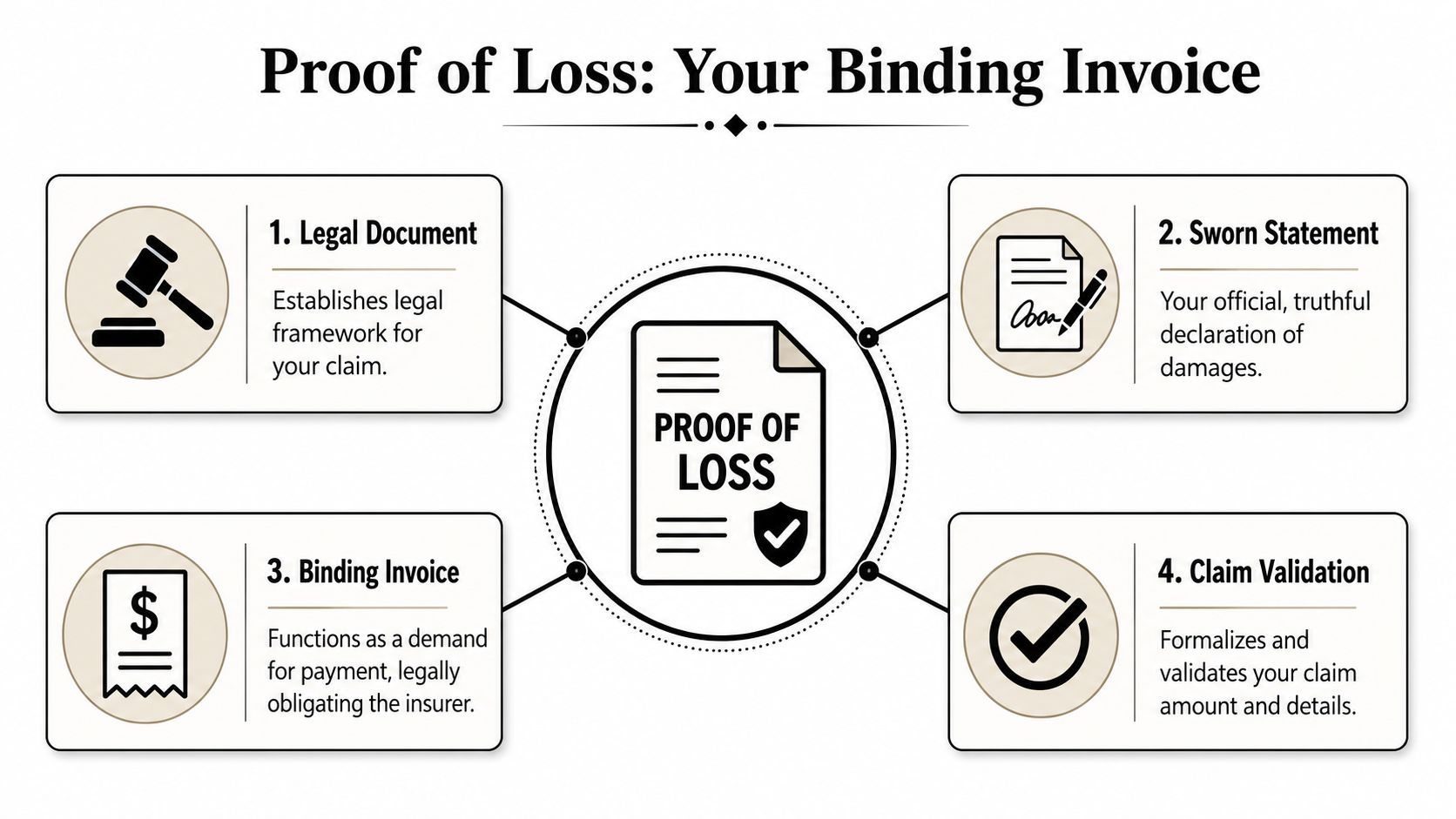
The best way to understand it is this: think of it as a binding invoice you submit under oath. You are telling the insurer, in writing, “This is the loss, this is what I'm claiming, and I'm swearing this information is true to the best of my knowledge.”
That is very different from the first notice of claim. Your initial report might be a phone call, a claim portal submission, or a quick conversation with an adjuster. The Proof of Loss form is more serious. It turns the claim from a report into a documented position.
Why insurers care so much about this form
Insurance companies like documents they can point to later. This form gives them one.
If your numbers are too low, they may argue that your own sworn submission supports a lower payment. If your description is vague, they may say you failed to prove part of the loss. If your paperwork doesn't match your claimed amount, they may use that inconsistency to stall, reduce, or dispute payment.
That's why I tell policyholders not to treat the Proof of Loss form like administrative clutter. It's one of the most important papers in the claim file.
What it does in practical terms
A properly prepared Proof of Loss form usually serves several functions at once:
| Function | What it means for you |
|---|---|
| Formal claim statement | It states the facts and amount you are claiming in a structured way. |
| Sworn declaration | You are certifying the truth of the information, which raises the stakes. |
| Negotiation anchor | It gives the insurer a number and a position to respond to. |
| Documentation gateway | It forces your claim to stand on actual estimates, inventories, receipts, and records. |
What it is not
It is not the same thing as accepting the insurer's valuation. It is not a favor to the carrier. And it is definitely not something you should sign blank, half-complete, or with “we can fix it later” in the back of your mind.
A weak Proof of Loss form doesn't just fail to help you. It can actively make your claim harder to recover.
The biggest misunderstanding
Homeowners often assume the insurer will “figure out the rest” after they submit the form. That's backwards. The insurer expects you to support the amount you claim. If your package is disorganized, the carrier has room to say your claim remains unproven.
That's why the strongest claims are built, not improvised. The form matters because it memorializes your side of the claim in a way the insurer can't ignore.
The Anatomy of a Flawless Proof of Loss Form
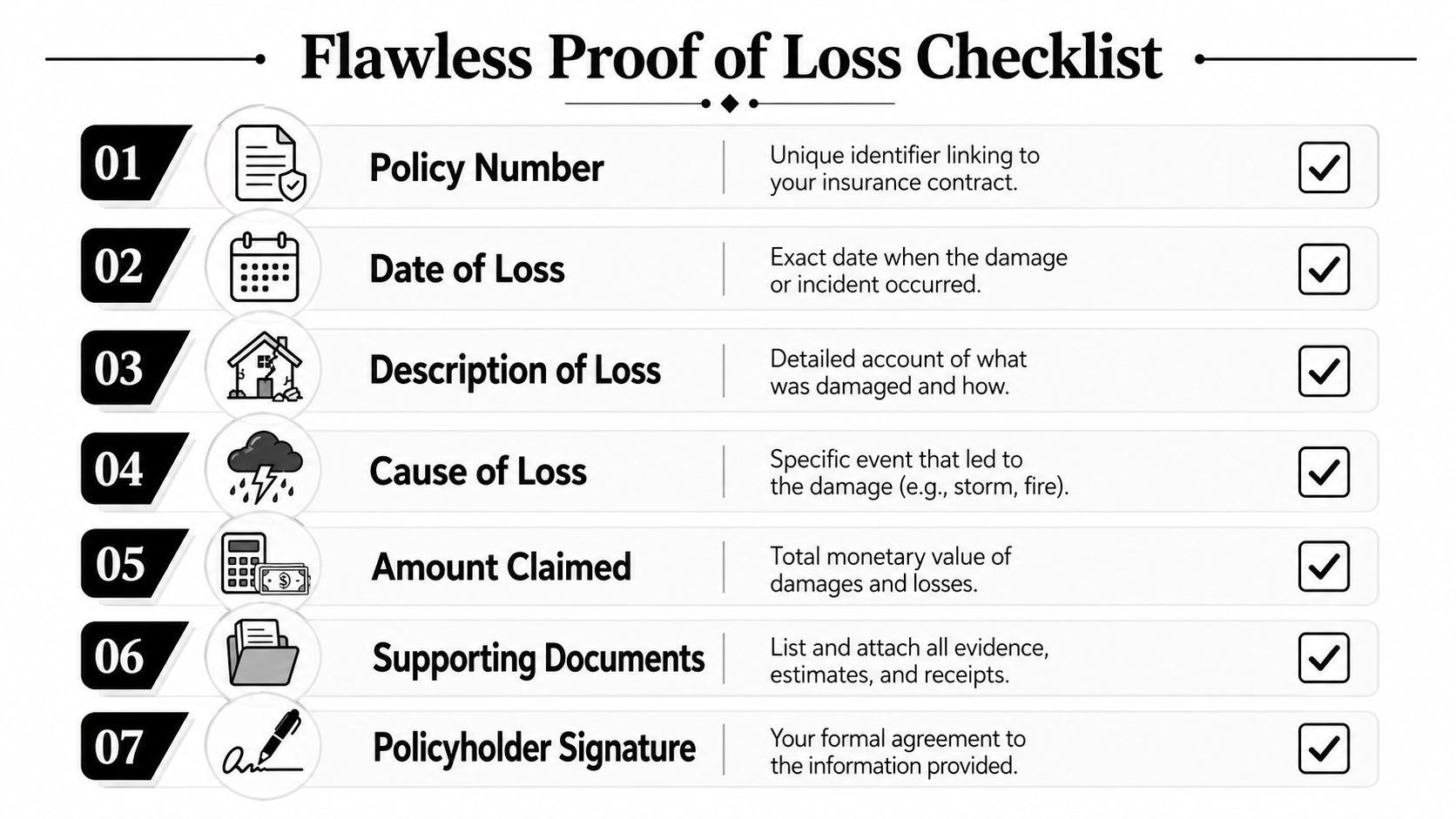
Most Proof of Loss forms look intimidating because they mix legal language with claim details. Strip that away, and the form is really a checklist. Every field exists for a reason. If you understand what each part is doing, the document becomes much easier to complete correctly.
Identification fields you must get right
Start with the basics. These seem obvious, but errors here create needless problems.
- Policy number: This ties the form to the correct contract. One wrong digit can trigger delays or misfiling.
- Named insured: Use the insured name as it appears on the policy, not a nickname or shorthand.
- Property address: Make sure it matches the loss location tied to the claim.
- Date of loss: Be precise. If the loss unfolded over time, use the date the loss occurred or was discovered in a way that matches the claim record.
The loss description section
Many people become too brief here.
Don't write “water damage throughout house” if the actual loss involved a failed supply line that affected the kitchen, hallway, lower-level ceiling, insulation, flooring, cabinetry, and contents. You want a description that is accurate, specific, and consistent with your photographs and estimates.
A good loss description answers these questions:
- What happened
- What areas were affected
- What types of property were damaged
- Whether the damage forced you out of the home
The amount claimed
This field carries the most weight. It is where homeowners are most likely to undershoot their claim or use numbers they can't support.
Your amount claimed should be built from evidence, not guesswork. That usually includes repair estimates, mitigation invoices, contents lists, receipts, photos, and housing expense records if you had to live elsewhere. If you haven't built a contents list yet, a structured personal property inventory template can help you document room-by-room losses in a way that supports the form.
Actual cash value and replacement cost
These terms confuse homeowners constantly.
Here's the practical distinction:
| Term | Plain-English meaning |
|---|---|
| Actual cash value | The value after accounting for age, wear, or depreciation. |
| Replacement cost | The cost to repair or replace with like kind and quality, subject to your policy terms. |
Your policy controls how these values apply, and the form may ask for one, the other, or both. Don't assume. Read the policy language and match your figures to the claim category being requested.
Common mistake: Homeowners copy the insurer's rough estimate onto the Proof of Loss form because it's the only number they have. If that estimate misses damaged items, your sworn submission may understate the claim before negotiations even begin.
Signature and notarization
A Proof of Loss form is often sworn. That means your signature may need notarization.
This isn't ceremony. It's what gives the document legal force. Don't sign before the form is complete, and don't sign in a rush on your kitchen counter while the adjuster is waiting on the phone. Review every line, every figure, and every attachment reference first.
A Step-by-Step Guide to Completing the Form
The right way to complete a Proof of Loss form is methodical. The wrong way is to fill in blanks from memory while your insurer is pressing for speed. You need a process.

Step one: gather the full claim file
Before you touch the form, assemble your support.
That usually includes your policy, the insurer's request for the form, contractor estimates, emergency mitigation invoices, receipts, photos, videos, contents inventories, and any temporary housing records. If you have multiple categories of damage, organize them by building, contents, and extra living expenses rather than stuffing everything into one folder.
Use a simple evidence stack:
- Damage evidence: Photos, videos, inspection notes
- Repair pricing: Contractor estimates, mitigation bills, specialist reports
- Personal property support: Inventory, receipts, credit card records, product photos
- Displacement costs: Lease records, hotel bills, meal records where applicable under the policy
Step two: calculate before you write
Never use the form to “figure out” your numbers. Calculate them first.
Your figures should come from a valuation method you can defend. If you're still sorting out how actual cash value, replacement cost, and depreciation affect your numbers, this guide to loss valuation methods is worth reviewing before you finalize the form.
Step three: fill out the facts, then verify consistency
Complete the identifying details first. Then write the loss description. Then insert the claimed amount. That order helps because it keeps you from jumping straight to the dollar figure before the narrative and supporting documents are aligned.
Check consistency across these items:
- Dates: The date on the form should match the claim timeline and reports.
- Cause of loss: Don't call it “storm damage” in one place and “roof leak” in another if those descriptions imply different causes.
- Scope of damage: The areas listed on the form should match the estimate and photo set.
- Amount claimed: Every major number should be traceable to a document.
Step four: attach support that actually proves the claim
More paperwork isn't always better. Better paperwork is better.
Create a clean attachment package. Label estimates. Group photos by room or area. Separate building damage from contents. If a contractor estimate includes assumptions, note them. If part of the loss remains under investigation, don't hide that. State it clearly and document what is known.
A strong attachment package often includes:
- A repair estimate
- A contents spreadsheet
- Invoices for emergency services
- Receipts for out-of-pocket expenses
- A brief cover letter identifying the attachments
Send a package that a skeptical reviewer can follow in minutes. If the adjuster has to decode it, you've made your own claim harder.
Step five: notarize it correctly
If the insurer's form requires a sworn statement, sign it in front of a notary. Don't pre-sign it. Don't leave blank sections for someone else to complete later.
Keep the signed copy exactly as submitted. Scan it before sending.
Step six: submit with proof of delivery
Email is convenient, but convenience is not the same as proof. If you submit by email, keep the sent message and attachments. If you mail it, use a delivery method that creates a record.
Your file should contain:
| What to keep | Why it matters |
|---|---|
| Signed copy of the form | Shows exactly what you submitted |
| All attachments | Preserves your support package |
| Delivery confirmation | Helps if the insurer later claims non-receipt |
| Follow-up email or letter | Creates a paper trail |
Step seven: don't go silent after submission
After the form is sent, watch the insurer's response carefully. If they ask questions, insist on specifics. If they say the form is incomplete, ask exactly what they believe is missing. Don't let vague criticism sit in the file unanswered.
Silence helps the carrier, not you.
Proof of Loss Rules for Oregon and Washington
Policyholders often get tripped up when insurers talk about deadlines as if they are whatever the company says they are. They aren't.
Oregon gives homeowners an important protection. Under Oregon law, if an insurer requires a proof of loss, the insurer must provide the form and specify the 60-day deadline, which gives policyholders a clear timeframe to comply under ORS 742.061. That matters because it limits the insurer's ability to play games with vague or shifting demands.
What Oregon homeowners should do with that rule
If you're in Oregon, check for two things the moment the insurer requests a Proof of Loss form:
- Did the insurer provide the actual form?
- Did the insurer clearly specify the deadline?
If either piece is missing, don't assume the carrier's informal email language is enough. Ask for the form and the deadline in writing.
Why this matters in the real world
Some insurers rely on urgency and confusion. They send an email asking for a sworn proof, but they don't clearly frame the request, don't provide a proper form, or use loose language that makes the deadline sound immediate. That creates pressure, and pressure leads homeowners to sign weak submissions.
Oregon policyholders should not accept that kind of ambiguity.
What about Washington
Washington policyholders should also expect the insurer's request to be clear, written, and tied to the policy language. The practical rule is straightforward: don't rely on verbal instructions, assumptions, or casual deadlines relayed by phone.
If you own property in Washington, insist on the following before submitting:
| What to confirm | Why you should confirm it |
|---|---|
| The insurer-specific form | Carriers often want their own version completed |
| The exact due date | You need a written date, not a vague “as soon as possible” |
| What categories to include | Building, contents, and expense claims may need separate support |
| Whether notarization is required | Many forms are sworn and must be signed properly |
The safest approach in both states is the same. Get the request in writing. Read the policy. Match your submission to the insurer's formal demand, not to an adjuster's offhand comment.
If the insurer wants a sworn document that can affect payment, you're entitled to clear written instructions. Ask for them.
Common Insurer Pitfalls and How to Avoid Them
Insurers don't need to deny a claim outright to limit what they pay. Often they just need you to submit a weak Proof of Loss form. That gives them an advantage.
Experience matters. The carrier knows which errors show up over and over. Homeowners usually don't. I've seen the same traps repeated in different forms with different adjusters, and the pattern is consistent. Rush the insured, narrow the claim, then treat the form as if it defines the entire loss.
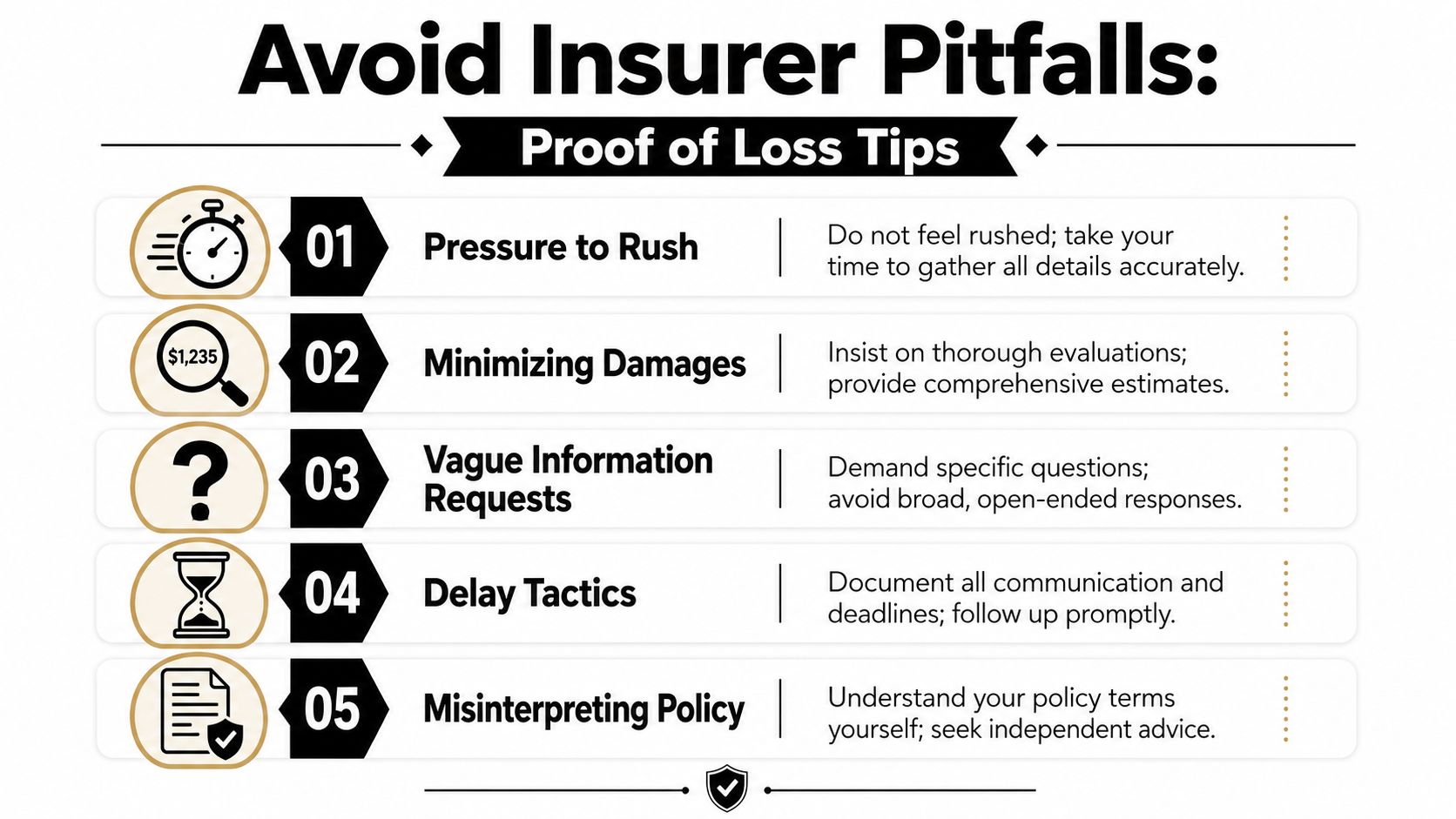
The pressure tactics to expect
Some tactics are subtle. Others are blunt.
- A pre-filled low number: The adjuster sends a form with the carrier's estimate already inserted and asks you to sign it “to move things along.”
- An informal rush: You're told they need it back immediately, even when the written request doesn't say that.
- A blank signature request: Someone suggests you sign now and they'll complete the details later.
- A shifting standard: After submission, the insurer suddenly claims your support wasn't enough, even though they never said what they wanted in the first place.
None of that helps you. It helps them manage the claim downward.
How to protect yourself
Use a defensive routine every time.
- Never sign a blank form. Not partially blank. Not “mostly done.” Blank is unacceptable.
- Refuse unsupported numbers. If the amount claimed doesn't come from documents, it doesn't belong on the form.
- Keep a complete copy. Form, attachments, email, delivery proof. Everything.
- Demand specifics. If the insurer says your form is deficient, ask them to identify the exact missing item or inconsistency.
- Correct the record quickly. If the adjuster misstates your position in writing, respond in writing.
The trap homeowners miss most often
The biggest trap isn't always the deadline. It's the assumption that cooperation means agreement.
You can cooperate fully and still reject the insurer's low estimate. You can submit documents promptly and still dispute their scope. You can answer questions and still protect your claim.
If the carrier sends a partial estimate and wants you to swear that it represents your full loss, stop. That's not routine paperwork. That's a strategic move.
If the claim later expands because hidden damage appears, code issues surface, or the first estimate was incomplete, you may need additional documentation or a supplemental presentation. Understanding an insurance claim supplement becomes useful, because many losses are not fully visible when the first paperwork is filed.
Cooperation is good. Surrendering your valuation is not.
When to Engage a Public Adjuster for Your Proof of Loss
Some claims are manageable with careful documentation and patience. Others are too large, too technical, or too adversarial to handle alone. You don't need to hire help for every claim. You do need to recognize when the stakes justify it.
The situations that call for help
You should strongly consider bringing in a public adjuster if any of these are true:
- The loss is major: Fire, widespread water damage, structural impact, or a large commercial property loss.
- The numbers are disputed: The insurer's estimate plainly misses rooms, materials, or categories of damage.
- The documentation burden is overwhelming: You're trying to inventory contents, coordinate contractors, and live somewhere else at the same time.
- The carrier's instructions are inconsistent: One adjuster says one thing, a desk examiner says another, and nobody will put clear guidance in writing.
- You're being pushed to sign a valuation you don't agree with: That is exactly when representation matters.
What a public adjuster actually does
A public adjuster works for the policyholder, not the insurer. On a Proof of Loss form, that means documenting the damage, developing support for the amount claimed, organizing the submission, and negotiating from a file that can stand up under scrutiny.
If you need that kind of representation, review what a licensed public adjuster does before you decide how to proceed. In Oregon and Washington, that role can be especially valuable when the claim involves complicated policy language, hidden damage, or an insurer that keeps moving the target.
One clear recommendation
If you're losing sleep over whether the number on the form is wrong, the claim is already serious enough to justify professional review. One option is NW Claims Management, a Portland-based public adjusting firm that represents policyholders in Oregon and Washington and handles claim documentation, valuation, and negotiation.
You don't need help because you're incapable. You need help because the insurer deals with this system every day. Most homeowners don't.
Frequently Asked Questions About Proof of Loss Forms
What happens if I miss the deadline
Deadlines on a Proof of Loss form are not clerical details. They are one of the insurer's cleanest denial arguments.
Miss the date, and the carrier may claim you failed to meet a policy condition. In Oregon and Washington, that risk gets worse when the insurer has been stringing the investigation along and then suddenly demands a sworn form on a short clock. Watch the date in the letter, the date in the policy, and the date the insurer says the form is due. If those do not line up, press for clarification in writing immediately.
If you need more time, ask for an extension before the deadline expires. State the reason, request a written response, and keep proof that you sent it.
Can I revise a Proof of Loss form later
Sometimes, yes.
Large property losses develop over time. Drywall comes out. Moisture damage appears. Contractors find code upgrade issues. Prices change. A supplemental claim may be possible, but do not assume the insurer will treat a revision kindly just because the damage was not obvious on day one.
Carriers often use the first signed Proof of Loss as an anchor. If your original number is too low, they may point back to it later and argue that you already swore to a smaller loss. Submit the strongest documented claim you can the first time. Then, if new damage appears, notify the insurer in writing and ask exactly how they want the supplemental amount presented.
Does signing the form mean I'm accepting the insurer's payment
Usually no, but read every page before you sign anything.
A Proof of Loss is your sworn statement of the amount claimed. A release or settlement agreement is what usually closes the claim. Insurers sometimes send multiple documents at once and count on homeowners to sign quickly. That is how people give up rights they never meant to waive.
Read the title of each document. Read the fine print. If the form includes release language, stop and review it carefully before signing.
What's the difference between sworn and unsworn
A sworn Proof of Loss is signed under oath, often notarized. An unsworn submission gives claim information without that oath.
Treat a sworn form like testimony. If a number is uncertain, resolve it before you sign. If a category of damage is still being investigated, do not guess. Insurers can use inaccurate sworn statements to attack your credibility, even when the mistake was innocent.
Should I use the insurer's estimate as my amount claimed
No, not unless you have checked it line by line and confirmed it reflects the full loss.
Carrier estimates often miss rooms, omit overhead and profit, underprice materials, or leave out work that becomes obvious only after demolition. That pattern shows up constantly in Oregon and Washington claims. The first estimate is often a cost-control document, not a full valuation of what it takes to put the property back.
Your Proof of Loss should be based on your documented damage and your supporting numbers. It should not be a copy of the insurer's draft.
What if the insurer says my form is incomplete
Make them identify the problem precisely.
Ask for the exact field, attachment, figure, or category they claim is missing. General complaints about an "incomplete submission" are often used to keep the clock running while the insurer avoids taking a clear position. Specific objections can be answered. Vague ones should be challenged in writing.
Keep that exchange in your file. It matters.
Should I send original receipts and originals of signed paperwork
Keep the originals unless the insurer specifically requires them and you have confirmed how they will be handled.
Send copies, keep a complete claim file, and preserve proof of delivery. That file should include the signed Proof of Loss, estimates, receipts, photos, emails, letters, and notes of every call. If the claim turns into a coverage dispute or appraisal fight, your records will carry real weight.
If you are stuck on the numbers, unsure about the wording, or worried that the deadline is being used against you, get professional review before you sign. NW Claims Management assists policyholders in Oregon and Washington with documenting property losses, preparing claim support, and negotiating from the policyholder's side.