The most common advice after smoke exposure is simple: if you can't see soot and the smell is fading, the house is probably fine. That advice is incomplete and can leave both homeowners and insurers looking at the wrong evidence.
Smoke can move through HVAC systems, wall cavities, penetrations, contents, and porous finishes. It can also leave chemical residues and fine particles that aren't obvious during a quick visual inspection. In one controlled study of a smoke-contaminated house, volatile organic compounds decreased slowly over about five weeks, beginning ten days after the fire, and average indoor VOC levels fell only to about 20% of the initial indoor value. Another study found that some compounds off-gassed in less than ten days, while naphthalene and C12 aromatics remained above background for at least three months. Chemical and Engineering News
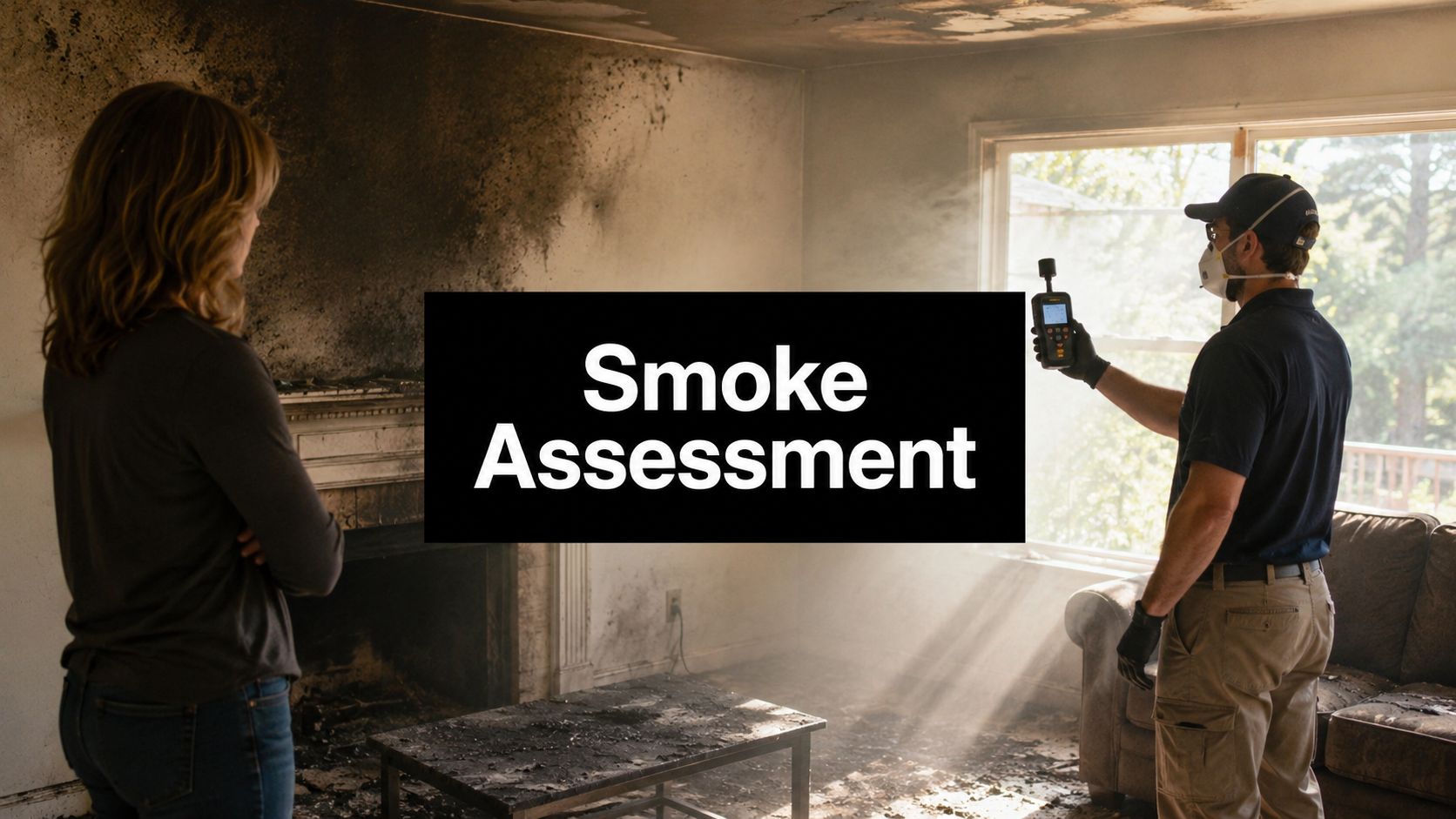
A defensible smoke damage assessment therefore needs more than photographs of discolored walls. It should connect visible residue, air and particulate measurements, surface findings, building airflow, HVAC conditions, contents, and the cost of restoring the property. That record matters when the first insurance inspection focuses only on the burned room or treats lingering odor as a cosmetic issue. Homeowners can also review broader post-fire claim steps in this guide to what to do after a house fire, but smoke-specific evidence deserves its own careful treatment.
Why Visible Soot Is Only the Beginning
Smoke damage doesn't stop where the flames stopped. It follows air pressure, temperature changes, ductwork, cracks, plumbing penetrations, and other pathways through the structure. A bedroom untouched by flames may still contain residue on its ceiling, inside its return-air pathway, or within textiles that absorbed smoke during the event.
The nose isn't a reliable measuring instrument. Odor can remain after some residues have been removed, and dangerous contamination may exist where odor is weak or absent. Wildfire smoke guidance warns that indoor contamination can include chemical residues such as polycyclic aromatic hydrocarbons and heavy metals, with professional evaluation sometimes requiring testing before and after cleaning to define the work and verify its effectiveness. Los Angeles County Department of Public Health guidance
What a quick walkthrough misses
A cursory inspection often records what's easiest to photograph:
- Dark soot on walls
- Yellowing around vents
- A visible smoke odor
- Damaged furniture near the fire
Those observations matter, but they don't establish the full contamination boundary. A professional assessment should identify direct fire damage, smoke-only areas, odor migration, residue on horizontal and vertical surfaces, HVAC contamination, contents exposure, and concealed voids.
The distinction has financial consequences. If an adjuster writes a scope only for repainting a visibly stained room, the estimate may omit duct cleaning, insulation removal, wall-cavity access, contents handling, specialized cleaning, deodorization, or post-cleaning verification.
Practical rule: Treat visible soot as evidence of contamination, not proof of its limits.
Why testing changes the conversation
Air testing and particulate monitoring can show whether indoor conditions changed during a wildfire event, even when exterior burn severity doesn't explain the indoor findings. Surface sampling can help identify residue where visual evidence is ambiguous. Testing won't replace professional judgment, but it gives the claim a technical record that odor complaints alone can't provide.
The California study described in the verified research used observations from more than 1,400 buildings and found that average indoor PM2.5 nearly tripled during wildfire events, rising from 4.1 µg/m3 on non-fire days to 11.1 µg/m3 on fire days. The same study found the geometric mean infiltration ratio for outdoor-origin PM2.5 fell from 0.4 on non-fire days to 0.2 on wildfire days, showing why building-specific infiltration conditions matter. California indoor air study
The central question isn't “Can I see smoke damage?” It's “Can the inspection show where smoke traveled, what it left behind, and what work will remove or contain it?”
Types of Smoke Residue and What They Mean for Your Property
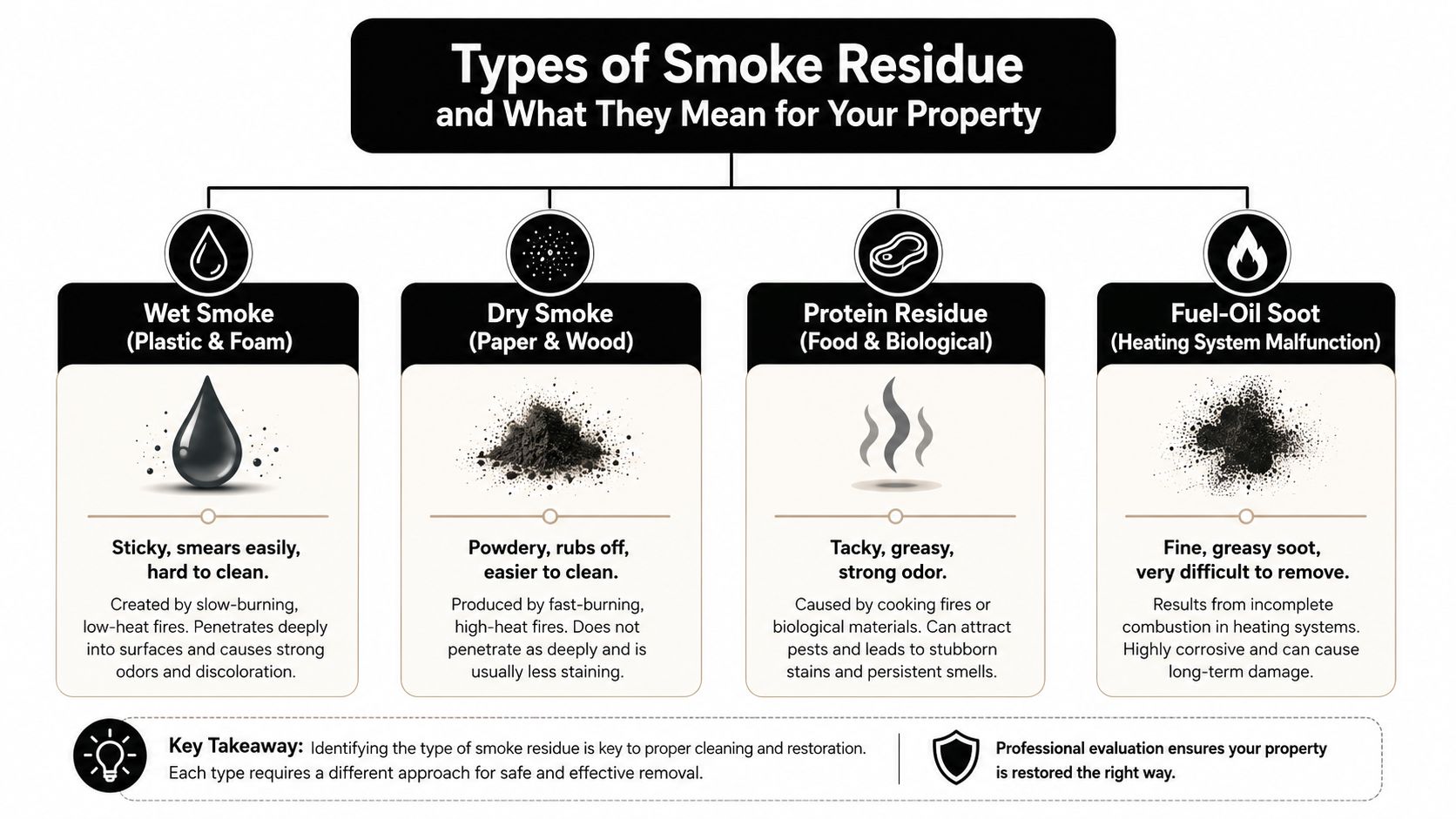
Different fuel sources produce different residues. The label matters because a powdery deposit on painted drywall may respond to a different method than a sticky film on cabinets, and neither should be treated like protein residue from a kitchen fire.
Wet smoke
Wet smoke commonly comes from burning plastics, foam, rubber, and other materials that produce a dense, sticky residue. It smears easily, penetrates porous finishes, and can make amateur wiping worse by spreading contamination across a larger surface.
Restoration teams may need controlled agitation, carefully selected cleaning agents, content separation, and access to areas where the film settled. Cabinets, vinyl, upholstery, insulation, and HVAC components deserve close attention because a surface that looks clean can still retain odor or residue.
Dry smoke
Dry smoke, often associated with paper and wood, tends to produce a lighter, powdery deposit. It may be easier to remove from some hard surfaces, but that doesn't make it harmless or automatically limited to the room of origin.
Fine particles can enter gaps, fabrics, dust reservoirs, and ventilation pathways. A dry residue that wipes away from a wall may remain in carpet backing, drapery, or an air-handling component. The assessment should record the surface, material, cleaning method, and whether the item is salvageable.
Protein residue
Protein residue can result from food or biological materials. It may produce limited visible soot but a strong, persistent odor, which creates a frequent documentation problem. Homeowners may assume that low visibility means low scope, while the actual work may involve odor source identification, contents treatment, and cleaning of affected surfaces.
Fuel-oil soot
Fuel-oil soot can arise from a heating-system malfunction and may deposit around equipment, registers, and airflow routes. The inspection should connect residue patterns to the appliance, ductwork, filters, and nearby contents rather than treating each mark as an isolated stain.
Why particle size and deposition matter
Thermophoresis causes soot to move toward and settle on cooler surfaces. That helps explain why residue may appear around temperature differences, exterior walls, ceilings, or metal components rather than forming a simple ring around the ignition point. Technical inspection guidance also notes that soot particles are often about 2.5 microns or smaller, while particles at 5 microns or below can reach the lower lung and deep alveolar region. Particles around 10 microns or larger are more likely to be trapped in the upper airway. Rimkus fire-damage inspection guidance
Those measurements don't determine the claim by themselves. They do explain why residue type, particle size, material porosity, and HVAC conditions should appear in the assessment record. If occupants use portable filtration while waiting for evaluation, a resource such as smoke air purifiers at EcoQuest may help with airborne particles, but an air purifier doesn't clean contaminated drywall, insulation, ducts, furniture, or hidden cavities.
The Technical Inspection Process and Tools
A defensible inspection begins with building conditions, not a repair estimate. The assessor should establish where smoke entered, how air carried it, which materials it contacted, and whether contamination can continue to migrate through the structure.
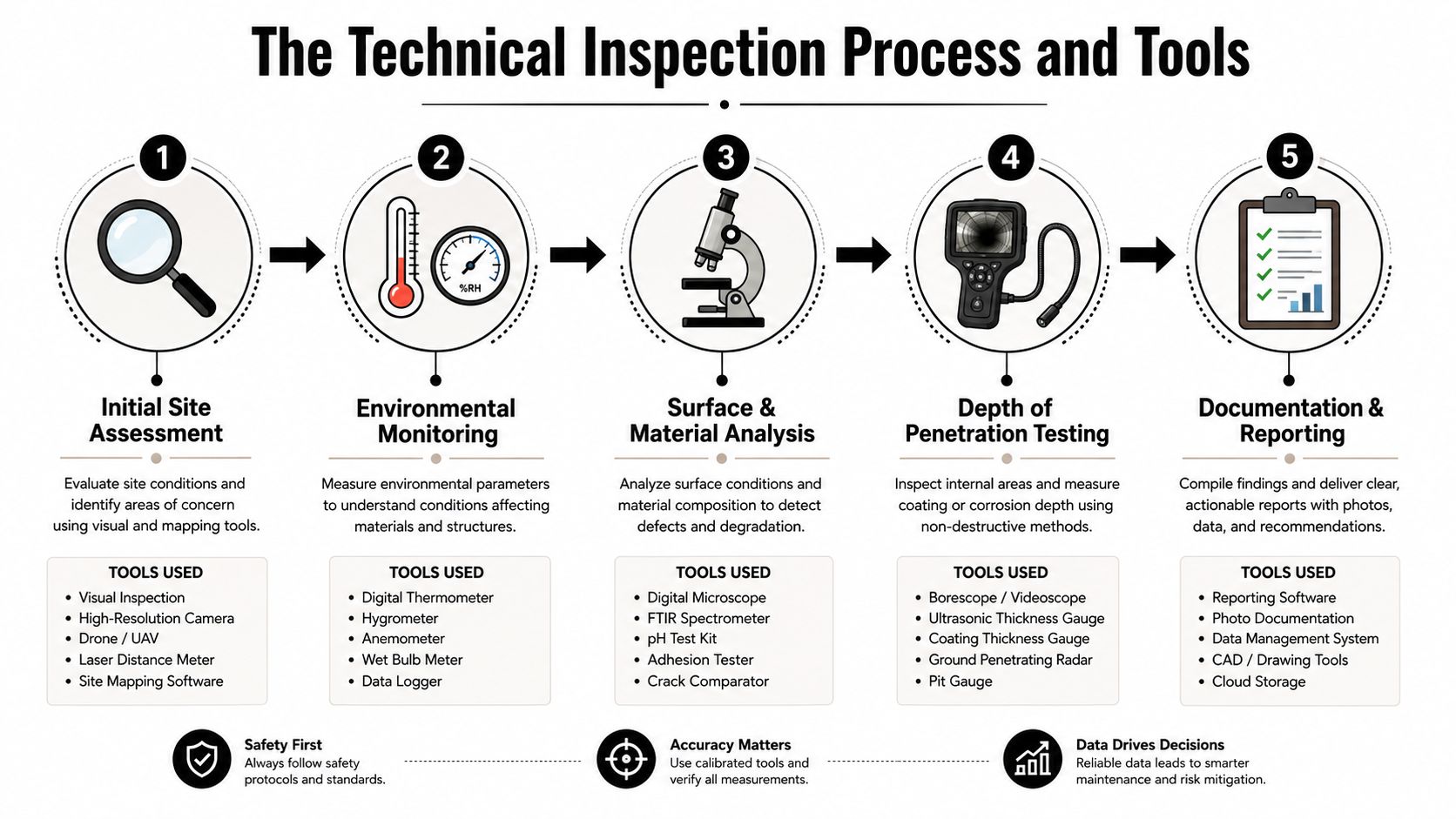
Establish the site conditions
The first pass should record the fire origin, exterior openings, visible residue, damaged finishes, contents, HVAC layout, and water or structural damage caused by firefighting. Photograph rooms before cleaning. Note power, ventilation, access restrictions, and any condition that limits the inspection.
Thermal imaging can reveal temperature differences, missing insulation patterns, damp areas, and concealed conditions requiring closer examination. It does not identify smoke directly, so each image must be interpreted with photographs, material observations, and other readings.
Moisture meters matter wherever suppression water, firefighting, or weather exposure affected the building. Moisture can change the restoration sequence and create a separate damage category. Document it separately rather than folding it into an unsupported smoke-cleaning estimate.
Measure the indoor environment
Particulate counters allow room-to-room comparisons and can help identify whether HVAC operation or pressure differences are transporting particles. Temperature and humidity readings add context for odor, material behavior, and measurement reliability.
Odor checks should be performed room by room. A useful report identifies intensity, suspected source, and whether the odor is present in air, contents, wall surfaces, or mechanical systems. Persistent odor may indicate chemical residue or contaminated porous materials even when visible soot is limited.
Homeowners investigating persistent odors can review chemical smell in house solutions for general troubleshooting context. That information does not replace a fire-loss assessment, particularly where smoke residue or HVAC contamination may be involved.
Inspect surfaces, cavities, and air pathways
Chemical sponges and other surface tools can collect or characterize residue that visual inspection misses. Check horizontal and vertical surfaces, ceilings, trim, cabinet interiors, attic or crawlspace connections, wall penetrations, return-air grilles, filters, coils, and accessible duct interiors.
Airflow and pressure pathways can carry contamination beyond the room nearest the fire. A closed door does not establish a clean boundary, and HVAC components may require separate inspection, cleaning, or testing.
The property inspection checklist can help homeowners organize rooms, observations, photographs, and suspected damage. The final scope should follow professional findings and material-specific cleaning requirements.
A strong report includes floor plans or room maps, location-labeled photographs, instrument readings, residue descriptions, HVAC observations, contents categories, concealed-area findings, and a clear distinction between confirmed damage and recommended testing. That record gives the adjuster a traceable basis for evaluating work that soot alone cannot explain.
Health Risks and Hidden Contamination Beyond the Burn Area
Reoccupancy depends on who will live in the property and what remains in the air, surfaces, and mechanical systems. Children, older adults, and people with respiratory conditions may have less tolerance for lingering particles or chemical vapors. A clean-looking room does not answer those health questions.
Wildfire smoke can enter through gaps around windows and doors, then circulate through a central return-air system. Filters, duct dust, upholstered furniture, cabinets, and ceiling surfaces may retain evidence of exposure even where discoloration is slight or absent.
Indoor air changes during smoke exposure
Indoor particle levels can rise during wildfire events as outdoor smoke infiltrates the building. Filtration, mechanical ventilation, window operation, pressure differences, building tightness, and HVAC runtime affect both the amount entering and the areas receiving it. The Findings on indoor particulate exposure provides relevant context for evaluating indoor particulate exposure.
Inspection should connect occupant concerns to observable conditions. Record odors, visible residue, settled dust, ventilation settings, filter status, and any symptoms reported after exposure. Persistent odor alone does not prove a health hazard, but it supports further examination when paired with residue, HVAC findings, or failed cleaning.
HVAC systems need their own scope
An HVAC system can collect and redistribute particles. Replacing a filter may help, yet it does not resolve contamination on grilles, coils, air handlers, insulation, duct interiors, or dust reservoirs.
The assessor should document the system type, filter condition, operating status, return and supply locations, visible residue, and evidence of airflow between affected and apparently unaffected rooms. Porous components that cannot be cleaned effectively may require replacement, with the condition and proposed work clearly supported in the report.
Homeowners seeking general context on indoor-air testing can review Mesa indoor air quality. The claim should still rely on property-specific findings. A detailed contents restoration service assessment can classify belongings as cleanable, questionable, or unsalvageable and document the handling required for each category.
Reoccupancy requires documented criteria
No single smell check establishes that a home is ready for occupancy. The decision should consider air measurements, residue removal, HVAC condition, chemical findings, ventilation, occupant vulnerability, and whether restoration work continues to release particles or vapors.
Temporary relocation may be reasonable when contamination persists or cleaning has not been verified. Document who recommended restricted occupancy, the evidence reviewed, the unresolved sources, and the conditions required before return. That record protects health decisions and gives the insurer a clear basis for evaluating related restoration and living expenses.
Your Immediate Action Checklist After Smoke Exposure
The first priority is safety. Don't enter a fire-affected structure until emergency personnel or an appropriate professional has cleared it, and don't assume a structure is safe because flames are out.
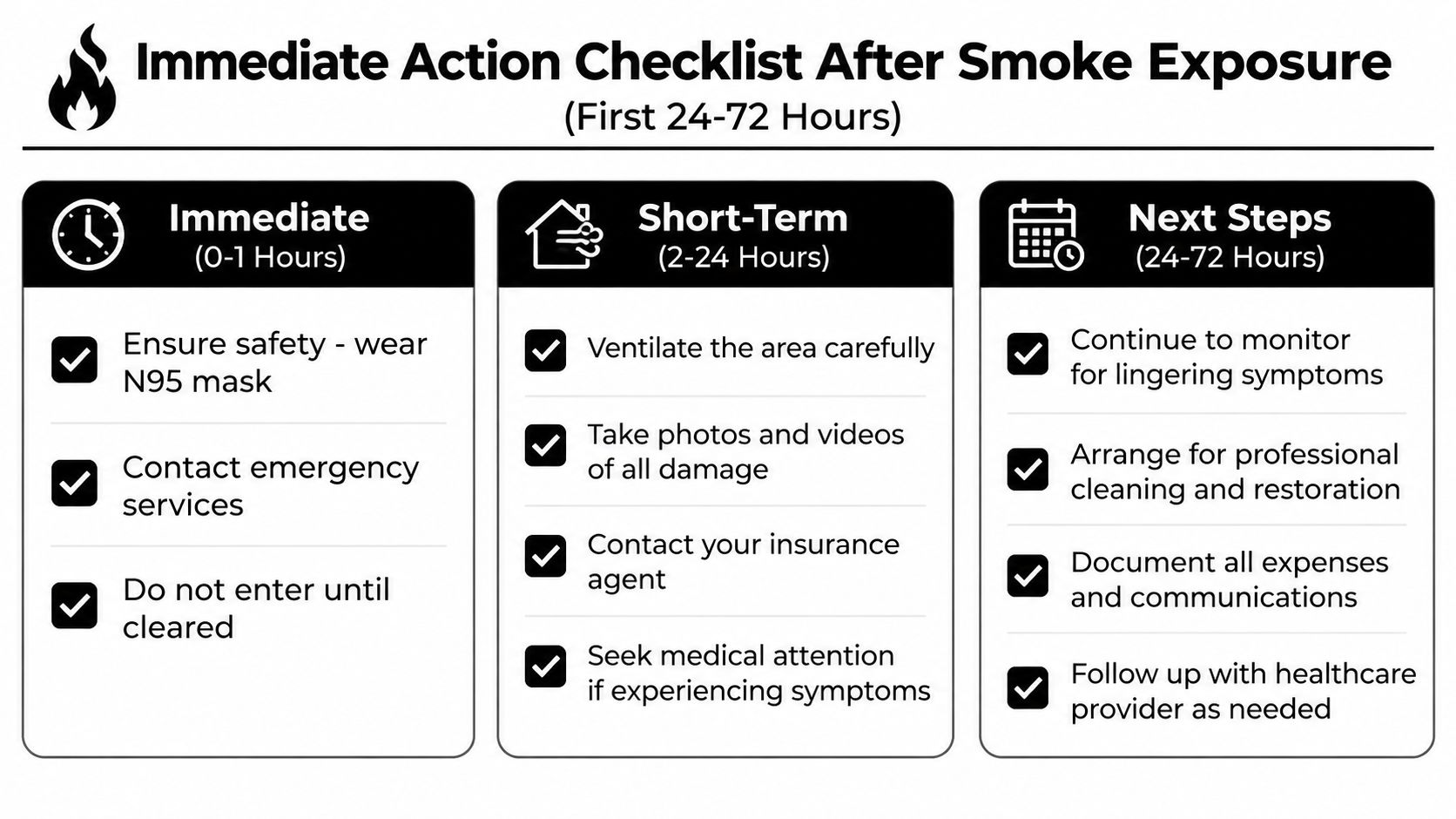
Immediate actions
- Protect people first: Follow fire officials' instructions, keep children and pets away, and use appropriate respiratory protection if authorities permit limited entry.
- Preserve the scene: Don't scrub soot, run fans through contaminated rooms, discard contents, or alter HVAC equipment before documenting conditions.
- Prevent additional damage safely: If professionals confirm it's safe, protect openings from weather and shut down systems that may distribute smoke, but don't take electrical or structural risks.
- Start a loss log: Record dates, observed odors, room conditions, expenses, temporary housing needs, and conversations with insurers or contractors.
Build the first record
Take wide photographs that establish the room, then closer images of surfaces, vents, filters, contents, ceilings, floors, and visible residue. Keep the original files, avoid editing them, and make notes identifying the room and approximate location.
Notify the insurer promptly and ask for written instructions about emergency work, inspection access, mitigation authorization, and personal property handling. Prompt notice doesn't mean accepting a narrow scope. It means creating a clear record that the carrier had an opportunity to inspect.
Avoid claim-damaging shortcuts
Don't use household cleaners on unknown residue. Wet cleaning can smear some soot types and push contamination deeper into porous materials. Don't rely on candles, fragrance products, or a single portable purifier to prove that the property has been restored.
Keep receipts for reasonable emergency expenses and maintain a list of anything moved, cleaned, discarded, or stored. Before disposal, photograph the item and seek written direction where possible.
Documentation That Moves Insurance Claims Forward
Insurance claims respond to evidence, not just severity. A room that looks lightly affected can require a substantial scope if the record shows smoke migration, contaminated contents, HVAC involvement, persistent VOCs, or cleaning that can't restore a porous material.
The strongest file separates what was observed, what was measured, what was tested, and what work is necessary. That distinction prevents an adjuster from treating a recommendation as proof of damage, while also preventing invisible conditions from disappearing because they weren't photographed.
What the file should contain
- Room-by-room photographs: Show wide views, close-ups, vents, ceilings, floors, cabinets, contents, and concealed-access points.
- A contamination map: Mark direct fire areas, smoke-only zones, odor locations, HVAC pathways, and areas requiring testing.
- Instrument records: Preserve particulate, temperature, humidity, moisture, and other readings with the room, date, equipment, and conditions identified.
- Residue documentation: Describe color, texture, transfer, suspected source, surface type, and the proposed cleaning method.
- Contents inventory: List affected items, condition, location, cleaning potential, replacement basis, and photographs.
- Scope logic: Connect every task to a finding, such as duct cleaning to HVAC residue or wall access to concealed smoke migration.
- Temporary expense records: Save invoices and receipts for lodging, cleaning, storage, protective equipment, and other reasonable loss-related costs.
What insurers scrutinize
An insurer may question a scope that uses one generic cleaning line for an entire property, recommends replacement without material-specific reasoning, or reports odor without identifying a source. The same applies to air testing that lacks baseline context, photographs without locations, and estimates that don't distinguish fire damage from smoke contamination.
Ask for the carrier's inspection report and compare it against your own room map. If the report omits rooms, contents, ductwork, or concealed spaces, respond in writing with the missing evidence and request a supplemental inspection.
Documentation rule: Every major line item should answer three questions. What was found, where was it found, and why is this treatment required?
Preserve original evidence before remediation begins. Evidence preservation guidance can help organize photographs, records, samples, and communications so the claim doesn't depend on memory after cleaning changes the scene.
When to Handle It Yourself Versus Hiring a Public Adjuster
A straightforward claim may be manageable without representation. If one room has limited cosmetic soot, the source is clear, contents are simple, the insurer accepts the affected areas, and you're comfortable reviewing estimates and negotiating, direct handling may be practical.
The calculation changes when contamination extends beyond the visible area. Smoke-only rooms, HVAC involvement, extensive contents, disputed testing, temporary relocation, structural repairs, or a denied claim create more opportunities for scope gaps.
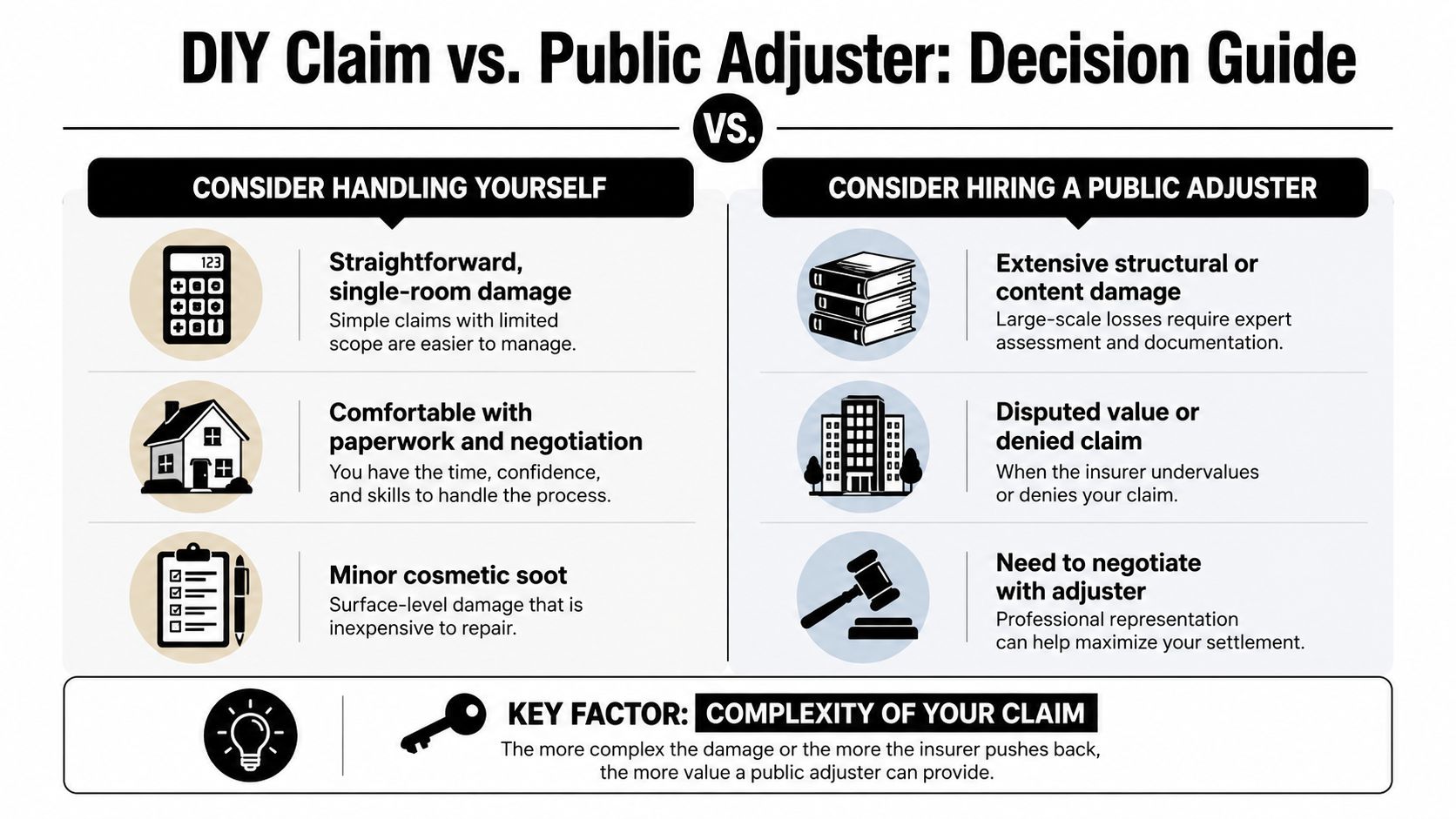
A practical comparison
| Consider handling the claim yourself | Consider hiring a public adjuster |
|---|---|
| The damage is limited and easy to inspect | Smoke has migrated through multiple rooms |
| The carrier accepts the basic scope | The carrier's inspection appears incomplete |
| Contents are limited and well documented | Contents, HVAC, or concealed cavities are disputed |
| You can manage calls, records, and estimates | You need someone to coordinate valuation and negotiation |
| You understand the policy and deadlines | Coverage, causation, or settlement value is contested |
Oregon and Washington homeowners should verify that any public adjuster they consider is licensed for the applicable state and provides a clear written agreement. Fee arrangements vary, and contingency-based compensation means the representative's fee is tied to the claim outcome, so ask exactly how the fee is calculated and what services it covers.
When representation adds value
A public adjuster can organize the loss, interpret policy language, coordinate technical documentation, evaluate structure and contents, and negotiate with the insurer. That can be particularly useful when the carrier accepts fire damage but rejects smoke-only contamination, limits cleaning to visible soot, or treats persistent odor as insufficient proof of a covered loss.
NW Claims Management is one Oregon and Washington option that provides claim evaluations and represents policyholders in property claims, including assessments involving smoke infiltration, soot residue, and odor remediation. Homeowners can review additional criteria in this guide on when to hire a public adjuster.
Don't hire representation solely because the word “smoke” appears in a report. Hire help when the claim's complexity, disputed scope, or documentation burden exceeds what you can manage confidently.
Common Questions About Smoke Damage Assessment
How long can smoke contamination remain indoors?
Persistence depends on the compound, material, ventilation, and cleaning. Some VOCs decline slowly over weeks, while compounds such as naphthalene and C12 aromatics can remain above background for at least three months. Odor alone cannot establish that contamination has cleared, so document testing, affected materials, and cleaning results.
Is an air purifier enough?
No. Filtration can reduce airborne particles, but it does not remove residue embedded in drywall, upholstery, insulation, contents, ducts, or wall cavities. Run air cleaners to reduce exposure while qualified professionals assess the property. Cleaner air is not proof that remediation is complete.
Can I move back in when the smell fades?
Do not base reoccupancy on smell alone. Request documented findings for air quality, residue removal, HVAC condition, chemical contamination, ventilation, and remaining sources. A home can retain particulate or chemical contamination after odor becomes faint.
What if the insurer's inspection seems incomplete?
Request the report and compare it with a room-by-room map. Respond in writing with omitted rooms, contents, HVAC components, readings, photographs, and testing needs. Preserve evidence before cleaning or disposal changes the loss.
Is smoke from a neighboring wildfire covered?
Check whether the policy covers smoke or soot as a covered peril and whether a deductible, exclusion, or causation requirement applies. For an Oregon or Washington home outside the burn area, document the wildfire event, wind direction, dates of smoke intrusion, HVAC operation, and residue or odor inside the property. Coverage still turns on the policy language and proof of direct interior damage, not the presence of regional haze.
NW Claims Management helps Oregon and Washington policyholders document smoke infiltration, soot residue, odor remediation, structural impacts, and contents losses for fire-related claims. Visit NW Claims Management to request a claim evaluation and discuss whether professional representation fits your situation.