You can have a roof that still stands, inventory still on the shelves, and employees still asking when to reopen, yet the cash keeps bleeding out. That's the moment business interruption coverage stops being a policy term and becomes survival math. If your doors are shut because the building can't operate, rent, payroll, loan payments, and other continuing costs don't pause just because revenue did.
I've seen owners fixate on the property damage and miss the worse problem. A fire upstairs, a utility failure, a road closure, or a collapse next door can turn a working business into a dead one overnight. If the interruption is covered, the policy is supposed to replace lost income and certain ongoing expenses while you're forced to sit still. If the wording is tight, the payout can be smaller than the shutdown you lived through.
That's why the first question isn't “Do I have coverage?” It's “How is this coverage calculated, what triggers it, and how long does it really pay?” Those are negotiation questions, not glossary questions.
When the Lights Stay Off but the Bills Keep Coming
The owner opens the front door at 7 a.m. and the bakery smells like smoke, even though the fire was in the unit above. The ovens are intact. The display case is untouched. The county inspector won't let anyone in, and the landlord says the building stays closed until repairs are done. Revenue stops immediately, but the lease doesn't.
That's the problem business interruption coverage is built to solve. It's there to replace the income a business would have earned if the loss hadn't forced a shutdown, and to help absorb continuing expenses that don't disappear just because the doors are locked. In practical terms, this is the cash bridge that keeps a business from running out of oxygen while the building is being repaired.
If you're dealing with roof damage, a storm event, or a building closure, a qualified contractor can help document the physical side of the loss. For a commercial owner facing that kind of damage, commercial roofing storm damage solutions can be part of the recovery picture because the repair timeline affects the interruption timeline.
Practical rule: if the damage keeps you from operating, the interruption claim is often worth as much attention as the repair estimate.
The money usually comes through a commercial property policy or a businessowners policy, but the protection only matters if the trigger, the records, and the timeframe line up. That's why BI isn't just about being “insured.” It's about whether the policy matches the way your business earns money and the way your building gets put back together.
What Business Interruption Coverage Actually Means
Business interruption coverage is income replacement during a covered shutdown. It's not paying to fix the roof, the wiring, or the walls. It's paying for the business that can't happen while those repairs are underway.
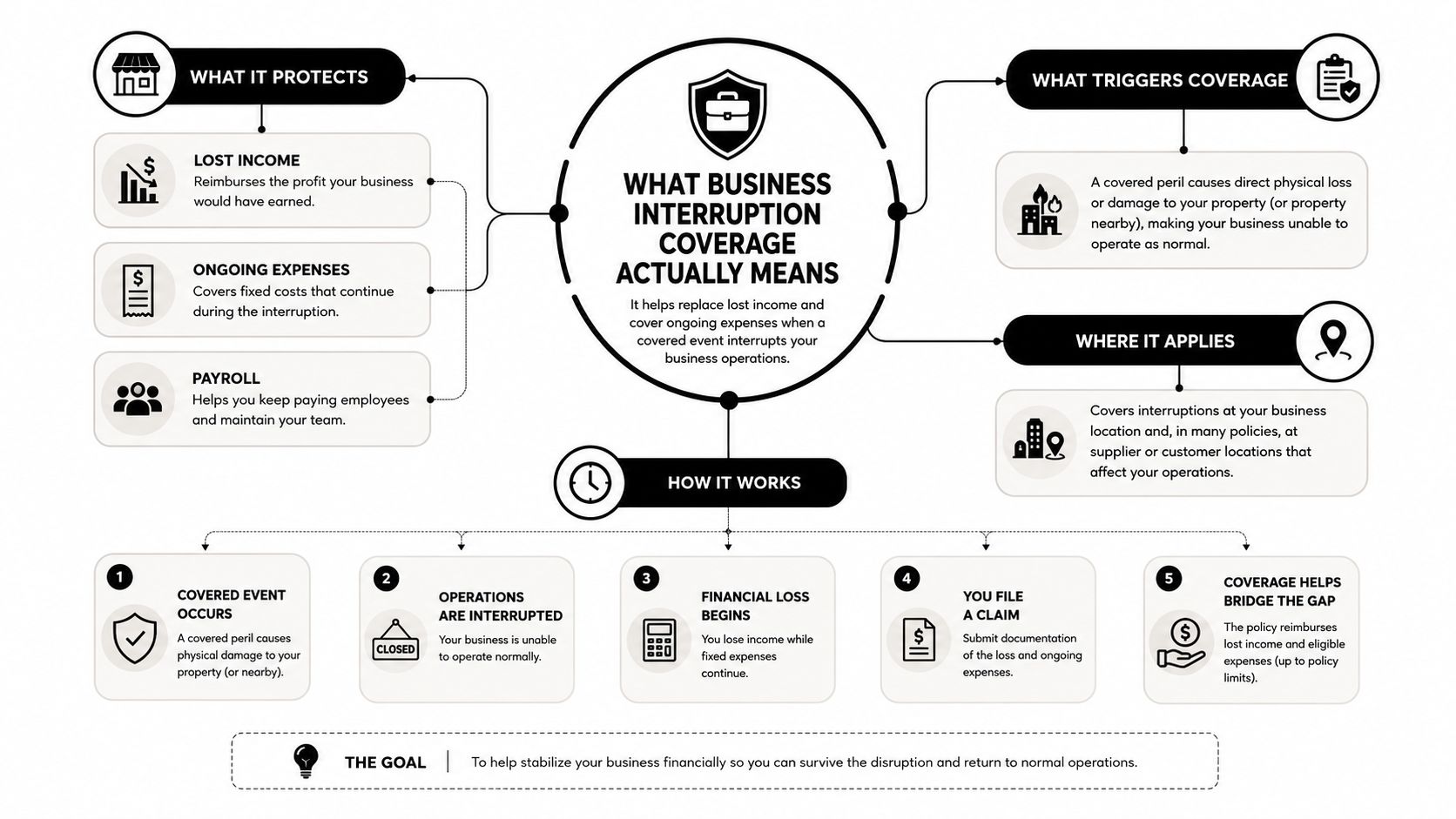
Business income, extra expense, and civil authority
Think of business income as the payroll and rent the business can't earn because it can't open. Think of extra expense as the cost of keeping the operation alive somewhere else, like temporary space, rented equipment, or emergency logistics. Think of civil authority coverage as the policy stepping in when a government order blocks access after nearby physical damage.
A simple way to read the declarations page is this:
- Business income replaces lost earnings tied to the interruption.
- Extra expense pays for added costs needed to keep operating or reopen faster.
- Civil authority can apply when access is restricted by order, not because your own building is the only one damaged.
Your own policy language controls the details, and that's where people get burned. Two policies can look similar on paper and behave very differently after a loss because one includes broader time element wording and one hides the key trigger in a narrow endorsement.
If you want the cleanest working definition, use this one. BI coverage is the financial backstop for the time your business can't function because a covered event has taken away the ability to operate normally.
For a plain-language breakdown of how extra costs fit into a claim, review extra expense coverage explained.
The Three Core Forms of BI Coverage
| Coverage Type | What Triggers It | Common Documentation |
|---|---|---|
| Standard BI | Physical damage to the insured property that shuts or slows operations | Income records, payroll records, lease or loan statements, repair timeline |
| Contingent BI | Damage to a dependent property, such as a supplier, buyer, or key service location | Supplier correspondence, order logs, customer impact records, delivery records |
| Civil Authority BI | Government restriction on access after nearby physical damage | Emergency orders, closure notices, proof of loss of access, local event records |
Standard BI
This is the form most owners think they have. Your own premises take the hit, and your own revenue drops because you can't operate. A burned office, flooded retail space, or closed production facility can trigger it if the policy language is satisfied.
The proof usually starts with your own books. An adjuster wants to see what the business was earning before the shutdown, what continuing expenses stayed in place, and what was avoided because operations stopped. If the numbers are messy, the insurer will push the loss down.
Contingent BI
This one gets ignored too often. If your supplier burns down, your warehouse loses inventory, or a critical outside facility goes offline, your business may still be hurt even though your own building is fine. That's dependent-property risk, and it matters for anyone who relies on a narrow supply chain.
A policyholder should read this endorsement with the same attention they give to their own property limits. If your operations depend on one location that nobody thought to name clearly, this coverage can be a dead letter when you need it most.
Civil Authority BI
This is the one tied to access restrictions. A road closure, safety order, or emergency directive can keep customers and staff out even when your walls didn't burn. The big issue is that many policies still expect a physical damage trigger somewhere in the area before the civil authority language pays.
That's why the paperwork matters. If you're leaning on civil authority coverage, you need the order, the reason for it, and the link between the nearby damage and the closure. For rental and occupancy questions that come up in similar claims, see loss of rents coverage guidance.
How Insurers Calculate the Lost Income Payout
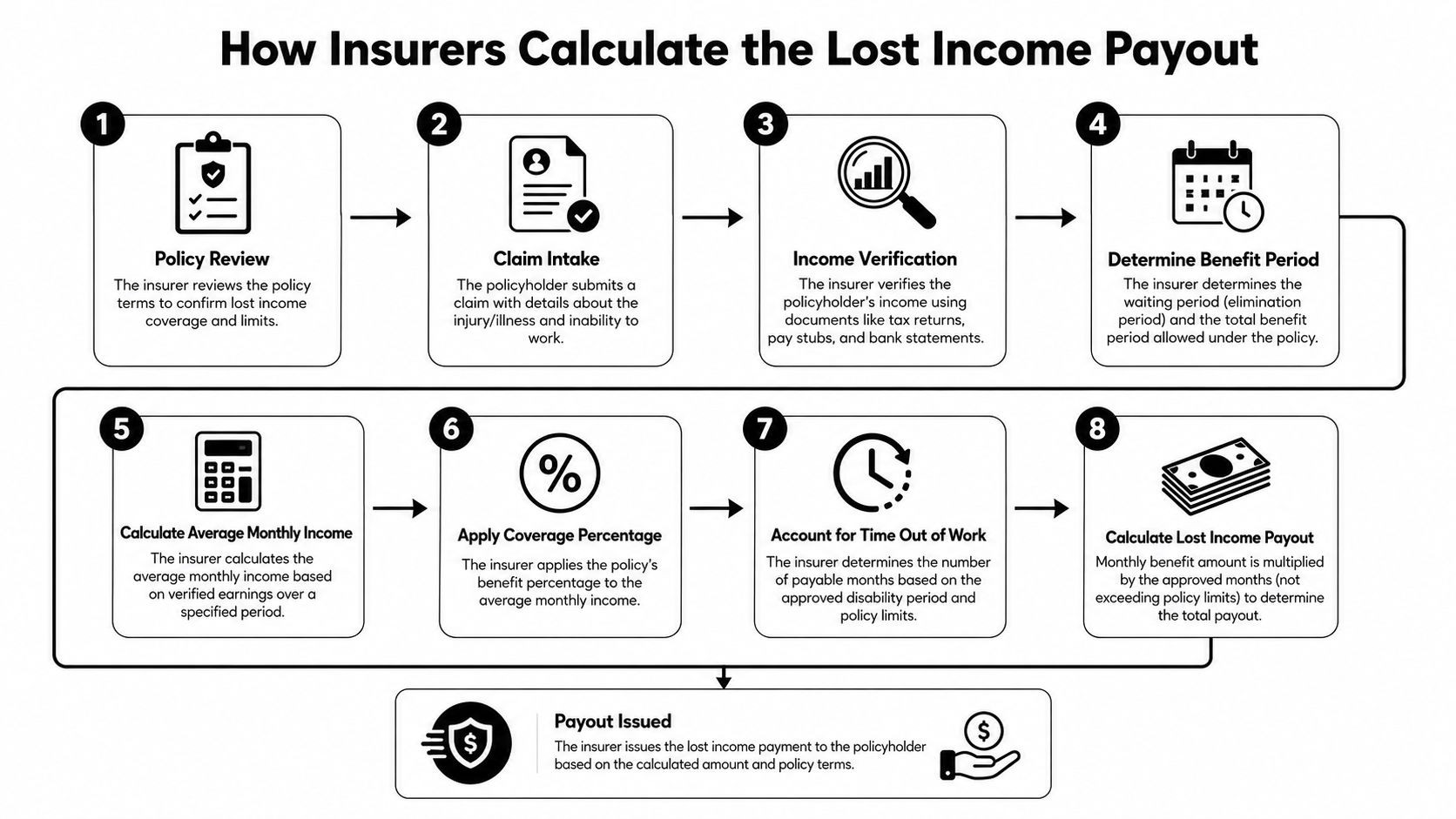
Insurers size the payout by looking at four things: net income, continuing expenses, the period of restoration, and the policy limit. That's the skeleton of the claim. If any one of those pieces is under-documented or underwritten, the settlement shrinks.
The math starts with your books
The carrier usually starts with prior financial statements, then adjusts for trend, seasonality, and the actual interruption window. If your business was already growing, flat, or seasonal, that history matters. If the adjuster uses a simple prior-year snapshot without reasonable adjustment, the math can understate the loss.
A clean record set helps. The insurer will want income statements, payroll records, lease obligations, loan payments, tax records, and anything that shows what stayed in place while sales fell. The better your records, the less room they have to argue that the loss is speculative.
Policyholder rule: never let the adjuster reduce the claim to last year's revenue minus this year's receipts. That's not a serious BI calculation.
A simple settlement example
Say a business had steady monthly earnings before the shutdown, then lost an entire month of operations. If the policy limit is set too low, the insurer can stop paying long before the actual interruption ends. If the policy wording is narrow, they can also argue over what counts as continuing expense versus avoidable cost.
That's why forensic support matters. A good claim is built from accounting records, operational records, and a timeline that matches the physical repairs. For owners who need help with the financial side, forensic accounting support for claims is often the difference between a rough estimate and a defensible demand.
The limit can quietly cap the recovery
A payout is never just about proving loss. It's also about whether the policy limit was chosen with enough room for the interruption period. If the limit is tight, the carrier can do the right math and still leave you short. That's not a math problem anymore, it's a buying problem.
Why the Standard 12 Month Limit Often Falls Short
A one-year indemnity period sounds comfortable until you've lived through permits, inspections, utility work, labor shortages, and contractor scheduling. Then it starts looking thin. The clock on the policy does not move at the same speed as the clock on a real rebuild.
The rebuild clock and the policy clock are not the same
A business can be unable to reopen long after the visible damage is “fixed.” That gap is where standard limits fail. A property owner in Oregon or Washington can run into local approval delays, weather interruptions, or supply constraints that stretch a repair far beyond the time the policy was written to assume.
Marsh treats getting the values right and setting the indemnity period as separate issues, and that's the right way to think about it. The market still likes to treat a 12-month limit as default coverage, but default is not the same as adequate. If the rebuild takes longer, the policy can end while the loss is still very real.
Run this stress test on your own limit
Ask three questions:
- How long would it take to restore the building if permits move slowly?
- How long would it take to replace equipment, materials, or specialty contractors?
- How long would it take the business to ramp back up after reopening?
If the honest answer pushes beyond the policy period, the limit is too short. That is the part owners miss. They size BI from last year's revenue, but they should size it against how long the operation is shut down under present repair conditions.
A policy that fits an average repair time can still fail on a bad year.
If you're reviewing renewals, look for the indemnity period wording first, then ask whether an extended period of indemnity is available. For a deeper look at that issue, see extended period of indemnity coverage.
Filing a Business Interruption Claim Step by Step
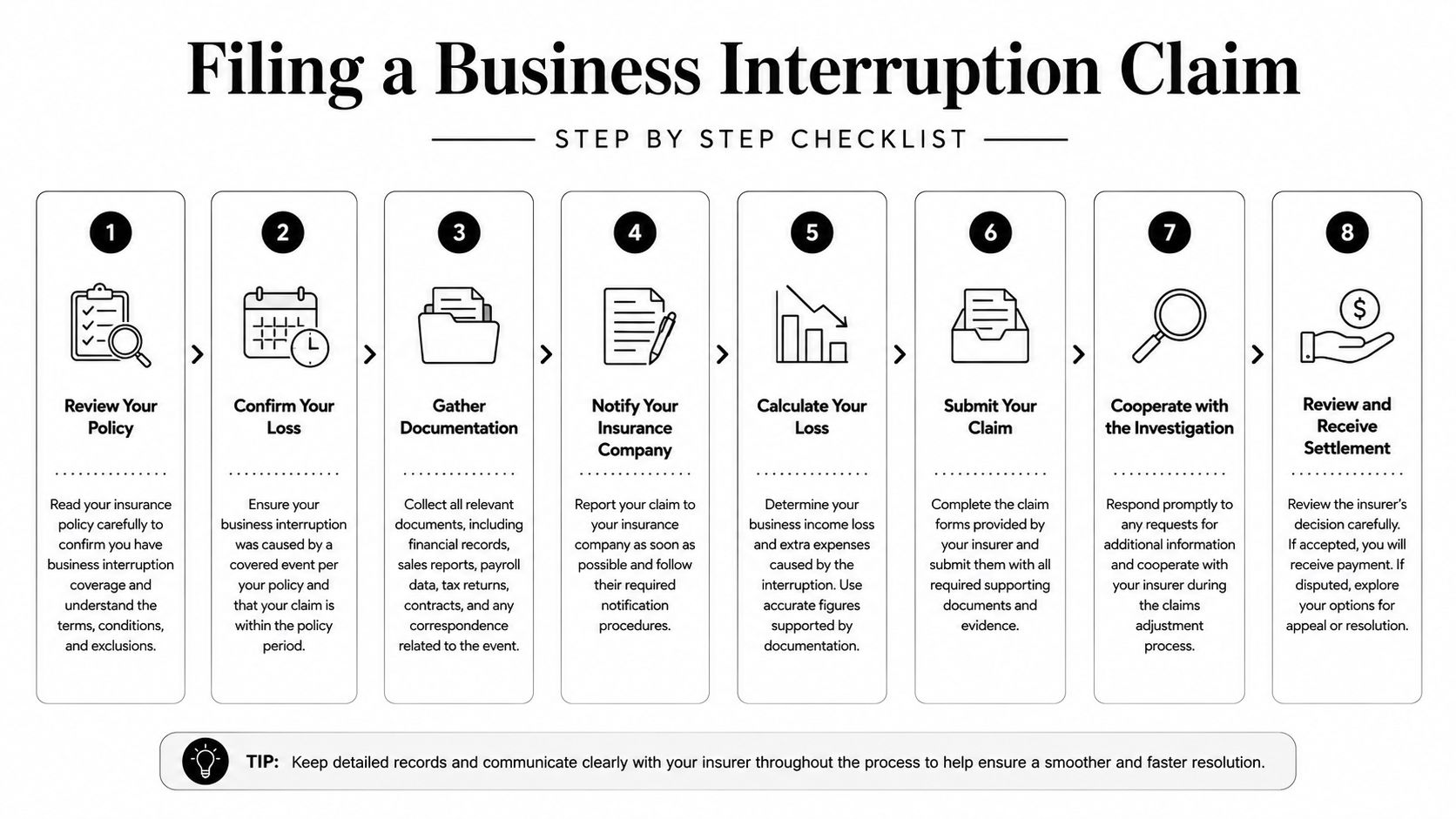
The first 48 hours matter. Not because the insurer needs instant perfection, but because missing documentation makes the rest of the claim harder than it needs to be. Start with evidence, then notice, then a clean paper trail.
What to do right away
- Photograph the damage and the closure conditions. Get the building, the blocked access, and anything showing why operations stopped.
- Notify the carrier promptly. Do it in writing if you can.
- Preserve financial records. Back up accounting files, payroll reports, invoices, and lease documents before anything gets moved or rebuilt.
- Track every interruption-related cost. Temporary space, rentals, overtime, and emergency vendors can matter later.
That record set gives the adjuster a timeline and keeps the insurer from arguing that the loss is unsupported. It also helps separate the actual BI claim from the property repair claim, which are related but not the same thing.
What the insurer will ask for
Expect requests for the proof of loss form, monthly financials, sales records, payroll, tax returns, expense histories, and the repair timeline. If you had a partial shutdown, expect them to ask which parts were still operating and whether some revenue was still coming in. If the policy has a narrow physical-loss trigger, expect an argument there too.
The carrier's favorite tactic is to narrow the interruption period or narrow the definition of what counts as covered loss. The answer is evidence. Match your records to the policy trigger and don't rely on a phone call summary when written proof exists.
How the negotiation usually goes
The first offer is often conservative. That's normal. Treating it as final is a mistake. If the numbers ignore seasonality, omit continuing expenses, or cut off the restoration period too early, push back with records and a written explanation.
A strong claim file is simple, not flashy. It should show what the business earned before the loss, what it had to keep paying, what it spent to stay alive, and how long it was disabled. If those four pieces are clear, the insurer has less room to squeeze the payout.
Oregon and Washington Notes Policyholders Should Know
Oregon and Washington policyholders run into the same core BI fights, but local claim handling still matters. Public adjusters in both states operate under state licensing rules, and that matters when you want someone negotiating only for you, not for the carrier. A policyholder who tries to self-handle a complicated interruption claim usually leaves money on the table in one of two places, the loss calculation or the timeline.
Regional rebuilds also tend to be slowed by practical realities that never show up in the declarations page. Wildfire debris, flood cleanup, trade labor shortages, and permit queues can all stretch a shutdown long past what a broker assumed at renewal. That's why local knowledge matters when the insurer starts acting like the loss should have been wrapped up faster.
NW Claims Management is a Portland-based public adjusting firm that works for policyholders in Oregon and Washington, and it handles commercial claims, including the documentation of business interruption losses where applicable. If your claim is heading into the accounting weeds or the carrier is already trimming your downtime, that kind of representation gives you a counterweight at the table.
The smart move is to use a licensed public adjuster when the claim involves disputed time element losses, not just broken property. The fight is usually not over whether damage happened. It's over how much income was lost, how long recovery really took, and whether the policy language was written tightly enough to avoid a fair payout.
Your Next Move After Reading This Guide
The three key points are simple. Know the policy form. Document the loss early. Challenge the insurer's math when it cuts the period too short or ignores continuing expense. Those are the points that decide whether a BI claim becomes a real recovery or just a partial check.
If you're staring at a shutdown right now, don't wait for the carrier to define the claim for you. Review the declarations page, gather the financial records, and compare your rebuild timeline to the indemnity period written into the policy. Then decide whether you want to handle the negotiation alone or bring in a policyholder advocate before the offer lands.
For owners who want a licensed public adjuster to evaluate the claim and handle the paperwork and negotiation, commercial public adjuster support is one practical place to start. The point is to get the claim framed correctly before the insurer anchors the number low.
NW Claims Management handles policyholder claims across Oregon and Washington, including commercial losses where business interruption is part of the recovery. If you want a straight review of your policy language, your downtime, and the numbers the carrier is likely to challenge, visit NW Claims Management and ask for a claim evaluation.