Ever wonder what a building inspection job really entails? At its core, you’re a property detective. Your job is to evaluate a building's health, safety, and structural integrity, providing an objective analysis that’s crucial for real estate transactions, insurance claims, and code compliance.
This role is a unique blend of deep technical knowledge and sharp observational skills, allowing you to spot critical issues that most people would walk right past.
What a Building Inspector Really Does in 2026

Think of a building inspector as a property’s biographer. They don't just use a checklist; they use a methodical process of examination to tell the building's true story—from its foundation to its roof, and everything in between. It's about connecting small clues to paint a complete picture of the property’s current condition.
A typical day is anything but typical. It’s a dynamic role that gets you out of the office and onto various job sites.
A building inspector's schedule is often a mix of fieldwork and office tasks. Here's a quick look at how a day might unfold.
An Inspector's Typical Day at a Glance
| Time of Day | Primary Activity | Key Objective |
|---|---|---|
| Morning (8 AM – 9 AM) | Pre-Inspection Prep | Review property files, plan the inspection route, and check all equipment (drones, thermal cameras, moisture meters). |
| Mid-Day (9 AM – 2 PM) | On-Site Inspection | Conduct a thorough visual and functional examination of the property, including structural, electrical, and plumbing systems. |
| Afternoon (2 PM – 4 PM) | Documentation & Reporting | Compile field notes, upload photos, and begin drafting the inspection report using specialized software. |
| Late Afternoon (4 PM – 5 PM) | Client Communication & Follow-Up | Finalize and send the report, answer client questions, and schedule the next day's appointments. |
This breakdown shows the balance between hands-on investigation and the crucial administrative work that follows.
The Modern Inspector's Toolkit and Impact
By 2026, this job has become even more sophisticated. Technology is no longer just helpful; it's central to the work. Inspectors now routinely rely on thermal imaging cameras to find hidden moisture behind walls, drones to safely inspect steep roofs, and powerful software to create detailed reports.
Many professionals in 2026 use tools like an automated property report generator to streamline documentation, ensuring every finding is recorded accurately and efficiently.
This isn't a niche profession, either—it's a major economic driver. The global market for building inspection services is valued at an estimated $10.47 billion in 2026, a solid jump from $9.76 billion in 2025. This growth, fueled by stricter safety regulations, reflects a steady compound annual growth rate of around 2.1%.
For those of us in the insurance world, this growth underscores just how much our industry relies on precise inspection data. A detailed, factual report is often the single most important document for validating a property damage claim.
This meticulous work is absolutely essential for public adjusting firms like NW Claims Management, which serves property owners across Oregon and Washington. We depend on objective inspection reports to substantiate claims and build a strong case. A well-documented property damage assessment from a qualified inspector provides the factual foundation we need to advocate for a fair settlement on behalf of our clients.
Your Roadmap to Inspector Qualifications and Certifications
So, you’re ready to become the go-to expert who can walk into a building and see its secrets? Let's talk about what it takes to get there. Unlike a lot of careers, there isn't just one straight line to becoming a building inspection job pro. People come into this field from all sorts of backgrounds.
Some of the best inspectors I know started with a high school diploma or GED, then dove headfirst into specialized training programs. Others came in with a two-year or four-year degree in something like architecture, engineering, or construction management. That kind of formal education gives you a serious leg up, providing a deep well of knowledge on building science, codes, and the complex systems that make a structure work.
Navigating Licenses and Certifications
Think of your education as building the engine, but your license and certifications are the keys that let you legally and credibly drive the car. The rules can be a bit of a patchwork, varying from state to state and sometimes even from one city to the next. You’ll need to do your homework on your local requirements.
Generally, here’s what you'll be looking at:
- State Licensing: Many states have their own licensing boards that spell out the bare minimums for education, field experience, and passing an exam. States like Oregon and Washington, for example, have very specific rules for home inspectors designed to protect consumers.
- Professional Certifications: Even if your state doesn't require a license, getting certified is a must. Credentials from respected organizations like the International Code Council (ICC) or the American Society of Home Inspectors (ASHI) are the gold standard. They show clients and employers that you've met a high national benchmark.
Getting these credentials isn’t a weekend project. It’s a real commitment. You'll typically have to log a certain number of classroom hours, get your hands dirty with supervised field training, and finally, pass a tough national or state exam.
The whole point of this tough process is simple: to make sure your signature on an inspection report actually means something. That piece of paper proves you have the expertise to back up your findings, which is what gives them real authority in real estate deals and, just as importantly, insurance claims.
The Importance of Lifelong Learning
Passing your first big exam is the starting line, not the finish. The world of construction is always changing—new materials hit the market, building methods get updated, and safety codes are constantly revised. This is why continuing education isn’t just a nice-to-have; it's almost always a requirement to keep your license active. For inspectors dealing with property damage, knowing exactly what to document is critical. If you find yourself in that world, our guide on how to file a property damage claim shows just how detailed that documentation needs to be for insurers.
Keeping up with the industry doesn't just check a box—it makes you a better, more valuable inspector. An expert who is current on the latest moisture barrier standards or electrical codes can spot subtle but hugely important issues that a less-informed inspector might walk right past. That's where you provide real, tangible value.
Understanding Your Salary and Career Growth Potential
A career as a building inspector is more than just a job—it's a profession with real financial stability and a clear path for advancement. How much you earn and how far you go really comes down to your experience, the certifications you earn, and even where you work. Think of it like building your own house: every new skill is another beam, and each certification is a new, more valuable floor.
While you can expect a decent starting salary right out of the gate, the real money comes with time and specialization. As you collect credentials from respected organizations like the ICC or ASHI, your value skyrockets. An inspector who is certified in multiple areas—say, both commercial electrical and plumbing systems—will earn a significantly higher income than someone with just a basic residential license.
This progression generally follows a three-part journey.
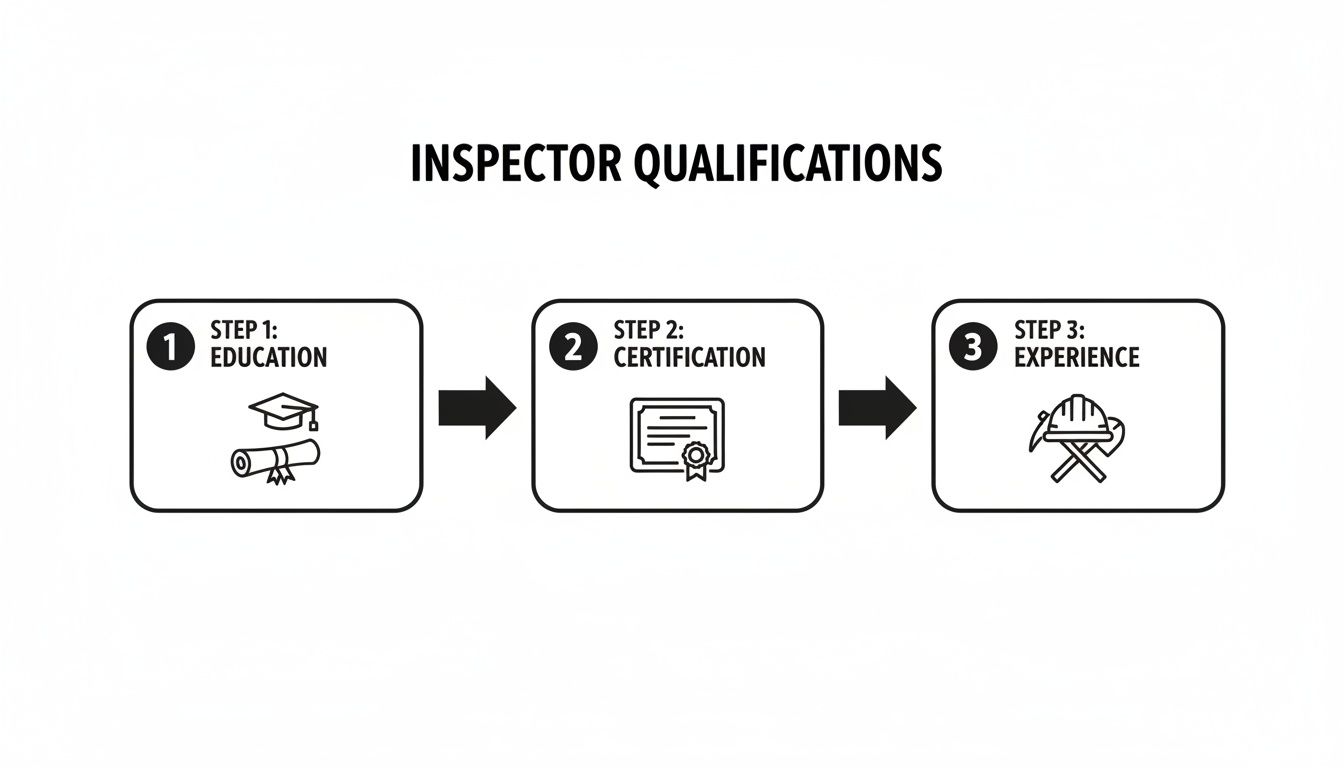
As you can see, it’s the blend of formal education, official certifications, and practical, on-the-job experience that builds a lasting career.
Charting Your Career Path
The career ladder in this field has several well-defined rungs. Most people start out as junior inspectors, learning the ropes from a seasoned pro. After a few years of solid work, you can move up to a lead inspector or supervisor role, where you’ll manage a team and take on more complex projects.
From there, the path can branch out in some interesting directions. Many experienced inspectors move into municipal jobs as plan examiners, reviewing blueprints to ensure they meet code before a single shovel hits the ground. It’s a great way to use your field knowledge to stop problems before they start.
The industry itself is incredibly strong. As of 2026, there were about 30,732 building inspection businesses in the United States alone. The entire U.S. market is worth a massive $4.9 billion, which points to a steady, high volume of inspections. You can dive deeper into the numbers with IBISWorld's detailed Building Inspectors industry report.
All this adds up to a stable and growing demand for skilled inspectors.
The Entrepreneurial Route
If you have an entrepreneurial streak, the ultimate move is to start your own inspection firm. This offers the greatest potential for both income and freedom. As the owner, you're in charge of building your brand, hiring your own team, and managing your client relationships.
Becoming an independent firm owner means you are no longer just an inspector; you are a trusted consultant whose reputation is built on reliability, accuracy, and expertise. This is the pinnacle of the building inspection job career path for many.
This natural progression from rookie inspector to business owner is what makes the field so appealing. It's a career where investing in yourself pays off in real, tangible ways, offering a rewarding journey for anyone willing to put in the work.
How Your Inspection Report Wins an Insurance Claim

When a property owner files an insurance claim, the inspector's report is no longer just a document—it becomes the single most important piece of evidence. It’s the objective, factual backbone of the entire claim, and it can single-handedly determine whether the homeowner gets a fair payout or a frustrating denial.
A big part of a building inspection job is knowing how to create a report that speaks the language of insurance adjusters: clear, detailed, and impossible to ignore. For a public adjuster fighting on behalf of a client, this report is their ace in the hole. It shifts the entire conversation from opinions and guesswork to documented, undeniable facts.
The Report as Objective Evidence
Let's walk through a common scenario. A nasty winter storm rolls through Portland, Oregon, creating ice dams on a homeowner's roof. Water begins to sneak into the attic and drip down behind the walls, but the initial damage is barely visible. The insurance company’s adjuster does a quick walkthrough, sees a few water stains, and offers a small settlement to patch the roof and slap on a coat of paint.
This is exactly where a sharp building inspector can change the game. The homeowner's public adjuster calls in an inspector who does a truly thorough investigation, not just a quick look.
- Moisture Readings: They pull out a moisture meter and find high moisture levels buried deep inside the wall cavities, proving the water damage is far more serious than a simple surface stain.
- Thermal Imaging: Using a thermal camera, the inspector spots cold patches in the insulation. This reveals that the insulation is saturated and has lost all its R-value—something completely invisible to the naked eye.
- Code Compliance Check: They also notice the original roof flashing wasn't installed to current building code, a critical detail that helped cause the failure in the first place.
Each of these findings is documented with crystal-clear photos, exact measurements, and citations of local building codes.
An inspector’s report is the counter-narrative to an insurer's lowball offer. It replaces subjective assessments with hard data, building an undeniable case for the true scope of the damage and the cost of proper repairs.
This is the kind of detail that wins claims. The public adjuster takes this comprehensive report back to the insurance company, now armed with indisputable proof. The moisture readings justify tearing out the drywall, the thermal images prove the need for all-new insulation, and the code violations demand that the roof be repaired correctly, not just patched.
The entire outcome hinges on the quality of that inspection. To see how this evidence fits into the bigger picture, you can learn more about the complete property damage claim process.
An insurance company can argue with a homeowner all day long. What they can't easily argue with is scientific data and documented code violations. This is how a building inspection job directly empowers property owners and helps secure the full settlement they truly deserve.
Crafting a Resume That Lands the Interview
Your resume is the very first impression you’ll make, and for a building inspection job, it needs to be sharp and to the point. Most resumes I see simply list past duties, which is the fastest way to get lost in a stack of applicants.
To really get noticed, you have to stop thinking about your resume as a history of tasks. Instead, think of it as a highlight reel of your accomplishments. Don't just say you were "responsible for inspections." Show your impact with real numbers. This small shift from passive duties to active achievements makes a world of difference to a hiring manager.
From Passive to Powerful Resume Language
Let's look at how to transform those bland, passive bullet points into powerful statements that prove your value. This is all about showing, not just telling.
The table below gives a few before-and-after examples to get you started.
From Passive to Powerful Resume Language
| Passive Phrase (Avoid) | Action-Oriented Phrase (Use) |
|---|---|
| Inspected properties for issues. | Identified and documented an average of 15-20 critical structural, electrical, and plumbing issues per property across 50+ supervised residential inspections. |
| Wrote inspection reports. | Authored 100+ detailed inspection reports with a 99% accuracy rate, incorporating photographic evidence and local building code citations. |
| Checked for code compliance. | Ensured 100% compliance with ICC and local building codes, preventing potential safety hazards and costly project delays. |
See the difference? The "after" examples prove you deliver tangible results. For the best possible outcome, always take the time to tailor your resume to the job description. This shows you've done your homework and are genuinely interested in that specific role.
Highlighting Transferable Skills
What if you don't have direct inspection experience? Don't worry, you’re not out of the running. Many other professions build the exact skills needed to excel as a building inspector. Your job is simply to connect the dots for the person reading your resume.
Think like a prosecutor building a case. Your previous experience is your evidence. Your resume must clearly and convincingly argue why that evidence proves you'll be a successful inspector.
For instance, an accountant’s knack for extreme detail is a huge asset when spotting subtle code violations. A project manager who juggles contractors, clients, and deadlines is already great at the communication side of the job. Frame these experiences to show that you're the perfect candidate for a building inspection job, just waiting for the chance to apply your skills.
Acing the Interview and Finding Your First Opening

Once your resume gets you in the door, it’s time to prepare for the interview. For a building inspection job, this is where the rubber meets the road. They’re not just checking boxes; hiring managers want to see how you think on your feet and solve problems in real-time.
You can bet they’ll throw some situational questions your way to see how you handle pressure. A classic one is, “Imagine you’re on-site and a contractor is adamant their work meets code, but you know it doesn’t. What do you do?” They want to see your technical know-how and your people skills in action.
How to Frame a Winning Answer
The best approach here isn't to just give a hypothetical response, but to tell a story. The STAR method is perfect for this because it gives your answer a clear, compelling structure based on your actual experience.
- Situation: Start with the context. "I was inspecting a residential project, and the plumbing contractor had used a non-compliant PVC pipe for a critical drain line."
- Task: State your objective. "My responsibility was to make sure every single component, right down to the piping, strictly adhered to the local building code before I could sign off."
- Action: Describe what you did. "I pulled out my code manual, pointed to the exact section, and calmly explained why that specific material wasn't approved and the risks of it failing down the line."
- Result: Explain the outcome. "He saw the reference, understood the issue, and his team replaced the pipe. We avoided a failed inspection and, more importantly, a potential costly disaster for the homeowner."
Using this method turns a tricky question into a mini case study that proves your competence. It shows you can be firm, fair, and factual—skills that are also vital when negotiating with an insurance company and require that same level of clear, evidence-based communication.
Where to Find Your Next Building Inspection Job
So, where do you actually find these openings? While it's tempting to just hit the big job boards, the real gems are often found elsewhere. You have to go where the pros go.
The best opportunities are often found where industry professionals gather. Go beyond generic search engines and tap into the community's own networks to find your ideal role.
Here’s where to focus your search for high-quality inspector positions:
- Industry-Specific Job Boards: Head directly to the source. The official websites for the International Code Council (ICC) and the American Society of Home Inspectors (ASHI) are goldmines for relevant job postings.
- The Usual Suspects: Don't ignore LinkedIn, Indeed, and Glassdoor. The trick is to create highly specific job alerts for titles like "building inspector" or "code enforcement officer" in the cities or regions you're targeting.
- Local Chapters and Networking: This is the insider track. Attending local ASHI or ICC chapter meetings puts you in the same room as hiring managers. It's hands-down the best way to learn about jobs that haven't even been advertised yet.
Common Questions About a Building Inspection Career
So, you're thinking about a career as a building inspector. It's a great field, but you probably have a few practical questions about what the job is really like day-to-day. Let's clear up some of the most common ones.
Is This a Physically Demanding Job?
In a word, yes. You won’t be chained to a desk, that’s for sure. A typical day involves a lot of moving around. You’ll be on your feet for hours, climbing ladders to get a good look at roofing, and carefully maneuvering through cramped crawl spaces or dusty attics.
This isn't to say you need to be a professional athlete, but good physical mobility is a must. You need to be steady on your feet, comfortable with heights, and able to carry your gear across all sorts of terrain, from a brand-new construction site to a 100-year-old home with tricky access points.
Can I Work Part-Time as an Inspector?
It’s definitely possible, but usually not right out of the gate. Most entry-level jobs are full-time because that’s the fastest way to rack up the hands-on experience and certifications you need to become truly proficient.
The real flexibility comes once you've established yourself. Many inspectors start out working full-time for an established firm, build their skills and reputation, and then transition to part-time work or even launch their own business where they can set their own hours.
A common path is to work for a larger firm for several years to build expertise and a strong reputation, then launch a solo practice where you control your own hours and workload.
How Much Interaction Is There With Homeowners?
You'll be talking to people constantly, so strong communication skills are non-negotiable. A huge part of the job is acting as a translator. You have to take complex, technical findings and explain them in simple, clear terms to a homeowner who is likely feeling stressed about one of the biggest purchases of their life.
You won't just be talking to clients, either. You’ll regularly coordinate with real estate agents, contractors, and sometimes even public adjusters when damage is involved. Being able to communicate with authority and empathy is just as critical as your technical expertise. If you're curious about the different roles in this ecosystem, it helps to understand the differences between a public adjuster vs an insurance adjuster to see how everyone fits together.
Navigating the complexities of property damage and insurance can be overwhelming. The experts at NW Claims Management are here to help property owners in Oregon and Washington get the fair settlement they deserve. If your property has suffered damage, contact us for a free claim evaluation.