At its core, an accident investigator job is about being a detective. Your mission is to arrive at the scene of an incident—whether it's property damage, a traffic collision, or a workplace injury—and figure out exactly how and why it happened. You're the person who methodically pieces together the evidence to find the truth.
This work is critical. The unbiased reports from investigators are the foundation for everything that comes next, from insurance claims and legal battles to implementing new safety measures that prevent it from happening again.
What an Accident Investigator Actually Does
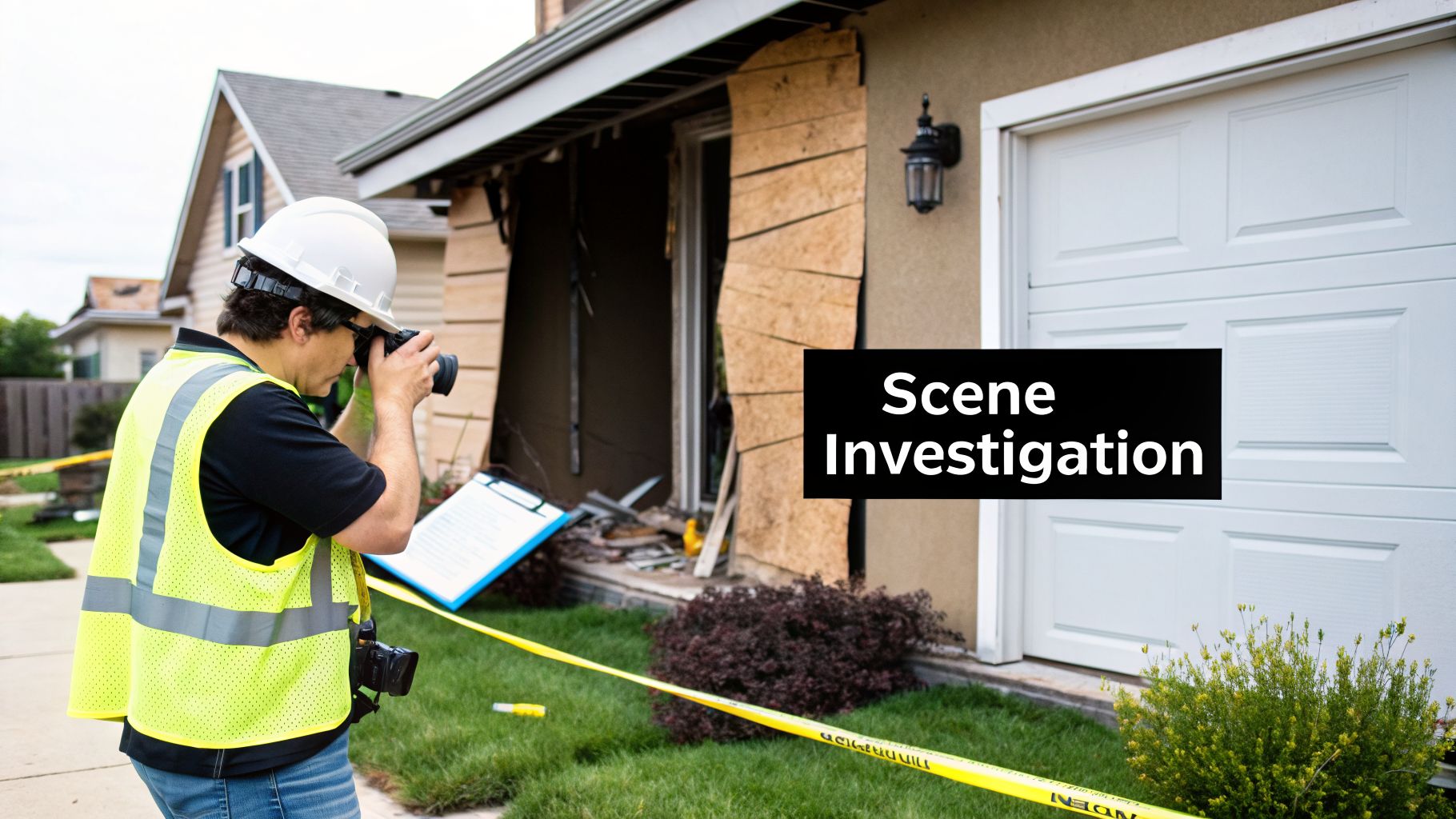
Think of yourself as a puzzle solver walking into a chaotic scene. It could be a collapsed roof, a flooded commercial building, or a multi-car pileup. Your job is to bring order to that chaos by creating a clear, factual story of what went down. It’s not about pointing fingers; it’s about establishing the facts.
But the work goes way beyond just snapping a few photos. A good investigator has a trained eye for details others would completely miss. You’re documenting everything, from the exact position of debris to the condition of safety equipment, preserving evidence that is absolutely vital for a fair outcome.
Core Daily Responsibilities
No two days are ever really the same, but the job always circles back to three main activities: collecting evidence, analyzing it, and reporting your findings. This is the bread and butter of the profession.
Here’s what a typical day might look like:
- On-Site Evidence Gathering: This is what most people picture. You’re at the scene, photographing everything from multiple angles, taking precise measurements, and collecting physical evidence. For a vehicle wreck, this could mean pulling black box data from an Electronic Control Module (EDM) to analyze speed, braking, and other key factors right before impact.
- Conducting Interviews: You'll talk to everyone—witnesses, first responders, and the people directly involved—to get their side of the story. The real skill here is asking neutral, open-ended questions that draw out the facts without leading the conversation.
- Reconstructing the Event: With all the data collected, you start building a timeline. This might involve using specialized software to model a vehicle collision or bringing in engineers to help understand why a structure failed.
The ultimate goal is to produce an objective, evidence-based report that explains the sequence of events and identifies the causal factors. This report becomes the definitive record used by insurance companies, legal teams, and safety organizations.
For car accidents, a huge part of the job is accurately identifying vehicles and tracing their history, which always starts with understanding the VIN number. When it comes to property damage, investigators document every detail to make sure policyholders are treated fairly—a process that requires knowing the key differences between how a https://nwclaimsmanagement.com/public-adjuster-vs-insurance-adjuster/ operates. Here in Oregon and Washington, firms like NW Claims Management depend on these experts to effectively represent homeowners and businesses during the claims process.
The Skills That Define a Top Investigator
Being a great accident investigator is about more than just showing up to a scene with a clipboard and a camera. The best in the field are a unique blend of scientist and psychologist, able to piece together the physical evidence while also navigating the complexities of human memory and behavior.
Success in an accident investigator job really boils down to mastering two distinct but equally important skill sets. You need the technical know-how to analyze the scene, but you also need the people skills to get the real story.
The Technical Toolkit
First, let's talk about the hard skills. These are the nuts and bolts of the job—the tangible, trainable abilities you’ll use every day to make sense of the physical evidence. Without a firm grasp of these, an investigation is just guesswork.
Forensic Photography and Videography: Anyone can snap a picture, but an investigator needs to capture images that tell a clear, unbiased story. This means understanding angles, lighting, and scale to document evidence in a way that will stand up in court or during a claim review.
Scene Diagramming and Measurement: You have to create a precise map of the incident scene. Whether you're using a simple tape measure or a sophisticated 3D laser scanner, your job is to lock in the exact location of every piece of evidence, from tire marks to debris.
Evidence Preservation: Knowing how to properly identify, collect, and bag evidence is non-negotiable. A broken chain of custody or contaminated evidence can completely derail a case, so this process has to be perfect every time.
Applying Scientific Principles: This is where you get to play detective with science. Investigators often use principles from physics and engineering to reconstruct what happened. You might be calculating vehicle speeds from skid marks or figuring out why a specific component failed under stress.
The Human Element: Mastering Soft Skills
Hard evidence tells you what happened, but it rarely tells you why. For that, you need to talk to people. This is where soft skills come in, and frankly, they’re what separate a good investigator from a truly exceptional one.
An investigator’s report must be a fortress of facts, built with meticulous detail and objective analysis. The best investigators know that their final product must withstand intense scrutiny from insurance companies, legal teams, and other stakeholders.
These interpersonal abilities are harder to measure, but they are absolutely critical for getting to the truth.
Unbiased Interviewing: You have to be an expert at asking open-ended, non-leading questions. Your goal is to create a space where witnesses feel comfortable sharing what they know without feeling defensive or pressured.
Active Listening: The most important clues are often hidden in what isn't said. A great investigator listens for hesitations, inconsistencies, and subtle emotional cues that can point toward a new line of questioning.
Objective Report Writing: All your findings mean nothing if you can't communicate them clearly. Reports must be written in concise, factual, and completely objective language. Your job is to present the evidence and let it speak for itself. You can see how this plays out in our guide to the property damage assessment process.
A strong investigator seamlessly blends these technical and interpersonal abilities. The table below breaks down how these core competencies are applied in the real world.
Core Competencies for Accident Investigators
| Skill Category | Specific Skill | Real-World Application |
|---|---|---|
| Technical Analysis | Scene Diagramming & Reconstruction | Using laser scanners and software to create a 3D model of a multi-car pileup to determine the sequence of impacts. |
| Evidence Management | Chain of Custody | Properly collecting a failed vehicle part, sealing it in an evidence bag, and documenting every person who handles it. |
| Communication | Objective Report Writing | Drafting a final report that presents conflicting witness statements and physical evidence without favoring one conclusion. |
| Interpersonal | Empathetic Interviewing | Calming a distraught witness to get a clear, coherent account of the events leading up to an industrial accident. |
| Critical Thinking | Root Cause Analysis | Moving beyond the immediate cause (e.g., brake failure) to identify the underlying reason (e.g., improper maintenance schedule). |
Ultimately, these skills work together, allowing an investigator to build a comprehensive and defensible account of any incident.
Your Roadmap to an Investigator Career
Breaking into the world of accident investigation is a lot like conducting an investigation itself—it requires a clear, methodical plan. While there isn't a single "right" way in, a strategic approach will set you up for success, starting with the right educational and professional foundation.
Many of the sharpest investigators I know got their start with a bachelor's degree. Fields like criminal justice, forensic science, engineering, or even business administration are fantastic launching pads. A degree gives you the framework for critical thinking and clear writing, which are non-negotiable in this line of work. That said, real-world experience can be just as powerful. Many people transition successfully from careers in law enforcement, the military, or insurance claims adjusting, where they've already honed their investigative instincts.
Gaining Specialized Skills
A degree or prior experience gets your foot in the door, but an accident investigator job demands a very specific set of skills. This is where you really start to build your expertise.
You’ll want to look for specialized courses and certifications that teach you the nuts and bolts of the job, such as:
- Accident Reconstruction: This is where you learn the physics behind a crash or a structural failure, often using sophisticated software to model exactly what happened.
- Fire and Arson Investigation: It’s a fascinating science, learning to read burn patterns and identify accelerants to figure out how a fire started and spread.
- Evidence Collection and Preservation: Think of it as forensics 101 for investigators—mastering the proper techniques to handle evidence is crucial for maintaining the chain of custody.
This whole process boils down to a core workflow that every seasoned investigator has mastered.
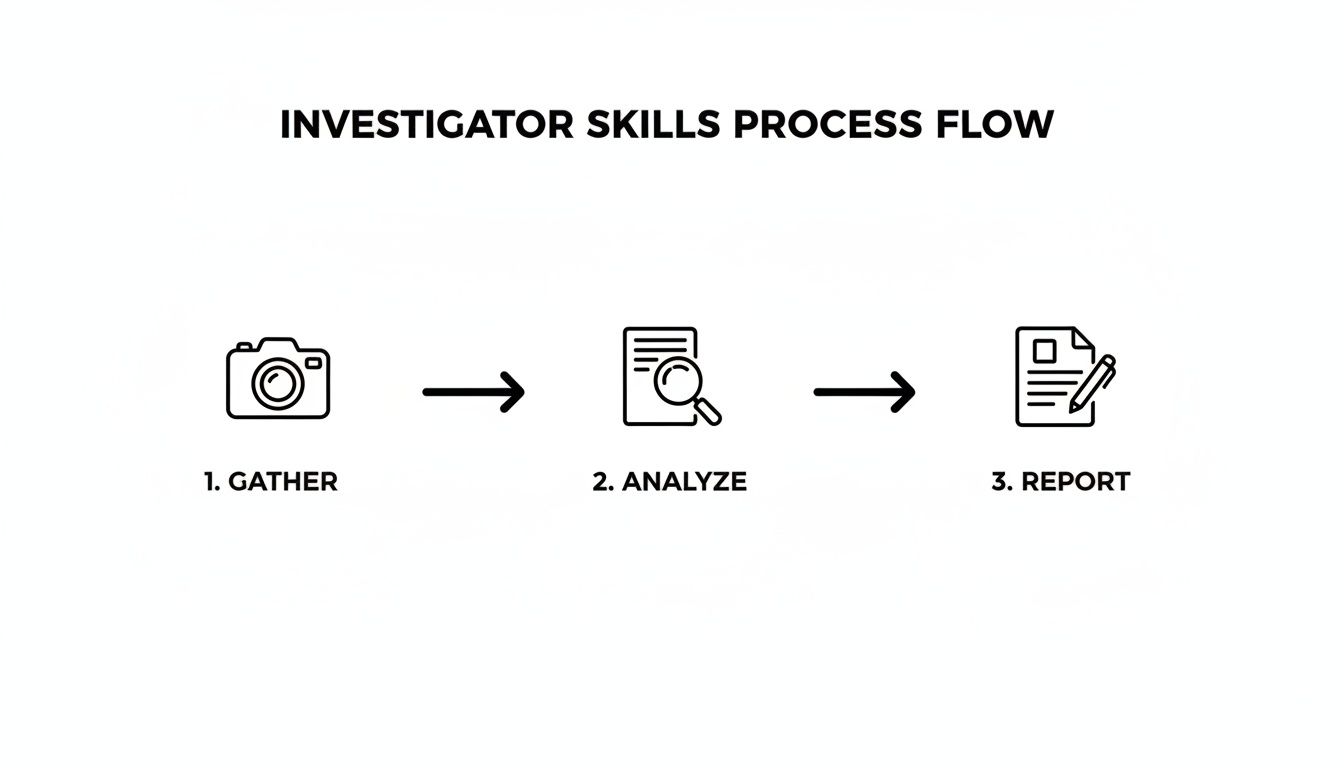
As you can see, every investigation moves through these logical steps—from gathering all the raw data to delivering a final, evidence-based report.
From Training to Your First Job
Once you've layered training on top of your foundational knowledge, it's time to get your hands dirty. This is the final and most important piece of the puzzle. Look for internships or entry-level positions at insurance companies, private investigation firms, or public adjusting agencies. These are the best places to learn the ropes from experienced pros and see how your skills apply to real-world cases.
Your resume needs to do more than just list what you've done. It has to tell a story. Frame your experience to show you have an investigative mindset—highlight specific times you gathered facts, analyzed the details, and drew a logical conclusion.
Here in the Pacific Northwest, you'll likely need a license, particularly if your work touches on insurance claims. Both Oregon and Washington require you to be licensed to work as an independent or public adjuster. For anyone considering this route, it's essential to understand exactly what a public adjuster does. You can learn more about the role of a public adjuster to see if it’s the right fit. Holding that license isn't just a formality; it proves your expertise and gives you the legal authority to represent clients, making you a much stronger candidate for local firms.
Let's Talk Salary and Job Outlook for Investigators

Beyond being a fascinating and challenging line of work, an accident investigator job offers a genuinely stable and financially sound career. The need to find out what really happened after an incident isn't going away, which keeps skilled investigators in constant demand.
Of course, your starting salary is just that—a start. Your real earning potential unlocks as you gain experience and build a reputation. Think of specialized certifications in fields like fire cause analysis or commercial vehicle reconstruction as direct investments in your future paycheck. The more you know, the more you're worth.
National Salary Benchmarks
Across the country, investigator salaries can look very different. Someone fresh out of training will be on the lower end, but it's not uncommon for a seasoned pro with a decade of experience handling major cases to earn well into the six figures. It’s a field where expertise truly pays off.
To put some numbers on it, let's look at a major market like California, which often sets the tone for compensation. The average accident investigator there pulls in around $74,338 a year. But that's just the middle ground. The salary spectrum realistically runs from $51,800 on the entry-level side to $97,200 for experienced hands, with the top experts clearing $114,974. You can see a full salary breakdown for yourself over at ZipRecruiter.com.
Earning Potential in Oregon and Washington
Here in the Pacific Northwest, the story is much the same. There's a steady demand for sharp investigators, especially those who specialize in property claims. How you get paid can differ, though. Many investigators are salaried employees, but others, particularly public adjusters, work on a contingency fee. This means their income is a percentage of the settlement they help their client secure.
According to the Bureau of Labor Statistics, the field for claims adjusters, appraisers, examiners, and investigators is projected to grow by 3% over the next ten years. It might not sound dramatic, but it points to solid, long-term stability.
For a great investigator, a contingency model can be incredibly rewarding. If you're curious about that side of the business, it helps to understand how the fees work. We break it all down in our guide to the typical public adjuster cost.
Ultimately, whether you focus on car crashes, property damage, or on-the-job accidents, your chosen specialty will shape your career path and your paychecks for years to come.
Where to Find the Best Investigator Jobs
So, you've got the skills and the drive. The next big question is: where are the actual jobs? A smart job hunt involves a two-pronged attack—casting a wide net on major platforms and then zeroing in on the industry-specific hubs where the best firms post their openings.
Of course, your search should start with the big players like LinkedIn and Indeed. They're fantastic for getting a sense of the overall market and seeing which companies are hiring.
Broaden Your Search Terms
Here's a pro tip that experienced investigators learn early on: don't just search for "accident investigator." Companies often use different titles for roles that involve the exact same skillset, and sticking to one term means you'll miss out on a ton of great opportunities.
Think like a hiring manager and expand your keyword list. You'll be surprised at how many more relevant jobs pop up when you also search for:
- SIU Investigator: These "Special Investigations Unit" roles are all about digging into potentially fraudulent insurance claims.
- Forensic Investigator: A common title used by private firms that handle complex, high-stakes cases.
- Claims Adjuster (Field/Property): Many of these jobs are heavily focused on on-site investigation as a primary duty.
- Cause and Origin Investigator: This is the go-to title for specialists in fire and explosion analysis.
The market for these skills is surprisingly strong. A recent check on Indeed showed 2,274 active accident investigator jobs across the U.S., ranging from surveillance work to senior SIU positions. With a projected 3% growth in the field, it's clear that qualified professionals are in steady demand. You can explore current job listings on Indeed.com to get a feel for what’s out there right now.
Niche and Specialized Platforms
While the big job boards are a great start, the real gold is often found in the more specialized corners of the internet. Check out the career centers for professional organizations like the National Association of Public Insurance Adjusters (NAPIA) or the International Association of Arson Investigators (IAAI). The listings there are often higher quality because they're posted by employers looking for serious professionals.
Your job search should be a lot like an investigation. Be methodical, be thorough, and don't be afraid to look where others aren't. That’s often where the best opportunities are hiding.
To pull everything together, you can also search for investigator jobs on platforms that aggregate postings from multiple sources, saving you time. By blending broad searches with targeted, niche inquiries, you set yourself up to find not just any job, but the right job. And for those interested in fighting for policyholders, understanding when to hire a public adjuster will give you great insight into the kinds of firms that might be a perfect fit.
Common Questions About an Investigator Career
So, you're seriously considering a career as an accident investigator. You've looked at the skills, the potential salary, and how to get your foot in the door. But what’s it really like day-to-day? Some questions just don't get answered in a standard job description.
Let’s pull back the curtain on a few of the most common things people wonder about before diving into this line of work. Think of this as the stuff you'd ask an experienced investigator over a cup of coffee.
How Do Investigators Handle the Emotional Stress?
This is probably the biggest question people have. You're constantly dealing with the aftermath of traumatic events—injuries, major financial losses, and people at their most vulnerable. So, how do you not take it all home with you?
The key isn't to become cold or robotic; it's to develop what I call professional empathy. You have to learn to be a calming, objective force in the middle of chaos. It's a skill you build over time, learning to separate the facts of the case from the raw emotion surrounding it.
The best investigators find that balance. They're human enough to connect with a distraught witness and build trust, but disciplined enough to prevent their own emotional response from coloring the evidence.
Developing this mental resilience is crucial. Many good firms and public agencies even offer mental health resources because they know the toll the job can take. Your ability to manage this side of the work is just as important as any technical skill you possess.
Public Sector vs. Private Sector Careers
Your career as an investigator can go in two very different directions: working for the government or for a private company. The choice you make will completely shape your daily grind, your goals, and your career path.
It really comes down to what drives you.
Public Sector Investigators are all about public safety and prevention. They work for agencies like the National Transportation Safety Board (NTSB), OSHA, or state and local law enforcement. Their job is to figure out why something happened to stop it from happening again and to enforce safety regulations. The work is meticulous, methodical, and serves the greater good.
Private Sector Investigators are focused on liability and financial resolution. You’ll find them working for insurance companies, law firms, or public adjusting firms like NW Claims Management. Here, the mission is to build an airtight, evidence-based case that clarifies financial responsibility for a claim or lawsuit. The pace is often faster, and your findings have immediate financial consequences.
The demand for investigators is holding steady, with a projected growth of 3% between 2018 and 2028. This growth is especially noticeable in the insurance world, where public adjusters depend on detailed investigations to make sure homeowners and businesses get the settlements they're entitled to. You can check out more about these career trends on Zippia.com.
What Does Career Advancement Look Like?
Forget the traditional corporate ladder. In this field, advancement is all about building expertise and a solid reputation.
When you're starting out, you’ll cut your teeth on smaller, more straightforward cases—think minor fender-benders or basic property damage claims. This is your training ground for mastering the fundamentals: collecting evidence, conducting interviews, and writing clear, concise reports.
As you prove yourself, you’ll be trusted with more complex assignments. This is where you can start to specialize. Maybe you'll become the go-to expert for commercial trucking accidents, fire and arson cases, or catastrophic equipment failures. Developing a deep niche is the fastest way to become indispensable and boost your earning potential.
For seasoned investigators, the path often moves away from fieldwork. You might step into a management role, supervising a team of investigators and providing quality control on their cases. Others become sought-after consultants, providing expert testimony in court or helping companies build better safety programs. Your career grows as your expertise deepens; your reputation for being thorough and unbiased becomes your most valuable asset.
At NW Claims Management, our expert public adjusters are seasoned investigators who put their skills to work for you. If you're facing property damage in Oregon or Washington, don't navigate the complex claims process alone. We'll manage the entire investigation to ensure you get the fair and full settlement you deserve.