A pipe bursts, the roof starts leaking, or a fire leaves half your property exposed. You call the carrier listed on the policy and hope the process will be straightforward. Then the paperwork starts, the inspection feels rushed, and every answer seems to create two more questions.
If norguard insurance co is on your policy, you need to approach the claim with your eyes open. That doesn't mean panic. It means discipline. Insurance claims are business transactions, and the company handling your file is not your personal advocate.
I am going to offer the same guidance I would provide to a concerned property owner in Oregon or Washington who has just contacted me following a significant loss. Secure the scene. Preserve the evidence. Be careful with your phrasing. Do not assume the insurer's initial assessment of the loss is the accurate version.
Your Guide to Navigating a NorGuard Insurance Claim
The first few days after a loss are where policyholders make the biggest mistakes. Not because they're careless, but because they're overwhelmed. They trust the company adjuster to sort it out, they throw away damaged materials too early, or they speak too casually on the phone and end up narrowing their own claim.
That's the wrong approach.
With norguard insurance co, start from the assumption that every part of your claim needs support. Every damaged room. Every affected material. Every temporary repair. Every extra expense. If you can't prove it, you may not get paid for it.
What to do first
Start with the property, not the paperwork.
- Stop further damage. Tarp the roof, shut off water, board broken openings, and move contents out of active danger.
- Photograph before cleanup. Wide shots first, then close-ups, then video walkthroughs with narration.
- Create a loss log. Write down the date of loss, who you spoke with, what they said, and what happened next.
- Read the policy, especially duties after loss. Your obligations matter. Miss one, and the carrier may try to use it against you.
- Get independent opinions early. Roofing, mitigation, structural, electrical, and contents issues should not be defined only by the insurer.
If your damage includes roofing, a plain-language guide to steps to filing a roof claim can help you avoid common early missteps before the scope gets locked in.
For a broader view of how claims usually unfold, review this breakdown of the home insurance claim process. It's useful because once you understand the sequence, delays and deflections are easier to spot.
Practical rule: Treat the first inspection like the opening move in a negotiation, not the final word on damage.
That mindset alone will save you trouble. A property claim can still be resolved fairly, but only if you document it like someone may challenge every line item later.
Who Is NorGuard Insurance Co?
Your building is damaged, the claim is open, and now you are dealing with a carrier backed by a large national insurance operation. That matters. NorGuard is part of the Berkshire Hathaway GUARD family, which means your claim is likely to be handled through a structured corporate process with multiple layers of review, vendor input, and approval authority.
For policyholders in Oregon and Washington, that scale cuts both ways. A large insurer has systems, templates, and experienced claim personnel. It also has every incentive to standardize damage, narrow scope, and push your loss into a tidy estimate that may not reflect what it takes to repair the property correctly.
Here is the plain-English takeaway. You are not dealing with a local decision-maker who can casually fix a bad scope on the spot. You are dealing with a process. If the first inspection is incomplete or the estimate is built on wrong assumptions, those errors can follow the claim for weeks unless you challenge them early and in writing.
NorGuard's parent group describes the company as part of a long-established insurance operation with nationwide licensing and a broad commercial footprint, according to Berkshire Hathaway GUARD's company profile. That background helps explain why many NorGuard claims feel procedural from the start. The file moves. The paperwork moves. The property owner is left trying to force the actual damage back into the conversation.
That is why Oregon and Washington policyholders need to understand what insurance adjusters are supposed to do during a claim. If the carrier's representative misses obvious damage, avoids code-related items, or treats unanswered questions as reasons to delay, you need to recognize it for what it is and respond immediately.
Why policyholders should pay attention to NorGuard's structure
Large carriers tend to break claim handling into separate functions. One person inspects. Another writes the estimate. A supervisor reviews payment. A vendor may weigh in on mitigation, roofing, engineering, or contents. That setup often creates predictable problems:
- The estimate gets generic. Unique construction features, matching issues, and local repair requirements can get stripped out.
- Responsibility gets blurry. Each person handles one piece, and no one takes ownership of the full loss.
- You end up carrying the burden. If something is omitted, underpriced, or delayed, you usually have to prove the problem before the carrier fixes it.
That is not theory. It is how underpaid property claims happen.
What NorGuard writes, and why that affects the claim
NorGuard is known for commercial lines, including businessowners coverage, workers' compensation, and liability products. For a property owner, that usually means claims with more moving parts than a simple residential loss. You may be dealing with building damage, business personal property, loss of use, code upgrades, tenant issues, or interrupted operations all at once.
Those claims go sideways fast when the scope starts too small.
My advice is simple. Treat NorGuard as an experienced insurer with a disciplined claim system, not as a neutral guide trying to build your case for you. If you are in Oregon or Washington, especially on a larger commercial or mixed-use loss, document aggressively, question every omission, and do not let early claim notes define the entire outcome.
The Standard Claim Process With NorGuard
Here's how a claim with norguard insurance co is supposed to work when everything runs by the book. You report the loss, the insurer opens a file, a company adjuster gets assigned, the property is inspected, damage is evaluated, and the carrier issues a coverage decision and payment based on its estimate.
That's the official version. You need to know it so you can tell when your real claim starts drifting off course.
Step one is claim reporting
Report the loss promptly and keep your description simple and accurate. State what happened, when you discovered it, and what emergency steps you took to prevent further damage. Don't guess about hidden damage, cause details you haven't confirmed, or total cost.
Once the claim is opened, start using written communication as much as possible. Email gives you a timeline. Phone calls don't.
Step two is the adjuster assignment and inspection
The insurer usually assigns a company adjuster or sends an independent field adjuster to inspect. That person is there to evaluate the loss for the insurer. He or she is not serving as your advocate.
During inspection, expect them to photograph damage, ask about the event, review affected areas, and begin building a scope. Many claims get boxed in too early at this stage. If they miss wet insulation, detached underlayment, smoke migration, concealed moisture, or code-related work, the estimate may start too low and stay too low unless someone pushes back.
If you want a clearer picture of what the insurer's side of the process typically includes, this guide on claims adjuster duties lays out the role well.
Step three is the document phase
After inspection, the carrier may request documents. Common requests include:
- Proof of loss materials such as inventories, photos, receipts, and repair invoices
- Mitigation records from water extraction, drying, board-up, or tarping vendors
- Repair support like contractor bids, engineering findings, or roofing assessments
- Financial records if the claim touches lost income, extra expense, or interrupted operations
None of that is unusual. What matters is organization. Sloppy submission makes it easier for the insurer to say your claim is incomplete.
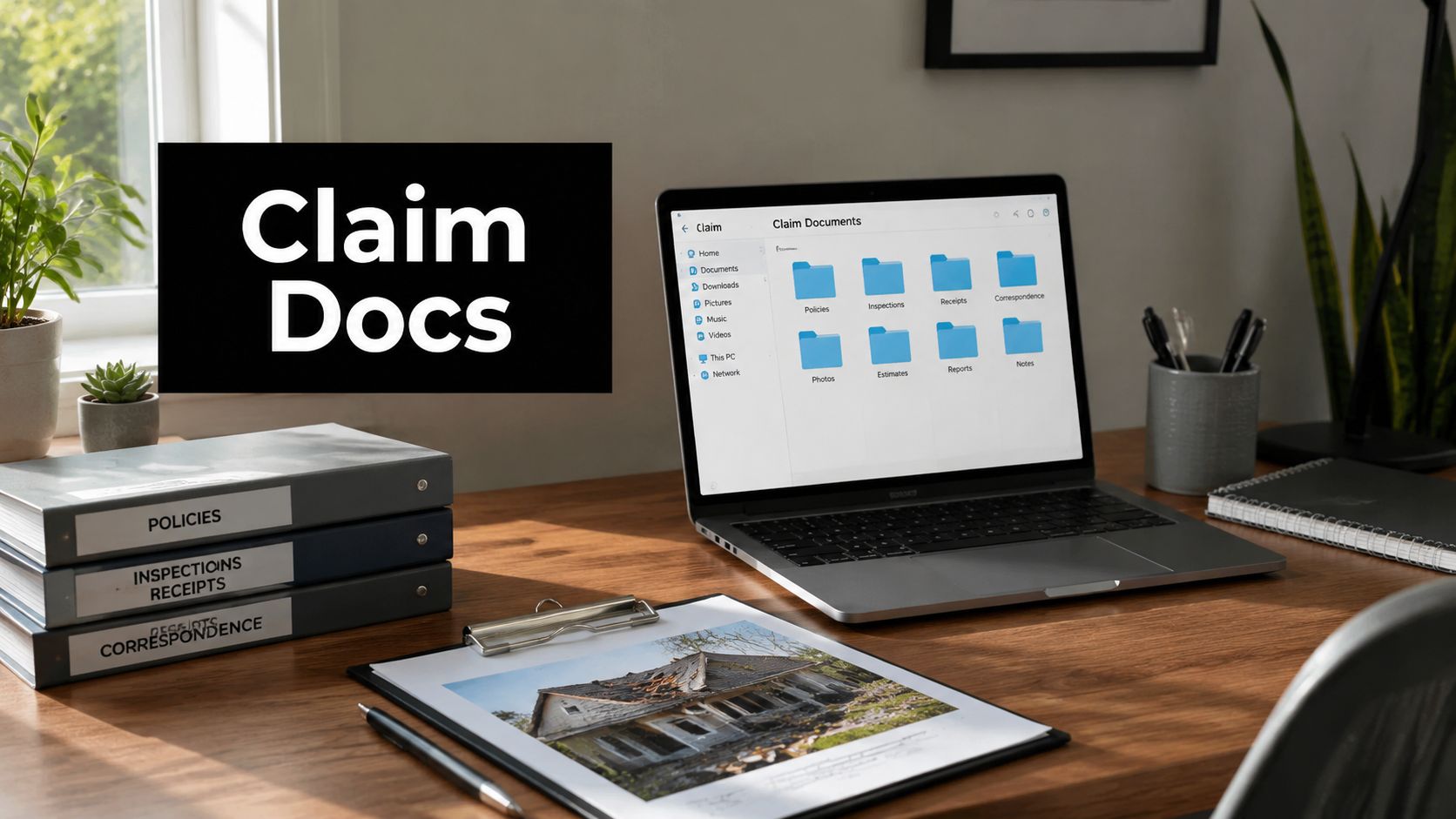
Put every document in a dedicated claim folder. Name files clearly and send them with a short email summary so there's no confusion about what was delivered.
Step four is the estimate and coverage position
The carrier then issues some version of its position. That may be full acceptance, partial acceptance, reservation of rights, or denial of some portion of the claim. In many property losses, the first real fight is not over whether there was damage. It's over scope, cause, pricing, and policy interpretation.
You might see line items for visible repairs while whole categories are left out. That's common with roofing accessories, interior finishes, moisture-related work, code upgrades, and business-related losses.
Step five is supplementing and negotiation
Most serious property claims are not one-and-done. New damage appears during tear-out. Contractors find hidden conditions. Pricing disputes surface. Replacement details become clearer. That leads to supplements.
A normal claim process allows for that. It should not punish you for discovering legitimate damage after initial inspection. The insurer may review added materials, request support, reinspect, and revise payment.
If the process stays transparent, manageable, and responsive, good. If it turns evasive, stalled, or strangely narrow, that's when you stop treating it like routine paperwork and start treating it like a dispute.
When The Claim Process Goes Wrong A Troubling Precedent
Your building is torn open after a storm. Water is still finding its way in. You report the claim, send photos, answer questions, and expect the carrier to deal straight. Instead, the file starts drifting. Calls slow down. New document requests keep coming. The first payment looks official, but it leaves out costly parts of the repair.
That is how claim trouble often starts with carriers that handle losses aggressively. By following a set procedure. In ways that look reasonable on paper until you measure the damage against what it takes to put the property back.
NorGuard has a public bad faith history that policyholders should take seriously. In a Colorado case, a jury awarded $145M after NorGUARD denied needed inpatient rehab for a worker with a traumatic brain injury, failed to comply for months after a judge's liability ruling, and made low offers before trial, according to Ogborn Mihm's summary of the verdict.
Yes, that was a workers' compensation case. The lesson still matters for property claims in Oregon and Washington. The conduct pattern is what matters. Delay. Resistance after the evidence gets stronger. Pressure to accept less than the claim supports.
What bad faith looks like on a property file
Bad faith is unfair claim handling. Simple as that.
On a property loss, it usually does not arrive as a dramatic denial letter on day one. It shows up as a file that keeps narrowing around the insurer's preferred outcome. The inspection focuses on what is visible and skips what is likely hidden. The adjuster asks for records you already sent. The carrier pays for patchwork repairs while avoiding code items, moisture mapping, matching materials, access costs, overhead and profit, or business interruption.
That pattern matters because each small omission lowers the claim.
For Oregon and Washington policyholders, this risk is higher on losses involving wind-driven rain, roof openings, attic moisture, frozen pipes, smoke spread, and layered water damage. These claims are interconnected. A roof failure is not just roofing. It can mean insulation, drywall, flooring, trim, electrical components, mold prevention, and lost income if operations were interrupted. If the carrier breaks that chain apart, underpayment starts fast.
The playbook carriers use when they want the file cheaper
Watch the sequence, not just the words.
A carrier trying to reduce exposure does not need to deny the whole claim. It can accept enough of the loss to look cooperative while keeping the significant money off the table. That is often more effective because many policyholders assume partial payment means the claim is being handled fairly.
Common tactics include:
| Tactic | What it does to your claim |
|---|---|
| Partial acceptance with missing line items | Makes the payment look legitimate while leaving expensive repairs unfunded |
| Reinspection delays after hidden damage is found | Buys time and pressures you to proceed without enough money |
| Repeated requests for the same records | Slows the file and creates a false excuse for inaction |
| Selective policy reading | Uses exclusions or limitations aggressively while ignoring coverage language that helps you |
| Low early offer | Sets an artificial benchmark below real repair cost |
If you live in Oregon or Washington, do not treat that as ordinary friction. Treat it as a warning that the file needs tighter control.
What you should do the moment the pattern appears
Get disciplined. Fast.
Stop having important conversations only by phone. Confirm every call by email. Tie every repair item to evidence. Use photos, contractor findings, moisture readings, invoices, timelines, and policy language. If the carrier ignores one category of damage, isolate it and force a written response on that item.
Do not argue from frustration. Argue from proof.
If NorGuard starts stalling, narrowing scope, or soft-pedaling a denial through partial payment, read this guide on how to fight an insurance claim denial. That is the point where you protect the file before the carrier's version becomes the official story.
My advice on the NorGuard risk
Here is my view. A public $145M bad faith verdict is a serious warning sign. It shows what can happen when this carrier digs in and puts cost control ahead of fair handling.
Do not assume your claim will be treated fairly because the process sounds polite. Require written answers. Require a real scope. Require support for every reduction. If you are an Oregon or Washington policyholder dealing with NorGuard, protect your rights early, because once a low claim position hardens, it gets much harder to reverse.
Your Step-by-Step Guide for Managing a NorGuard Claim
A NorGuard claim can look calm at first. Then you get a polite email, a narrow inspection, and an estimate that misses half the loss. If you are in Oregon or Washington, handle the file like it may become a dispute from day one.
That is the right mindset with this carrier.
Secure the evidence before the story gets rewritten
Start at the loss site. Record a full video walkthrough before cleanup, tear-out, or temporary repairs change what can be seen. Then take photos from wide, mid-range, and close-up angles. Cover every affected room and every likely path of damage, including roofing, attic, insulation, wall cavities, flooring, trim, exterior elevations, equipment, and contents.
Keep damaged materials when it is safe. Do not toss shingles, wet drywall, warped flooring, failed components, or damaged stock until they have been documented and NorGuard has had a fair chance to inspect.
Use a claim diary. Keep it simple and consistent:
- Who you spoke with
- Date and time
- What they asked for
- What you sent
- What they said would happen next
That diary matters when the file slows down or the adjuster changes position.
Put every important point in writing
Phone calls are fine for scheduling. They are weak for disputes.
Use email for anything that affects scope, cause, pricing, deadlines, temporary repairs, code issues, living expenses, business interruption, or partial denials. If a call happens, send a short follow-up the same day confirming what was discussed. That one habit prevents a lot of carrier revisionism.
Be careful with your wording. Do not guess at cause. Do not minimize the loss to sound cooperative. Do not say damage is minor if more areas may open up once repairs begin.
Write every message as if a supervisor, regulator, or jury may read it later.
Perform your policy duties without making the carrier's job easier
NorGuard can use missed deadlines, poor recordkeeping, or incomplete responses to box you in. Do not give them that opening.
Handle the basics in order:
- Report the claim promptly
- Prevent further damage
- Document conditions before major disposal or demolition
- Save receipts for emergency work, temporary repairs, and extra living or operating costs
- Answer written requests on time and keep copies of everything
If NorGuard asks for broad document dumps or vague information, make them clarify the request in writing. Cooperate fully. Stay organized. Those are different things.
Build your own scope before NorGuard's version hardens
Do not rely on the carrier's estimate as the master document. That is how underpayments become the baseline.
Get independent experts that fit the loss. For a roof claim, that may be a roofer and a general contractor. For water or fire, you may need mitigation, electrical, flooring, contents, HVAC, or engineering input. Ask for detail, not a one-page bid. You want line items, damage explanations, repair method, and code or matching issues called out clearly.
This matters even more with a carrier that already raises fair-claims concerns earlier in this article. In Oregon and Washington, the safest approach is to assume every missing item will stay missing unless you prove it belongs.
Challenge the first estimate like a professional
Fast payment does not mean accurate payment.
Read the estimate line by line. Look for what is missing, not just what is included. A weak first number often leaves out tear-out, overhead and profit, code work, manipulation of contents, concealed moisture damage, detached finishes, permit costs, and full paint or flooring transitions needed for matching.
Ask direct questions:
- Was the roof inspected up close or only from the ground?
- Were wet materials tested or just viewed?
- Does the estimate include access and tear-out for hidden damage?
- Are code upgrades, permits, and matching addressed?
- For business losses, are income interruption and extra expense being tracked correctly?
If the answer is vague, the estimate is not ready for agreement.
Force written decisions on disputed items
Do not argue in circles. Isolate the issue and pin it down.
For each omitted or underpaid item, send one organized package with photos, expert support, invoices or bids, and a short explanation of why the item belongs in the claim. Then ask for a written coverage or valuation position by a specific date. That puts pressure on the carrier to respond to the actual evidence instead of drifting past it.
A simple format works best:
- Identify the missing item
- Attach proof
- State the repair or replacement basis
- Request a written response by a deadline
That is how you keep control of the file.
Know when to bring in help
Some policyholders can manage the early stage on their own. Once NorGuard starts delaying, under-scoping, shifting explanations, or paying part of the claim while avoiding the hard issues, you need support. Read our guide on when to hire a public adjuster for a difficult insurance claim.
My advice is simple. If the claim involves serious property damage, conflicting expert opinions, business losses, or a pattern of partial answers, stop treating it like routine paperwork. Treat it like a contested file and build your case accordingly.
Red Flags That Signal You Need a Public Adjuster
Some claims stay manageable. Others turn into a second job you never asked for. If you're spending your nights chasing emails, arguing over missing line items, and wondering whether the carrier is playing fair, that's not a sign to push harder alone. It's a sign to get help.
A public adjuster works for the policyholder. Not the insurer. That distinction matters most when the claim starts sliding from routine into adversarial.
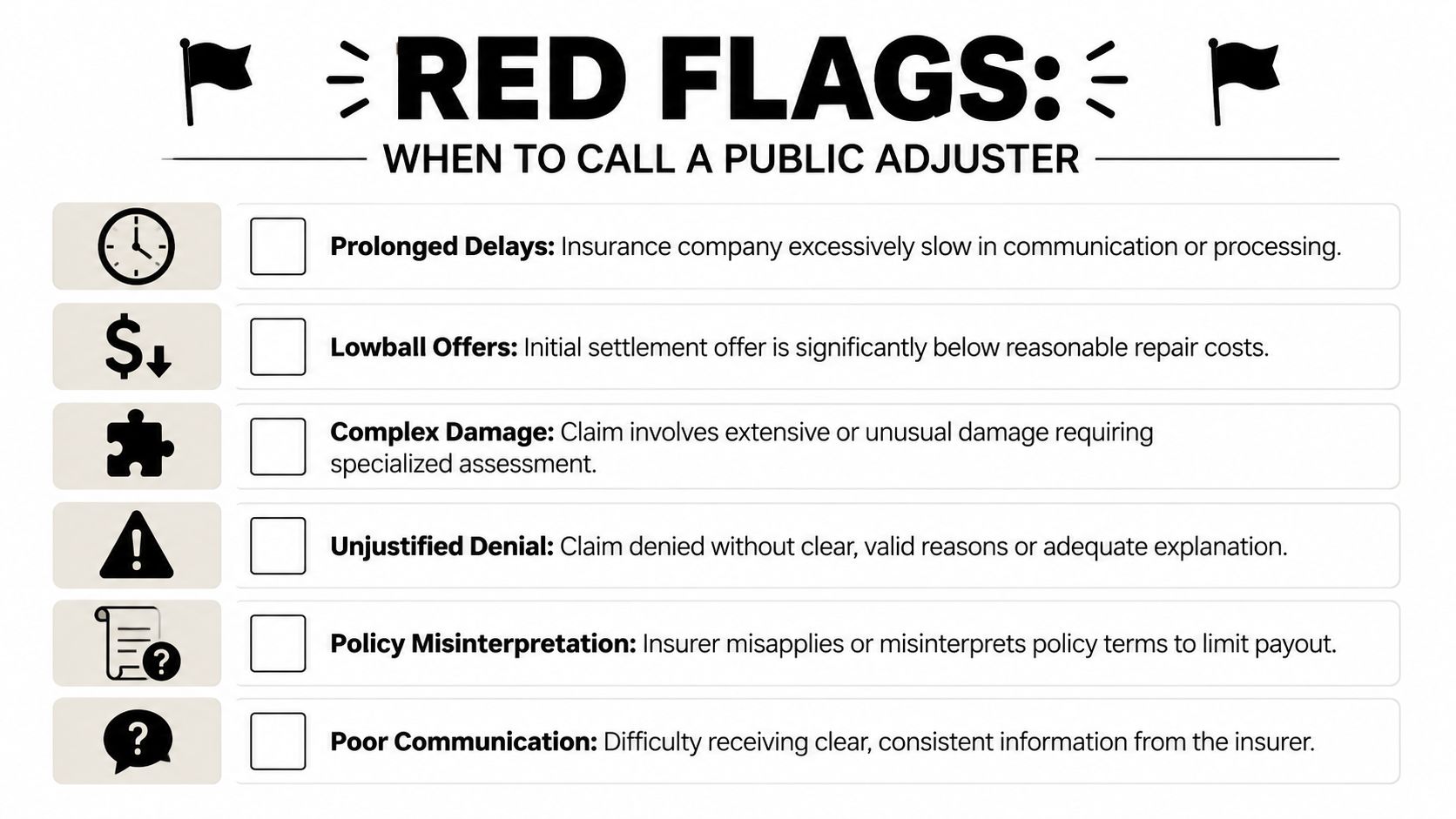
Warning Signs You Need a Public Adjuster for Your NorGuard Claim
| Red Flag | Why It's a Problem |
|---|---|
| Prolonged delays | Delay gives the insurer leverage and leaves you funding the problem longer |
| Lowball offer | A weak first number can anchor the entire negotiation below real repair needs |
| Complex damage | Multi-trade losses are easy to under-scope and hard for one owner to manage alone |
| Unjustified denial | A denial without a clear, valid explanation usually signals a deeper dispute |
| Policy misinterpretation | If the carrier is twisting terms, the fight is no longer just about damage |
| Poor communication | Conflicting answers and silence make it harder to protect deadlines and rights |
The practical threshold
You don't need to wait for a formal denial to bring in a public adjuster. That's one of the biggest mistakes I see. By the time denial arrives, the insurer's file may already contain months of unchecked assumptions.
Call for help when any of these are happening:
- You're getting different answers from different people
- The scope feels obviously incomplete
- Contractors are telling you the estimate won't cover the work
- The carrier keeps asking for more but doesn't make decisions
- The loss involves business interruption, major structural issues, or multiple buildings
- You're too stressed or too busy to keep managing the process properly
Why early help changes the outcome
A public adjuster can step in before the dispute hardens. That matters because once a carrier has committed to a narrow version of the loss, reversing it takes more effort.
Early intervention helps by:
- Organizing the evidence before it gets scattered
- Defining the scope before underpayment becomes normalized
- Controlling communication so the file reflects the actual loss
- Reducing the chance that a rushed acceptance closes off later recovery
If you're unsure whether you're at that point, review these common scenarios on when to hire a public adjuster. Most policyholders wait too long. They hope responsiveness will improve. It usually doesn't without pressure.
If the claim feels confusing, one-sided, or exhausting, that feeling matters. Claims that are being handled fairly usually don't leave policyholders constantly guessing.
My rule of thumb
If your claim is large, technical, commercial, or already contentious, bring in a public adjuster early. If the insurer has gone quiet, issued a weak estimate, or started leaning heavily on policy language to limit payment, bring one in now.
Waiting rarely helps the policyholder. It usually helps the file the insurer is building.
How NW Claims Management Levels the Playing Field
You report serious property damage, expect a fair review, and then the file starts drifting. The estimate comes in thin. Key damage gets treated as questionable. Calls drag out. If you are in Oregon or Washington and dealing with NorGuard, do not treat that as normal claim friction. Treat it as a sign to get your side organized fast.

NW Claims Management levels the field by building the claim the way the insurer builds its defense. That means a documented scope, a supported valuation, a clean record of communication, and a strategy for pushing back when NorGuard narrows causation, omits repair items, or hides behind delay.
For Oregon and Washington policyholders, four things matter most:
- Read the policy for coverage grants, exclusions, limits, and loss settlement wording
- Document all damage before conditions change or repairs erase evidence
- Price the work using real local conditions, not a stripped-down desk estimate
- Force clear written positions when NorGuard leaves decisions vague
That is the difference between a claim that gets managed and a claim that gets managed against you.
Why local representation matters with NorGuard
NorGuard claims in OR and WA often turn on issues that are easy for a carrier to minimize on paper. Moisture spread. Hidden structural impact. Roofing and envelope failures. Code upgrades. Business interruption timing. Contractor scarcity. These are not side issues. They drive value.
A good public adjuster does more than ask for a higher number. They pin down the scope, challenge weak causation positions, document what the carrier missed, and keep the file from becoming a record of the insurer's version of events. That matters even more when you are dealing with a carrier that has faced bad faith allegations in the past. You do not beat that with frustration. You beat it with a tighter file than theirs.
If you want to see what that work includes, review NW Claims Management's public adjuster services for Oregon and Washington policyholders.
The practical benefit
Good representation changes the pressure on the claim and the burden on you. Instead of reacting to each new estimate, reservation, or delay, you have someone setting deadlines, answering scope disputes with evidence, and protecting your right to full payment under the policy.
That is a big deal after a major loss. You are already trying to stabilize the property, deal with contractors, and keep life or business moving. You should not also be expected to become an expert in estimating, policy interpretation, HVAC damage evaluation, or documentation standards overnight. If part of your claim involves cooling systems or equipment questions, even a consumer resource like this Phoenix Valley AC installation troubleshooting guide can help you frame better questions for your own experts.
My advice is simple. If NorGuard is under-scoping, delaying, or turning every issue into a debate, bring in an expert advocate on the policyholder's side before the file hardens against you.
Frequently Asked Questions About NorGuard Claims
Is NorGuard part of Berkshire Hathaway
Yes. NorGuard operates as part of the Berkshire Hathaway GUARD group. For policyholders, the key takeaway isn't branding. It's scale. You're dealing with a large institutional carrier, and that means you should expect formal procedures, layered review, and a negotiation environment that favors organized documentation.
Should I trust the company adjuster if they seem helpful
Be polite, cooperative, and professional. But don't confuse friendly communication with aligned interests. The company adjuster represents the insurer's side of the claim. That doesn't make them the enemy. It does mean you should independently verify scope, pricing, and policy interpretation before relying on their conclusions.
Can a property claim be underpaid without being fully denied
Absolutely. That's one of the most common problems. A claim can be accepted in part and still be underpaid through missing line items, limited repair methods, omitted code work, or narrow damage evaluation. Many policyholders hear “covered” and assume the estimate is complete. It often isn't.
What if part of my damage involves systems I don't understand
Bring in qualified specialists early. Roofing, HVAC, electrical, moisture, structural, and contents issues often need separate evaluation. If you're trying to understand equipment concerns after a loss, even general consumer resources can help frame the right questions. For example, this Phoenix Valley AC installation troubleshooting guide is useful as a basic reminder that mechanical systems need proper diagnosis, not guesswork.
How do public adjusters usually get paid
Most public adjusters work on a contingency basis, which means their fee is tied to the claim outcome under the terms of their agreement. Ask for the fee structure in writing, ask what services are included, and make sure you understand the scope of representation before signing anything.
When should I ask for professional help
Sooner than expected. If the claim is large, technical, delayed, under-scoped, or just consuming too much of your time, that's enough reason to get guidance. You do not need to wait until things are a mess.
If you're dealing with norguard insurance co and you want experienced help from a licensed Oregon and Washington public adjusting firm, contact NW Claims Management. They provide free claim evaluations, represent policyholders only, and help homeowners, businesses, nonprofits, and public entities push for a fair, fully documented settlement.