The call comes after dinner, or first thing Monday morning. A roof leak turned the hallway ceiling soft, a windstorm peeled shingles into the yard, or a pipe burst and soaked the bedroom wall. You do what most policyholders do. You open the claim, wait for the adjuster, and hope the insurer will pay what the loss is worth.
That hope is where people lose money. A claim payout isn't automatic, and it isn't fixed just because the damage is obvious. It becomes a negotiation, shaped by how the loss is documented, how the policy is read, and whether the insurer can push you into accepting a smaller number before you've built your case.
This compensation payouts guide is for Oregon and Washington property owners who want the blunt version. The money you recover depends on the type of payout, the valuation method, the paper trail, and the pushback you give when an estimate comes in low. In a serious loss, help from a licensed public adjuster can also change the outcome, because you're not bargaining from the insurer's side of the table.
What Happens After the Damage Is Done
A homeowner in Portland wakes up to water dripping through a light fixture. A shop owner in Tacoma walks into a wind-damaged storefront and sees broken glass, warped framing, and inventory at risk. In both cases, the next move feels urgent, but it's not just about calling the carrier and waiting for a check.
That first claim conversation usually starts the insurer's control of the file. The insurer wants its own version of the loss, its own estimate, and its own reading of what's covered. If you don't document the damage early and force the carrier to deal with the full scope, the gap between the loss and the payout gets built in from the start.
Practical rule: treat the first few days like evidence preservation, not cleanup mode.
That means taking photos before anything gets moved, saving damaged materials when possible, and keeping every repair-related receipt from day one. If the loss is storm-related and you need immediate stabilization help, a local resource such as storm damage restoration services can be useful for emergency mitigation while you build the claim record.
The rest of the process is about using what you know. You need to know what kind of payout you're dealing with, how insurers calculate it, what paperwork changes the number, and where Oregon and Washington rules give you room to fight back. Most owners don't lose because the loss isn't real. They lose because the file is thin, the negotiation starts too early, and the insurer gets to define the damage before you do.
Types of Insurance Compensation Payouts Explained
Actual Cash Value and replacement cost
The most important distinction in property claims is Actual Cash Value, or ACV, versus Replacement Cost Value, or RCV. ACV usually reflects depreciation, so older materials get valued lower. RCV aims at the cost to replace with like kind and quality, but insurers often pay only part of it up front and hold the rest until repairs are completed.
For a 10-year-old roof, that difference matters immediately. If the carrier treats the roof as heavily depreciated, the first check can be far smaller than what you need to replace it. Insurers like ACV when they can justify it, because depreciation reduces the payout without changing the visible damage.
Living expense and business interruption payments
If your home is uninhabitable, additional living expenses coverage can pay for temporary displacement costs tied to the loss. For commercial owners, business interruption coverage is about lost operating income and the extra expenses needed to keep the business moving. Those claims rise or fall on records, not sympathy.
A restaurant with smoke contamination may have property damage and a shutdown loss at the same time. The building claim covers the physical damage, while the interruption claim depends on proving what the business would have earned without the loss. If payroll, invoices, and sales records are incomplete, the insurer will use that gap to cut the number.
The insurer doesn't pay for what you meant to lose. It pays for what you can prove.
Supplemental claims after hidden damage appears
A lot of Oregon and Washington claims expand after the first teardown. Hidden water damage behind cabinets, under flooring, or inside wall cavities often doesn't show until demolition starts. That's where a supplemental claim comes in, and it should be expected, not treated like an exception.
This is why the first estimate is rarely the final number. If the insurer closes its file too fast, hidden damage gets left out. A careful claim file keeps the door open for later repairs, especially when the original loss spread deeper than the surface suggested.
How Insurers Calculate Your Payout Amount
The basic math
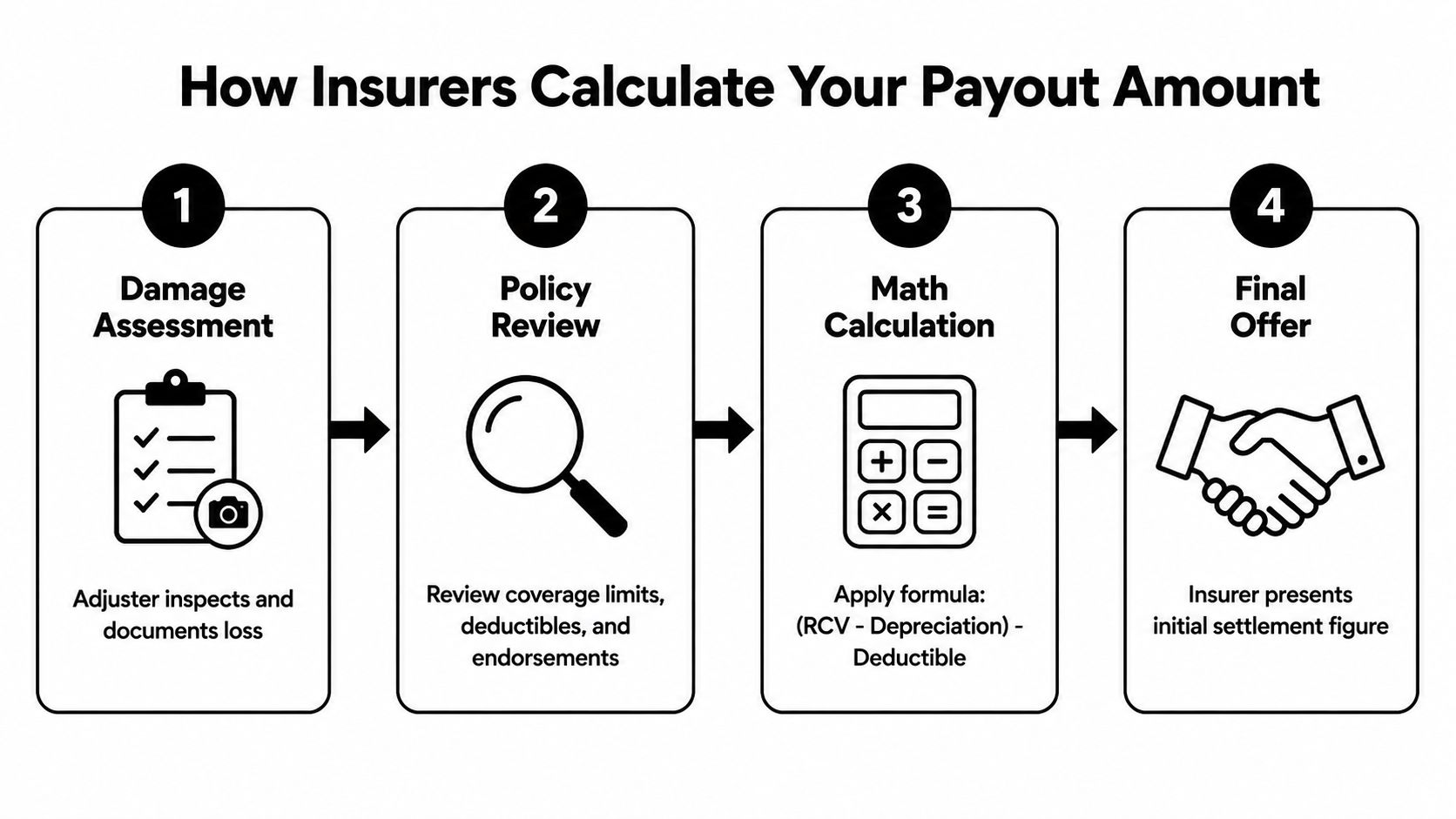
Most property payouts start with scope, then move to valuation, then to deductions. A claim adjuster inspects the damage, reviews the policy language, applies depreciation if the claim is ACV, subtracts the deductible, and then tests the result against policy limits and sub-limits. The sequence matters because a mistake at any step lowers the final offer.
One common formula is simple in practice, even if the paperwork looks messy. The insurer estimates the repair cost, applies depreciation where allowed, and subtracts the deductible. If a kitchen fire destroys cabinets, drywall, flooring, and appliances, each line item can be trimmed separately, which is why a full-room estimate often matters more than a one-line summary.
For a deeper breakdown of valuation methods, the insurer's math is easier to challenge when you understand loss valuation methods. That's where owners start spotting the difference between a legitimate estimate and a strategically narrow one.
Where the estimate gets shaved
Insurers often reduce payouts by leaving out labor, undercounting demolition, or valuing materials as if they're easier to replace than they really are. They can also narrow the scope by claiming an item is wear and tear, not covered damage, or by assuming a partial repair will somehow blend perfectly with the rest of the property. That assumption is where many underpayments hide.
Ordinance and law coverage, code upgrade items, and matching materials are frequent blind spots. If the carrier pays only to restore the damaged area but ignores the need to bring the work up to code, the owner absorbs the gap. If matching across a room or façade is needed for a consistent repair, leaving it out can make the payout look reasonable while still being short.
What to review before you sign
Don't read the dollar figure first. Read the scope line by line. Then ask whether every damaged area, every material, every tear-out item, and every required upgrade appears somewhere in the estimate.
Practical rule: if the estimate doesn't show up in the repair scope, it usually doesn't show up in the payment either.
That's the point where many owners need a second set of eyes. A strong review catches omissions before you accept them as final.
Common Insurer Tactics That Reduce Your Settlement
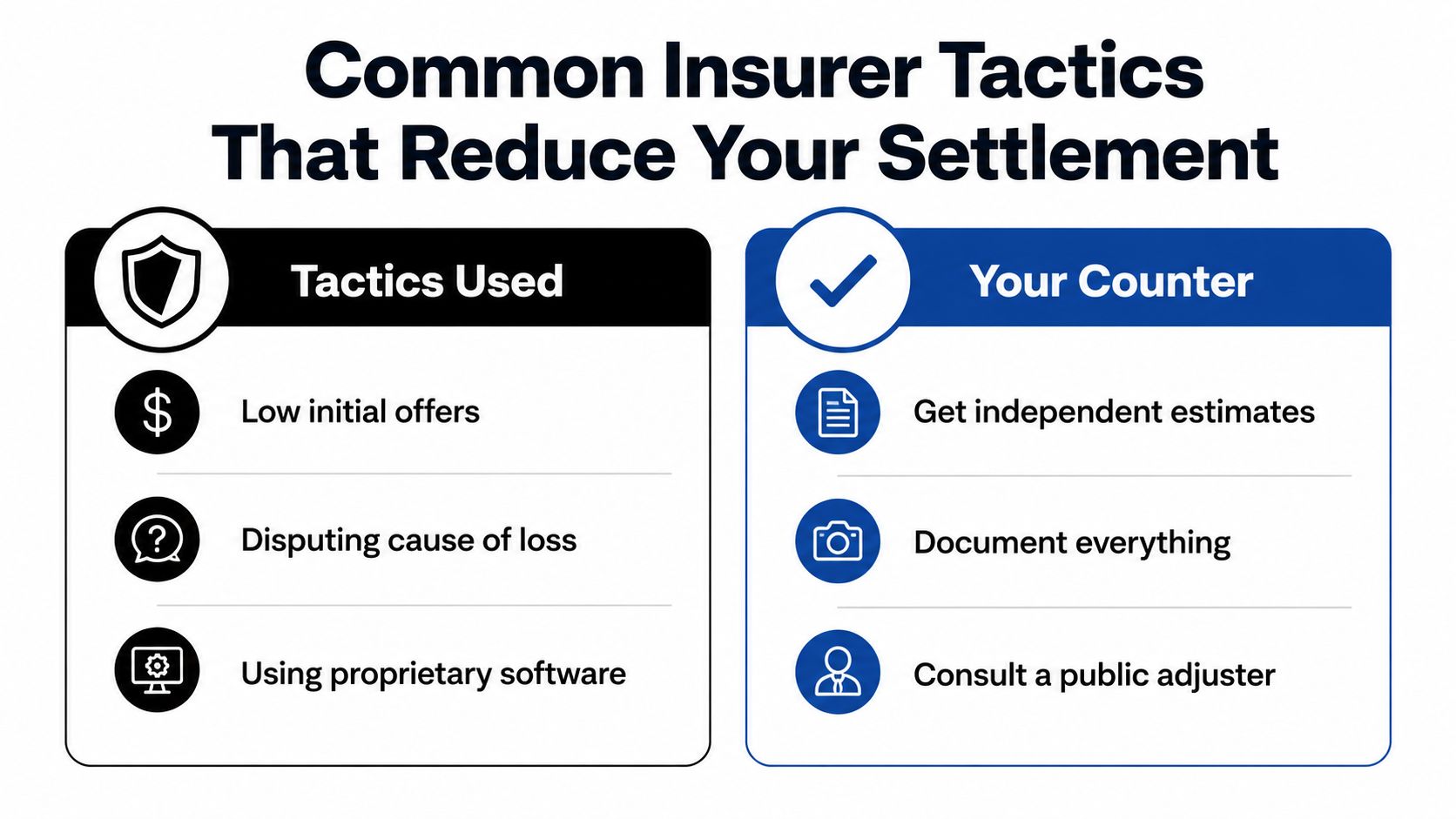
Insurers rarely announce that they're trying to underpay you. They do it by narrowing the discussion, not by admitting intent. The tactics are predictable, and if you've handled claims in Oregon and Washington long enough, you see the same playbook again and again.
Low offers and pressure to move fast
The first offer is often designed to test resolve, not to reflect the actual loss. A policyholder who is stressed, displaced, and staring at repair bills is easier to push into a quick acceptance. That's why early numbers often look tidy but don't include the full scope.
The best counter is to slow the conversation down with independent estimates and a written response that points to missing items. If you don't have a contractor on your side yet, get one. If the carrier is anchoring low, don't argue emotionally. Argue from the estimate, the photos, and the policy.
Cause disputes and selective reading
Another common move is to say the damage came from something else. Pre-existing wear, poor maintenance, or an excluded condition gets raised whenever the insurer wants to dodge responsibility for part of the loss. Sometimes they're right on a narrow issue. Often they're using a broad label to shrink a covered claim.
That's where documentation wins. Show the condition before the loss, show the loss event, and show the damage path. If the adjuster ignores an entire room or assumes unrelated deterioration caused the claim, demand a written explanation and tie your response to the physical evidence.
Preferred vendors and scope control
Insurers also lean on vendors they know and trust. That doesn't automatically mean the work is bad, but it does mean the estimate can be built around what the insurer wants to pay, not what the property needs. When a preferred vendor's scope leaves out tear-out, matching, or replacement of connected items, the shortfall lands on you.
For a straightforward look at why adjusters make these moves, review insurance adjuster tricks. The pattern is simple. The insurer controls the first draft, and the first draft is usually not generous.
Documentation You Need Before Filing Your Claim
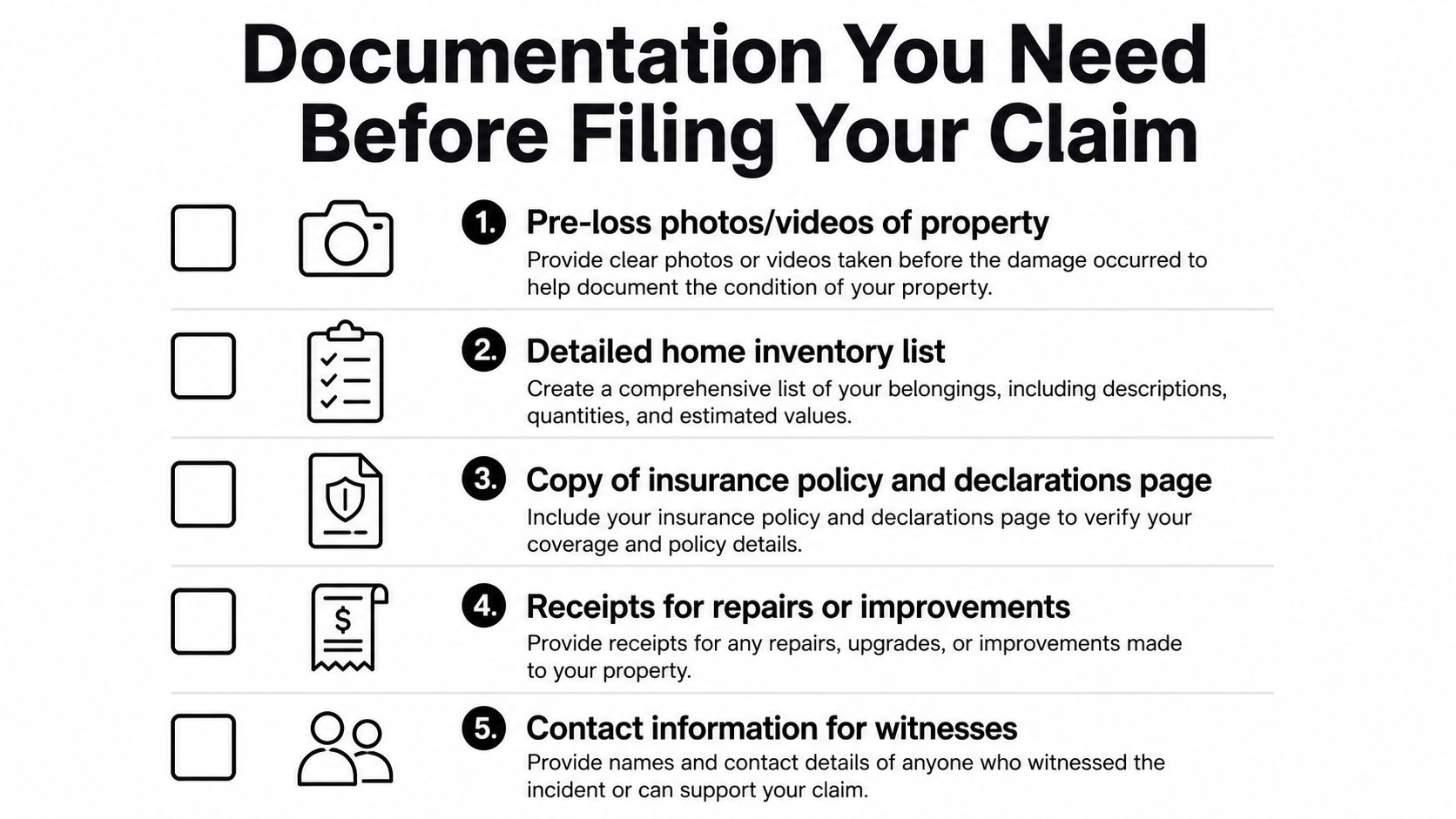
The best claims file starts before the loss, but most owners don't have that luxury. So build what you can now, while the evidence is still fresh. Contemporaneous records carry more weight than reconstruction after the fact because they show condition, timing, and cost without the fog of memory.
What to gather right away
Start with pre-loss photos if you have them, then add post-loss photos and video before cleanup begins. Save your policy, declarations page, receipts for repairs or improvements, and any witness contact details you can collect. If a contractor has already looked at the damage, keep that estimate with the date attached.
For homeowners, a home inventory makes the difference between a vague contents claim and a usable one. For businesses and nonprofits, preserve financial records that show ordinary operations, because interruption claims live or die on those numbers. If you're missing a piece of the puzzle, say that plainly and keep looking, because the insurer will absolutely exploit silence.
How to organize it
Use one folder for photos, one for receipts, one for insurer communications, and one for repair estimates. Keep a running log with dates, names, and what was said on each call or email. That log becomes especially valuable when the insurer changes position later.
If you need a structured contents list, use the personal property inventory template. It saves time and prevents the classic mistake of forgetting lower-value items that add up fast.
Practical rule: if you can't show it, date it, and tie it to the loss, expect the insurer to question it.
That's the power in documentation. It shifts the conversation from opinion to proof, and proof is what forces a better payout.
Oregon and Washington Claim Rules That Affect Your Payout
Oregon and Washington look similar from the outside, but claim handling can feel different once the insurer starts dragging its feet. The practical difference is not just the policy. It's how quickly you apply pressure, how you frame a dispute, and whether your representation is licensed for the state you're in.
Licensing and representation
Public adjusters working property claims in Oregon and Washington need to operate within each state's licensing rules. That matters because an unlicensed or out-of-state approach can create problems when the claim gets serious. If you're hiring help, make sure the person is authorized where the property sits.
Dispute handling and escalation
Both states give policyholders ways to challenge a low offer, but the route depends on the policy language and the facts of the loss. Appraisal clauses, supplement submissions, and written disputes can all be used strategically, but only if the file is organized enough to support them. A weak submission just gives the insurer more room to stall.
Bad faith standards also matter because they shape how insurers behave when they know you're willing to push. If the carrier knows the file is documented, the estimate is defensible, and the owner understands the policy, the tone usually changes. That doesn't guarantee a bigger check, but it removes the easy excuses.
Regional claim realities
In Oregon, wildfire exposure can make insurers more cautious around structural, smoke, and contents damage. In Washington, wind and water damage patterns can create disputes over whether the loss was sudden, hidden, or tied to maintenance. Those regional realities affect how adjusters frame the claim, especially when multiple causes are in play.
The takeaway is simple. Don't treat Oregon and Washington claims like generic national forms. The insurer won't. Your response should match the state, the policy, and the loss history.
Why a Public Adjuster Changes Your Payout Outcome
A public adjuster works for you, not the carrier. That alone changes the tone of the claim. The insurer's adjuster is there to control exposure, verify scope, and limit payment to what the policy can defensibly support. Your side needs someone who builds the claim like a case file and negotiates it like one.
What representation actually does
A strong public adjuster inspects damage, organizes evidence, prepares the scope, and pushes back on omissions line by line. That includes the annoying parts most owners don't want to handle, like documentation cleanup, estimate comparison, and written negotiation over missing items. If the first offer is short, the adjuster doesn't just complain. They build the rebuttal.
For policyholders looking at representation options, benefits of hiring a public adjuster should be read with one question in mind, whether the fee is likely to be justified by the recovery. In many serious claims, the answer is yes, because a better prepared file often exposes money the carrier never volunteered.
Why cost objections miss the point
People worry about fees and ignore the underpayment already sitting in front of them. That's the wrong comparison. The critical question is whether you want to settle against the insurer's first draft or against a professionally built claim that accounts for the full loss.
NW Claims Management handles residential, commercial, and nonprofit property claims across Oregon and Washington, from inspection through negotiation. That matters most when the loss is layered, the documentation is messy, or the insurer is using delay and narrow scope to push the number down. The point isn't flash. It's influence.
Practical rule: if the claim is big enough to hurt, it's big enough to justify a serious review before you accept anything.
That's where a licensed public adjuster changes the outcome. Not by magic, but by making the insurer deal with a complete, defensible claim instead of a thin, hurried one.
Your Action Plan for Maximum Recovery
The first 48 hours are about preservation. Photograph everything, save damaged items when you can, start the communication log, and keep cleanup limited to emergency mitigation. If the insurer wants an early statement, give the facts, not speculation.
Over the next several weeks, build the file. Collect repair estimates, organize receipts, update your inventory, and compare every item in the insurer's scope against what got damaged. If you see omissions, don't wait for the carrier to “catch up.” Put the missing items in writing and support them with evidence.
When the offer arrives, review it as a negotiation document, not a final answer. Check the valuation method, the depreciation, the deductible, and the missing scope. If the number feels thin, get professional help before you sign a release, because once you accept, you usually don't get a second chance.
For owners who want a harder look at the payout process, the practical checklist in how to maximize insurance claim payout belongs on your desk, not in your bookmarks. The earlier you get experienced eyes on the file, the less money the insurer gets to keep by default.
If your property claim in Oregon or Washington is already stuck, NW Claims Management can review the loss, inspect the damage, and handle the negotiation from the policyholder side. Visit NW Claims Management for a free claim evaluation and get a clear read on what your payout should look like before you accept the insurer's number.