
That first settlement offer from your insurance company can be a gut punch. It’s almost always too low, and it leaves you wondering how you'll ever rebuild. The reason is usually the same: their valuation is based on simplified, outdated numbers.
This is where knowing your way around the Portland Assessor's Database can completely change the game and become your single most important tool for getting a fair payment.
Why Assessor Data Is Crucial for Your Claim
When a fire or other disaster strikes your Portland home, the adjuster's initial offer might feel disconnected from reality. We see it all the time. The core of this problem is the massive gap between your property’s Assessed Value (AV) and its Real Market Value (RMV). Getting a handle on this difference is the first step in fighting back against a lowball offer.
Your Assessed Value, the number on your tax statement, is capped by state law and rarely keeps up with the market. The Real Market Value, on the other hand, is what your property could actually sell for today. That difference is where your leverage lies.
The Value Gap in Portland Real Estate
Nowhere is this gap more obvious than in Portland’s fast-moving real estate market. In one recent fire claim, the homeowner was presented with an initial offer that was a staggering $80,000 less than the real cost to rebuild.
By pulling the official records from the Portland assessor's database, we proved the home's true specifications, construction quality, and its context in the current market. That evidence forced the insurer to adjust their numbers. This isn't a rare win; it's the fundamental strategy we use to build a fact-based claim from day one.
The core of a strong insurance claim isn't what you think your property is worth; it's what official documentation can prove. The assessor's database provides that indisputable proof.
The data speaks for itself. While a platform like Zillow might show a typical Portland home value hovering around $524,251, a deeper look at historical assessor data paints a more dramatic picture. In fact, an analysis of over 170,000 properties between 2010 and 2020 revealed a median value increase of about 120%.
This clearly shows how quickly true market values can run away from the assessed values on file, creating a major point of conflict in any large claim. It's a gap that some insurers may try to use to their advantage by anchoring their settlement offer to the lower, outdated figure.
Knowing how to counter this is critical. You can learn more by reading about common insurance adjuster tricks and how to push back. When you come to the table armed with official data, you shift the entire conversation from a matter of opinion to one of undeniable fact.
How to Find Your Property in the Multnomah County Database
Government websites can feel a little intimidating at first, but thankfully, the Portland assessor's database is surprisingly easy to use. Your first stop will be the Multnomah County Assessment & Taxation property search portal. This is the official gateway to all the data tied to your property, and it's the most reliable place to start.
Think of this public data as your secret weapon. When an insurer comes back with a lowball offer, the county’s official records on your property’s value, size, and features are your best evidence for pushing back and demanding a fair settlement.
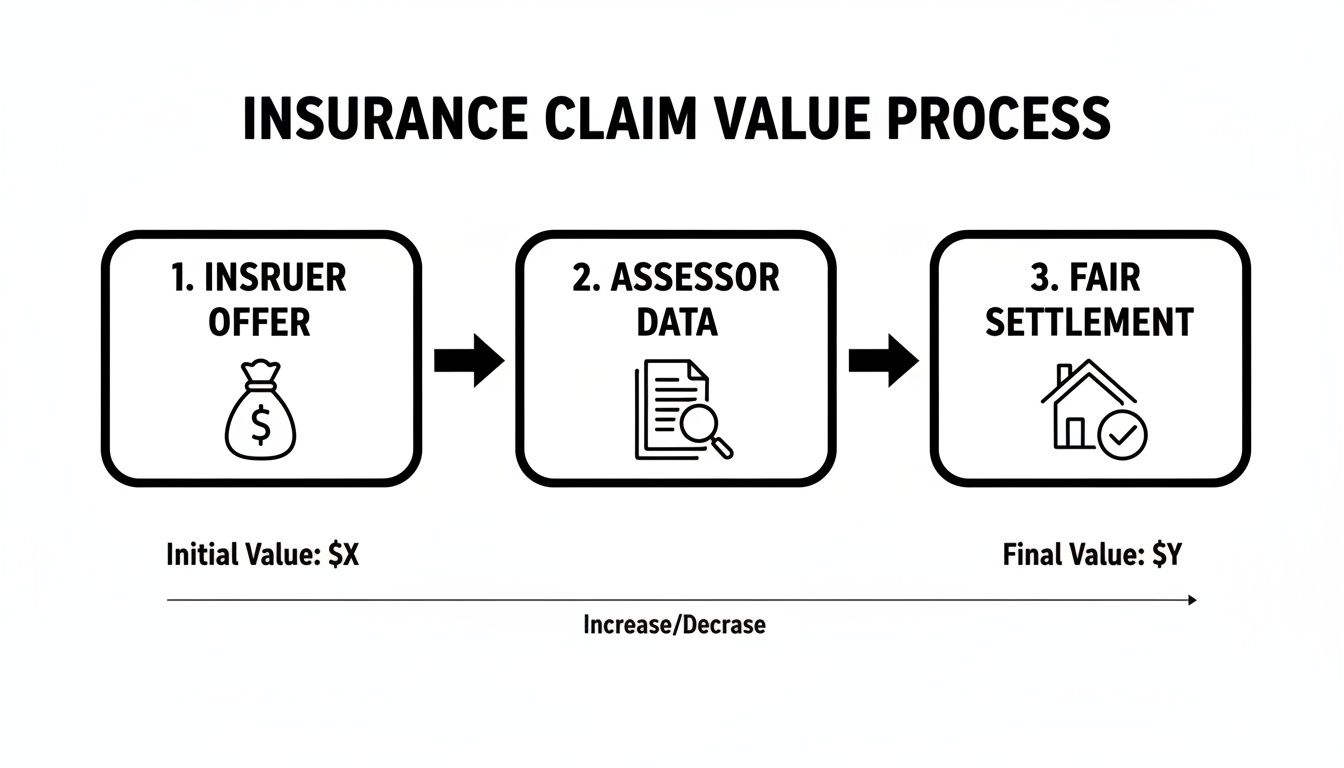
While we're focusing on Multnomah County here, the general process is similar across the country. You can almost always find property data directly from the county assessor's or tax collector's website.
Finding the Right Search Method
Once you land on the search page, you’ll see a few different ways to look up a property. The two most common are by address and by account number.
Don't be afraid to try a few variations if your first search comes up empty. Sometimes the system is picky about formatting.
Pro Tip from the Field: If a full address like "123 NW Main Street" isn't working, simplify your search. Just entering the street name, like "Main," can often bypass tricky formatting issues, especially with new or complex addresses.
Your Search Options Explained
Understanding the different identifiers will help you pull up any property record with confidence, even in tricky situations.
-
Property Address: This is the most straightforward method. Just type it in. If it fails, try common abbreviations like "St" for Street or "Ave" for Avenue.
-
R Number (Account Number): This is the gold standard. Every property has a unique "R" number, which you can find on any property tax statement. It’s the most precise way to search because it eliminates any confusion with street names or zip codes.
-
Map & Tax Lot: This is what surveyors and appraisers use. It’s a highly specific identifier that’s incredibly useful for properties that might not have a standard street address, like a vacant lot or a large rural parcel.
I’ve seen cases where a property owner recently split their lot, and the old address no longer pulled up a record. The only way they could find the new, updated details was by using the R number from their latest tax bill.
Getting this right is critical. The data you pull from the assessor's office forms the factual bedrock of your insurance claim. It’s objective, third-party proof that your insurer simply can't ignore.
Turning Assessor Data Into Claim Leverage
Alright, you’ve found your property in the Portland assessor’s database and now you're staring at a wall of information. It can look a little intimidating, but this is where the magic happens. This raw data is your secret weapon for turning the tables during an insurance negotiation.
Knowing how to read these details is how you transform public records into undeniable proof for your claim. If you have a lot of documents to manage, you might find that tools for AI-driven data extraction from documents can help you organize everything quickly.

Unpacking the Key Data Fields
Let's cut through the noise and focus on the data points that really move the needle on your claim. Each one tells a story about your property—a story that can directly challenge an insurer's attempt to lowball your settlement with generic, cookie-cutter estimates.
- Year Built & Building Style: This is so much more than a date. If you have a classic 1920s Portland bungalow, this field is your proof. It justifies the need for period-specific materials and craftsmanship, not just cheap, modern replacements. Think lathe-and-plaster walls or true-to-era wood flooring.
- Building Footprint (SqFt): The adjuster from your insurance company will measure your property, but people make mistakes. The official square footage listed in the assessor's records is your objective, third-party backup. It’s crucial for verifying the total scope of work and also for calculating your contents claim, which is often tied to your home's size.
- Property Class: This simple code (like 101 for a single-family home) officially defines your property's use. It solidifies the foundation of your claim and makes sure the correct policy coverages are being applied from the start.
Don't let your insurer use their standardized software to define your property's value. The Portland assessor's database gives you the specific, factual ammunition you need to demand a settlement that honors your home's real character and quality.
The Power of RMV Over AV
This next point is absolutely critical. You have to understand the difference between Assessed Value (AV) and Real Market Value (RMV). The AV is an artificially low number used for property taxes. The RMV, on the other hand, is the county's own estimate of what your property would actually sell for on the open market.
It's a common tactic for insurers to subtly anchor their settlement offer to the much lower AV. Your job is to pull the conversation away from that number and refocus it entirely on the RMV.
The statewide data shows just how big this gap is. According to Oregon's FY 2024-25 Property Tax Statistics Report, the total RMV for real property is $1.039 trillion. The total AV? Just $547.168 billion. On average, a property’s taxable value is barely half its actual market value. You can see the full breakdown in the state's official property tax statistical report.
This one statistic can shut down any argument that relies on tax value. By getting comfortable with these key data points, you build a powerful, evidence-based case that an adjuster will find very difficult to ignore. As you collect your proof, it also helps to learn how to get more from an insurance claim by keeping all your documentation in perfect order.
Building Your Damage Inventory with Assessor Data
Alright, so you’ve navigated the system and pulled up your property record. Now what? This is where the rubber meets the road—where you turn those dry facts and figures from the Portland assessor's database into a powerful damage inventory your insurance company can't ignore. It’s how you get paid what you're actually owed.

Let's put this into a real-world context. Say a fire guts your kitchen and leaves heavy smoke damage across the main floor. The adjuster’s first offer comes in, and it feels low. They’re proposing to rebuild using cheap, standard-grade materials. Your job is to build a counter-argument backed by official records.
Connecting the Dots: From Assessor Data to a Stronger Claim
The first thing to do is start methodically pulling key details from that assessor record and weaving them into your proof of loss. You aren't just making a list; you're building a case that justifies a higher repair cost and better quality materials.
I recommend starting a simple spreadsheet or even just a document. For every part of your house that’s damaged, you’re going to marry that damage with specific data from the county’s file.
Think about our fire scenario. The adjuster wants to use particle board cabinets and laminate flooring. But your assessor record says "Year Built: 1948" and "Building Style: Cape Cod." Your argument becomes: "This home's original 1948 construction included solid wood cabinetry and real hardwood floors, which are necessary to restore its pre-loss condition and character. The materials you've proposed are not of like kind and quality."
See how that works? It immediately reframes the entire conversation, moving it away from the insurer's generic pricing software and toward the specific reality of your home.
Using Assessor Maps to Tell the Story
Here’s a trick most people miss: the property maps available in the assessor's database are gold. They aren't just crude outlines; they're to-scale diagrams of your lot and the building's footprint. You can easily export these as a PDF or image file.
Once you have the file, use any basic image editor to mark it up. For that kitchen fire, you could draw a red box around the kitchen to designate the "total loss" zone. Then, shade the rest of the main floor in yellow to show where there's heavy smoke and water damage.
This annotated map becomes an incredibly powerful piece of visual evidence. It gives anyone looking at your file a clear, undeniable summary of the damage scope that an adjuster can't easily minimize or misinterpret.
Tucking this map into the front of your claim file gives the adjuster an immediate, professional overview of the loss before they even read a word of your inventory. It shows you’re serious and organized. For a deeper look at what a full professional submission looks like, check out our guide on the property damage assessment process.
Don't Forget the 'Extras': Sheds, Decks, and Fences
Finally, scroll down to the "Improvements" or "Other Features" section of your property record. This is a treasure trove of items that often get completely overlooked in an adjuster's initial, rushed assessment.
Pay close attention to line items for things like:
- Detached garages or sheds
- Decks and patios
- Retaining walls
- Fencing
- In-ground sprinkler systems
If that storm dropped a tree that crushed your back deck and a 50-foot section of fence, the assessor's record is your official proof that those structures existed and contributed to your property's value. Add every single one of these damaged items to your inventory, noting that their existence is documented in the county's own files. It’s a simple step that ensures every last piece of your loss gets counted.
Advanced Database Strategies for Complex Claims
When a commercial property, HOA, or nonprofit faces a major property damage claim, it's not just about fixing a building. It's about protecting the organization's future, its income, and its mission. For these bigger, more complicated claims, the Portland assessor's database becomes an indispensable tool for building a rock-solid case.
While a typical home insurance claim might center on replacing materials with "like kind and quality," complex claims are a different beast. We have to think about future value, lost income potential, and what local regulations will demand. This is where we need to dig much deeper into the assessor's records.
Uncovering Value with Zoning and Land Use Data
A property's official zoning code is a powerful piece of evidence that is often overlooked. Let's walk through a real-world scenario: a nonprofit's community center is devastated by a fire. The insurance company’s initial offer covers a basic rebuild of the old structure.
But what if the assessor’s data shows that the property is zoned for high-density, mixed-use development and sits within a designated Urban Renewal Area? Suddenly, the conversation changes. That official designation is your proof that the property’s true value lies in its development potential. We can now argue that a simple like-for-like replacement would ignore the property's "higher and better use," causing a massive financial loss.
When you're dealing with a complex claim, your goal is to build an argument so airtight that the insurer has no other logical option but to agree. The historical data, zoning records, and sales trends you pull from the Portland assessor's database are the cornerstones of that argument.
Proving Today's Value with Yesterday's Data
Historical data is another game-changer, especially in a dynamic market like Portland. It’s not uncommon for an insurer to base their offer on old, outdated values, but the assessor’s own data provides the perfect counterargument.
For instance, looking at data from the Multnomah County Assessor’s Office, we saw median home values in some Portland neighborhoods, like Boise, shoot up by over 150% between 2010 and 2020. A property that was worth $300,000 in 2010 could easily be valued at $660,000 or more by 2020. This is the hard data you need to justify today's real-world replacement costs.
On a large commercial loss, an experienced public adjuster might pull the tax lot histories and sales records for an entire city block. By showing how market forces have driven up the value of all surrounding properties, you can build a compelling case that your damaged property must be valued in the context of its appreciating neighborhood. Tackling these details is precisely when to hire a public adjuster who knows how to turn this raw data into a winning claim strategy.
Answering Your Top Questions About Using Assessor Data in a Claim
When you start digging into the Portland assessor's database for your insurance claim, a few questions almost always come up. I've heard them all over the years. Getting these sorted out early on is crucial for building a solid case and making sure you have the right documentation when you need it most.
Why Is My Assessed Value So Much Lower Than My Property's Real Worth?
This is, without a doubt, the number one question property owners ask. The answer is rooted in Oregon's unique property tax system.
Your tax bill is calculated using the Assessed Value (AV), which is legally defined as the lower of two numbers: your property’s Real Market Value (RMV) or its Maximum Assessed Value (MAV). Because of Measure 50, a law passed back in 1997, that MAV is capped and can only go up by 3% per year.
In a hot real estate market like Portland's, your property's actual worth (the RMV) climbs much faster than that 3% limit. This creates a massive, and growing, gap between the low taxable value your bill shows and what it would actually cost to rebuild. For your claim, the Assessed Value is basically irrelevant. You need to focus entirely on the RMV.
Can I Just Use Data from Zillow or Redfin Instead?
While sites like Zillow or Redfin are fantastic for getting a quick snapshot of the market, insurance companies see their data as speculative. An adjuster can easily push back on a "Zestimate," but they simply can't argue with official government records.
The Portland assessor's database provides the legally recognized facts about your property. Details like square footage, year built, and sale history form the undeniable bedrock of your claim.
Think of it this way: use the assessor's data as your primary source of truth. Then, you can supplement it with recent comparable sales from Redfin to paint a clear picture of current market conditions and justify your valuation.
What if the Information on My Property Record Is Wrong?
It’s more common than you'd think to find an error on your property record—maybe the square footage is off, or a deck you built is missing entirely. While you can contact the Multnomah County Division of Assessment to get their records corrected, this discrepancy can actually become a powerful tool for your claim.
This is where you can gain some real leverage. Here’s how to approach it:
- Document the discrepancy. Use your own measurements, the original blueprints, or a professional appraisal to prove the actual specifications of your home.
- Present it strategically. Explain to your public adjuster that even the county's official record undervalues the property.
- Strengthen your argument. This proves that the insurance company's initial assessment, which likely relies on that same flawed data, is fundamentally inaccurate and has to be revised upward.
Working through these details is what separates a weak claim from a strong one. For more guidance on putting all your evidence together, our article on how to file a property damage claim provides a great step-by-step overview. By getting ahead of these common issues, you put yourself in a much better position to negotiate a fair settlement.
The insurance claims process is complicated and designed to favor the insurance company. At NW Claims Management, we work only for you, the policyholder. If you're facing a property loss in Oregon or Washington and need an expert to manage your claim and fight for the settlement you deserve, contact us for a free claim evaluation.