When the dust settles after a disaster at your home or business, you’ll quickly meet the claims adjuster. This person becomes the single most pivotal figure in your financial recovery.
So, what exactly do they do? In a nutshell, their job is to investigate your claim, figure out the extent of the damage, and negotiate a final settlement based on what your insurance policy covers. It’s like they're part detective, part project manager, and part accountant, all rolled into one.
What Are the Core Duties of a Claims Adjuster
The adjuster is usually the first person the insurance company sends to the scene. They wear a lot of hats, from investigative work to financial analysis, but the most important thing to understand is who they’re really working for. This allegiance shapes every decision they make.
It's a massive field for a reason. Here in Oregon and Washington, we see firsthand how many professionals are needed to handle claims from the constant threat of fires, storms, and floods. The industry is substantial—the median pay for a claims adjuster was $76,790 back in May 2024, which shows you the level of specialized skill involved. You can get a sense of the claims adjusting market size and its growth at IBISWorld.
Who Does the Adjuster Work For?
Knowing who signs an adjuster’s paycheck is the key to protecting your own interests. It's not as simple as it seems, and their motivations can be wildly different.
To help clear things up, here’s a quick look at the three main types of adjusters you might encounter.
Quick Look at Claims Adjuster Roles
| Adjuster Type | Who They Represent | Primary Goal |
|---|---|---|
| Company Adjuster | The insurance company (their employer) | Settle the claim efficiently according to company guidelines and budget. |
| Independent Adjuster | The insurance company (as a contractor) | Represent the insurer's interests, often during busy times or for specific types of claims. |
| Public Adjuster | You, the policyholder | Advocate for your best interests to secure a full and fair settlement. |
As you can see, only one of these professionals has a legal and ethical duty to put your needs first.
- Company Adjuster: This person is a direct employee of your insurance company. They’re on the company payroll, and their main responsibility is to their employer. Their goal is to close your claim according to the insurer's procedures, which almost always involves keeping the payout as low as possible.
- Independent Adjuster: Insurance companies hire these adjusters as outside contractors, especially when they're swamped with claims (like after a major storm). Even though they aren't direct employees, they are paid by the insurance company and work to protect the insurer’s financial interests.
- Public Adjuster: This is the only type of adjuster who works exclusively for you, the property owner. Licensed by the state, a public adjuster’s job is to advocate on your behalf to get you the maximum, fair settlement you're entitled to under your policy.
A public adjuster is your dedicated advocate. Unlike the others, their success is tied directly to your recovery. They fight to make sure your interests, not the insurance company's, are the top priority from start to finish.
This isn't just a minor detail—it can be the most critical factor in your claim's final outcome. Understanding who is truly on your side from day one gives you the power to navigate the process effectively.
Navigating the Claims Adjusting Process Step-by-Step
When you're already grappling with a major property loss, the insurance claim journey can feel like a confusing and intimidating maze. The good news is that it follows a predictable path. Once you understand the stages, you can see exactly what the claims adjuster is doing and why.
Think of it as a seven-act play. Each scene builds on the last, moving from the initial incident report all the way to the final check. For property owners in Oregon and Washington, knowing this sequence is the first and most important step toward taking back control.
Stage 1: The Investigation
As soon as you file a claim, the adjuster’s first hat is that of an investigator. Their primary duty is to piece together a clear, factual story of what happened. This isn't just a quick glance; it's a methodical effort to answer the who, what, when, where, and why of your loss.
Imagine a fire breaks out in a Seattle restaurant. The adjuster will immediately get to work by:
- Reviewing the first notice of loss you submitted.
- Interviewing you, the owner, to get your firsthand account.
- Speaking with potential witnesses, like employees or people in neighboring businesses.
- Requesting official documents, such as the fire marshal's report or any police records.
The entire point of this stage is to verify that the event is, in fact, covered by your insurance policy. This initial legwork lays the foundation for everything that follows.
Stage 2: The Site Inspection
With the basic facts in hand, the adjuster’s next job is to visit the property for a detailed inspection. This is where they get their boots on the ground to see the damage for themselves. It’s an absolutely critical duty because it connects the paperwork to the physical reality of your loss.
They will meticulously document everything, taking hundreds of photos and detailed notes. They’re trained to spot not just the obvious, direct damage—like charred walls—but also the indirect damage, like smoke contamination in an unaffected room or hidden water damage from the firefighter's hoses.
An adjuster’s inspection is like a doctor's physical exam for your property. They are looking for all symptoms of the damage, both obvious and hidden, to make an accurate diagnosis of the loss.
This is why it's so vital for you to be there during the inspection, pointing out every single thing you've noticed. A small crack or a slight discoloration that seems minor to you could be a red flag for a much larger, hidden problem that a trained professional will recognize.
Stage 3: The Evidence Collection
While the inspection is happening, the adjuster is also collecting and organizing all kinds of evidence. This goes way beyond just snapping a few photos. Their duty is to build a comprehensive file that proves and justifies every single part of your claim.
This phase involves a few key tasks:
- Inventorying Damaged Property: For a home or business, this means creating a detailed list of every single item that was damaged or destroyed.
- Gathering Documentation: This is where you’ll need receipts, warranties, and proof of purchase for valuable items to establish what it will cost to replace them.
- Securing Expert Reports: In complex cases, the adjuster may need to bring in specialists like a structural engineer to assess foundation damage or an industrial hygienist to test for mold.
This mountain of evidence becomes the bedrock for your claim's value. Without it, your claim is just a story with no proof. This is also where having a public adjuster on your side can be a game-changer, as they ensure no piece of critical evidence gets missed.
To help you visualize how this all fits together, here’s a simple breakdown of an adjuster's core duties.
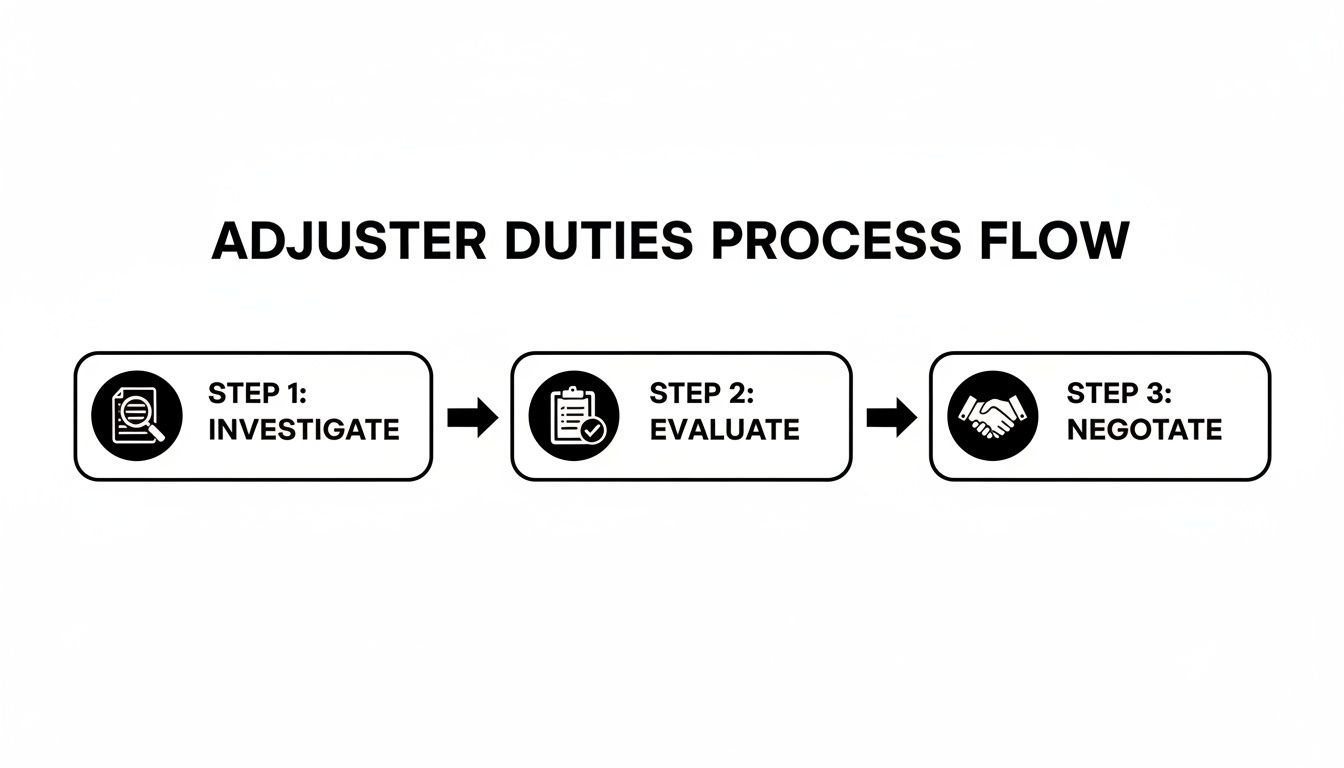
As you can see, each phase flows directly into the next, building the case for a fair and accurate settlement.
Stage 4: The Damage Valuation
With all the evidence collected, the claims adjuster's duties now pivot to valuation—putting a dollar amount on your loss. This is often one of the most disputed parts of any claim, as it requires interpreting your policy’s language around "Actual Cash Value" (ACV) and "Replacement Cost Value" (RCV).
- Replacement Cost Value (RCV): This is straightforward—it’s the cost to buy a new, similar item at today's prices. There's no deduction for age or wear.
- Actual Cash Value (ACV): This is the replacement cost minus depreciation. Depreciation accounts for an item’s age, condition, and obsolescence.
For instance, say a 5-year-old sofa was ruined in a pipe burst. A brand-new replacement might cost $2,000 (its RCV). After factoring in five years of use, the adjuster might calculate its ACV at $1,200. Most policies are set up to pay the ACV first, and then you receive the rest of the money once you actually buy the replacement.
Stage 5: The Estimate Preparation
After determining the value, the adjuster prepares a detailed repair estimate. This document, typically built using specialized software like Xactimate, provides a line-by-line breakdown of every repair, from the cost of lumber and labor to drywall, paint, and city permits.
This estimate represents the insurance company's formal opening offer. It isn't just a lump sum; it's a granular scope of work detailing exactly what they believe they owe you according to your policy.
Unfortunately, a troubling trend has emerged where some insurance carriers pressure their adjusters to withhold these detailed estimates from policyholders. This tactic destroys transparency and puts you at a huge disadvantage, forcing you to argue your case without even seeing their math.
Stage 6: The Negotiation
Here’s where your own advocacy, or that of your public adjuster, can make a world of difference. The insurance company's first estimate is an offer, not a final, non-negotiable number. The negotiation phase is a normal and expected part of the process.
If the adjuster's estimate missed damaged items, used outdated pricing for materials, or completely overlooked part of the scope of work, this is your time to push back with your own evidence. An effective adjuster negotiation depends entirely on having solid documentation, a deep understanding of your policy, and a firm grasp of local construction costs.
If things get complicated, it's wise to get a clearer picture of what to expect. Learning more about the typical property damage claim process shows you how an expert can help navigate these discussions.
Stage 7: The Settlement and Claim Closing
The final stage is reaching an agreement on the settlement amount. Once you and the insurer see eye-to-eye on a final number, the company will issue payment. You'll be required to sign a "Proof of Loss" form, which is a formal, sworn statement that finalizes the agreed-upon value of your claim.
Once the settlement is paid out, the claim is officially closed. At this point, the claims adjuster's duties for your loss are complete. By understanding these seven stages, you're in a much stronger position to protect your interests and ensure you receive the full and fair compensation you're owed.
After a fire, flood, or major storm, an insurance adjuster will arrive to assess the damage. But before you even start talking about repairs, there's one critical question you need to ask: who does that adjuster really work for? The answer to that question can mean the difference of tens or even hundreds of thousands of dollars in your settlement.
Think of it like this: you're walking into a complex legal negotiation. The other side has a team of seasoned experts. Would you want their colleague advising you, or would you bring your own dedicated representative? That’s the fundamental difference between the insurance company's adjuster and a public adjuster.

The Company Adjuster: Their Employee
The adjuster your insurance company sends out works for them. Period. Whether they're a staff employee or an "independent" adjuster hired by the insurer, their loyalty is to the company that signs their paychecks.
Their job is to investigate your claim based on the insurance company's internal rules and financial targets. While many are perfectly professional, they operate within a system built to manage costs and limit what gets paid out. Their performance is often measured by how quickly they can close files and how close they stick to a budget. This creates a built-in conflict of interest, where their duty to their employer often clashes with your need for a complete financial recovery.
The Public Adjuster: Your Advocate
A public adjuster is the complete opposite. We work for one person and one person only: you, the policyholder. We are licensed at the state level and have a fiduciary duty to act in your best interests, always. Our entire purpose is to level the playing field, bringing the same policy expertise and documentation skills to your side of the table that the insurer has on theirs.
This shift in allegiance changes the entire dynamic of the claims process. A public adjuster's only goal is to find, document, and prove the true scope of your loss to get you the maximum settlement allowed by your policy. For a deeper dive, our guide on the differences between a public adjuster vs an insurance adjuster is a great resource.
"A good public adjuster doesn't just count the obvious damage. We read every line of your policy to find coverage you didn't know you had. We bring in our own engineers and experts to counter the insurer's low assessments, and we find hidden damages—like smoke contamination in ducts or foundation cracks—that the company adjuster might overlook or dismiss."
Our motivation is also structured to benefit you. A public adjuster is paid a small, agreed-upon percentage of the final claim settlement. This means our success is directly tied to yours. We don't get paid unless we get you paid, which keeps our goals perfectly aligned with your own.
Company Adjuster vs Public Adjuster Side-by-Side
To see how this plays out in the real world, it helps to compare their roles directly. The table below breaks down the key differences you'll experience.
| Aspect | Insurance Company Adjuster | Public Adjuster (NW Claims Management) |
|---|---|---|
| Who They Work For | The insurance company. | You, the policyholder. |
| Primary Goal | Close the claim efficiently and within the insurer's budget. | Maximize your settlement to ensure a full recovery. |
| Financial Incentive | Salary/contract fees from the insurer; may be bonused on cost control. | A small percentage of the final settlement amount; we only succeed when you do. |
| Scope of Work | Tends to focus on visible, obvious damage to control costs. | Conducts a forensic investigation to find all hidden and consequential damages. |
| Policy Interpretation | Interprets the policy in the way that is most favorable to the insurer. | Interprets the policy to find all available coverage for your benefit. |
| Negotiation Stance | Represents the insurer's financial interests. | Acts as your exclusive advocate, negotiating for the highest possible payout. |
As you can see, the adjuster's allegiance directly shapes every task they perform, from the initial inspection to the final negotiation.
This difference in who an adjuster works for trickles down into every single one of their duties. A company adjuster might be under pressure to use cheaper materials in their repair estimate or to ignore complex issues that would drive up the cost. We’ve even seen cases where managers have instructed their adjusters to remove legitimate, covered items from an estimate.
A public adjuster’s work, by contrast, is all about expansion and proof. We perform our own independent inspection, write a much more detailed scope of loss, and use it to challenge every part of the insurer's assessment that doesn't add up. This transforms the situation from you just having to accept an offer into a true negotiation between two parties on equal footing.
How Oregon and Washington State Regulations Protect You
When you're trying to recover from major property damage, it can feel like your insurance company holds all the cards. But you’re not on your own. In both Oregon and Washington, a strong set of laws and regulations exists specifically to level the playing field and protect you, the policyholder.
This legal oversight is your safety net, ensuring the claims process is handled fairly. It’s particularly important when it comes to public adjusters. Before a public adjuster can even think about representing you, they have to clear a high bar set by the state, including passing a tough exam and securing a surety bond. Think of that bond as a financial promise that they will act ethically and manage your claim funds with integrity.
Key Consumer Protections in Oregon
In Oregon, the Department of Consumer and Business Services (DCBS) lays down very clear rules for how adjusters must behave. These aren't just suggestions; they are enforceable regulations designed to make the process transparent and fair.
Here are a few of your most important rights:
- Prompt Communication: Your insurer and their adjuster can’t just leave you hanging. They are legally required to respond to your calls and emails in a reasonable amount of time.
- Good Faith Investigation: An adjuster must conduct a thorough and unbiased investigation. They can't just look for reasons to deny your claim without a solid, evidence-based reason.
- Clear Explanations: If any part of your claim is denied, the insurance company has to give you the reason in writing, pointing to the specific policy language they’re using to make their decision.
Washington State's Fair Claims Practices
Washington offers similarly strong protections through its Unfair Claims Settlement Practices Act (WAC 284-30-330). The Office of the Insurance Commissioner (OIC) is very active in enforcing these rules to shield homeowners and businesses from bad faith tactics.
The whole point of these state laws is to balance the power between you and a massive insurance corporation. They make sure an adjuster's duties are performed not just to please their employer, but within the legal boundaries that prioritize your fair treatment.
This means adjusters in Washington are flat-out prohibited from misrepresenting what your policy covers. They can't try to pressure you into a lowball settlement when it's obvious the claim is valid, and they certainly can't delay payment once you've reached an agreement. These rules provide a powerful defense against the most common frustrations people face.
The Power of State Licensing
The licensing requirements in both Oregon and Washington are your best assurance of professionalism. By requiring public adjusters to be licensed, bonded, and to complete ongoing education, the state ensures you're hiring someone who is not only a claims expert but is also legally accountable.
This strict framework makes one thing crystal clear: a public adjuster's primary duty is to you. Their loyalty isn't divided. They are legally and ethically bound to fight for your best interests, giving you a powerful, knowledgeable ally when you need one most.
When Should You Hire a Public Adjuster for Your Claim?
Knowing when to bring in an expert for your insurance claim can feel like a tough call, but making that decision at the right time can save you a world of stress and, frankly, a lot of money. While you probably don't need a public adjuster for every minor leak, there are some clear signals that you need a professional in your corner.
Think about it like this: if you get into a small fender bender, you can likely handle the insurance paperwork on your own. But for a major, multi-car pile-up involving serious injuries? You’d call an experienced attorney, no question. The same logic applies to your property claim. The key is recognizing the exact moment your claim shifts from a minor headache to a major financial event.
Your Claim is Large or Complex
Let's start with the most obvious one: the sheer size and complexity of the damage. If you're facing a catastrophic loss—a house fire, a major flood that swamps your business, or severe structural damage from a storm—the stakes are enormous. These aren't simple claims; they have dozens of moving parts and huge sums of money on the line.
Take a house fire, for instance. The damage goes far beyond what you can see. It creates a tangled web of issues:
- Structural Damage: Is the building's frame, foundation, or roof still sound?
- Smoke and Soot Damage: This nasty, acidic residue gets everywhere, contaminating drywall, insulation, and your entire HVAC system.
- Water Damage: The water used to put out the fire introduces a whole new problem, creating a perfect environment for mold and rot.
- Personal Property Loss: Try creating a detailed inventory of thousands of items, from furniture and electronics down to every last fork and family photo. It's a monumental task.
With so much at stake, the insurance company's adjuster might be rushed or incentivized to overlook less obvious damage. A public adjuster's job is to make absolutely sure nothing is missed.
You Receive a Lowball Settlement Offer
This is one of the most common reasons we get a call. An insured gets an initial offer from their insurance company, looks at the devastation around them, and the math just doesn't add up. Not even close. This is a massive red flag.
A low offer can happen for a few reasons. The company adjuster may have used outdated pricing for local labor and materials, completely missed entire areas of damage, or misinterpreted your policy to deny coverage for things that should be included.
When an insurer's initial offer wouldn't cover even half of the repair estimates you’ve gotten from reputable contractors, that isn't a starting point for negotiation. It's a sign that your claim is not being assessed fairly, and it’s the perfect time to bring in a professional advocate.
The Process Becomes Overwhelming
Recovering from a disaster is emotionally and physically draining. The last thing you need is a second full-time job managing a complex insurance claim. The constant demand for paperwork, the endless back-and-forth on the phone, and the confusing jargon can quickly overwhelm anyone.
If you find yourself buried in forms, struggling to keep your story straight, or just too stressed to deal with one more thing, that’s a clear sign you need backup. A public adjuster steps in and takes that entire burden off your shoulders. We manage the process from start to finish, letting you focus on what really matters—your family, your home, or your business.
For a deeper dive, learn more about when hiring a public adjuster is the right choice on our blog.
A Practical Checklist for Managing Your Property Claim

When your home or business is damaged, it’s easy to feel overwhelmed and powerless. The good news is that you can take back a measure of control right away. By taking a few specific, deliberate actions, you can protect your interests and set your claim up for success.
Think of this as your game plan for navigating the chaos. Following these steps helps ensure you're not just reacting to what the insurance company does, but actively managing your claim to build the strongest possible case for a full recovery.
The First 48 Hours
What you do immediately after a loss can have a huge impact on your final settlement. In my experience, these are the three most critical first steps.
Stop the Bleeding: Your policy actually requires you to prevent the damage from getting worse. This is called "mitigating your damages." Get a tarp on that leaky roof, board up broken windows, or call a water extraction crew to start drying out a flooded basement. This shows the insurance company you're being responsible.
Document Everything, Right Now: Before anyone touches, moves, or cleans a single thing, get out your phone. Take tons of photos and videos of all the damaged areas. Get wide shots of the rooms and then zoom in for close-ups of specific items. You can't have too much documentation—this initial visual record is your most powerful evidence.
Notify Your Insurance Company: Call your insurer as soon as you can to report the loss and get the process started. They will give you a claim number. Write it down, save it in your phone, and guard it with your life. You'll need it for every single conversation and piece of paperwork from here on out.
Setting Up Your Claim for Success
Once the immediate crisis is under control, it's time to shift gears into organization and information gathering. This is where you lay the foundation for a successful negotiation down the road.
Request a Certified Copy of Your Policy: Don't settle for the summary or declarations page they send you every year. You need to ask for a complete, certified copy of your policy, including all endorsements and riders. This is the legal contract that dictates everything about your claim.
Start a Communication Log: Grab a notebook or open a new digital document. From this moment on, you will log every single interaction related to your claim. Write down the date, time, and name of every person you talk to. Jot down a quick summary of the conversation and any promises or instructions they gave you.
Create Your Damaged Property Inventory: Start making a detailed list of every single personal item that was damaged or destroyed. For each item, note its description, approximate age, what you paid for it, and where you bought it if you can remember. I know this is a painful and exhausting task, but it's absolutely vital for proving the value of your contents claim. For a closer look at this process, check out our guide on how a professional property damage assessment can make this much easier.
Managing the Process
As your claim moves forward, you have to stay engaged. Don't make the mistake of passively waiting for the insurance adjuster to tell you what happens next.
Be a participant, not a spectator. The insurance adjuster works for the insurance company; your job is to advocate for yourself. Keeping detailed records and holding onto all your receipts for temporary repairs and living expenses is crucial for reimbursement.
Get Organized: Designate a box or a folder for all your claim-related paperwork. This is where you'll keep your communication log, estimates from contractors, receipts for temporary living expenses (like hotels and food), and all letters or emails from your insurer.
By following this checklist, you go from being a victim of the situation to the manager of your own recovery. Every step builds on the last, helping you create a comprehensive file that backs up your claim and puts you in a much stronger position when it's time to negotiate that final settlement.
Frequently Asked Questions About Claims Adjuster Duties
When your property is damaged, you're going to have a lot of questions. It's a stressful time, and getting clear, straight answers about the claims process is crucial. Here are some of the most common concerns we hear from property owners in Oregon and Washington.
How Much Does a Public Adjuster Cost?
This is usually the first question on everyone's mind, and the answer is simple. Public adjusters nearly always work on a contingency fee basis.
Think of it like this: we don't get paid unless you get paid. Our fee is a small, agreed-upon percentage of the final settlement we recover for you. This model ensures our goals are perfectly aligned with yours—to get you the maximum possible payout from your insurance company.
This approach comes with two huge advantages for homeowners and business owners:
- There are no upfront costs or out-of-pocket fees to hire us.
- We offer a free initial consultation and claim review to see how we can help.
You only pay for our expertise out of the settlement funds we secure on your behalf. More often than not, our fee is covered by the additional money we find in your claim—money you likely would have never seen on your own.
Can I Handle a Major Claim Without an Adjuster?
Legally, yes, you can. But the real question is, should you? Trying to manage a large, complex claim by yourself is a bit like deciding to represent yourself in court against a team of seasoned corporate lawyers.
For a tiny, straightforward claim, you might be fine. But when you're dealing with significant damage from a fire, a major storm, or a burst pipe, you’re up against industry professionals. The insurance company's adjuster is an expert trained to protect their employer's financial interests, not yours.
A public adjuster is your expert, leveling the playing field. We bring the same deep knowledge of insurance policies, damage valuation, and negotiation tactics to your side of the table, making sure you receive a complete and fair settlement.
Will My Insurer Cancel My Policy if I Hire a Public Adjuster?
Absolutely not. It is illegal for an insurance company to penalize you in any way—including canceling your policy or refusing a renewal—simply because you hired a public adjuster to represent your interests.
Hiring your own advocate is a standard, protected right within the industry. It signals that you're taking your claim seriously, which is something every policyholder is entitled to do. If you ever feel like you're being pushed around, it helps to be aware of other common insurance adjuster tricks and stand firm on your rights.
Feeling overwhelmed and unsure about the next steps? The team at NW Claims Management is here to lift that burden. We handle the entire claims process from start to finish, fighting for the full and fair settlement you're owed. Contact us today for a free, no-obligation evaluation of your claim at https://nwclaimsmanagement.com.