The fundamental principles for risk management aren't just for Wall Street traders or corporate executives. They form a practical cycle of identifying, assessing, managing, and monitoring threats—a powerful toolkit you can use to protect your property and finances, especially when you’re staring down a complicated insurance claim.
A Practical Guide to Winning Your Insurance Claim
When a disaster strikes your home or business in Oregon or Washington, the last thing you need is a confusing, drawn-out battle with your insurance company. This guide is designed to take the abstract principles for risk management and turn them into your personal playbook for navigating a property insurance claim. Think of it as a map and compass for weathering the storm.
By understanding these core concepts, you can effectively counter the delay-and-deny tactics that insurers sometimes use. It’s about more than just getting a check; it’s about documenting the true, full extent of your loss and taking back control of your recovery.
While our focus here is on property damage, the underlying logic is universal. To handle any complex claim, you have to know the rules of the game—much like you'd need to understand what is a health insurance claim before trying to decipher a hospital bill. An expert advocate using a strategic approach can help turn a devastating event into a clear, manageable process that leads to a fair settlement. This guide will show you how.
What This Guide Will Cover
We’re going to translate six core risk principles into concrete, actionable steps for your property claim. Forget the dry, academic definitions. We’ll dive into real-world applications for fire, water, and storm damage claims, moving you from feeling like a victim to becoming a proactive leader in your own recovery.
You’ll learn how to:
- Identify and Document: Find and prove the hidden damages that adjusters often miss, building a complete and undeniable picture of your loss.
- Mitigate and Transfer: Leverage your policy for what it is—a contract. You'll learn how to make the insurance company honor the risk you paid them to take on.
- Retain and Monitor: Make smart decisions about your deductible and constantly adapt your claim strategy to overcome the insurer's objections and arguments.
This approach is essential for anyone on the difficult road to restoration. To get a better sense of how these strategies fit into the overall timeline, you can see a step-by-step breakdown of the typical home insurance claim process.
Principle 1: See the Full Picture of Your Loss
When disaster strikes, it's human nature to zero in on the obvious. The charred wall from a kitchen fire, the gaping hole in the roof after a storm, or that ugly water stain spreading across the ceiling. But this is exactly where your insurer wants your focus to stay.
The first, and arguably most important, principle of managing your claim is risk identification. Forget the insurance jargon for a moment. Think of yourself as the lead detective investigating a crime scene. Your job is to uncover the entire story of what happened, not just the most visible clues. The insurance adjuster, on the other hand, often works to define the loss as narrowly as possible. It’s a simple way to minimize their payout.
To them, a small roof leak from a classic Pacific Northwest downpour might just be a quick patch job. But anyone who's dealt with property damage knows that’s rarely the whole story. That "minor" leak has likely soaked the insulation, creating a perfect environment for hidden mold to flourish. It could have also warped the roof decking, quietly compromising its structural integrity.
Beyond the Obvious Damage
A successful claim hinges on your ability to connect these seemingly separate issues into a single, cohesive narrative. This means documenting every potential problem, no matter how small it might seem at first.
This isn’t just a clever claims strategy; it’s a reflection of how risk actually works in the real world. According to the Allianz Risk Barometer 2026, which surveyed over 3,700 global experts, the biggest threats don't happen in a vacuum. Major issues like cyber incidents (38%), business interruption (31%), and natural catastrophes (29%) tend to cascade, with one event setting off a chain reaction. Your property damage claim is no different. You can dig into the full global risk report on their official site.
Creating Your Comprehensive Loss Inventory
The most powerful tool you have for proving the true extent of your loss is a detailed property damage assessment. This isn't just a simple list of broken things; it's the evidence-backed story of your loss.
This is where you start building the foundation of a strong claim.
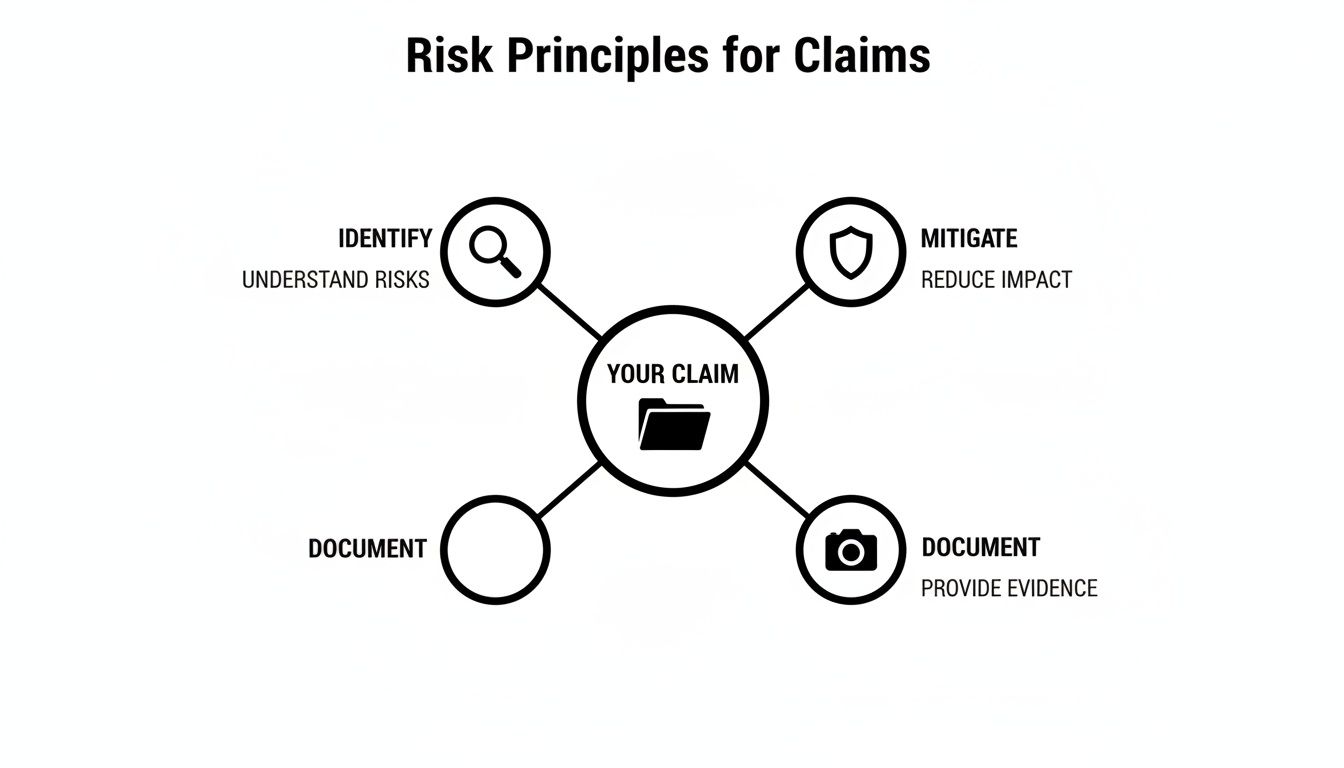
As you can see, a winning claim depends on the interplay between identifying all your losses, meticulously documenting the evidence, and taking steps to mitigate any further damage.
For businesses, these ripple effects can be even more devastating. A fire doesn't just destroy a piece of machinery; it can bring your entire operation to a standstill, leading to lost income and even critical data loss if servers are affected.
By linking the direct physical damage to all the secondary consequences—like business interruption or the need for temporary housing—you paint a complete picture of your total loss. This prevents the insurer from chopping up your claim into smaller, disconnected problems to justify a lower settlement.
Your mission is to leave no stone unturned. Use this checklist as a starting point for your own "investigation":
- Structural Damage: Look past the surface. Check for cracks in the foundation, warped window and door frames, and any signs of stress on support beams.
- Systems Damage: Don't assume everything is fine. Test your electrical, plumbing, and HVAC systems for hidden problems caused by the initial event.
- Contents and Inventory: Create a detailed list of every single item that was damaged, from major furniture down to the pens in your desk.
- Business Interruption: If you're a business, start calculating lost revenue and any ongoing operational costs you’re still incurring while shut down.
By applying this first principle, you shift from being a passive victim waiting for the insurer's lowball offer to an active, informed advocate for your own recovery. This foundational work is what sets the stage for a successful negotiation.
Principle 2: Using Your Policy as a Powerful Tool
When disaster strikes, your world is suddenly split into two critical tasks: controlling the immediate damage and figuring out how to pay for it all. In the world of risk management, we call these two actions mitigation and transference. You might not use those terms, but if you’ve had a major property loss, you’ve definitely lived them.
Risk transference is the whole reason you bought insurance in the first place. You paid premiums, month after month, to hand off the massive financial risk of a fire or storm to an insurance company. Your policy is the legal contract that seals that deal. It’s your proof.

This contract is the most powerful tool you have for your recovery. The problem? It’s often packed with dense, confusing legal jargon. Our entire job as public adjusters is to step in as your expert advocates, decoding that contract and making sure the insurer honors every single promise they made when they agreed to take on your risk.
Putting Risk Mitigation Into Action
While transference is about the financial agreement, mitigation is all about what you do on the ground, right now. After a loss, you have a formal duty to prevent the damage from getting any worse. This isn’t just a good idea—it’s a responsibility that can make or break your claim.
Imagine a tree just punched a hole in your roof during a windstorm. Here’s what immediate mitigation looks like:
- Tarping the Roof: This is priority one. Getting a tarp over that hole stops rain from destroying your insulation, ceilings, and everything inside.
- Boarding Up Windows: After a fire or break-in, securing smashed windows and doors protects your property from theft, vandalism, and the weather.
- Shutting Off Water: If a pipe bursts, the very first thing you do is find the main shutoff valve and stop the flow. It’s the single most important step to prevent a small leak from becoming a full-blown flood.
Meticulously documenting these emergency repairs is absolutely essential. Take photos and videos before, during, and after you do anything. Keep every single receipt for tarps, plywood, or a 24/7 plumber. This creates a clear record that you acted responsibly, which makes it nearly impossible for the insurance company to claim later damage is your fault.
Enforcing the Contract
Your insurance policy is the official rulebook for the entire claim, and knowing what those rules say is everything. A simple misunderstanding between "replacement cost" and "actual cash value," for example, can be a tens-of-thousands-of-dollars mistake.
You can get a head start on decoding the fine print in our guide on understanding insurance policy limits explained.
This is where having an expert in your corner becomes so critical. We dive deep into your policy, holding the insurer accountable for the promises made in that contract. We turn a confusing document into your most powerful tool for getting the full settlement you deserve.
Principle 3: Using Expert Advocacy to Build Resilience
Real recovery from a property disaster isn’t just about putting things back the way they were. It’s a chance to build back stronger by applying proven principles for risk management. A great starting point is a concept called risk retention—the portion of risk you consciously decide to handle yourself.
The most common example of this is your insurance deductible. Think of it as your skin in the game. It's the amount you agree to pay out-of-pocket before your insurance policy takes over. Choosing the right deductible isn't just about saving on premiums; it's a strategic decision and your first real step toward building financial resilience.
Shifting the Burden to an Expert
Once a major claim happens, the single most powerful way to build resilience is to transfer the overwhelming burden of managing it to a professional. Make no mistake, handling a significant property claim is a full-time job. It requires a deep understanding of complex policy language, fluctuating construction costs, and tough negotiation tactics—skills most homeowners and business owners simply don't have.
Hiring a public adjuster isn’t an expense; it's an act of risk management. You are actively protecting your time, your sanity, and your financial outcome by putting a professional advocate in your corner to fight for you.
This move completely changes the game. Instead of just reacting to your insurance company's low-ball offers and delays, you get a proactive partner who runs the entire process. While they document every loss, interpret the fine print, and go toe-to-toe with the insurer, you can focus on what truly matters: your family, your employees, and getting your life or business back on track.
Turning Chaos into a Managed Recovery
This kind of hands-on advocacy is what resilience looks like in the real world. This mindset is becoming a crucial strategy for businesses everywhere. A recent Aon survey of 2,941 global leaders revealed that the most successful organizations are learning to treat risk not just as a threat to be avoided, but as a "lever for growth." You can dive deeper into this strategic shift in the 2026 Global Risk Management Survey.
You can apply that same powerful mindset to your property claim. With an expert on your side, the chaotic aftermath of a disaster transforms into a managed, strategic recovery process.
It all comes down to having a skilled professional who knows the system inside and out. They understand the critical difference between the adjuster sent by your insurer and an advocate who works only for you. To fully grasp their different roles and motivations, check out our guide on the public adjuster vs. insurance adjuster. Having that expertise on your team ensures your claim is negotiated from a position of strength, not desperation.
Principle 4: Adapting Your Strategy to Win the Negotiation
Filing an insurance claim isn’t a one-and-done event. It's the opening move in a long, strategic negotiation. To come out on top, you have to be ready to watch every development and adjust your game plan based on what the insurance company does. This is where the core principles for risk management truly come to life.
Think of it like a chess match. You wouldn't make your first move and just hope for the best. You have to anticipate your opponent's counters and adapt your strategy with every turn. This constant monitoring and adjustment is what turns a passive claim into a proactive push for the settlement you deserve.

Staying Ahead of the Insurer
To do this right, you need to track everything—every email, phone call, and deadline. It means keeping a close eye on the progress of repairs and knowing what’s happening with material costs and building codes here in Oregon and Washington. Nothing can be allowed to fall through the cracks.
What happens if a contractor finds new damage during demolition? Or if the insurer starts using stall tactics? Your strategy has to shift on a dime.
This isn't just a claims tactic; it's how the most successful global firms handle risk. They build constant monitoring and compliance into their day-to-day operations. In the most demanding markets, 95% of business leaders report high confidence in their risk management, which comes directly from this kind of rigorous oversight. You can see more on this in the FIS Global Innovation Research 2026 findings.
Vigilance is your most powerful negotiation tool. It transforms the claim from a static report into a living document that accurately reflects the real-time, true cost of making you whole.
When to Adapt Your Approach
Pivoting your strategy isn't just about reacting to problems; it's about spotting opportunities to make your case even stronger. Any time new information appears, your approach should evolve with it.
Here are a few common scenarios where you absolutely have to adapt:
- Discovery of Hidden Damage: A contractor opens a wall and finds extensive rot or faulty wiring that wasn't visible before. Your original claim must be amended immediately to cover these new costs.
- Rising Material Costs: The price of lumber or roofing skyrockets between when you filed the claim and when repairs can actually start. Your settlement needs to be updated to match that market reality.
- Insurer's Lowball Estimate: The adjuster’s estimate comes in way under your contractor's quotes. You have to pivot by providing detailed, line-item comparisons and expert reports to prove their valuation is wrong.
This is the very essence of the negotiation process. To learn more about how these moves fit into the bigger picture, check out our guide on negotiating with an insurance company. A good public adjuster is trained to manage this entire dynamic process, making sure every move is calculated to get you the full and fair settlement you’re owed.
Answering Your Questions About Claims and Risk
When your property is damaged, talk of risk management principles can feel a bit out of touch. You’re not thinking about theory; you have urgent, real-world questions that need straight answers. Let’s walk through the ones we hear most often from property owners who are feeling lost in the claims process.
How Do I Identify Risks After My Property Is Already Damaged?
This is a great question. After a disaster, your focus shifts. You're no longer trying to prevent a fire; you're trying to document the entire ripple effect it caused. A fire isn't just about the charred wood and melted plastic. It's about the invisible smoke damage that seeped into every crack, the electrical wiring that’s now a hidden hazard, and the moisture from the firehoses that could be quietly feeding a new mold problem.
Think of yourself as a crime scene investigator. Grab your phone and start recording a video walkthrough of every single part of the damaged area. Don't just scan the room—open the cabinets, look under the rugs, and narrate everything you see and smell. This detailed record helps you identify every connected risk, building a comprehensive claim that your insurer can't easily dismiss.
Isn't Hiring a Public Adjuster Just Another Expensive Cost?
We hear this concern a lot, but let's reframe it as a risk management decision. Right now, the single biggest financial risk you're facing is your insurance company undervaluing your claim. It happens all the time, and it can cost you dearly.
A reputable public adjuster works on a contingency fee. This means they are paid a small, agreed-upon percentage of the settlement money they recover for you. If they can’t get you more than the insurance company’s initial offer, you owe them nothing. In effect, you transfer the risk of a lowball settlement to an expert who has every financial incentive to get you the maximum possible payout.
The significant increase they can often secure in the final settlement almost always dwarfs their fee. It's a strategic investment to safeguard your financial recovery.
What's the Most Important Principle When Negotiating With an Insurer?
While all the principles work together, the key to a successful negotiation is to adapt your strategy based on a complete and evolving picture of your loss. Your initial claim is just the opening move in a chess match. Your insurer will come back with their own assessment, and it's almost guaranteed to be lower than yours.
Winning this negotiation is all about how you respond. You have to monitor their arguments, pick apart their reports, and hit back with solid counter-evidence.
- Did the price of lumber suddenly spike after your claim was filed? Your demand needs to be updated to reflect that new reality.
- Did their adjuster fail to find hidden water damage behind a wall? You need to present a report from your own expert to prove it exists.
A public adjuster is your strategist in this ongoing process, constantly adjusting the game plan to make sure your final settlement is fair. Of course, good risk management isn't just for disasters. It also means using proactive tools for property risk management to head off problems before they start. This combination of foresight and assertive negotiation is how you turn a crisis into a controlled, successful recovery.
Don't let your insurance company dictate the value of your loss. At NW Claims Management, we are licensed public adjusters who work exclusively for you, not the insurer. We fight to get you the full and fair settlement you are owed. If you’re facing a property damage claim in Oregon or Washington, contact us today for a free claim evaluation and take the first step toward a successful recovery.