You’re probably here because the usual career paths aren’t landing. Maybe you’ve worked construction, restoration, roofing, customer service, property management, or some other job where people rely on you when things go sideways. You want solid work, a skill you can build on, and a role that matters when someone’s home or business has been hit hard.
That’s where insurance adjuster trainee jobs get interesting.
Done well, adjusting sits at the intersection of investigation, documentation, communication, and negotiation. You’re not just pushing paperwork. You’re walking damaged property, sorting facts from assumptions, reading policy language carefully, and helping move a claim toward resolution. In the Pacific Northwest, that can mean a fire loss outside Portland, a burst pipe in a Seattle condo building, or storm damage on a commercial roof in a smaller town where owners need answers fast.
There’s also a split most career guides gloss over. Not all adjusters work from the same side of the claim. That difference shapes your daily work, your training, and the kind of professional you become.
Beyond the Obvious A Career Where You Make a Real Difference
A trainee usually starts with a simple idea. Get licensed, get hired, learn the file, and build competence. What changes once you enter the field is your understanding of who you serve.

The three paths are not the same
There are company adjusters, independent adjusters, and public adjusters.
- Company adjusters work for the insurance carrier. Their job is to investigate and resolve claims on behalf of the insurer.
- Independent adjusters usually work for firms that carriers hire when claim volume spikes or when they need outside field support.
- Public adjusters represent the policyholder, not the insurer.
That last category is the one many newcomers never hear about when searching for insurance adjuster trainee jobs. If you want a clean comparison of the sides involved, this breakdown of public adjuster vs insurance adjuster is worth reading.
Why the public side attracts the right kind of trainee
Public adjusting appeals to people who don’t just want a claim processed. They want the claim understood.
When a family is living around smoke damage, or a business owner is trying to reopen after a major water loss, the paperwork is only part of the problem. Someone has to organize the damage story, tie it to the policy, document it correctly, and push the process forward without losing important scope.
That’s rewarding work. It’s also hard work.
Carrier roles often offer more defined training systems at the start. Public adjusting can feel less scripted. You need judgment earlier. You need to be comfortable asking better questions, spotting missing line items, and advocating without becoming reckless. Good trainees grow fast in that environment. Weak trainees get exposed fast.
Public adjusting isn’t for people who want easy files. It’s for people who want meaningful ones.
Why Oregon and Washington matter
The Oregon and Washington markets are especially practical places to think about this career. You’ll see a mix of residential, commercial, nonprofit, and municipal property issues. You’ll also see weather, wildfire, and water-related losses that demand clear documentation and steady communication.
That combination makes the Pacific Northwest a strong training ground. You learn building damage. You learn policy interpretation. You learn how to handle stressed clients without becoming part of the chaos.
If you want a career where your judgment affects real outcomes, this field can deliver that. If you want a low-pressure desk role with no field tension, it probably won’t.
Decoding the Adjuster Trainee Role and Required Skills
A trainee’s day rarely looks tidy. You might spend the morning returning calls, the middle of the day at a loss site, and the evening finishing notes so the file doesn’t fall behind.
What the work actually looks like
Take a common Pacific Northwest claim. A Portland homeowner reports water damage after a supply line failure under a second-floor sink. As a trainee, you might help confirm the loss facts, inspect affected rooms, photograph damage, measure materials, and organize everything into a file that someone can estimate and negotiate from.
On another day, you may be at a Seattle commercial property where wind-driven rain affected multiple suites. That requires different discipline. Tenant improvements, business interruption concerns, and building system details raise the standard immediately.
The people who last in insurance adjuster trainee jobs learn one lesson quickly. Documentation drives outcomes.
Admin work is not busywork
New people often focus on inspections because fieldwork feels more like “real adjusting.” That’s a mistake.
The Adjuster Success Method puts pre-claim administration at 60% of overall success, and says adjusters who master that phase can close 40% more claims weekly because their workflow stays organized and responsive (AdjusterPro’s Adjuster Success Method). In practice, that means returning calls promptly, logging activity cleanly, setting appointments, maintaining file chronology, and making sure no task sits unowned.
If you’re sloppy before you ever step onto the property, the rest of the file usually reflects it.
The field skills that separate strong trainees
You don’t need to know everything on day one. You do need to be coachable and methodical.
Here’s what matters most early.
- Photo discipline: The same AdjusterPro framework warns that inadequate photo documentation causes 35% of estimate revisions. Take more angles than you think you need. Capture room context before close-ups. Photograph transitions, moisture paths, overhead areas, and the unaffected spaces that help establish boundaries.
- Measurement accuracy: Whether you use a laser measure, tape, or digital sketching tools, your dimensions have to support the estimate. If your measurements drift, your scope drifts with them.
- File notes: Write notes as if another adjuster may inherit the file tomorrow. Because sometimes they will.
- Client communication: Distressed owners often repeat themselves, skip details, or mix timelines. Your job is to listen patiently, then organize the facts.
- Software fluency: Learn Xactimate and be willing to work in other claims platforms. The software won’t make you a good adjuster, but poor software skills will slow down every file you touch.
A useful companion skill is understanding how to inspect loss sites with purpose. This guide to property damage assessment shows the kind of disciplined observation that separates surface-level inspection from real claim documentation.
What doesn’t work
Weak trainees usually fail in familiar ways.
| Habit | What happens |
|---|---|
| Waiting to update the file | Facts get lost, deadlines slip, and the claim becomes harder to defend |
| Taking random photos | Key damage relationships never get documented clearly |
| Talking too much at the inspection | You miss what the policyholder is actually telling you |
| Guessing on building components | Your estimate becomes unreliable |
| Treating every claim the same | Residential kitchen damage and commercial tenant loss require different thinking |
Practical rule: If your file can’t tell the loss story without you in the room, it isn’t ready.
The good news is that these are trainable skills. Trainees improve fastest when they respect the administrative side, stay humble in the field, and treat every inspection as a fact-gathering exercise instead of a performance.
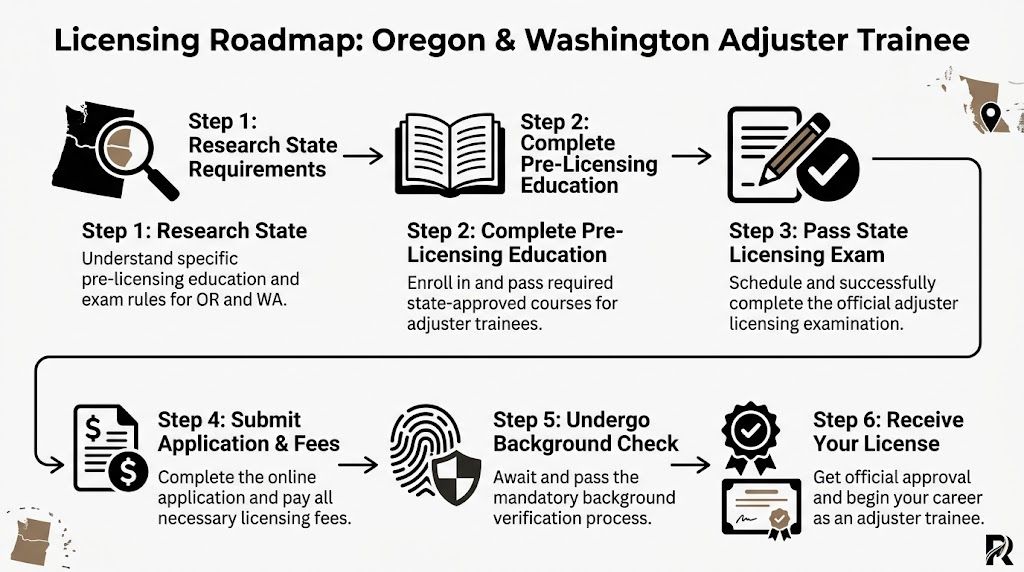
Your Licensing Roadmap for Oregon and Washington
Licensing is the part that scares people who are otherwise ready for the work. It shouldn’t. It’s a process, not a mystery.
Start with the right expectation
The path can move quickly if you stay focused. According to Kaplan’s insurance licensing guidance, becoming a licensed adjuster trainee can take 2 to 4 weeks for focused candidates, and the state exam generally requires a 70% to 75% passing score. The same source notes that pre-licensing providers such as AdjusterPro report a 96% pass rate for students who use their practice exams. It also highlights an Oregon rule that matters in real file handling: ORS 746.265 requires claim notifications within 24 hours (Kaplan financial licensing resources).
That last point matters because licensing isn’t just about passing a test. It’s about learning the compliance habits that shape your work.
The six-step roadmap
Research the license type first
Before you enroll in anything, get clear on the role you want.
If you want to work in the broader claims ecosystem, you’ll usually be looking at adjuster licensing tied to carrier or independent claims work. If you want to represent policyholders directly, you need to understand the public adjuster path and the separate rules attached to it. This explanation of what it means to define public adjuster helps clear up that distinction.
Don’t assume “adjuster” is one universal license. In practice, the side of the claim you work on changes the legal requirements and the training emphasis.
Complete pre-licensing education
Kaplan notes that state-specific licensing courses often run 20 to 40 hours. Don’t race through them just to check a box. The strongest trainees use this time to build foundations in:
- Policy interpretation
- Claim ethics
- State regulations
- Basic estimating language
- File handling discipline
Use the practice exams seriously. The people who fail usually aren’t incapable. They’re rushed, distracted, or overconfident.
Sit for the exam prepared, not hopeful
A lot of candidates treat the exam like a trivia test. That’s the wrong attitude.
You’re proving that you can work in a regulated environment where deadlines, coverage questions, and documentation standards matter. Study the terms. Review missed questions. Understand why an answer is right, not just which answer is right.
Oregon and Washington require local thinking
The Pacific Northwest rewards people who know local claim realities.
Oregon and Washington both involve property issues that can become technical fast. Moisture intrusion, smoke migration, roof damage, code-related questions, and complex building assemblies all show up in real files. A trainee who only memorizes test material but never studies property damage in the region will feel behind almost immediately.
That’s why many good candidates pair licensing study with practical exposure. Read estimates. Review photo reports. Learn basic residential components and commercial terminology. You don’t need mastery yet. You do need familiarity.
Understand reciprocity, but don’t rely on it blindly
Kaplan’s overview notes that reciprocity between states such as Oregon and Washington can extend coverage into a large share of U.S. jurisdictions. That’s useful if you eventually want broader flexibility.
But reciprocity is not permission to stop paying attention. Each state can still have its own compliance details, continuing education expectations, and role-specific requirements. A smart trainee verifies current rules before assuming a license transfers cleanly into the work they want to do.
What to gather before you apply
Keep your paperwork organized from the start.
- Course completion records: Save certificates and confirmations in one folder.
- Exam documentation: Keep pass information accessible.
- Identity and application details: Make sure your legal name matches across records.
- Background check items: Handle these promptly if required.
- Renewal reminders: Put continuing education and renewal dates on your calendar early.
Most licensing delays don’t come from hard material. They come from incomplete applications, missed instructions, or candidates who stop paying attention after the exam.
The mistake that costs beginners time
The biggest licensing mistake isn’t failing the exam. It’s getting licensed with no plan for what comes next.
While you’re studying, start identifying whether you’re targeting carrier trainee roles, catastrophe-oriented independent firms, or a public-adjusting apprenticeship. Those are different conversations, and your first job search will be cleaner if your license strategy and career direction line up from the beginning.
If you’re serious about insurance adjuster trainee jobs in Oregon and Washington, think of the license as your entry key, not your finish line.
Crafting a Resume That Gets You the Interview
Most trainee resumes fail for one reason. They describe past jobs, but they don’t translate those jobs into claims value.
A hiring manager doesn’t need a generic list of duties. They need evidence that you can inspect carefully, document clearly, manage a file, and deal with people under pressure.

Your experience is probably more relevant than you think
Construction workers often undersell themselves. They understand materials, sequencing, trade coordination, and what damaged components look like in the field.
Customer service professionals often do the same. They know how to calm upset people, track follow-ups, and manage conversations where emotions are high and facts are scattered.
Property managers, restoration coordinators, roofers, estimators, law enforcement officers, and project managers all bring useful habits into insurance adjuster trainee jobs. The trick is reframing the work.
Weak bullet
“Responsible for helping customers and managing daily operations.”
Stronger bullet
“Handled high-stress customer issues, documented conversations accurately, coordinated follow-up actions, and maintained organized records across multiple active cases.”
The second version sounds closer to claims because it is closer to claims.
Use the language hiring managers scan for
Applicant tracking systems and human reviewers both look for role-relevant keywords. Use them where they fit.
A few worth considering:
- Loss documentation
- Scope of work
- Property inspection
- Client advocacy
- Estimate review
- Policy interpretation
- File management
- Xactimate
- Damage assessment
- Negotiation support
If you’ve never touched Xactimate, don’t pretend you have. Put it in a skills section only if you’re actively training in it or have beginner familiarity.
A better summary section
Try something tighter than “motivated professional seeking opportunity.”
Use a summary more like this:
Licensed adjuster candidate with experience in property inspections, customer communication, and detailed documentation. Comfortable working in field environments, learning estimating platforms, and organizing complex information under deadline. Interested in trainee work involving property loss investigation, file management, and policyholder-facing communication.
That tells the employer what you can do, not just that you want a job.
Tailor the resume to the side of the claim
Carrier and public-adjusting employers often value different signals.
| Employer type | What they usually notice |
|---|---|
| Carrier | Process discipline, compliance mindset, customer handling, consistency |
| Independent firm | Availability, mobility, adaptability, field stamina, clean documentation |
| Public-adjusting firm | Advocacy, detail depth, policy interest, damage analysis, communication judgment |
If you want help tightening the overall structure, this guide on how to write a resume that wins interviews is a useful practical resource.
The cover letter should do one thing
It should explain why this side of the industry fits you.
For a policyholder-facing role, that might mean explaining that you’re drawn to work where careful documentation supports fair outcomes. For a carrier role, it may be more about consistency, communication, and regulated file handling.
And if you’re applying into a role that involves negotiation, it helps to understand how that skill plays out in claims. This overview of negotiating with insurance company gives useful context for the language and posture involved.
Don’t try to sound impressive. Sound usable. That’s what gets interviews.
Where to Find Trainee Openings The Inside Scoop
If you search insurance adjuster trainee jobs on the big boards, you’ll mostly see carrier listings. That’s useful, but it gives a distorted picture of the field.
Carrier jobs are the visible path
Carrier trainee roles are easiest to find because large insurers advertise consistently. They often have formal onboarding, standard operating procedures, clearer supervision, and a more predictable first-year structure.
That’s a real advantage for some people.
You’ll usually learn claim intake, customer contact expectations, internal systems, and file handling in a fairly controlled environment. If you like established processes and defined promotion ladders, carrier work can be a strong launch point.
The trade-off is philosophical and practical. You are handling claims from the insurer’s side. That doesn’t make the work unethical. It does mean your role is shaped by the carrier’s processes, authority levels, and business priorities.
Independent adjusting firms suit a different temperament
Independent firms often become attractive when claim volume surges. Catastrophe work, travel, compressed timelines, and field-heavy assignments can make this path exciting and exhausting.
This route works best for people who can operate with less hand-holding and don’t mind irregular rhythm. Some stretches are intense. Some are quiet. You may gain broad exposure quickly, but your training quality can vary depending on who brings you in and what the deployment looks like.
A new adjuster who thrives here usually has:
- Schedule flexibility
- Good field habits
- Tolerance for fast-changing assignments
- Comfort with temporary workflows
- A willingness to learn by doing
Public-adjusting openings are harder to see, but worth seeking out
This is the hidden market most generic guides miss.
According to the source material provided for this article, most online discussion around trainee roles focuses on carrier jobs, while a significant gap exists in coverage of public-adjusting firms. The same material notes that demand is rising in places like Oregon, which saw over 1,200 wildfire claims in 2025 (ZipRecruiter insurance adjuster trainee market context). For a trainee who wants client-side advocacy, that matters.
Public-adjusting firms don’t always advertise the way large insurers do. Some prefer apprenticeships, referrals, or direct outreach from candidates who already understand the role. That means you may need to network more deliberately.
How to look in Oregon and Washington
Start locally and think in terms of relationships, not just listings.
For carrier roles
Look at insurer career pages and major job boards. Search by city and by broader regional terms. Be flexible on title wording. Some employers may use “claims trainee,” “claims representative trainee,” or similar labels instead of “adjuster trainee.”
For independent firms
Track firms that handle property catastrophe claims and monitor whether they recruit before seasonal loss activity. Read job descriptions carefully. Some “trainee” listings still expect licensing, software familiarity, or rapid deployment availability.
For public-adjusting firms
This path takes more initiative.
- Reach out directly: A thoughtful email can outperform a cold application.
- Show that you know the difference: If you don’t understand the policyholder side, it will show immediately.
- Ask about shadowing or apprenticeship structures: Some firms hire around fit and teach around process.
- Study claim timing in the region: Wildfire, storm, and water losses shape demand patterns.
If you’re trying to understand when policyholders usually seek outside representation, this explanation of when to hire a public adjuster gives useful context on the moments when public-side work becomes especially important.
A side-by-side reality check
| Path | Best fit | Main upside | Main challenge |
|---|---|---|---|
| Carrier | Process-oriented beginner | Structured training and steadier entry path | You work from the insurer side |
| Independent | Flexible field worker | Variety and exposure to surge claim environments | Training and workload can be uneven |
| Public | Advocacy-driven trainee | Closer involvement with policyholder interests and complex damage issues | Fewer visible openings and less hand-holding |
If you want a job title, search the boards. If you want a career track, study who the work serves.
That’s the inside scoop. The best opening isn’t always the most advertised one.
Acing the Interview and Understanding Your Offer
Interviews for insurance adjuster trainee jobs usually test three things. Can you stay organized, can you deal with stressed people, and can you learn technical material without falling apart.

The questions you should expect
You may hear questions like these:
- Tell me about a time you handled a difficult customer
- How do you manage multiple deadlines
- Describe a situation where you had to learn something technical quickly
- What would you do if two parties gave conflicting accounts
- Why do you want to work in claims
- How would you respond to a policyholder who is angry or overwhelmed
These aren’t trick questions. Interviewers want to see your process.
A good answer has a shape
Use a simple structure.
Situation
Give enough context to make the problem real.
Action
Describe what you did, not what the team did in general.
Judgment
Explain why you chose that response.
Result
Keep the outcome honest and relevant.
For adjusting roles, your answer should usually show some mix of calm communication, documentation discipline, fairness, and follow-through.
What interviewers notice immediately
They notice whether you speak in organized sequences. That matters because claims work is organized storytelling backed by facts.
They also notice whether you sound combative when talking about conflict. A good adjuster can be firm without being theatrical. That’s especially important if you want to move toward policyholder advocacy later. You need conviction, not ego.
A trainee who can explain a messy situation clearly is already showing one of the core skills of the profession.
Understand the offer, not just the headline number
Compensation in this field varies by employer type, geography, and claim mix.
The U.S. Bureau of Labor Statistics reports that the median annual wage was $76,790 in May 2024 for claims adjusters, appraisers, examiners, and investigators. The same BLS data shows the top 10% earned over $105,440. For entry-level trainee roles, pay tends to be lower, and some markets show trainee compensation around $67,000 annually (BLS occupational outlook for claims adjusters).
That tells you two things. First, this can become a solid long-term profession. Second, your first offer is not the whole career.
What to compare before you say yes
Look beyond salary.
- Training depth: Who will teach you?
- Claim type: Auto, property, commercial, catastrophe, and policyholder-facing work all build different careers.
- Software exposure: Will you learn estimating tools or only intake systems?
- Field time: Too little can slow development. Too much without support can bury you.
- Compensation model: Salary, fee-based, or contingency structures create different incentives and income patterns.
- Mentorship quality: A strong supervisor is worth more than a slightly higher starting number.
Public-side roles may involve different compensation logic than carrier positions. You should ask direct questions about how income is earned, when it is earned, and what support exists while you’re building capability.
Questions you should ask them
End the interview by asking thoughtful questions.
- What does success look like in the first few months
- How are files reviewed for quality
- What estimating and documentation systems will I use
- How much field exposure should I expect
- Who trains new hires day to day
- How do you handle mistakes made by trainees
Those questions show maturity. They also help you avoid joining a team that talks about training but doesn’t provide any.
Your First 90 Days and Building a Long-Term Career
The first three months decide whether you become dependable or just enthusiastic.
What to do right away
Keep your focus narrow at first. Learn the file flow. Learn how your team names documents, saves photos, writes notes, and escalates questions. Competence starts with repeatable habits.
Find the person who does clean work and watch how they move. Good trainees ask why a room was scoped a certain way, why a note was written in that sequence, and why one issue gets documented immediately while another waits for confirmation.
The rookie mistakes to avoid
Don’t chase only the easiest assignments. Don’t leave your notes for later. Don’t assume your memory is better than the file.
Most of all, don’t get defensive when your estimate or documentation gets corrected. Early correction is a gift in this business. It’s how you become reliable.
How a real career grows
This field can branch in several directions. Some people become strong staff adjusters. Some move into independent property work. Some specialize in larger or more technical losses. Some build deep expertise in commercial claims, nonprofits, or complex structural damage. A smaller group builds a career on the public side because they want to advocate directly for policyholders.
The best long-term adjusters keep learning. They stay current on licensing obligations, study building systems, improve their estimating judgment, and get better at explaining claim issues to ordinary people without sounding vague or evasive.
If that sounds like work, it is. It’s also the reason this profession keeps capable people engaged for years.
You won’t know everything in your first 90 days. You don’t need to. You need to be accurate, teachable, responsive, and steady under pressure. Build from there, and the career opens up.
If you’re in Oregon or Washington and want to understand the policyholder side of this profession more clearly, NW Claims Management is a practical place to start. As a licensed public adjusting firm serving property owners across both states, the team works in the claim environment new adjusters need to understand. If your interest in insurance adjuster trainee jobs is tied to advocacy, property damage analysis, and helping people recover after major losses, studying how firms like this operate will give you a far more accurate view of the career than generic job-board advice ever will.