
You reported the injury. Maybe you saw a doctor. Maybe you're already worried about missed paychecks. Then your phone lights up with a number you don't know, and the person on the line says they're your workmans comp adjuster.
That moment throws a lot of people off. The voice may sound polite and organized. The questions may sound routine. But the call matters because this person often becomes the main gatekeeper for what happens next in your claim.
If you're feeling unsure, that's normal. Workers' comp has its own language, its own paperwork, and its own power structure. Once you understand the adjuster's job, how the claim moves, and how to respond carefully, the process becomes far less mysterious.
The First Call You Never Expected to Get
A warehouse worker strains his back lifting stock. He tells his supervisor, gets checked out, and goes home thinking the next step will be simple. The next morning, his phone rings. The caller introduces herself as the insurance adjuster handling his workers' comp claim. She asks how the injury happened, whether he's had back problems before, where he treated, and when he expects to return to work.
Nothing about that call sounds dramatic. But it often feels unsettling because you didn't choose the conversation, you may still be in pain, and you probably don't know what role this person plays.

A workers' compensation claim isn't a small side process. It's part of a large insurance system. In 2023, private insurance carriers wrote $43.0 billion in workers' compensation net written premium in the U.S., and the line had a combined ratio of 86, marking the 10th consecutive year of underwriting profitability according to NCCI's workers' compensation market report. That matters for one reason. Your claim is being handled inside a system that tracks cost, timing, documentation, and outcomes very closely.
Why that first conversation feels so important
The adjuster usually becomes the central contact for the insurance side of your case. If you've ever dealt with a claim administrator like Sedgwick claims management services, you already know how much depends on who is managing the file and how they interpret the paperwork in front of them.
You're not expected to know all of this on day one. But you should know this much:
The adjuster may sound helpful, but they're also gathering information that can affect treatment, benefits, and the overall direction of your claim.
That doesn't mean you need to be fearful or combative. It means you need to be informed. Calm beats panic. Documentation beats memory. Careful answers beat rushed ones.
What injured workers usually want to know right away
In this situation, individuals frequently share the same questions:
- Who is this person really working for
- Do I have to answer every question immediately
- Can they delay treatment or checks
- What happens if I say something wrong
- How do I know whether the claim is being handled fairly
Those questions are the right ones. Once you understand the adjuster's actual job, the process starts to make sense.
What a Workmans Comp Adjuster Actually Does
A workmans comp adjuster works like the insurance side's file manager and decision coordinator. Once your injury is reported, this is often the person who starts pulling the claim together. They gather facts, compare those facts to the policy and state rules, and decide what information is still missing before benefits are approved, delayed, or challenged.
That role carries real weight. The adjuster may not diagnose your injury, but they often control the pace of the claim by deciding what gets requested, reviewed, and acted on.
The adjuster's core job
For a clearer breakdown of claims adjuster duties, it helps to start with the big picture. The adjuster investigates what happened, reviews medical and wage information, checks whether the injury fits workers' comp rules, and keeps the file moving from one step to the next. If the claim becomes disputed, the adjuster may also coordinate with nurses, supervisors, defense counsel, or outside medical evaluators.
In plain English, that usually means:
- They investigate the injury report. They look at how the accident happened, when it happened, who knew about it, and whether the different accounts line up.
- They collect and review records. That may include incident reports, clinic notes, work restrictions, payroll records, and statements from you and your employer.
- They decide what benefits are being processed. Medical treatment, wage-loss checks, and other claim-related payments often pass through the adjuster's review.
- They track what changes over time. If your doctor changes your restrictions, if you return to work, or if the employer disputes part of the claim, the adjuster updates the file and responds.
A useful way to understand this is to picture the claim as a train moving through stations. The adjuster does not build the track, and the adjuster does not act as your doctor. But they often control when the train stops, what paperwork has to be loaded, and whether it can move to the next station.
Why adjusters ask so many questions
Those questions usually serve a few specific purposes:
- Is the injury legally tied to work
- What treatment has been requested or provided
- Has the injury caused lost wages or work restrictions
- What document, decision, or response is needed next
That is why the adjuster may ask for dates, body parts injured, witness names, job duties, prior treatment, or your doctor's information. Some of those requests are routine. Some can feel broader than you expected. Either way, your answers become part of the claim record, much like notes added to a permanent file folder.
What this means for you
The adjuster is evaluating the claim while communicating with you. A friendly tone does not change that job.
Practical rule: Treat every call, email, and form as part of the official claim process.
Clear and accurate information helps your claim. Guessing, rushing, or speaking loosely can create confusion that stays in the file long after the conversation ends.
The Four Types of Adjusters You Might Meet
Many injured workers assume an adjuster is just an adjuster. In reality, the title can describe different roles. That matters because the answer to one basic question changes everything: Who do they work for?
In workers' comp, the first three types below are usually on the insurance or employer side. The fourth type, a public adjuster, serves a very different function and usually does not handle injury claims.
Comparing Workers' Compensation Adjuster Types
| Adjuster Type | Who They Work For | Primary Goal |
|---|---|---|
| Staff Adjuster | Insurance company | Handle claims for the carrier under its procedures |
| Independent Adjuster | Hired by an insurance company | Manage claims on the insurer's behalf as an outside contractor |
| Third-Party Administrator | Employer or self-insured entity | Administer claims for an organization that handles its own risk structure |
| Public Adjuster | Policyholder in a property insurance claim | Advocate for the insured on property damage losses |
The first three usually represent the insurance side
A staff adjuster works directly for the insurance company. If your employer carries workers' comp through a private insurer, this may be the person assigned to your file.
An independent adjuster is not an employee of the carrier, but functionally they still represent the carrier's interests on the claim. To the injured worker, the difference may not feel important. The file is still being handled from the insurance side.
A third-party administrator, often called a TPA, handles claims for companies that are self-insured or use outside claim administration. If you work for a large employer, school district, hospital system, or municipality, a TPA may be the organization contacting you.
For a broader explanation of how these roles differ from someone who advocates for a policyholder, this comparison of public adjuster vs insurance adjuster is useful.
The public adjuster is different
People often get confused online regarding these roles. A public adjuster does not step into a workers' comp injury claim the way a workers' comp attorney does. Public adjusters usually help with property insurance claims, such as fire, storm, water, or vandalism losses to buildings and contents.
That means when looking for a workmans comp adjuster, you should not assume a public adjuster fills the same role or can represent you in an injury-benefit dispute.
If the issue is your medical treatment, wage benefits, denial, or settlement after a workplace injury, you're usually looking at workers' comp process questions or legal representation, not public adjusting.
Why this distinction matters to you
The title can sound similar, but the job isn't. If you don't know which type of adjuster you're dealing with, you can misunderstand their authority, their incentives, and what kind of help you need.
A simple rule helps:
- Insurance staff, independent adjusters, and TPAs usually manage the claim from the employer or insurer side.
- Public adjusters usually represent policyholders in property damage claims.
- Workers' comp attorneys handle disputes over workplace injury benefits and rights.
That last distinction becomes important when the claim stalls or turns adversarial.
Navigating the Workers Comp Claims Workflow
Most workers' comp confusion comes from not knowing where you are in the process. The adjuster may ask for information before you've even seen all the paperwork. A doctor may place restrictions before the insurer has made a final decision. Checks may depend on records you didn't know were missing.
This simple workflow helps you place each event in context.
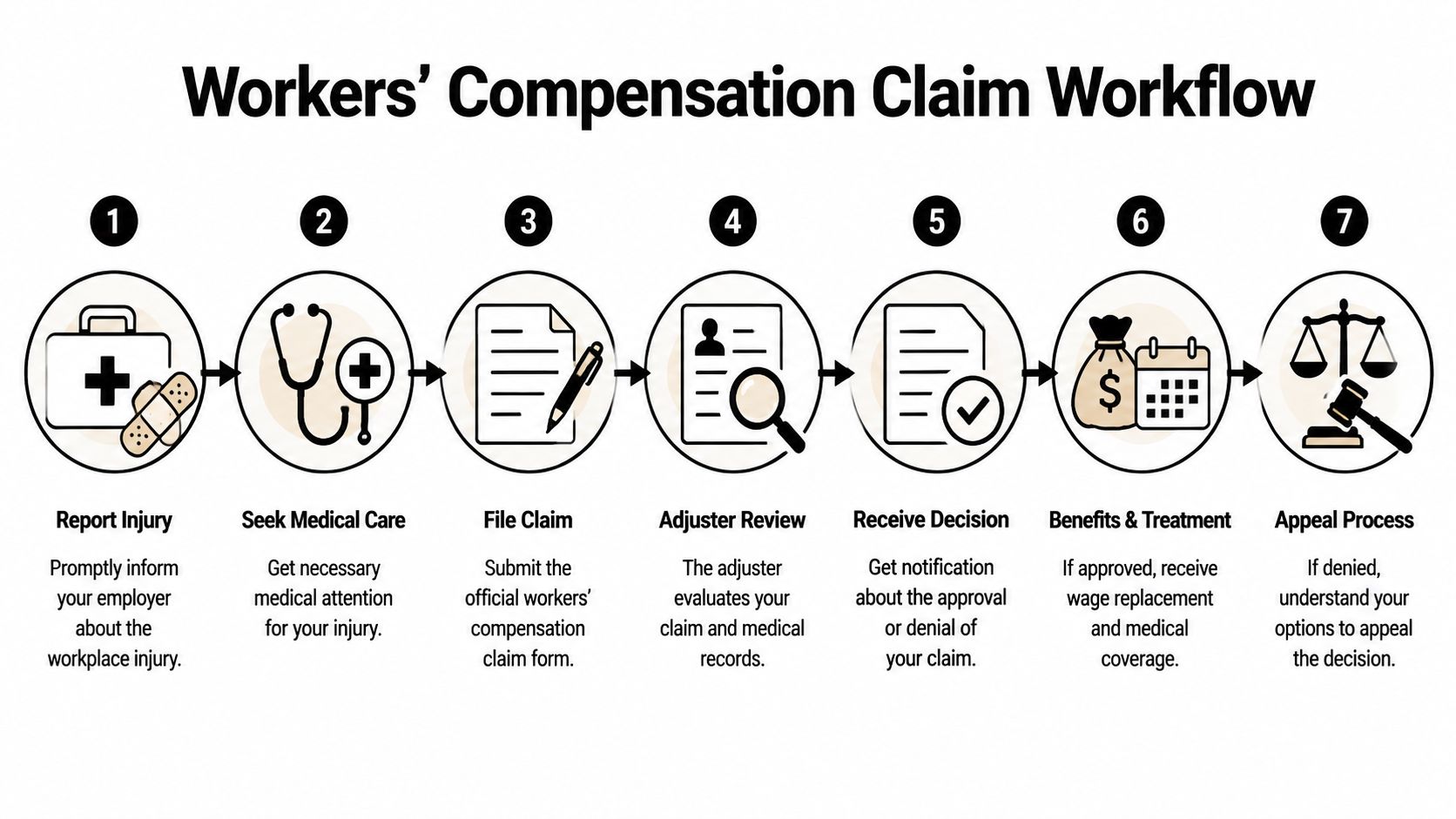
Step one through step three
Report the injury. Tell your employer promptly and make sure the basic facts are accurate. If the date, body part, or description is wrong at the start, that mistake can echo through the file.
Seek medical care. Your health comes first, but the records created at this stage also matter. Be consistent when you describe how the injury happened and what symptoms began after the incident.
File the claim paperwork. Some workers think telling a supervisor is enough. Often it isn't. Make sure required claim forms are completed and submitted.
Step four and step five
Adjuster review begins. This is usually when the adjuster gathers the employer report, medical notes, wage information, and your statement or interview. They're comparing documents, checking for gaps, and deciding what the file supports.
A decision follows. The claim may be accepted, delayed while more information is gathered, or denied. Delay is one of the hardest parts for injured workers because it creates uncertainty around treatment and income. As this discussion of common workers' comp adjuster tactics notes, understanding the difference between a normal timeline and an unreasonable delay is critical, because delay can pressure workers to give up or accept less than they should.
Keep a simple timeline for your own file. List the date of injury, the date you reported it, each doctor visit, each adjuster contact, and every missing payment or unanswered request.
What the adjuster is doing behind the scenes
While you wait, the adjuster may be:
- Reviewing medical records to see whether the diagnosis matches the reported event
- Checking wage records if you're claiming lost-time benefits
- Speaking with the employer about your job duties and the injury report
- Requesting more information from providers or other parties
- Coordinating an exam if the claim becomes disputed
In these moments, silence becomes dangerous. If the adjuster asks for something and you don't respond, the file may sit. If the adjuster goes quiet, you need a record showing you followed up.
After approval or denial
If the claim is accepted, the file moves into treatment and benefit administration. You may receive medical authorizations, work status updates, and wage-related communications. If the claim is denied, the issue becomes procedural and sometimes legal.
A good worker-level resource for understanding benefits at a practical level is UL Lawyers' overview of work comp benefits. Even if your state's rules differ, it can help you frame the core questions: what is being paid, what is being disputed, and what rights attach to each part of the claim.
The later stages
At some point, your file may involve an Independent Medical Exam, often called an IME, especially when the claim is disputed or there's disagreement about diagnosis, causation, restrictions, or future treatment.
After that, many cases move toward one of two outcomes:
- Ongoing administration, where treatment and benefits continue while you recover or return to work.
- Closure or settlement discussions, where the parties try to resolve remaining issues.
If you know where you are in this sequence, the adjuster's calls and letters become much easier to understand.
Your Rights and Common Pitfalls When Dealing with Adjusters
A lot of injured workers get tripped up because they think the adjuster is a neutral helper. That's the wrong starting point.
The adjuster's role is tied to the insurance side of the claim. That doesn't mean every adjuster is hostile or dishonest. It means their job is not to act as your personal advocate.

According to this explanation of what a workers' compensation claims adjuster is, the adjuster's incentives are aligned with the insurance carrier. Their role focuses on cost management, evaluating claims, limiting unnecessary payments, and resolving cases early. That makes them part of the insurer's loss-control function, not a neutral decision-maker.
Common misunderstandings that hurt claims
Workers often make avoidable mistakes because they assume cooperation means saying yes to everything. It doesn't.
Here are frequent trouble spots:
- Recorded statements too early. You may still be medicated, confused, or unsure about what happened. A rushed statement can create inconsistencies.
- Loose language about your condition. Saying "I'm fine" out of politeness can be used very differently inside a claim file than you intended.
- Accepting verbal assurances. If an adjuster says something important by phone, get it confirmed in writing.
- Settling before you understand the medical picture. Early closure can sound attractive when bills are piling up, but it may not reflect the full scope of the claim.
You can be cooperative without being careless. Those are not the same thing.
Rights questions to raise early
State law controls many details, but these are sensible rights-focused questions to ask:
- What information do you need from me right now
- Is this request mandatory under my state's workers' comp process
- Will you confirm this request or decision in writing
- What happens if I disagree with this determination
- What deadline applies to my response or appeal
If you want a practical outside read on protecting your work injury claim from adjusters, that guide can help you spot pressure points that often arise in real claims.
Watch for pressure disguised as convenience
Some tactics are subtle. The adjuster may frame a settlement push as a quick way to reduce stress. They may ask broad questions that go beyond the immediate injury. They may present an IME as another doctor's visit when, in reality, the exam may play a major role in a disputed case.
A separate guide on insurance adjuster tricks people often encounter can help you recognize familiar patterns in claim communication, even though property and injury claims follow different rules.
Know this: If a request feels important, confusing, or one-sided, pause before answering. Ask for the question in writing, review your records, and get advice if needed.
Practical Tips for Communicating with Your Adjuster
Good communication isn't about being charming. It's about being clear, accurate, and documented. That's how you protect your credibility and reduce avoidable disputes.
Many online articles tell injured workers to "be careful" with adjusters. That's incomplete advice. You need a usable method.
Build a paper trail on purpose
A major content gap in this area is practical communication guidance. As noted in this discussion of insurance adjuster tricks in workers' comp, many articles warn about adjuster behavior but don't explain how claimants should document injuries, challenge requests, or prepare for recorded statements.
Start with a communication log. Use a notebook, a notes app, or a simple spreadsheet. For each interaction, record:
- Date and time
- Who contacted whom
- What was requested
- What you provided
- What deadline was mentioned
- What follow-up is needed
Email is often helpful for important requests because it creates a timestamped record. If a phone call happens first, send a short follow-up email summarizing it.
Simple scripts that help
If the adjuster calls unexpectedly, you don't have to answer every question on the spot. You can say:
"I'm happy to cooperate. I'd like to make sure I give accurate information, so please tell me what you need and I'll respond carefully."
If you're asked for a recorded statement and you're unsure, try this:
- Ask the purpose. Why is the statement being requested?
- Ask whether it's required under the rules that apply to your claim.
- Ask what topics will be covered.
- Ask for the request in writing if possible.
If the adjuster asks for documents, narrow the request politely:
- "Can you specify exactly which records you need?"
- "Is this related to the body part and date of injury in my claim?"
- "What's the deadline for providing this?"
What helps and what hurts
A few habits make a big difference.
- Do be consistent. Use the same basic description of how the injury happened each time you report it.
- Do review before responding. Look at your own records before discussing dates or treatment history.
- Don't guess. If you don't remember, say you don't want to speculate.
- Don't minimize symptoms out of politeness. Be accurate, not tough.
- Don't rely on memory alone. Confirm important points in writing.
Short, careful communication often works better than long explanations. The goal isn't to sound persuasive. The goal is to make the record reliable.
When to Get Help and Who to Call
Some workers' comp claims stay relatively straightforward. Others stop being manageable without outside help. The hard part is knowing when you've crossed that line.
A few signs usually tell you it's time to stop trying to handle everything alone.
Red flags that call for help
Consider getting professional guidance if:
- Your claim was denied
- Treatment is being delayed or disputed
- You are being pushed toward a settlement you don't understand
- An IME or other medical dispute may affect benefits
- Your injury may involve permanent limitations
- Your checks are missing, reduced, or inconsistent without a clear explanation

The right professional for the right problem
If the dispute is about your workplace injury claim, the right helper is usually a workers' compensation attorney. That person can advise you on deadlines, hearings, benefit disputes, settlement language, medical conflicts, and what the adjuster can or cannot require in your state.
A public adjuster is different. Public adjusters usually represent policyholders in property damage claims, not bodily injury workers' comp disputes. If you're curious about that role in the property-insurance context, this guide on when to hire a public adjuster explains where they fit.
Here's a practical example. Suppose a restaurant kitchen fire damages the building and equipment, and an employee is injured escaping the smoke. The business owner may need a public adjuster for the property loss. The injured employee may need a workers' comp attorney for the injury claim. Same event, two different insurance problems, two different kinds of representation.
That distinction matters because choosing the wrong kind of help wastes time when your claim is already under pressure.
Your Path to a Fair Resolution
By this point, the workmans comp adjuster should look less like a mystery and more like what they are: the insurance side's file manager, decision coordinator, and information gatekeeper.
Your strongest tools are not anger or guesswork. They're accuracy, records, calm communication, and a clear sense of when the process has shifted from routine administration into a dispute. If settlement becomes part of your case, it also helps to read practical discussions like this overview discussing workers' comp settlements so you know the kinds of questions people should ask before signing anything.
You don't need to master every legal detail to protect yourself. You need to understand the basic role of the adjuster, keep your own timeline, respond carefully, and get help when the claim stops moving fairly.
That approach won't remove every challenge. It does put you back in control of your side of the file.
If you're dealing with a property insurance claim after fire, storm, water, or vandalism damage in Oregon or Washington, NW Claims Management helps policyholders document losses, interpret coverage, and negotiate with insurers. They don't handle workers' comp injury disputes, but they do advocate for owners facing complex property claims who need experienced public adjusting support.